
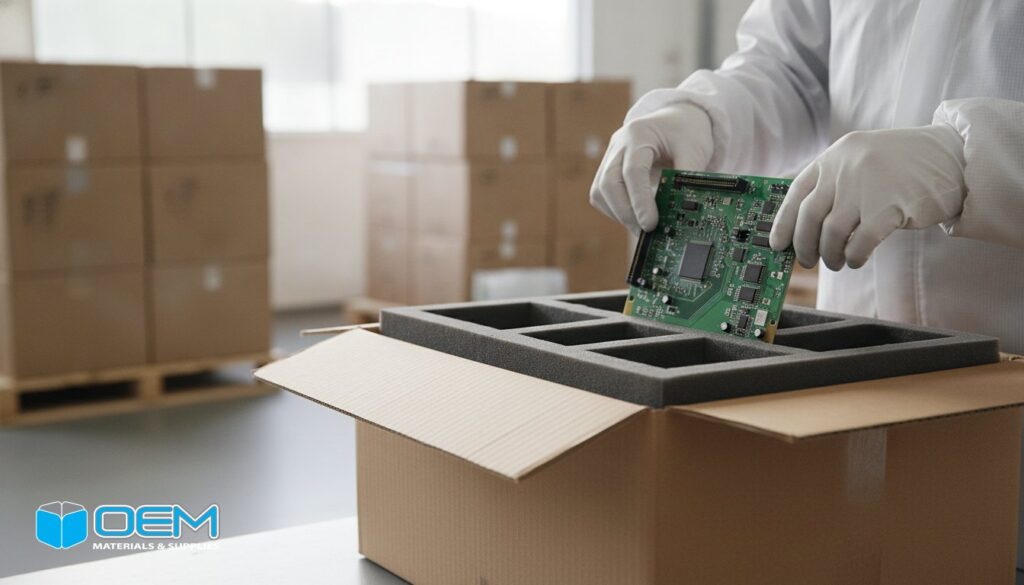
A single cracked circuit board or shattered medical lens does more than just trigger a shipping claim; it halts a production line and erodes hard-earned customer trust. Relying on generic bubble wrap and oversized boxes often results in inconsistent protection that fails the moment a carrier mishandles a pallet. Most operations managers realize that standard packaging solutions for fragile items are rarely enough to protect high-value industrial components throughout a complex supply chain. You need a precision-engineered system that accounts for G-force impact, transit vibration, and warehouse compression.
This guide explains how to design and implement professional-grade packaging systems that eliminate product damage for your most sensitive components. We examine how custom foam inserts, die-cut corrugated structures, and strategic kitting processes reduce labor costs while meeting updated ISTA 3E-2026 testing standards. By applying these technical principles, manufacturers in Los Angeles, Orange County, and San Diego can achieve a zero-damage shipping record and maintain compliance with evolving California packaging regulations. We will walk through the specific steps required to optimize your protection levels without overspending on unnecessary materials or labor.
Key Takeaways
- Identify how the specific forces of shock, vibration, and compression impact your components to prevent damage before it occurs during transit.
- Compare engineered foam densities and corrugated wall strengths to design robust packaging solutions for fragile items that meet industrial requirements.
- Transition from generic supplies to integrated systems that utilize custom die-cut inserts and wood crates for high-value protection.
- Leverage kitting and vendor-managed inventory to streamline operations and save floor space in Southern California manufacturing facilities.
The Mechanics of Protecting Fragile Industrial Components
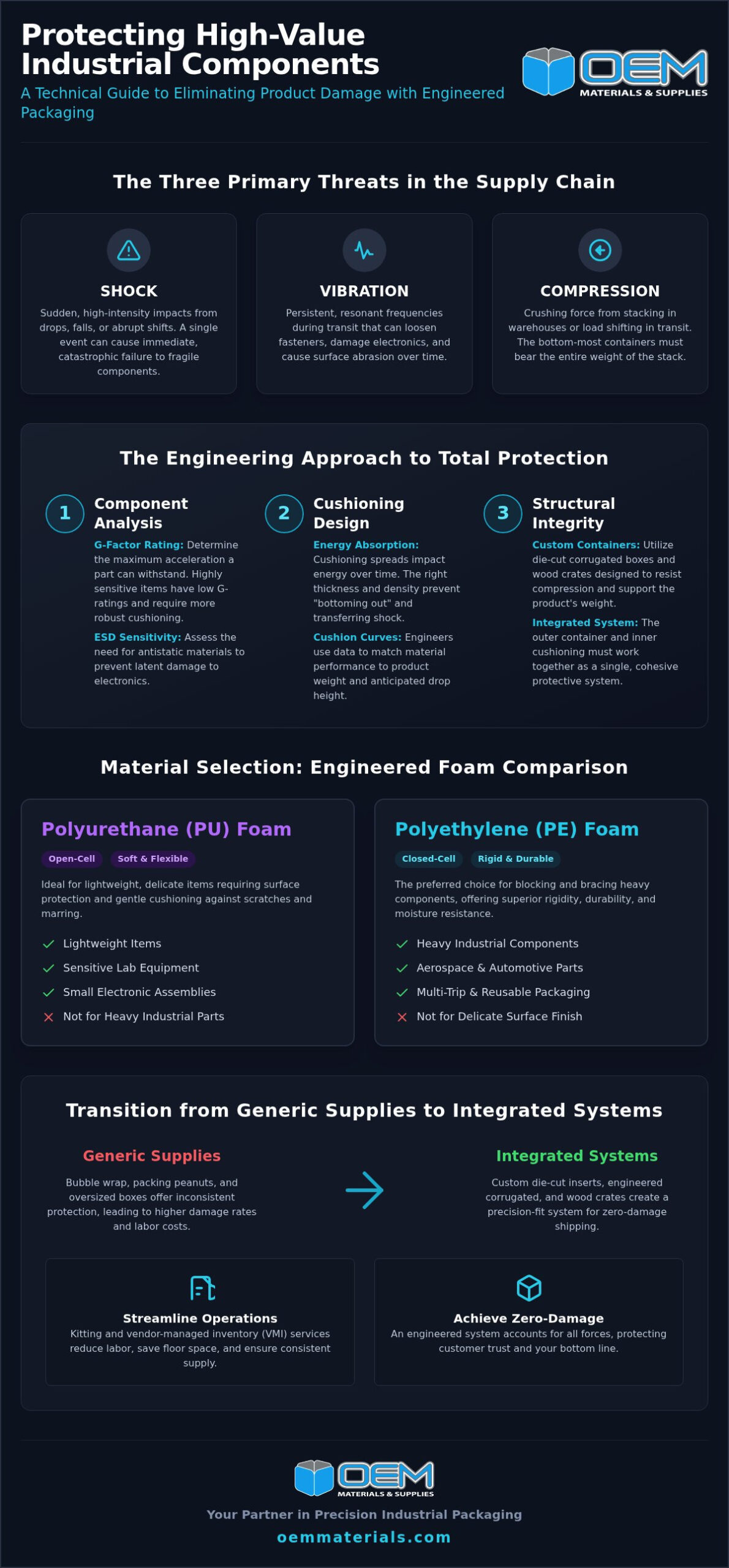
Fragile industrial items face three primary physical threats during the distribution cycle: shock, vibration, and compression. Shock occurs during sudden, high-intensity impacts. This might include a box falling from a sorting belt or a pallet shifting abruptly during emergency braking. Vibration is a persistent force throughout transit. It’s capable of causing internal fasteners to loosen or sensitive electronic components to fail over long distances. Compression protection is critical for items stored in stacked warehouse configurations. Long-haul trucking also requires heavy compression resistance, as bottom-layer containers must bear the weight of the entire stack without collapsing. Professional packaging solutions for fragile items must address all three forces to be successful.
Identifying Fragility Levels for OEM Parts
Effective packaging design starts with determining the G-factor or fragility rating of the specific component. This rating measures the maximum acceleration an item can withstand before damage occurs. Highly sensitive medical devices or aerospace sensors often have exceptionally low G-ratings. These items require more robust foam packaging to survive the rigors of the supply chain. Beyond physical impact, engineers must evaluate sensitivity to electrostatic discharge (ESD) for electronic items. This necessitates specialized antistatic materials to prevent latent component failure. Additionally, assessing surface finish requirements prevents abrasion from packaging materials that might otherwise mar polished surfaces or specialized coatings.
The Role of Cushioning in Energy Absorption
Cushioning functions by increasing the distance an item travels during an impact. This spreads the energy over a longer period, reducing the force felt by the product. Selecting the right cushioning materials involves calculating material thickness based on the item’s weight and the anticipated drop height. If it’s too thin, the material will bottom out and transfer the shock directly to the product. If it’s too firm, the deceleration happens too quickly. Deceleration in packaging is the rate at which an item slows down after impact. Engineers use cushion curves to match the material density to the product weight, ensuring the energy is absorbed rather than transmitted. Precision in these calculations ensures that your packaging solutions for fragile items remain both effective and cost-efficient for high-volume shipping.
Material Selection: Comparing Foam Density and Performance
Engineered foam serves as the foundation for high-performance packaging solutions for fragile items. Unlike generic supplies, engineered foams provide predictable energy absorption and structural support tailored to specific product weights. The primary metric for selection is density, which is measured in pounds per cubic foot (pcf). This value determines the material’s ability to support a static load without permanent deformation. Choosing the wrong density often leads to bottoming out during a drop or vibration failure during transit. Professional engineers use these density ratings to ensure that the material remains within its optimal cushioning range throughout the shipping cycle.
Polyethylene vs Polyurethane for Sensitive Goods
Polyurethane (PU) foam is an open-cell material characterized by its soft, flexible nature. It’s the ideal choice for lightweight items that require delicate cushioning, such as sensitive lab equipment or small electronic assemblies. Because it’s highly conformable, PU foam provides excellent surface protection against scratches and marring. However, for heavier industrial components, polyurethane often lacks the necessary compression resistance to prevent the product from shifting inside the container.
Polyethylene (PE) foam offers a closed-cell structure that provides superior rigidity and moisture resistance. It’s the preferred material for block and brace applications where the foam must hold a heavy part securely in place within a corrugated box or wood crate. PE foam’s higher density makes it more durable for multi-trip packaging or heavy-duty aerospace and automotive parts. For a deeper dive into these technical specifications, consult our industrial guide to foam inserts to see how material selection impacts performance.
Custom Die-Cut Foam for Precision Fit
Custom die-cutting transforms these raw materials into precision-fit protection. This process creates exact cavities that mirror the product’s geometry, which is essential for medical device kits and aerospace sub-assemblies. A precision fit eliminates the need for loose-fill materials like peanuts or air pillows, which often settle during transit and leave items vulnerable to impact. By utilizing custom packaging design, manufacturers can reduce total material usage while simultaneously improving protection levels. This methodical approach ensures that every component in a kit remains stationary regardless of how the outer carton is oriented. If you are unsure which density is required for your specific product weight, you can speak with an engineer to review your drop test requirements and annual usage data.
Structural Integrity with Custom Corrugated and Wood Crates
The outer container serves as the first line of defense against external impacts and environmental hazards. While internal cushioning manages energy absorption, the external structure must maintain its shape under significant stress. Effective packaging solutions for fragile items rely on the structural synergy between internal cushioning and external containment. Industrial components often exceed the weight limits of standard shipping cartons, requiring high-strength corrugated or wood-based structures to ensure safe arrival. Without a rigid outer shell, even the most advanced foam inserts cannot prevent damage caused by piercing or crushing forces.
Selecting the Right Corrugated Strength
Understanding the technical specifications of your outer carton is essential for preventing structural failure. The Mullen burst test measures the pressure required to puncture a box wall, focusing on containment strength. In contrast, the Edge Crush Test (ECT) measures the stacking strength of the board. For heavy industrial parts, we often recommend double-wall or triple-wall corrugated boxes that provide high ECT ratings. Custom sizing is equally important. Oversized boxes lead to excessive internal movement and increased risk of collapse when stacked in a warehouse or trailer. You can find more technical specifications in our guide for corrugated packaging box manufacturers to help determine the right board grade for your application.
Heavy Duty Crating for San Diego and Los Angeles OEMs
Crates are the preferred solution for heavy machinery, large medical equipment, and oversized aerospace components that require forklift handling. For manufacturers in San Diego and Los Angeles, these wood crates provide the necessary rigidity for both domestic trucking and international export. Integrating wood crating with internal foam blocking creates a hybrid protection system that handles massive weight while isolating the product from vibration. This is particularly vital for precision instruments that cannot withstand the slight flexing inherent in corrugated materials.
Palletized shipments require additional reinforcement to survive the logistics chain. Adding edge and corner protectors significantly increases the vertical stacking strength of a pallet load. This simple addition prevents the straps or stretch film from crushing the corners of your primary cartons. For Southern California facilities managing high-value inventory, these structural reinforcements reduce the likelihood of “hidden damage” that is only discovered after the customer opens the crate. Whether shipping across the Inland Empire or internationally, the outer structure must be engineered to match the specific fragility and weight of the internal component.
How to Design an Integrated Packaging System for High-Value Goods
Effective packaging solutions for fragile items are never accidental. They result from a disciplined engineering process that treats the package as a technical extension of the product itself. An integrated design starts with precise product dimensions and ends with a deep understanding of the shipping environment. A systematic approach ensures that every material layer, from the primary cushioning to the outer corrugated wall, serves a specific protective purpose. This level of planning prevents over-packaging, which unnecessarily inflates material waste and dimensional weight shipping costs. Collaborating with a supplier that offers custom packaging design services allows you to identify these variables before a single shipment is damaged.
Step 1: Define the Fragility and Shipping Environment
You must first identify how the item will be shipped. Small parcel environments often subject packages to more frequent drops and mechanical sorting than dedicated LTL or truckload shipments. Sensitive medical or electronic components may also require protection against temperature fluctuations and humidity. Document every handling point from your Orange County or San Diego manufacturing floor to the final end user. Understanding these logistical touchpoints allows you to engineer for the worst-case scenario without adding excessive weight.
Step 2: Prototype and Test the Configuration
Prototyping is a critical phase that separates professional packaging from guesswork. Create a physical sample using the selected corrugated board and engineered foam materials. Perform drop tests to verify that the internal cushioning effectively manages deceleration and prevents the product from bottoming out. This testing phase provides the data needed to refine the design. You can often remove unnecessary material while maintaining or even improving the overall protection level, leading to significant material savings over high-volume production runs.
Step 3: Implement Kitting for Assembly Efficiency
Protection is only effective if it’s implemented correctly on the packing line. Design your system so that it can be assembled quickly and intuitively by warehouse staff. Using pre-assembled packaging kits reduces labor time and eliminates the risk of missing components. Kitting improves consistency by ensuring that every fragile item is protected exactly the same way, regardless of which shift is handling the fulfillment. This methodical approach stabilizes your shipping outcomes and protects your brand reputation. To begin developing a custom system for your components, contact us for a packaging design consultation and provide your product dimensions and weight.
Strategic Logistics and Inventory Management for SoCal Manufacturers
Southern California manufacturers in Orange County and Riverside face unique space and logistics challenges. Packaging solutions for fragile items, especially custom foam and double-wall corrugated, are inherently bulky. This inventory can quickly consume valuable warehouse floor space that is better used for revenue-generating production. Managing these materials requires a strategic approach that balances high-level protection with operational space efficiency. Without a lean strategy, the cost of storing packaging can sometimes rival the cost of the materials themselves.
Optimizing Supply Chains in Orange County and San Diego
Proximity to local suppliers provides faster turnaround times for custom prototypes and production orders. A partner familiar with Southern California distribution hubs understands the specific logistical requirements of San Diego and Los Angeles County facilities. Local delivery models reduce lead times for bulky items and lower the carbon footprint associated with long-distance shipping. This proximity allows for more agile responses to supply chain disruptions or sudden shifts in production volume. It also facilitates easier onsite consultations for packaging design, ensuring that custom solutions are perfectly calibrated to the manufacturing environment.
Reducing Costs Through VMI and JIT Services
Implementing a packaging VMI program lowers administrative overhead by automating the replenishment process. Purchasing managers don’t need to manually track stock levels for complex packaging kits or custom foam inserts across multiple warehouse locations. The supplier maintains the necessary inventory based on agreed-upon minimums and maximums, ensuring critical supplies are always available for high-value shipping. This shift from reactive ordering to proactive management stabilizes the supply chain and prevents costly production delays.
Just-in-time (JIT) delivery models allow for leaner operations in high-cost industrial regions like the Inland Empire. Receiving materials only when they are needed on the assembly line helps manufacturers maximize their available square footage for manufacturing equipment. Labor savings are also achieved by outsourcing kitting and assembly to the supplier. Receiving pre-assembled packaging kits ensures that every component is ready for immediate use, which streamlines the packing process for sensitive electronics and medical devices. Inventory optimization can lead to significant cost reductions in industrial facilities.
Optimize Your Industrial Protection Strategy
Engineering effective packaging solutions for fragile items requires a technical shift from commodity supplies to integrated systems. By matching foam densities to product G-factors and reinforcing outer structures with high-ECT corrugated board or custom wood crates, you eliminate the variables that lead to shipping damage. These precision-engineered designs don’t just protect the product; they reduce material waste and stabilize your total cost of ownership. It’s a methodical approach that prioritizes long-term reliability over short-term material savings.
Manufacturers in Orange County, Los Angeles, San Diego, and Riverside can further enhance their operations through full-service kitting and vendor-managed inventory programs. These services allow your team to focus on core production while we ensure your custom-designed protection is always ready for the assembly line. Reliability in the supply chain starts with a partner that understands the intricacies of industrial logistics and technical material performance.
Ready to improve your shipping record? Contact OEM Materials & Supplies for a custom packaging consultation and quote to receive recommendations tailored to your specific product weight, dimensions, and annual usage. We look forward to helping you secure your high-value components for every journey.
Frequently Asked Questions
What is the best packaging material for extremely fragile electronics?
Polyurethane foam is the most effective material for sensitive electronics because of its soft, open-cell structure. It provides excellent vibration dampening and surface protection for delicate components. For these items, you must also integrate anti-static additives to prevent electrostatic discharge. Using specialized packaging solutions for fragile items like circuit boards or medical sensors ensures that both physical shock and electrical sensitivity are addressed during the transit cycle.
How do I determine the right foam density for my industrial product?
Foam density is determined by calculating the static load of your product, which is the weight divided by the surface area in contact with the foam. Most industrial applications use density ratings between 1.2 and 2.2 pounds per cubic foot. You must match this density to your specific drop height requirements. If the density is too low, the product will bottom out; if it’s too high, the foam won’t compress enough.
Can custom corrugated boxes replace wood crates for heavy fragile items?
Triple-wall custom corrugated boxes can often replace wood crates for items weighing up to several hundred pounds. These high-strength boxes offer significant weight savings and lower shipping costs while maintaining high edge crush test (ECT) ratings. However, wood crates remain necessary for oversized machinery or components that require structural rigidity for forklift handling. The choice depends on the specific weight distribution and the handling equipment used in your supply chain.
What are the most common causes of damage for fragile industrial shipments?
The primary causes of damage in industrial shipping are excessive shock from drops, persistent vibration during transit, and vertical compression in warehouse stacks. Shock occurs during sudden impacts, while vibration can loosen internal components or cause surface abrasion. Compression damage often happens when the outer container lacks the structural integrity to support the weight of stacked pallets. Engineering your packaging to mitigate these three forces is essential for maintaining a zero-damage record.
How does kitting help reduce the risk of product damage?
Kitting reduces the risk of damage by ensuring that every shipment is packed with the exact materials required for protection. Pre-assembled kits eliminate human error on the packing line, as staff don’t have to search for or cut individual foam pieces. This consistency is vital for maintaining high protection levels across multiple shifts. By providing a standardized setup, kitting ensures that your packaging solutions for fragile items are implemented correctly every single time.
Is custom fragile packaging cost-effective for low-volume production?
Custom packaging is highly cost-effective for low-volume production when the value of the individual component is high. A single damaged aerospace part or medical device often costs more than an entire year’s supply of custom packaging. While the unit cost may be higher for small runs, the reduction in replacement costs and shipping claims provides a positive return on investment. Protecting your brand reputation with professional-grade materials is a strategic long-term decision.
What testing standards should I look for in fragile item packaging?
You should look for packaging that meets ISTA and ASTM standards, specifically ISTA 3E-2026 for unitized loads and ASTM D4169 for shipping containers. These protocols simulate real-world conditions like vibration, shock, and compression. Passing these tests provides documented proof that your packaging system can survive the distribution cycle. Many large retailers and logistics providers require certification under these standards to avoid penalties and ensure the safety of high-value industrial goods.
How can local Southern California suppliers improve my packaging lead times?
Local Southern California suppliers improve lead times by providing faster prototyping and direct delivery to facilities in Orange County, Los Angeles, and San Diego. Proximity allows for onsite consultations and quicker adjustments to packaging designs. You can also implement just-in-time delivery models that reduce the need for onsite warehouse space. Working with a local partner eliminates long transit times and high freight costs associated with sourcing bulky packaging materials from out-of-state vendors.