
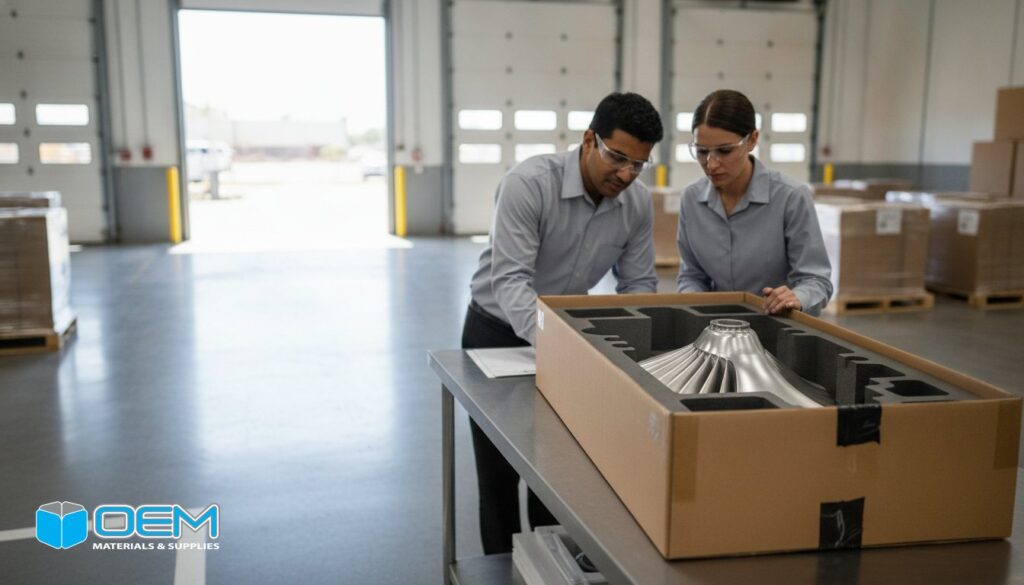
An off-the-shelf box is rarely a savings tool; more often, it is a liability that hides the true cost of product damage and wasted warehouse space. For operations managers in Southern California, sourcing high-performance custom shipping boxes is no longer just about branding. It is about protecting thin-margin components from the rigors of the industrial supply chain. With the Producer Price Index for corrugated box manufacturing rising 5.86% over the last year, any packaging that doesn’t fit perfectly or fails during transit represents a direct hit to your bottom line.
This guide provides a technical roadmap for specifying and sourcing containers that do more than just hold a product. We will examine how to design integrated foam and corrugated solutions that eliminate transit damage while optimizing your industrial supply chain efficiency. You will learn how to leverage local expertise in Los Angeles and Orange County to implement vendor-managed inventory programs and just-in-time delivery. By the end of this article, you’ll have the framework needed to transition from a basic vendor model to a strategic partnership that prioritizes engineering, compliance, and reliability.
Key Takeaways
- Understand why industrial manufacturing requires specific dimensional accuracy and stackability that standard retail box builders cannot provide.
- Identify the correct board grades and flute profiles for your application by comparing Edge Crush Test (ECT) and Mullen Burst Test standards.
- Learn how to specify custom shipping boxes with integrated foam cushioning to protect sensitive aerospace and medical components during transit.
- Reduce warehouse overhead and avoid production delays by implementing vendor-managed inventory and just-in-time delivery programs.
- Leverage local manufacturing and distribution in Los Angeles and Orange County to shorten lead times and improve logistical responsiveness across Southern California.
Industrial vs Retail Custom Shipping Boxes: Defining the Requirements
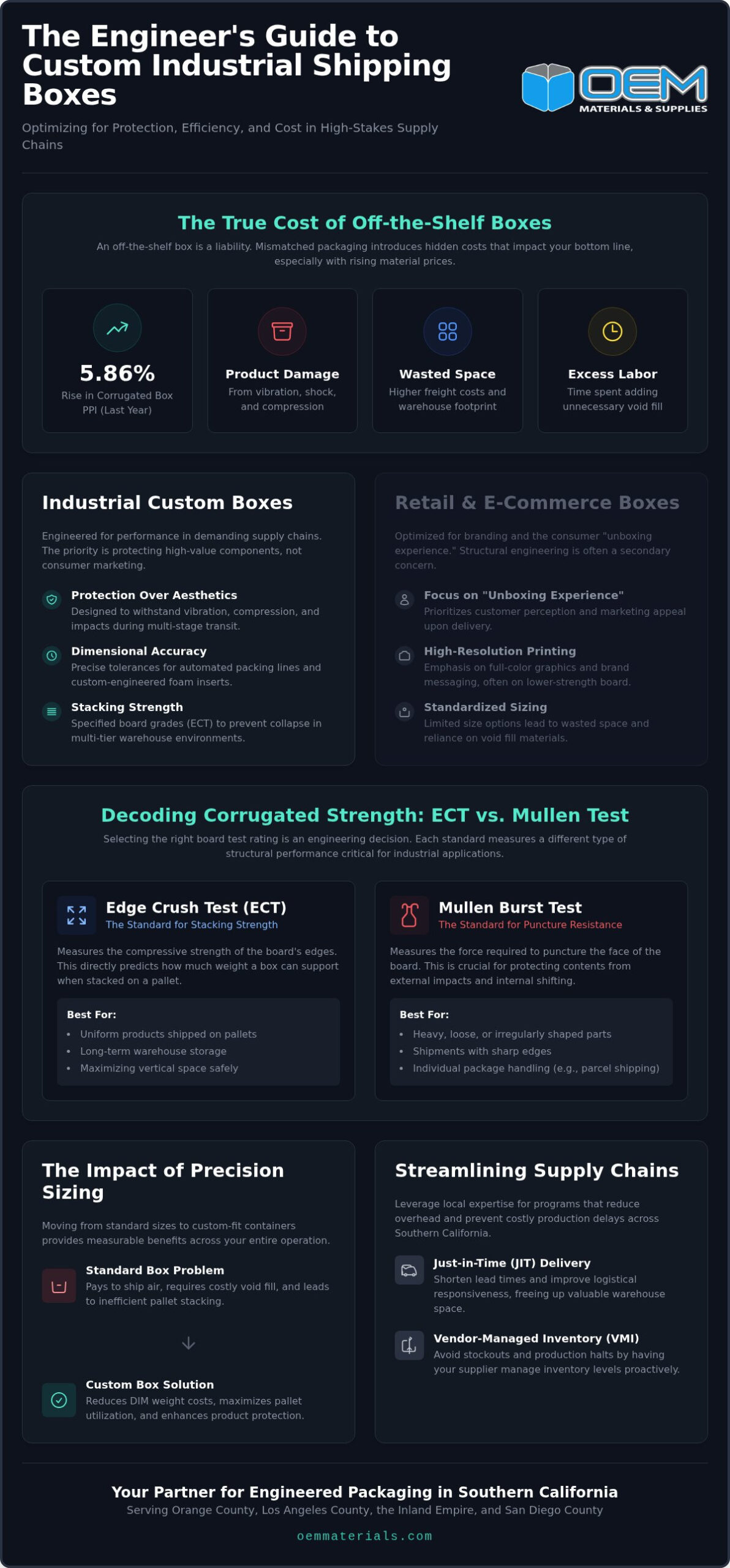
Industrial custom shipping boxes are engineered containers designed for specific logistical stresses. While e-commerce brands prioritize the “unboxing experience,” manufacturing sectors require structural integrity and dimensional accuracy. Many online box builders focus on high-resolution printing for consumer marketing, but these tools often lack the technical depth needed to specify board weight or flute profiles required for heavy-duty applications. For an aerospace component or a medical device, the priority is not how the box looks on a doorstep. It is how it performs at the bottom of a pallet stack in a high-vibration environment. Retail-focused suppliers rarely provide the tolerances needed for automated packing lines or precision-engineered inserts.
Protection Over Aesthetics
Transit vibration can cause micro-fractures in sensitive electronics or surface abrasion on automotive parts. Industrial custom shipping boxes must account for these forces through precise material selection. The Corrugated box design process involves calculating the compression strength needed to survive long-haul trucking and multi-tier warehousing. In B2B environments, structural design beats high-gloss printing every time. We specify board grades based on the specific fragility of the contents, often integrating internal cushioning to isolate the product from impact. This focus on durability ensures that sensitive industrial components arrive within tolerance. By prioritizing the structural makeup of the board, manufacturers in Southern California can reduce the high rates of product damage associated with generic commodity packaging.
Custom Sizing and Freight Optimization
Standardized boxes often force companies to pay for shipping air. When a box is even an inch too large, it increases dimensional weight (DIM) costs and requires excessive void fill like bubble wrap or paper. This leads to higher material expenses and increased labor. By utilizing professional custom packaging design, operations managers can maximize pallet utilization. Designing containers to fit standard industrial shelving systems reduces wasted warehouse footprint. A properly sized box ensures that the load is distributed evenly across the pallet, preventing the “pyramid” stacking that leads to crushed bottom layers. This technical approach to sizing directly impacts the total cost of ownership in the supply chain, particularly for high-volume manufacturers in Los Angeles and Orange County where warehouse space is at a premium.
Engineering Strength: Selecting Corrugated Flutes and Board Grades
Selecting the right material for custom shipping boxes is a matter of structural engineering rather than simple containment. Industrial applications involve heavy loads, high-stacking requirements, and multi-stage distribution cycles that test the limits of corrugated fiberboard. Using a board grade that is too light leads to collapsed bottom layers in a pallet stack. Conversely, over-specifying material increases freight costs and waste. It’s about finding the precise balance between durability and cost efficiency. For manufacturers in Los Angeles and Orange County, this choice is often dictated by the specific stresses of the regional supply chain.
ECT vs Mullen: Which Rating Matters for Your Product?
The distinction between the Edge Crush Test (ECT) and the Mullen Burst Test is critical for procurement professionals. ECT measures the compressive strength of the board’s edges, which directly correlates to how much weight a box can support when stacked on a pallet. ECT is the industry standard for stacking strength. In contrast, the Mullen test measures the force required to puncture the face of the board. If you ship heavy, loose parts or items with sharp edges that might poke through the side of the container, a Mullen-rated board is often the superior choice. Scientific research into testing corrugated fiberboard strength shows that stacking performance degrades over time due to humidity and load duration. We mitigate this by selecting moisture-resistant adhesives and appropriate board weights for long-term warehouse storage.
Flute Profiles and Structural Performance
The “flute” refers to the S-shaped waves between the linerboard sheets. Each profile offers different benefits for cushioning and compression:
- C-Flute (3/16″): This is the versatile standard for most industrial shipping boxes. It provides a good balance of stacking strength and cushioning.
- B-Flute (1/8″): It has a lower profile but higher crush resistance. It’s ideal for die-cut inserts, complex packaging kits, and smaller containers that require high structural integrity.
- BC Double-Wall: By combining flutes, we create heavy-duty containers for manufacturing equipment. This construction offers the puncture resistance of B-flute with the stacking strength of C-flute.
Understanding these variables is essential when reviewing an industrial guide to corrugated packaging box manufacturers. Selecting the wrong profile can lead to excessive material use or, worse, product failure. If you’re currently experiencing crushed boxes or transit damage, you can request a technical review of your current board specifications. We help operations managers optimize their material selection to ensure maximum protection while minimizing total shipping weight.
Optimizing Protection with Integrated Foam and Cushioning
Structural board selection is only half of the protection equation. While custom shipping boxes provide the external shell, engineered internal cushioning manages G-force impacts and vibration during transit. For manufacturers of high-value equipment, relying on generic loose void fill like packing peanuts or paper is insufficient. These materials shift during transport, often leaving the product vulnerable to surface abrasion or impact. Integrated foam solutions ensure that the product remains centered and isolated from external shocks. This level of precision is necessary for industries where even a minor scratch can lead to a rejected shipment.
Engineered Foam Selection
Choosing the right foam involves matching material density to the fragility of the component. Polyethylene (PE) foam is a closed-cell material known for its rigidity and resilience, making it the standard for heavy industrial parts and edge protection. It maintains its shape under significant weight and provides excellent multi-impact protection. For lightweight, highly sensitive electronic components or medical devices, Polyurethane (PU) foam offers a softer, open-cell structure that provides superior shock absorption for delicate items. In the electronics sector, Antistatic (ESD) foam is a mandatory requirement to prevent electrostatic discharge from damaging circuitry. Referencing our industrial guide to foam inserts can help you determine the specific G-rating requirements for your application.
Custom Die-Cut Packaging Solutions
Die-cutting allows for the creation of precise cavities that mirror the geometry of your product. This is particularly valuable for multi-part assembly kits where components must be kept separate to avoid metal-on-metal contact. By eliminating movement within the box, you remove the risk of abrasion and impact damage. These solutions also reduce labor costs on the packing line. Instead of manually wrapping parts in bubble film, workers simply drop components into pre-defined slots. This efficiency is a cornerstone of Just-in-Time (JIT) inventory strategies, where speed and accuracy are paramount.
For high-volume operations in Orange County and Los Angeles, we provide pre-kitted box and foam solutions. This means the custom shipping boxes arrive at your facility with the foam already inserted, drastically reducing handling time and warehouse footprint. You can view our full range of custom foam packaging solutions to see how integrated designs improve protection while lowering total assembly labor. This methodical approach ensures that even the most complex aerospace or automotive assemblies are secured against the rigors of the global supply chain.
Streamlining Supply Chains with VMI and JIT Delivery
High-volume manufacturing operations often struggle with the physical footprint of packaging materials. Storing pallets of custom shipping boxes occupies square footage that could otherwise be dedicated to production or finished goods. Beyond the space requirements, managing these inventories manually introduces the risk of human error. A simple counting mistake can lead to a line-down situation where products are ready for shipment but lack the necessary containers. Implementing advanced logistics strategies like Vendor Managed Inventory (VMI) and Just-in-Time (JIT) delivery transforms packaging from a storage burden into a streamlined flow.
Implementing a VMI Program for Custom Boxes
A successful VMI program shifts the responsibility of inventory monitoring from the buyer to the supplier. This proactive approach ensures that stock is always available without requiring constant oversight from purchasing managers. The implementation follows a methodical sequence:
- Step 1: Usage Analysis. We analyze your annual usage and identify peak production cycles to forecast demand accurately.
- Step 2: Stocking Levels. We establish minimum and maximum stocking levels based on your specific lead times and warehouse capacity.
- Step 3: Operational Integration. Supplier tracking is integrated with your plant operations to trigger automatic replenishment when stock hits the minimum threshold.
By utilizing our packaging VMI services, manufacturers in Orange County and Los Angeles can reduce their overhead and eliminate the administrative labor associated with frequent reordering. This system ensures that you only pay for what you need when you need it.
Kitting and Assembly Services
Efficiency at the packing station is a primary driver of throughput. When workers have to manually fold boxes, insert foam, and apply labels, it slows the entire distribution process. Our kitting and assembly services provide pre-assembled custom shipping boxes with inserts already in place. This allows your team to focus exclusively on placing the product and sealing the container. In medical device distribution, for example, kitting ensures that every component of a surgical kit is present and secured in its designated cavity. This reduces the risk of missing parts while significantly lowering labor costs per unit. This streamlined workflow increases the number of units shipped per shift and improves overall accuracy. If you are ready to optimize your warehouse logistics, you can request a consultation for custom kitting.
Sourcing Custom Shipping Boxes in Southern California
Sourcing custom shipping boxes from local manufacturers in Southern California offers a significant logistical advantage over distant commodity vendors. While many online suppliers ship nationwide via parcel carriers, the freight costs associated with bulk corrugated orders can quickly negate any initial price savings. Large-format boxes and high-volume runs are expensive to transport across state lines because of their weight and volume. By partnering with a regional supplier, manufacturers in Los Angeles and Orange County can reduce lead times and shipping expenses simultaneously. This proximity allows for a more responsive supply chain that can adapt to production changes in real time.
Local Support for SoCal Manufacturers
Proximity is especially critical for the aerospace and medical clusters in Southern California. These industries often face complex packaging challenges that require more than a phone call or a digital mockup. Local expertise allows for on-site design consultations where engineers can examine the physical product, its center of gravity, and the specific warehouse environment. This hands-on approach ensures that the final design integrates perfectly with existing racking systems and automated packing lines. If you are facing a unique logistical hurdle, you can request a custom packaging design consultation to develop a tailored solution. Regional distribution centers in Riverside and the Inland Empire further shorten the distance between the production line and your loading dock, ensuring that inventory is always within reach.
Selecting the Right Industrial Partner
Vetting a supplier for technical expertise is more important than chasing the lowest per-unit price. An industrial partner must demonstrate the ability to scale from rapid prototyping to high-volume production without compromising dimensional accuracy or board strength. When evaluating a vendor, ask about their quality control processes and their capacity to handle sudden spikes in demand. A reliable partner should act as a consultant that understands your specific supply chain requirements rather than just a commodity reseller. They should be able to provide samples that meet rigorous ISTA or ASTM standards to verify performance before you commit to a large run. You can explore our full range of corrugated boxes to see how we support diverse manufacturing sectors across San Diego and the surrounding counties. Choosing a partner with local manufacturing capabilities ensures that your custom shipping boxes are delivered on time, every time, regardless of broader market fluctuations.
Secure Your Supply Chain with Engineered Packaging
Shifting from commodity containers to engineered custom shipping boxes is a critical step in reducing transit damage and lowering total operational costs. By matching board grades to specific load requirements and utilizing integrated foam cushioning, manufacturers in the aerospace, medical, and automotive sectors protect their high-value components with precision. Local Southern California manufacturing and distribution in Los Angeles and Orange County provide the responsiveness needed to keep production lines moving without the delays of long-distance freight.
It’s clear that efficiency extends beyond the physical box. Implementing VMI and JIT logistics programs eliminates the hidden costs of overstocking and warehouse congestion. These services ensure that your packaging inventory aligns perfectly with your production schedule. This methodical approach transforms packaging from a simple expense into a tool for supply chain optimization. It allows your team to focus on manufacturing while we manage the complexities of inventory and protective design.
If you’re ready to evaluate your current packaging performance, request a quote for custom industrial shipping boxes today. Providing data on your product dimensions, weight, and annual usage helps us develop a solution tailored to your specific manufacturing needs. We look forward to helping you streamline your operations across Southern California.
Frequently Asked Questions
What information is needed to get an accurate quote for custom shipping boxes?
To provide an accurate quote for custom shipping boxes, we require the internal dimensions of the container. You should also specify the weight of the product and its fragility level to determine the appropriate board grade. Providing estimated annual usage and typical order quantities helps optimize production runs for cost efficiency. If your application requires specific compliance or integrated foam inserts, please include those technical requirements to ensure the quote reflects the full project scope.
What is the difference between ECT and Mullen ratings for industrial boxes?
The Edge Crush Test (ECT) measures the top-to-bottom compression strength of the corrugated board, which is essential for determining how well a box will stack on a pallet. The Mullen Burst Test measures the force required to puncture the face of the board. While ECT is the industry standard for stacking strength, Mullen ratings are preferred for heavy or sharp industrial parts that might pierce the container. Choosing the right rating depends on your specific logistical stresses.
Can custom boxes be designed with integrated foam inserts for fragile items?
Yes, we specialize in designing containers with integrated foam inserts made from polyethylene or polyurethane. These engineered solutions provide precise cavities that secure components and isolate them from transit vibration. This is particularly effective for aerospace and medical device manufacturers who need to eliminate product movement. By receiving containers with foam already installed, your team can reduce assembly labor and ensure consistent protection for every shipment across the industrial supply chain.
How do custom shipping boxes help reduce dimensional weight shipping costs?
Custom shipping boxes help reduce dimensional weight (DIM) costs by eliminating the excess air found in standard, oversized containers. Carriers calculate rates based on either actual weight or volume, whichever is greater. By engineering a box that fits your product precisely, you minimize the cubic volume and reduce the need for expensive void fill. This optimization ensures you aren’t paying to ship empty space, which significantly lowers freight expenses for high-volume manufacturing distributions.
What are the typical lead times for custom die-cut corrugated prototypes?
Typical lead times for custom die-cut corrugated prototypes are typically within a few business days, depending on the complexity of the design. This rapid prototyping allows engineers to test the structural integrity and fit of the container before committing to a full production run. We prioritize speed to help Southern California businesses maintain their development schedules. Once the prototype is approved, production lead times are established based on the total volume and material requirements.
How does a Vendor Managed Inventory (VMI) program work for packaging?
A Vendor Managed Inventory (VMI) program involves the supplier monitoring and replenishing your packaging stock based on agreed-upon minimum and maximum levels. We track your usage cycles and automatically deliver new shipments of containers before you run out. This system prevents line-down situations and frees up your warehouse floor space. It also reduces the administrative burden on your purchasing department by automating the reordering process for high-volume industrial packaging materials.
Are custom shipping boxes available in heavy-duty double-wall or triple-wall grades?
Yes, we provide heavy-duty containers in double-wall and triple-wall grades for demanding industrial applications. These multi-layered boards offer the extreme stacking strength and puncture resistance needed for heavy machinery, automotive components, and bulk raw materials. Triple-wall corrugated is often used as a lightweight, cost-effective alternative to wood crates. We help you specify the correct board weight to ensure your heaviest products remain secure during international or long-haul transit.
Do you provide on-site packaging design consultations in Southern California?
We provide on-site packaging design consultations for manufacturers throughout Los Angeles, Orange County, San Diego, and the Inland Empire. Our technical experts visit your facility to evaluate your product, packing process, and storage environment firsthand. This allows us to identify inefficiencies and design custom solutions that address specific logistical challenges. These face-to-face consultations ensure that the final packaging design integrates seamlessly with your production line and meets all necessary industry compliance standards.