
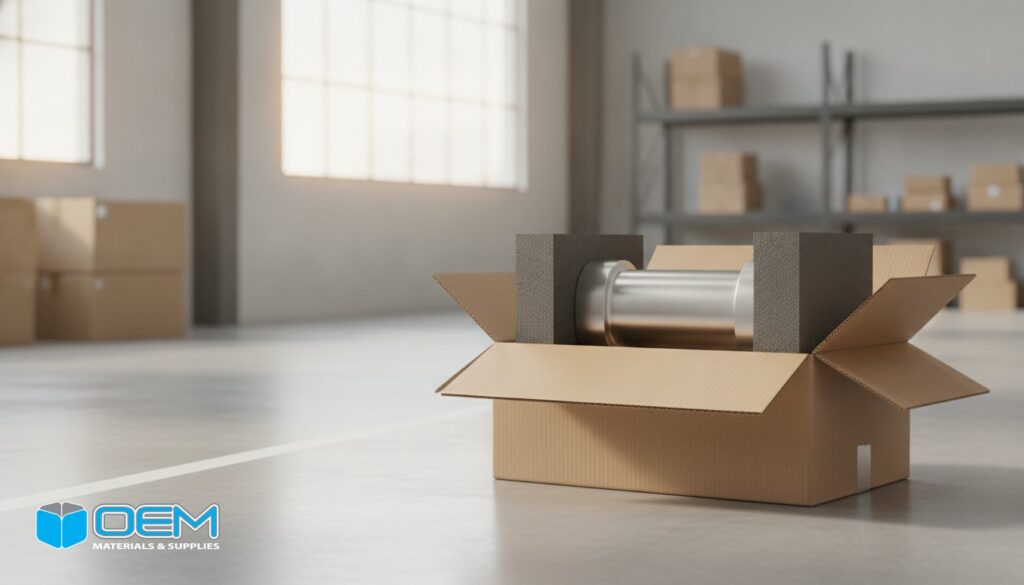
Relying on standard cushioning for high-value industrial equipment is often a direct path to unsustainable replacement costs and frequent freight claims. You understand that the chaos of LTL shipping environments demands more than just extra layers of bubble wrap or loose fill. For manufacturers in Los Angeles and throughout Southern California, the primary challenge involves balancing maximum protection with the urgent need to control rising dimensional weight fees. It’s a difficult trade-off that often results in either damaged goods or inflated shipping budgets.
This guide demonstrates how custom foam end caps serve as a precision-engineered solution to isolate sensitive components within a calculated float space. We will show you how to select the ideal materials and design configurations that eliminate transit damage while significantly reducing excessive packaging labor. By the end of this article, you will know how to optimize your material usage to lower the total cost of ownership for your shipping operations. We cover everything from density selection for heavy machinery to anti-static requirements for electronics, providing a clear roadmap for achieving a damage-free shipping record.
Key Takeaways
- Learn how custom foam end caps create a calculated float space to protect high-value equipment from impact and vibration during LTL shipping.
- Identify the best foam materials based on product weight, fragility, and surface sensitivity to ensure maximum durability and cost efficiency.
- Understand how precision engineering and prototyping prevent products from bottoming out by calculating accurate static loading requirements.
- Explore specialized design strategies for aerospace and medical sectors that require strict cleanliness and material performance standards.
- Optimize your supply chain by utilizing local Southern California production and just-in-time delivery to reduce inventory overhead and lead times.
Understanding Custom Foam End Caps in Industrial Packaging
Engineered protection for high-value equipment requires more than generic cushioning. Industrial custom foam end caps are precision-fabricated components designed to suspend a product securely within its shipping container. Unlike standard loose fill, these caps act as structural supports that isolate the item from external forces. This design strategy ensures that the product remains stationary, even when the outer box is subjected to the rough handling typical of LTL freight environments across Southern California.
Industrial manufacturers favor this approach for boxy or heavy equipment because it provides targeted protection at the most vulnerable points. While full foam inserts encase the entire product, end caps focus material only where it is needed most. This results in significant material efficiency. You aren’t paying for foam to cover flat, non-sensitive surfaces; instead, you’re investing in high-performance foam at the corners and edges where impact is most likely to occur. For heavy machinery or sensitive electronics, this targeted application of custom foam packaging provides a superior strength-to-weight ratio compared to full-cavity alternatives.
The Role of End Caps in Protective Packaging Systems
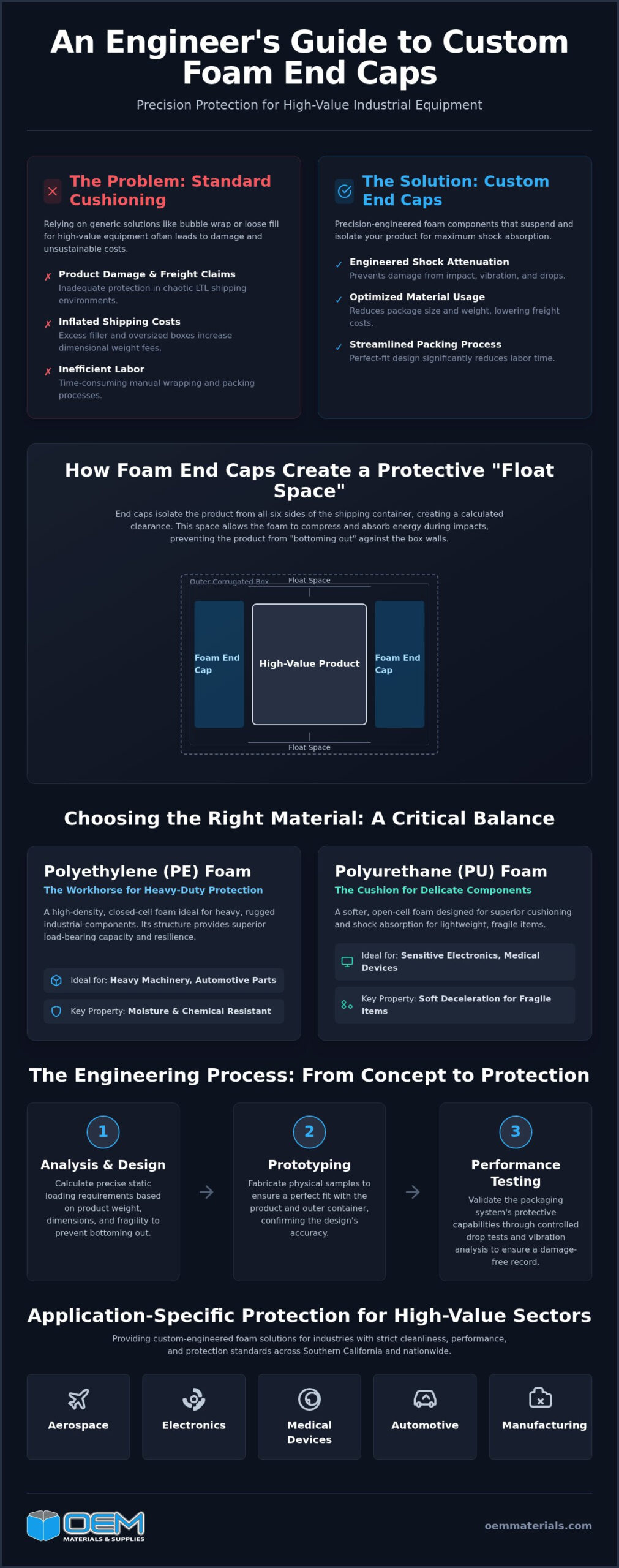
A primary goal of any protective system is shock attenuation. End caps achieve this by isolating the product from all six sides of a corrugated box, ensuring that no part of the equipment touches the outer walls. This creates a consistent clearance that allows the foam to compress and absorb energy during a drop or vibration event. Float space is the specific distance between the product’s surface and the internal wall of the outer shipping container. Maintaining this space is critical; if the foam is too thin or the density is incorrect, the product may bottom out, leading to immediate structural damage.
Economic Benefits of Custom Engineering
Precision engineering directly impacts your bottom line by utilizing custom packaging design to address packaging expenses through several logistical channels. Custom designs allow for the smallest possible outer box dimensions, which reduces dimensional weight (DIM) fees. Many shippers overpay because their boxes contain mostly air and unnecessary filler. Additionally, end caps streamline the assembly line. Because they’re designed for a perfect fit, warehouse staff can secure a product in seconds rather than spending minutes wrapping it in layers of bubble or foam sheet. It is important to clarify that specific cost savings and performance results depend on variables such as product dimensions, foam materials, and shipping requirements. This reduction in labor hours, combined with the elimination of secondary void fill, lowers the total cost of ownership for every unit shipped.
Material Selection for Precision End Cap Design
Selecting the correct material for custom foam end caps is a technical process driven by the static load of your specific product. If the material is too soft, the product will compress the foam entirely during a drop, leading to “bottoming out” and immediate damage. Conversely, if the foam is too rigid, it won’t deflect enough to dissipate energy, which can shatter sensitive internal components. This critical balance is governed by the foam’s cell structure and density. Closed-cell foams provide high load-bearing capacity and excellent recovery, while open-cell structures offer the soft deceleration required for lightweight items. For a comprehensive breakdown of the chemistry behind these choices, consult our industrial guide to foam inserts.
Polyethylene vs. Polyurethane Foam
Polyethylene (PE) is the workhorse for heavy, rugged industrial components due to its high density and closed-cell structure. It remains impervious to moisture and most industrial chemicals, making it the reliable choice for long-term storage or international ocean freight. Polyurethane (PU), on the other hand, is an open-cell foam designed for delicate instruments. While it provides superior cushioning for light loads, it’s more susceptible to moisture absorption and doesn’t offer the same chemical stability as PE. Choosing the right custom foam end caps requires a clear understanding of your shipping environment and the expected shelf life of the packaged equipment.
Cross-Linked Polyethylene and Specialty Foams
For high-precision sectors like medical device manufacturing or aerospace, cross-linked polyethylene (XLPE) offers a non-abrasive surface that protects Class A finishes from scratches. Its extremely fine cell structure prevents the “sanding” effect that coarser foams can have on polished metal or plastic surfaces. Additionally, sensitive electronics manufacturers often require anti-static (ESD) foams to prevent electrostatic discharge during handling and transit. These specialized custom foam packaging solutions are essential for meeting rigorous industry quality standards and ensuring product integrity upon arrival.
Density is typically measured in pounds per cubic foot (pcf), and matching this value to your product’s weight is essential for performance. A 1.7 pcf polyethylene is a versatile choice for many industrial parts, but heavy castings or motors may require 2.2 pcf or even 4.0 pcf to maintain structural integrity. If you’re managing multiple SKUs and need to verify performance before a full production run, speak with a design consultant to determine the exact density required for your annual usage.
The Engineering Process: Prototyping and Performance Testing
Engineering custom foam end caps requires a precise understanding of a product’s center of gravity and total mass. It’s not enough to measure outer dimensions; engineers must identify how weight is distributed to ensure the foam supports the heaviest points without deforming. Static loading is the weight of the product divided by the foam surface area. This calculation is the foundation of protective engineering, as it determines whether the foam will maintain its structural integrity or fail under the pressure of the product’s weight during transit.
Advanced CAD software allows designers to simulate the interaction between the foam and the product chassis before a single piece of material is cut. This digital precision enables the creation of complex geometries that lock the product into place, eliminating the need for excessive void fill. Digital cutting technology then allows for rapid prototyping, providing physical samples for fitment testing in a fraction of the time required by traditional tooling methods. This speed is a significant advantage for manufacturers in the Inland Empire and Orange County who need to move from design to production quickly.
From CAD Design to Physical Prototype
The process begins with an assessment of the product’s fragility, often measured in G-force tolerances. This data dictates the thickness of the foam needed to decelerate the product safely during an impact. After creating the digital die-cut pattern, a first article prototype is produced. This physical sample allows your team to verify fitment and ensure the caps integrate seamlessly with the outer corrugated boxes, creating a unified packaging system that prevents shifting.
Testing for Real-World Transit Conditions
Prototypes must undergo rigorous stress testing to simulate the repetitive vibration and vertical compression found in LTL shipping. Drop tests verify that the custom foam end caps successfully isolate the product from shock at every angle. Evaluating performance in multi-stack warehouse environments is also critical to ensure the packaging doesn’t collapse under the weight of other freight. Investing in professional custom packaging design ensures your shipping system meets rigorous industry standards and protects against costly freight claims.
Application-Specific Protection for High-Value Sectors
High-value sectors require specialized protection strategies that go beyond basic shock absorption. In aerospace and defense, components often feature irregular geometries and sensitive surface coatings that cannot tolerate any movement within the package. Precision-engineered custom foam end caps provide the necessary structural rigidity to hold these heavy, high-cost assemblies in place during long-haul transit. These specialized systems are almost always paired with heavy-duty corrugated boxes to create a robust outer shell that withstands the rigors of global logistics and multi-modal transport.
Medical and Life Science Requirements
Medical device manufacturers face some of the strictest packaging standards in the industry. The foam used must be non-abrasive to prevent damage to sterile barriers or polished surgical finishes. We often recommend high-density cross-linked polyethylene for these applications because it offers low-particulate shedding and excellent cleanroom compatibility. Unlike standard open-cell foams that might flake or off-gas, these high-purity materials ensure that sensitive life science equipment remains uncontaminated upon arrival. It’s also vital that these end caps maintain their structural integrity during temperature-controlled shipping. Extreme cold or high humidity in refrigerated containers can cause lesser materials to become brittle or lose their cushioning properties, but engineered polyethylene remains stable across a wide temperature range.
Electronics and Sensitive Instrumentation
For the electronics and automotive sectors, managing electrostatic discharge (ESD) is a primary concern. Sensitive circuit boards, microchips, and automotive sensors can be destroyed by static buildup that occurs during standard warehouse handling. Using specialized pink or black ESD foam for custom foam end caps provides a dissipative path that protects internal components from sudden electrical surges. Beyond static, these designs must also account for high-frequency vibrations that can loosen delicate solder joints or connectors. By integrating these caps with other cushioning materials, we create a comprehensive protection system that dampens vibration and absorbs impact simultaneously. This multi-layered approach is essential for protecting complex assemblies that must arrive ready for immediate installation.
If your product requires specialized material certifications or ESD protection for high-volume production, request a technical consultation to review your specific engineering requirements.
Sourcing Custom Foam End Caps in Southern California
Manufacturers in the Los Angeles and San Diego regions operate within one of the most complex logistics hubs in the world. Between the constant activity at the Ports of Long Beach and Los Angeles and the heavy drayage traffic across Southern California, products are exposed to significant vibration and handling stressors before they even leave the warehouse. Sourcing custom foam end caps from a regional partner allows you to address these specific transit challenges with speed and precision. Local production eliminates the logistical delays and high freight costs of shipping bulky foam from out-of-state facilities. A regional supplier also understands how the Southern California climate, particularly the high heat in the Inland Empire, affects the expansion and contraction of various foam materials during storage.
Optimizing the SoCal Supply Chain
Coordinating packaging delivery with production schedules in Orange County requires a partner that can respond to fluctuating demand in real-time. By utilizing just-in-time (JIT) packaging services, you can reduce the amount of floor space dedicated to storing bulky protective materials. This is especially beneficial for distribution centers in Riverside and the Inland Empire where warehouse efficiency is paramount. Implementing a vendor-managed inventory (VMI) program further streamlines operations by ensuring that your critical packaging components are always in stock, allowing your team to focus on production rather than monitoring inventory levels.
Partnering with a Full-Service Packaging Supplier
True efficiency is found when your protection strategy is integrated into a single, cohesive system. Choosing a partner that can provide custom foam end caps alongside corrugated boxes, pallets, and crates ensures that every component fits perfectly. This vertical integration extends to kitting and assembly services, where foam components are pre-installed into boxes or crates before they arrive at your facility. This reduces internal labor costs and speeds up the packing process. For companies looking to optimize their current setup, a comprehensive packaging audit can identify material waste and suggest design improvements that lower the total cost of ownership across your entire supply chain.
Optimize Your Industrial Logistics with Engineered Protection
Eliminating shipping damage and reducing total packaging costs requires a move away from generic cushioning toward calculated engineering. By matching foam density to the specific static load of your equipment, you ensure that sensitive components remain isolated within a protective float space. For manufacturers in Los Angeles and the Inland Empire, leveraging local expertise in custom foam end caps provides the additional benefit of reduced lead times and lower inventory overhead through VMI and JIT services.
OEM Materials & Supplies serves as a technical partner for aerospace, medical, and electronics OEMs across Southern California. We understand the rigorous standards required for high-value industrial sectors and provide the rapid prototyping necessary to validate performance before high-volume production begins. To begin optimizing your protection strategy, please provide your product dimensions, weight, and annual usage when you request a custom foam end cap quote and prototype from OEM Materials & Supplies. Our team is ready to help you achieve a damage-free shipping record and a more efficient supply chain.
Frequently Asked Questions
How do I determine the right foam density for my custom end caps?
Density selection is driven by static loading, which is the product weight divided by the surface area of the foam contact points. For most industrial equipment, a 1.7 pcf polyethylene foam provides the necessary resilience without being overly rigid. If your product is exceptionally heavy, such as a cast iron motor, we may recommend a 2.2 pcf or 4.0 pcf density to prevent the material from bottoming out during a drop event.
What is the typical lead time for custom foam prototypes?
Digital cutting and CAD design allow us to produce initial prototypes within a few business days for Southern California manufacturers. This speed is essential for engineering teams in Orange County and Los Angeles who need to validate fitment before starting a full production run. Once the first article is approved, high-volume production lead times depend on current material availability and the complexity of the specific assembly requirements.
Can custom foam end caps be used for international shipping?
Yes, custom foam end caps are ideal for international ocean and air freight because polyethylene foam is non-hygroscopic and chemically stable. It doesn’t absorb moisture or lose its structural integrity in high-humidity environments like a shipping container. This durability ensures that your high-value equipment remains suspended and protected throughout long-haul transit across multiple climate zones and various handling stages at international ports.
Do custom foam end caps require expensive tooling or dies?
Precision digital cutting often eliminates the need for expensive steel rule dies or molds during the prototyping and low-volume production phases. This reduces your initial setup costs and allows for design iterations without financial penalty. For high-volume orders, we may recommend tooling to improve production speed and lower the per-unit cost, but our engineering team will help you determine the most cost-effective path based on your annual usage.
How do I measure my product to ensure a precision fit for the end caps?
You should provide the maximum length, width, and height of your product along with the total weight and center of gravity. Providing a 3D CAD file is the most accurate method for ensuring a precision fit. If a file isn’t available, we’ll need to identify specific contact points and fragile components that require extra clearance to maintain the necessary float space inside the outer corrugated container.
Are there eco-friendly or recyclable foam options available for end caps?
Polyethylene foam is 100 percent recyclable and can be processed back into resin for other industrial applications. Beyond material choice, the most effective way to be eco-friendly is to optimize the design to use the minimum amount of foam necessary for protection. By reducing material waste and streamlining the outer box size, you lower the environmental footprint of your entire shipping cycle and reduce total material consumption.
What is the difference between fabricated and molded foam end caps?
Fabricated end caps are cut and assembled from flat foam sheets using heat welding or adhesives, making them ideal for lower volumes and complex geometries. Molded end caps are created by injecting foam beads into a specific tool, which is more cost-effective for extremely high-volume production runs. Most industrial OEMs in Southern California prefer fabricated polyethylene for its versatility and the lack of high upfront tooling costs for custom designs.
How do custom end caps help reduce dimensional weight shipping charges?
Custom foam end caps minimize the outer dimensions of your corrugated box by creating the smallest possible footprint that still provides adequate shock attenuation. Many shippers use oversized boxes filled with loose void fill, which triggers high dimensional weight fees from carriers. Engineering the foam to provide maximum protection in a smaller volume helps you avoid these surcharges while maintaining a damage-free shipping record and lower total shipping costs.