
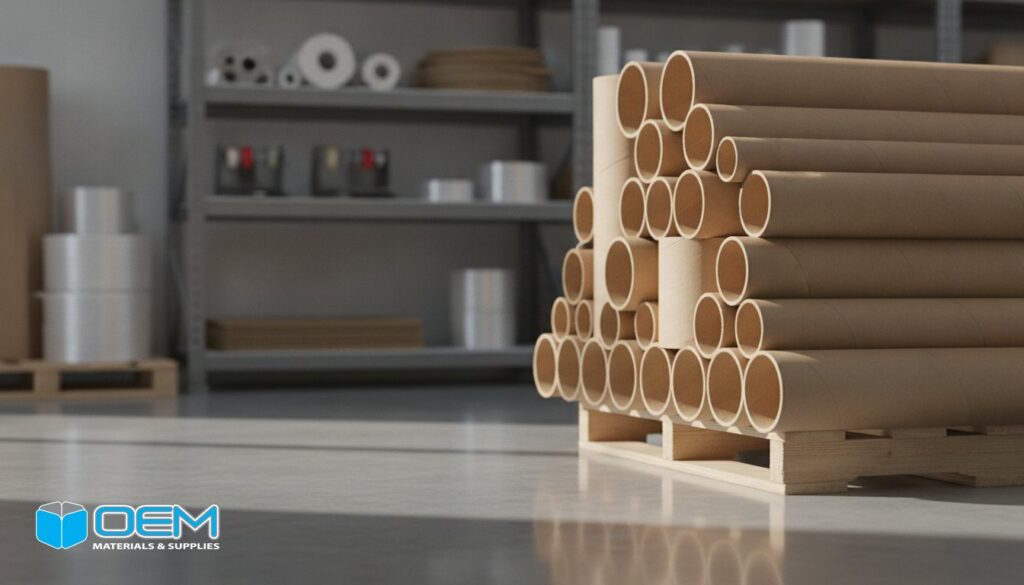
A standard shipping cylinder is often the weakest link in an otherwise sophisticated industrial supply chain. When you are transporting high-value blueprints, sensitive electronic components, or specialized textiles across Los Angeles and Orange County, a collapsed tube represents more than just a lost sale; it signifies a failure in operational precision. You likely already know that standard retail-grade packaging cannot withstand the crushing forces typical of LTL freight or high-volume distribution centers. Relying on inadequate materials leads to damaged goods and inflated labor costs from inefficient sealing processes.
This guide explains how to select heavy-duty mailing tubes that meet the rigorous demands of sectors like aerospace and medical device manufacturing. We will provide a technical understanding of tube strength ratings and wall thickness to help you achieve zero-damage shipments. You will also learn how a local Southern California partner can streamline your procurement through vendor-managed inventory, ensuring you never face a shortage of critical supplies during a production surge. By matching your packaging specifications to the actual stresses of your transit route, you can protect your bottom line and your professional reputation.
Key Takeaways
- Identify the critical structural differences between retail poster tubes and industrial-grade tubes engineered for high-load transit environments.
- Learn how to select wall thicknesses ranging from .06 to .25 inches to match specific crush resistance requirements for your supply chain.
- Understand how heavy-duty mailing tubes protect sensitive aerospace blueprints, medical components, and specialized textiles from environmental and physical damage.
- Implement best practices for secure sealing and flush-fit internal alignment to eliminate product shifting and reduce labor costs during the packing process.
- Explore the logistical benefits of partnering with a local Southern California supplier to integrate packaging into a vendor-managed inventory program.
Defining the Industrial Role of Heavy-Duty Mailing Tubes
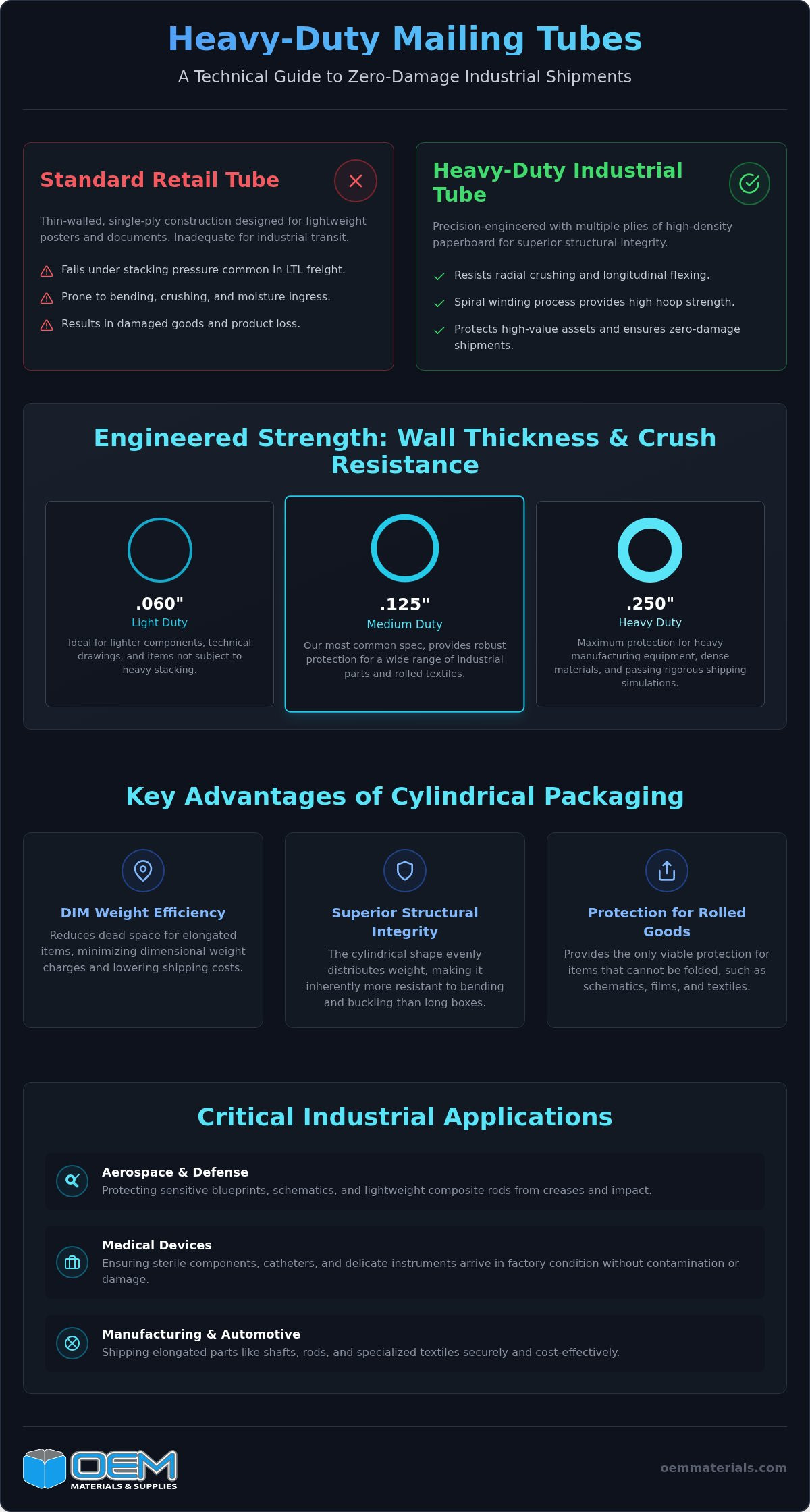
Industrial-grade mailing tubes and cores are not mere paper cylinders. They are precision-engineered components designed to protect high-value assets throughout the supply chain. Unlike thin-walled retail options, heavy-duty mailing tubes are built using multiple plies of high-density paperboard. This construction is vital for manufacturers in Los Angeles and Orange County who ship sensitive aerospace blueprints or medical device components that cannot tolerate even minor bending or moisture ingress. These tubes serve as a rigid shield, ensuring that technical documents and fragile parts remain in factory condition during transit.
Retail poster tubes often fail under the weight of palletized loads or during the rigors of LTL transit. In contrast, industrial heavy-duty shipping tubes provide the structural rigidity needed to resist radial crushing and longitudinal flexing. This durability ensures that technical drawings or delicate electronic assemblies arrive at their destination without creases or structural compromise. By selecting a tube designed for industrial loads, you eliminate the risk of product damage that typically occurs when using consumer-grade materials.
Spiral Winding and Material Composition
The strength of these tubes comes from the spiral winding process. During manufacturing, several layers of paperboard are wound around a mandrel at specific angles. This technique creates high hoop strength, which is the tube’s ability to resist internal and external pressure. We use high-grade kraft paperboard to maintain the tube’s shape under extreme stacking pressure. For applications requiring a more professional presentation or resistance to scuffing, reinforced white gloss finishes are available. These materials don’t just look better; they provide an additional layer of moisture resistance and surface protection for specialized goods.
When to Choose Tubes Over Corrugated Boxes
Deciding between a tube and a box depends on the geometry of your product. While corrugated boxes are versatile, they are often inefficient for elongated items. Consider these advantages of using a cylindrical format:
- Dimensional Weight (DIM) Efficiency: Tubes naturally conform to the shape of rods, shafts, and rolled textiles. This reduces the volume of dead space and helps lower shipping costs by minimizing DIM charges.
- Structural Integrity: A long, narrow box is prone to buckling in the middle. A heavy-duty tube’s cylindrical shape distributes weight evenly, making it inherently more resistant to bending.
- Protection for Non-Foldable Goods: Items like specialized manufacturing films or oversized engineering schematics must remain rolled to avoid permanent creasing. Tubes provide the only viable protection for these specialized materials.
Engineering Strength Wall Thickness and Crush Resistance Standards
The performance of heavy-duty mailing tubes is fundamentally defined by the relationship between wall thickness and crush load capacity. As the thickness of the spirally wound paperboard increases, the tube’s ability to resist external pressure scales significantly. In industrial applications, wall thicknesses typically range from .06 inches for lighter components to .25 inches for heavy-duty manufacturing equipment or dense textiles. The 2026 updates to ISTA Procedure 3E highlight the importance of compression testing for unitized loads, making wall thickness selection a primary factor in passing these rigorous shipping simulations. While thickness provides the primary defense, the inside diameter also influences stability. A larger diameter requires a proportionally thicker wall to maintain the same level of structural integrity against side-impact forces.
Standard lengths for these industrial cylinders vary widely to accommodate diverse product lines, usually ranging from 12 inches to 92 inches. When shipping longer items, the risk of longitudinal bowing increases, making the selection of an appropriate wall thickness even more critical. Adhering to established crush resistance standards ensures that your packaging remains intact whether it is at the bottom of a pallet or moving through a high-speed sorting facility.
Calculating Necessary Wall Thickness
Determining the correct specification requires an analysis of your entire logistics cycle. You must consider the weight of the product and the maximum stacking height in your warehouse. If your goods are shipped via LTL freight, they are often subjected to sustained compression from heavy pallets stacked above them. Parcel shipping, by contrast, introduces more frequent impact shocks. For industrial procurement managers, crush resistance is defined as the maximum compressive load a tube can withstand before its circular profile begins to deform or buckle. If you are unsure which specification fits your application, you can consult with our engineering team for a technical recommendation based on your product dimensions and weight.
End Plug Security and Integrity
The choice of end closure is just as vital as the tube itself. While plastic end plugs are suitable for many standard applications, metal end plugs are the industry standard for heavy loads or long-distance international transit. These plugs don’t just seal the tube; they reinforce the ends, preventing the paperboard from fraying or collapsing under pressure. To ensure the highest level of security, consider these integration methods:
- Mechanical Fastening: Using industrial staples to secure metal plugs directly into the tube wall for high-weight items.
- Friction Fit Optimization: Ensuring a precise tolerance between the plug diameter and the tube’s interior to prevent slippage.
- Tape Reinforcement: Applying high-tack packaging tape over the plug seam to create a moisture-resistant barrier and secondary mechanical hold.
Industrial Applications Across Aerospace Medical and Automotive Sectors
In Southern California manufacturing hubs like El Segundo and Palmdale, the demand for specialized protective packaging is driven by high-stakes industries that cannot afford material failure. Unlike retail suppliers who focus on posters and artwork, industrial partners treat mailing tubes and cores as critical components in the supply chain. In the Los Angeles-Long Beach metropolitan area, where aerospace manufacturing employed approximately 52,900 people in 2024, the protection of technical assets is a daily operational requirement. From housing high-value engineering schematics to serving as the internal foundation for rolled carbon fiber, heavy-duty mailing tubes provide the structural rigidity necessary to meet stringent industrial packaging standards.
The medical device sector also relies on these cylinders for the transit of elongated components. With the global medical device contract manufacturing market projected to reach $92.86 billion in 2026, manufacturers in Orange County and the Inland Empire require packaging that prevents the bending of delicate surgical rods or diagnostic equipment. Similarly, the automotive industry utilizes these tubes to protect mechanical rods and interior trim pieces that are susceptible to surface scuffing or structural deformation during LTL shipping.
Aerospace and Engineering Blueprints
Aerospace engineering blueprints are more than just documents; they are high-value intellectual property that requires moisture-resistant protection. Standard paper tubes often absorb humidity, which can lead to paper degradation or ink bleeding. We provide tubes with enhanced barrier properties to ensure these technical drawings remain pristine. Because engineering plans vary significantly in scale, we offer custom packaging design to accommodate oversized architectural layouts that exceed standard stock lengths. This ensures a flush fit that prevents the documents from sliding and fraying at the edges during transit.
Industrial Textiles and Specialized Cores
Heavy-duty tubes often serve a dual purpose as internal cores for industrial textiles and specialized manufacturing films. When winding materials like carbon fiber or high-performance polymers, the core must withstand significant crushing forces from the winding tension. A core collapse during this process can halt a production line and ruin thousands of dollars of material. By selecting a tube with the appropriate hoop strength and diameter, manufacturers can ensure compatibility with their machinery while maintaining material integrity. This level of technical specification is essential for high-tension winding processes used in modern aerospace and automotive manufacturing.
Best Practices for Secure Sealing and Shipping Optimization
Selecting high-quality heavy-duty mailing tubes is only the first step in a damage-free shipping strategy. The effectiveness of the packaging depends heavily on how the contents are secured within the cylinder. A common failure point in industrial logistics is the lack of a flush fit between the product and the tube interior. When a heavy item like a steel rod or a dense roll of textile is allowed to shift, it generates kinetic energy that can blow out the end caps. To prevent this, ensure that the product is centered and that any remaining space is eliminated through precise measurement or secondary materials.
For high-weight applications, relying solely on the friction fit of an end plug is insufficient. Industrial-grade packaging tape should be applied across the diameter of the plug and wrapped around the circumference of the tube. This creates a mechanical bond that reinforces the structural integrity of the closure. When utilizing heavy-duty mailing tubes for specialized components that require high-security sealing, you can request a quote for custom-sized tubes and industrial sealing supplies to match your specific weight requirements. This extra step is especially vital for LTL shipments moving through Los Angeles hubs where frequent cross-docking occurs.
Minimizing Internal Movement
To maintain the zero-damage standard required in aerospace and medical manufacturing, you must address internal voids. Filling the gaps at the ends of the tube prevents the “battering ram” effect, where the product repeatedly strikes the end plug during transit. Utilizing cushioning materials like custom foam inserts or high-density paper wadding provides a buffer that absorbs shock. This is particularly important for fragile items that are sensitive to vibration or longitudinal movement within the tube.
Labeling and Tracking for Logistics Efficiency
Labeling a cylindrical surface presents unique challenges for automated sorting systems used by major carriers. If a barcode is wrapped too tightly around a small-diameter tube, it becomes unreadable by standard scanners, leading to manual handling delays and potential shipping errors. Labels should be placed along the length of the tube rather than around the circumference to ensure a flat, scannable surface.
Using labels and printing supplies specifically designed with high-tack adhesives is essential for industrial environments. Standard office labels often peel away from the textured surface of kraft paperboard, especially when stored in the fluctuating humidity of Southern California warehouses. Ensuring that your tracking information stays permanently attached is a critical step in optimizing your distribution workflow across Los Angeles and Orange County. Clear destination marking and scannable barcodes reduce the risk of inventory shortages caused by misrouted shipments.
Strategic Sourcing and Inventory Management for SoCal Manufacturers
In an environment where demand for advanced manufacturing space in the South Bay is estimated to be four times the current supply, managing warehouse footprints is a critical operational priority. Sourcing heavy-duty mailing tubes from a local Southern California partner allows manufacturers to reclaim valuable floor space by shifting from bulk storage to a more responsive model. By integrating these supplies into packaging VMI services, you transfer the burden of inventory monitoring and replenishment to your supplier. This ensures that your production lines in Los Angeles or Orange County never stall due to a shortage of critical shipping materials.
Rising material costs make procurement efficiency essential. As of July 2026, the Producer Price Index for corrugated paperboard showed a 4.40% increase over the previous year, highlighting the need for strategic sourcing. A local partner provides a hedge against these fluctuations by optimizing delivery schedules and reducing the fuel surcharges associated with long-distance freight. Moving toward a Just-in-Time delivery model means your heavy-duty mailing tubes arrive exactly when needed for high-volume production runs, rather than sitting as stagnant capital on your warehouse shelves.
Reducing Logistics Overhead in Southern California
Our distribution network is designed to serve the specific needs of manufacturers across San Diego, Riverside, and the Inland Empire. Local stock means lead times are measured in hours or days rather than weeks. This proximity is particularly beneficial for aerospace and medical device firms that must respond quickly to shifting project timelines. We customize order quantities to match your actual usage patterns, allowing you to maintain lean operations without sacrificing the protection of your high-value rolled goods. Reducing the distance between the supplier and your facility also minimizes the risk of transit damage before the tubes even reach your packing station.
Partnering for Packaging Efficiency
Professional packaging audits go beyond simple order fulfillment to identify systemic cost-saving opportunities. We analyze how your mailing tubes interact with other essential supplies, such as stretch film and edge protectors, to create a unified packaging system. This holistic approach often reveals where material specifications can be adjusted to reduce weight without compromising safety. When requesting a quote, providing data on your annual usage and specific product dimensions allows us to design a procurement strategy that balances durability with fiscal responsibility. This collaborative approach ensures that your packaging remains an asset to your logistics chain rather than a source of hidden costs.
Optimizing Your Industrial Packaging Strategy
Protecting high-value assets requires more than a standard shipping container. It demands a technical understanding of wall thickness and crush resistance to withstand the stresses of modern logistics. By implementing heavy-duty mailing tubes that are engineered for structural integrity, manufacturers can eliminate product damage and streamline distribution workflows. Shipping sensitive aerospace schematics or specialized medical components necessitates matching your packaging to the specific crushing forces of your supply chain to ensure operational success.
OEM Materials & Supplies provides specialized support for the aerospace, medical, and electronics sectors across Orange County, Los Angeles, San Diego, and Riverside. We offer custom packaging design and vendor-managed inventory programs to reduce your warehouse footprint and ensure preparedness for production surges. Our team is ready to help you optimize your shipping protocols with reliable, industrial-grade solutions. To facilitate an accurate recommendation, please provide your product dimensions, weight, and annual usage requirements. Contact OEM Materials & Supplies for a Mailing Tube Quote and secure your supply chain today.
Frequently Asked Questions
What is the difference between a standard mailing tube and a heavy-duty tube?
Standard tubes are typically designed for light retail items like posters and use thin walls between .03 and .05 inches. Heavy-duty tubes utilize multiple plies of high-density paperboard with wall thicknesses ranging from .06 to .25 inches. This industrial construction provides the structural integrity needed to withstand the crushing forces of LTL freight and palletized shipping. While retail versions focus on presentation, heavy-duty options prioritize the protection of high-value industrial assets.
How do I determine the correct wall thickness for shipping heavy industrial rods?
Selecting the right thickness depends on the total product weight and the stacking requirements of your supply chain. For heavy industrial rods, a wall thickness of .125 to .250 inches is generally required to prevent the tube from bending or collapsing. You must also consider the shipping method; LTL transit often subjects packaging to higher compression than parcel delivery. Our team can analyze your specific dimensions to recommend a thickness that balances protection with cost.
Are metal end caps better than plastic caps for heavy-duty applications?
Metal end caps provide superior mechanical security for heavy loads because they resist the internal pressure of shifting items better than plastic. While plastic caps are efficient for lighter goods, they can pop out during rough transit. For industrial applications across Los Angeles and Orange County, we recommend metal caps secured with staples or industrial tape. This ensures that heavy components remain contained throughout the entire distribution cycle without compromising the tube’s structural ends.
Can heavy-duty mailing tubes be customized for specific lengths?
We provide custom-cut lengths ranging from 12 inches to over 92 inches to meet specialized manufacturing requirements. Customization ensures a flush fit for elongated items like mechanical shafts or oversized architectural plans, which prevents damaging internal movement. By utilizing heavy-duty mailing tubes tailored to your product’s exact dimensions, you reduce the need for excessive void fill and lower your overall dimensional weight shipping costs. This precision is essential for maintaining zero-damage standards.
How does spiral winding improve the strength of a paperboard tube?
Spiral winding involves overlapping multiple plies of paperboard around a mandrel at specific angles to create high hoop strength. This engineering technique allows the tube to resist radial crushing and internal pressure much more effectively than standard folded cardboard. The resulting structural rigidity ensures that the cylinder maintains its profile even under heavy vertical loads. This process is what allows our tubes to serve as reliable cores for high-tension winding in the aerospace and textile industries.
Do you offer local delivery for mailing tubes in Orange County and Los Angeles?
We provide dedicated local delivery services across Los Angeles County, Orange County, the Inland Empire, and San Diego County. Our regional distribution network allows us to offer significantly shorter lead times compared to out-of-state vendors. This proximity supports just-in-time manufacturing schedules and reduces the logistics costs associated with shipping bulky packaging materials. Local manufacturers benefit from a reliable supply chain partner that understands the specific operational demands of the Southern California industrial market.
How can a Vendor Managed Inventory program help with my packaging supply chain?
A Vendor Managed Inventory (VMI) program transfers the responsibility of monitoring and replenishing your packaging stock to our team. We track your usage of heavy-duty mailing tubes and other supplies to ensure you never face inventory shortages during production peaks. This service reduces your administrative overhead and optimizes your warehouse space by preventing overstocking. It’s a strategic solution for high-volume manufacturers who need to maintain lean operations while ensuring consistent material availability.
What is the maximum weight a heavy-duty mailing tube can typically support?
The weight capacity is determined by the combination of wall thickness, tube diameter, and total length. While a .25-inch wall tube can support substantial crushing loads, the specific weight limit depends on your stacking height and the shipping environment. We don’t provide a universal maximum because variables like moisture and vibration affect performance. We recommend testing prototypes with your actual product weight and dimensions to ensure the chosen specification meets your specific safety and transit requirements.