
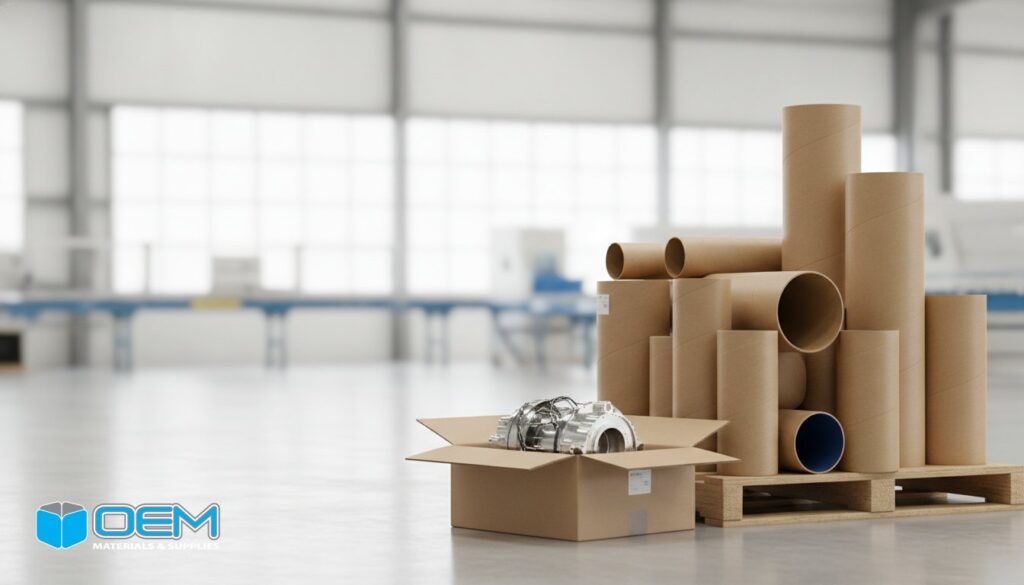
A single collapsed core can halt a production line or ruin thousands of dollars in high-performance film or aerospace components. For manufacturers in Los Angeles and Orange County, the search for reliable custom cardboard tubes often starts after a national supplier fails to meet a lead time or a shipment arrives crushed due to poor engineering. You understand that these aren’t just paper products; they are critical industrial components that must withstand specific crush test standards like ASTM D642 to ensure your inventory remains intact.
We recognize the frustration of managing excessive packaging inventory that crowds your warehouse floor while waiting on inconsistent deliveries. This guide explains how to specify engineered tubes that eliminate product damage and how to implement just-in-time delivery to reclaim your square footage. We will examine the technical requirements for industrial cores, the impact of California’s SB 54 and SB 343 on your packaging strategy, and the logistical advantages of partnering with a local supplier who understands the aerospace, medical, and electronics sectors. With paperboard material costs rising by over 4 percent in the last year, precision in sourcing is no longer optional for maintaining your margins.
Key Takeaways
- Understand how spiral-wound engineering and specific wall thicknesses provide the necessary crush resistance to protect sensitive industrial components during transit.
- Learn to specify the correct inner diameter and wall thickness for custom cardboard tubes to ensure a precise fit for winding machines or protective shells.
- Reduce freight costs and warehouse congestion by sourcing locally from Southern California partners who offer just-in-time delivery and vendor-managed inventory.
- Identify specialized applications for the aerospace and electronics sectors, including anti-static treatments and high-strength cores designed for precision-machined surfaces.
- Discover how integrated packaging strategies, such as pairing tubes with custom corrugated boxes or plastic pallets, optimize your entire manufacturing supply chain.
Engineering Custom Cardboard Tubes for Industrial Protection
Industrial applications demand more than a standard mailing container. High-performance custom cardboard tubes function as engineered components designed to withstand significant vertical and radial pressure. These spiral-wound products act as protective shells for machined parts or as high-strength cores for winding industrial textiles and films. Unlike retail-grade options, industrial tubes prioritize structural integrity to prevent the collapse or crushing of valuable inventory during long-haul transport.
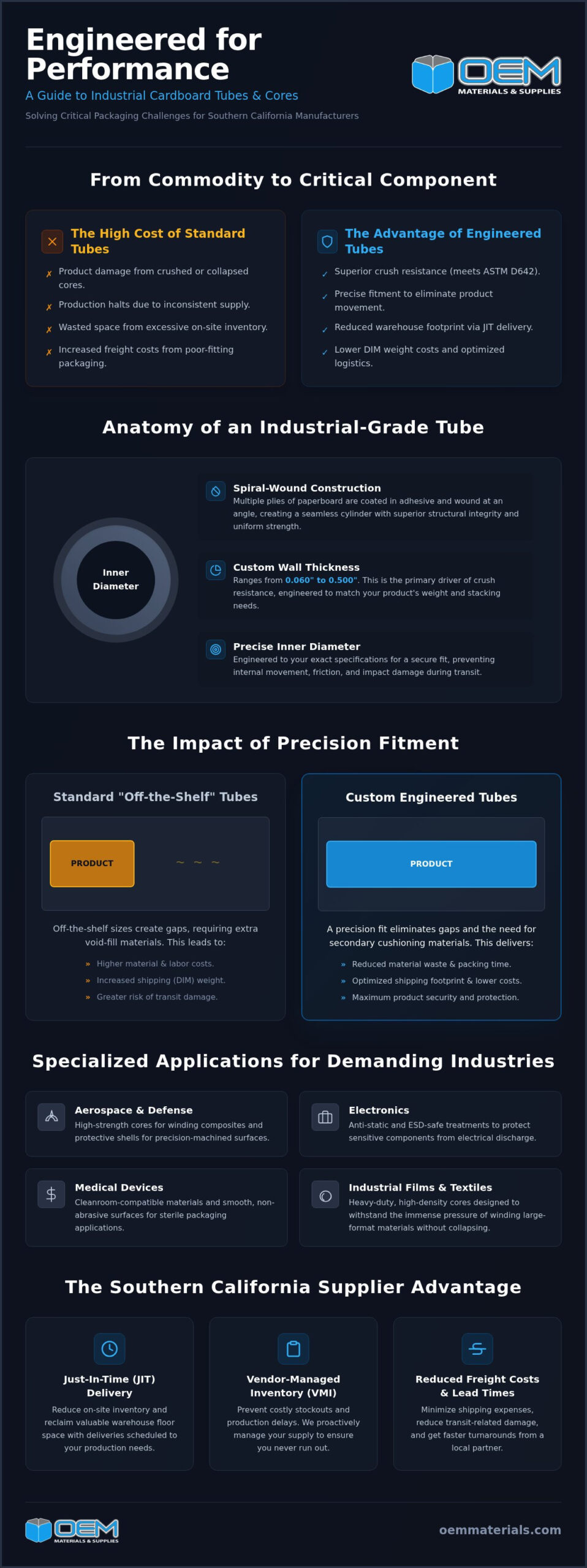
Reliable protection begins with material selection. Using high-grade recycled paperboard ensures that the final product meets the rigorous demands of manufacturing environments. By specifying the exact grade and density of the paperboard, engineers can calibrate the tube to specific industrial standards, such as ASTM D642 for compressive resistance. This level of technical specification is what separates a commodity vendor from a true industrial partner.
The Spiral-Wound Manufacturing Process
The strength of industrial cardboard shipping tubes comes from their spiral-wound construction. During manufacturing, multiple plies of paperboard are coated with high-strength industrial adhesives and wound at an angle around a stationary mandrel. This overlapping technique creates a continuous, seamless cylinder with uniform strength across its entire length. This construction method provides superior structural integrity compared to parallel-wound tubes, which are created by wrapping a single sheet around itself and are prone to unraveling under stress.
The total number of paperboard plies directly determines the ultimate load-bearing capacity and radial strength of the finished tube.
Why Industrial OEMs Require Custom Specifications
Procuring standard sizes often introduces hidden costs into a supply chain. Off-the-shelf tubes rarely match the exact dimensions of specialized industrial components, leaving internal gaps that allow products to shift. This movement leads to surface friction and impact damage during transit. By utilizing custom cardboard tubes, manufacturers eliminate these gaps and ensure a precision fit that holds the product securely in place.
Customization also streamlines the packing process. When a tube is cut to the exact length of the component, there’s no need for secondary cushioning materials like bubble wrap or crumpled paper to fill the void. This precision reduces the overall shipping footprint. Smaller footprints lead to lower dimensional (DIM) weight costs, which is a critical factor for Southern California businesses shipping across the country. Every inch of saved space translates to improved logistics efficiency and reduced material waste. Precision fitment isn’t just about protection; it’s a functional remedy for rising freight expenses.
Technical Specifications: Wall Thickness and Diameter
Specifying the technical dimensions of industrial packaging requires a data-driven approach. It isn’t about finding a close enough fit; it’s about engineering a solution that integrates with your manufacturing equipment and protects your bottom line. Technical specifications for custom cardboard tubes act as performance variables that determine whether a shipment arrives intact or as a loss. The inner diameter must match the core of a winding machine or the outer diameter of a precision part with minimal clearance to prevent shifting.
Selecting the right end caps is the final step in securing the load. Whether using plastic friction-fit plugs, metal ends for heavy-duty applications, or crimped paper ends, the closure must remain secure throughout the vibrations of transit. If you are unsure which closure suits your weight requirements, requesting a technical consultation can help identify the most secure and cost-effective option.
Calculating Required Wall Thickness
Wall thickness is the primary driver of crush resistance and stacking strength. For most industrial applications, thickness typically ranges from 0.060 to 0.500 inches depending on the specific load requirements. While a thin-walled tube might suffice for lightweight posters, heavy industrial parts like machined shafts or hydraulic components require thicker walls to prevent puncturing from external forces during handling. Engineers must consider the total weight of the palletized load. If tubes are stacked four levels high on a pallet, the bottom layer must possess a high enough ECT (Edge Crush Test) rating to support the cumulative weight without buckling.
Diameter and Length Precision
Internal diameters can be customized from small fractional inches for electronics to large industrial sizes for heavy textiles. Precision is equally vital for length. In high-volume kitting operations or automated packing lines, even a quarter-inch variance can cause a machine jam or require manual trimming. Manual trimming is a hidden labor cost that reduces throughput and increases waste. Consistent dimensions are critical for manufacturers using Vendor Managed Inventory, where packaging must be ready for immediate use on the production floor without secondary adjustments. Precise length cutting ensures that every tube fits perfectly into its secondary corrugated box, optimizing the entire shipping footprint and reducing dimensional weight expenses.
Industrial Applications for Custom Tubes and Cores
Industrial requirements for custom cardboard tubes vary significantly across the Southern California manufacturing landscape. A tube that secures a textile roll in a warehouse isn’t the same component required to protect a titanium shaft for an aerospace contractor in Los Angeles. Precision-engineered tubes serve as more than just containers; they are integral to the quality control process of high-value industrial sectors. Every sector has unique mechanical and environmental stressors that dictate the final tube specification.
Aerospace and Automotive Logistics
Aerospace and automotive logistics involve the transport of long, slender components such as drive shafts, rods, and hydraulic lines. These parts are susceptible to bending or surface marring if not properly supported. High-strength tubes provide a rigid barrier against impact in high-velocity shipping environments. For maximum protection, these tubes often integrate with custom foam packaging to provide end-to-end cushioning that prevents any internal movement. This combination is particularly effective for Orange County manufacturers shipping precision-machined parts that cannot tolerate even microscopic scratches.
Medical and Electronics Manufacturing
In medical and electronics manufacturing, the focus shifts from pure structural strength to contamination control and electrostatic discharge (ESD). Electronics manufacturers utilize anti-static treated tubes to prevent static buildup that could destroy sensitive circuit boards during transit. Medical device companies require dust-free, cleanroom-compatible materials to maintain the integrity of sterile equipment. Custom closures are essential here to prevent environmental contaminants from entering the tube during long-term storage or multi-stage shipping. Precise labeling on the tube exterior also allows for better tracking within complex medical supply chains, ensuring that every component is accounted for from the factory floor to the end user.
Textile and industrial film manufacturers in the Inland Empire and San Diego rely on heavy-duty custom cardboard tubes as cores for high-speed winding applications. These cores must maintain perfect circularity under the intense tension of industrial winding machines. A core that warps or collapses under pressure can ruin thousands of yards of material and cause significant machine downtime. By specifying the exact crush strength needed for the winding torque, manufacturers ensure their production lines run at peak efficiency without material loss. These heavy-duty cores are designed to withstand the radial pressure exerted by tightly wound films, preventing the telescoping effect that occurs when a core fails.
Procurement for Southern California Manufacturers
Sourcing custom cardboard tubes from national suppliers often introduces unnecessary friction into the manufacturing supply chain. Freight costs from the Midwest or East Coast can significantly inflate the total cost of ownership, while long-distance transit times leave little room for production schedule adjustments. Local sourcing in Orange County and Los Angeles County provides a functional remedy to these logistical hurdles. By partnering with a regional supplier, manufacturers in San Diego, Riverside, and the Inland Empire gain access to a more responsive support system that understands the specific regulatory and economic environment of California.
Reducing Lead Times with Local Supply Chains
Proximity is a critical factor in speed-to-market. When you work with a local partner, you avoid the multi-day transit delays and potential weather-related disruptions associated with national shipping routes. This geographic advantage is particularly evident during the design and testing phases. Quick-turn prototyping allows your engineering team to test new packaging designs for fit and durability within days rather than weeks. Local representatives can also provide on-site consultations at facilities throughout the Inland Empire. These face-to-face interactions help identify specific manufacturing challenges, such as tight dock space or unique kitting requirements, that might be missed during a digital consultation.
Optimizing Warehouse Space via JIT and VMI
Warehouse floor space in Southern California is a premium resource. Storing large quantities of bulky packaging materials like industrial tubes and cores is an inefficient use of square footage that could be utilized for production. Implementing JIT packaging allows factories to operate with minimal on-hand inventory. This model ensures that supplies arrive exactly when they are needed for the next production run, freeing up valuable floor space and reducing the risk of inventory damage during long-term storage.
Vendor Managed Inventory (VMI) programs further optimize operations by shifting the administrative and logistical burden of inventory management to the supplier. Instead of your purchasing manager manually tracking stock levels, the supplier monitors your actual usage and replenishes stock automatically. This proactive approach ensures that production lines never experience downtime due to a lack of critical shipping supplies. For high-volume manufacturers in sectors like medical devices or electronics, this stability is essential for maintaining a lean operation. To see how a localized supply chain can improve your operational efficiency, you can request a quote for custom tubes tailored to your specific annual usage and delivery requirements.
Integrated Packaging: Tubes as Part of a Total Solution
Effective industrial protection rarely relies on a single material. While custom cardboard tubes provide the primary structural barrier for cylindrical parts, they often function as one component within a broader, engineered packaging system. For complex shipments, these tubes are frequently nested inside corrugated boxes to provide additional stacking strength and a flat surface for automated labeling. When handling oversized or high-density tubes, stabilization on heavy duty plastic pallets is required to prevent rolling and ensure safe forklift handling during distribution in the Inland Empire and Los Angeles.
Integrated kitting services allow manufacturers to combine tubes, foam, and fasteners into a single SKU. This approach eliminates the need for your team to source and manage multiple vendors for a single product shipment. It also ensures that every component is engineered to fit together perfectly, reducing the risk of material incompatibility that can lead to product damage. A single-source supplier reduces administrative overhead and provides a functional remedy for complex procurement cycles.
Combining Tubes with Foam and Crates
Engineered foam inserts can be placed inside the tube to suspend fragile items, preventing them from touching the inner walls during transit. This is a common requirement for medical optics and sensitive electronic components that cannot tolerate vibration. For international export, large diameter custom cardboard tubes are often secured within custom wood crates to provide a secondary layer of protection against rough ocean freight handling. Utilizing multi-material kits simplifies the packing process and significantly improves labor efficiency by providing workers with a complete, ready-to-assemble solution.
The Value of a Full-Service Packaging Partner
Relying on a single wholesale industrial packaging supplier provides more than just administrative convenience. It ensures consistent quality control across all packaging components in a shipment. When the same partner designs the tube, the foam insert, and the outer box, you eliminate the dimensional variances that often occur when mixing components from different vendors. This holistic view of the supply chain allows for professional consultations that identify cost-saving opportunities, such as optimizing the total weight of the package to lower freight expenses. By consolidating your procurement, you gain a partner that is fully accountable for the performance of the entire packaging solution from the production line to the end user.
Optimizing Your Southern California Supply Chain
Industrial packaging is a critical extension of the product itself. Engineering the correct wall thickness and diameter prevents costly product damage while reducing dimensional weight expenses. By integrating tubes into a total solution with foam inserts and corrugated boxes, manufacturers in Los Angeles and Orange County can streamline their packing operations and improve labor efficiency. These functional remedies ensure that your logistics keep pace with production demands.
Transitioning to custom cardboard tubes from a local partner allows you to leverage VMI and JIT services to reclaim warehouse space and stabilize lead times. Whether you require specialized cores for high-speed winding or protective shells for aerospace components, precision engineering is the foundation of a reliable supply chain. We provide full-service design and prototyping to ensure your technical specifications meet the most rigorous industry standards across San Diego and the Inland Empire.
Designing effective packaging is a collaborative process; it’s one that rewards technical accuracy. Request a quote for custom industrial tubes and cores from OEM Materials & Supplies to receive a recommendation tailored to your product dimensions and annual usage requirements. We look forward to supporting your manufacturing goals with reliable, locally sourced solutions.
Frequently Asked Questions
What is the difference between a mailing tube and an industrial core?
Mailing tubes act as protective outer shells for shipping documents or parts, while industrial cores serve as internal mandrels for winding materials like film or textiles. Industrial cores require higher radial strength to withstand the tension of high-speed winding machines. Mailing tubes prioritize longitudinal rigidity and impact protection. We engineer both to specific industrial standards, ensuring the structural integrity matches the specific mechanical stress of your application.
How do I determine the correct wall thickness for heavy industrial parts?
Wall thickness is determined by the total weight of the component and the cumulative load if the tubes are palletized. For heavy industrial parts, thickness typically ranges from 0.125 to 0.500 inches. Engineers must calculate the Edge Crush Test rating required to support the bottom layer of a stacked load without buckling. Thicker walls also provide a functional remedy against puncturing during forklift handling or rough transit in manufacturing environments.
Can custom cardboard tubes be made moisture-resistant for overseas shipping?
Yes, custom cardboard tubes can be manufactured with moisture-resistant barriers or specialized outer plies for international export. These treatments prevent the paperboard from absorbing humidity, which can lead to structural softening and collapse in maritime environments. For total protection, we recommend integrating these tubes with our custom wood crates or plastic pallets to ensure the load remains stable and dry throughout long-haul overseas shipping cycles.
What are the standard lead times for custom tube production in Southern California?
Standard lead times for local production in Southern California are significantly shorter than those from national vendors. Because we are located near major hubs in Orange County and Los Angeles, we can offer rapid prototyping and quick-turn production runs. Our proximity allows for just-in-time delivery models, which reduce your need to store large volumes of packaging inventory on-site. Specific timelines depend on the complexity of the customization.
Are your cardboard tubes made from sustainable or recycled materials?
Most industrial tubes are manufactured from 100 percent recycled paperboard, making them a highly sustainable packaging choice. Under California’s SB 343 and SB 54 regulations, paperboard is considered a readily recyclable material in the state. This helps our clients in the aerospace and medical sectors meet corporate sustainability goals while remaining compliant with current state mandates. We prioritize high-strength recycled fibers that maintain structural integrity without compromising environmental standards.
What types of end caps or closures are available for industrial tubes?
We offer several closure options depending on the weight and security requirements of your product. Plastic friction-fit plugs are standard for most mailing applications, while heavy-duty metal end caps provide superior retention for high-density industrial parts. For lighter components, crimped paper ends offer a tamper-evident, fully recyclable solution. Selecting the correct closure ensures that your product remains secure within the tube throughout the vibrations of the shipping journey.
Do you offer custom printing or labeling for industrial identification?
Yes, custom labeling and printing are available to facilitate inventory tracking and industrial identification. This is particularly valuable for complex supply chains in the medical and electronics sectors where precise part identification is mandatory. We can apply high-visibility labels or direct printing to the outer ply of the custom cardboard tubes. This service helps warehouse managers quickly identify contents, reducing labor costs and minimizing errors during the kitting and assembly process.
What is the minimum order quantity for a custom diameter and length?
Minimum order quantities vary based on the specific diameter and length required for your project. While some custom sizes require larger production runs to offset the setup costs of the winding mandrel, we often accommodate smaller prototype runs for Southern California manufacturers. Our goal is to support both high-volume production and specialized low-volume engineering projects. For an accurate assessment, we recommend providing your specific dimensions, weight, and annual usage during the consultation phase.