
What if the structural failure of a single shipping container cost your operation more than the product inside? For manufacturers in the aerospace and medical device sectors, a bent or crushed tube is not just a minor nuisance; it is a direct threat to high-value blueprints and precision components. Selecting the right kraft mailing tubes requires a technical understanding of wall thickness and crush strength to withstand the rigors of LTL shipping and aggressive carrier handling.
You know that standard retail packaging often fails to meet rigorous industrial requirements, especially when moving heavy parts through the logistics hubs of Southern California. We will show you how to identify the exact tube specifications needed for zero-damage delivery while simultaneously improving your warehouse efficiency. This guide covers technical specifications, dimensional weight optimization for 2026 carrier rules, and how local VMI or JIT delivery programs in Orange County and Los Angeles can eliminate stockouts and reduce storage overhead. By aligning your packaging choices with your specific manufacturing output, you can protect your bottom line and your high-value components.
Key Takeaways
- Learn why spiral-wound construction provides superior crush resistance for heavy industrial parts compared to standard parallel-wound options.
- Identify the specific wall thickness and diameter required for your application to ensure kraft mailing tubes protect high-value components during LTL transit.
- Discover how aerospace and automotive manufacturers in Orange County and Los Angeles use heavy-duty tubes for the secure transport of metal extrusions and blueprints.
- Reduce warehouse overhead and eliminate stockouts by implementing Vendor Managed Inventory and Just-in-Time delivery strategies tailored for Southern California facilities.
- Determine the exact data points needed for accurate custom quotes, including annual usage volume and precise product dimensions.
Understanding the Structural Integrity of Industrial Kraft Mailing Tubes
Industrial kraft mailing tubes are precision-engineered cylinders designed to protect elongated or sensitive materials during transit. Unlike standard retail tubes, these industrial-grade components consist of multiple plies of high-density paperboard. These layers are bonded together to create a rigid structure capable of withstanding significant external pressure. For manufacturers shipping metal extrusions, specialized medical instruments, or aerospace blueprints, the tube serves as a primary structural barrier against the compression forces common in LTL shipping environments. Selecting high-quality kraft mailing tubes is a strategic decision for any operations manager focused on reducing product damage claims.
While corrugated boxes are versatile, they often lack the longitudinal rigidity required for narrow, heavy items. A box can buckle or fold when subjected to side-impact or stacking pressure. In contrast, the cylindrical geometry of a mailing tube naturally deflects impact and maintains its shape under load. This design is particularly effective for protecting items that cannot be folded or creased, such as high-value industrial films or large-format engineering schematics.
The Engineering of Spiral Wound Construction
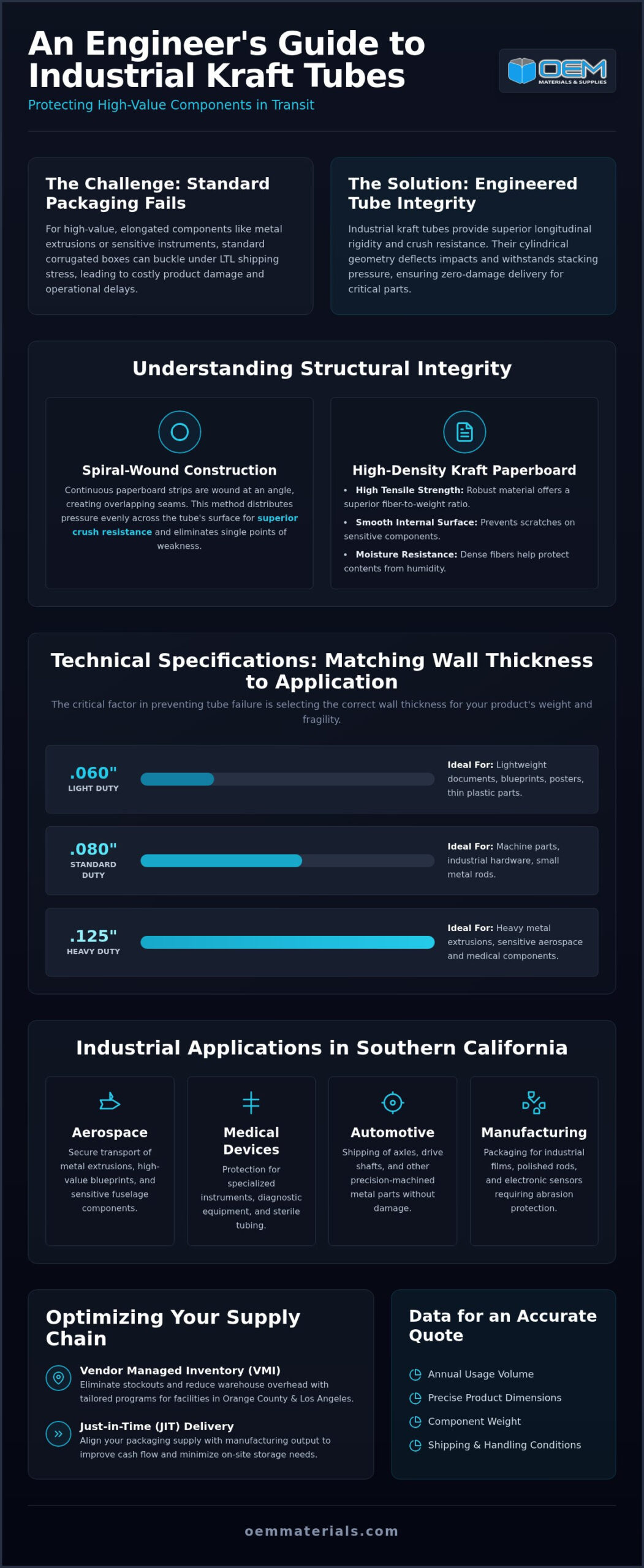
The strength of a tube depends heavily on its manufacturing method. During production, continuous strips of paperboard are wound at a precise angle over a stationary mandrel. This spiral winding technique creates overlapping seams that distribute external pressure across the entire surface area of the tube. This method provides superior crush resistance compared to parallel-wound tubes, where the paper is wrapped straight around the core. Spiral winding ensures that there is no single point of weakness along the length of the cylinder.
The adhesive used between these plies is equally critical. High-performance adhesives ensure the tube maintains its rigidity even when exposed to the high humidity levels often found in Southern California warehouse environments. Without a high-quality bond, the layers can delaminate; this leads to a catastrophic loss of structural integrity during transit. We prioritize tubes that maintain their specified crush strength from the factory floor to the final destination.
Why Kraft Paperboard is the Industrial Standard
Industrial tubes utilize high-density paperboard produced via the Kraft process, which is specifically designed for high tensile strength and durability. This material is significantly more robust than standard cardboard. It offers a higher fiber-to-weight ratio, allowing the tube to remain lightweight while providing heavy-duty protection. This weight efficiency is vital for controlling shipping costs under current dimensional weight rules.
Manufacturers also benefit from the material’s inherent properties:
- Sustainability: High-grade kraft paper often incorporates recycled content without compromising the tube’s ability to resist bending or snapping.
- Surface Protection: The internal liners of these tubes are engineered to be smooth. This prevents scratches or abrasions on sensitive components like polished metal rods or electronic sensors.
- Moisture Resistance: The dense fiber structure provides a natural barrier that helps slow the absorption of ambient moisture, protecting the contents from environmental degradation.
Technical Specifications: Wall Thickness and Diameter Selection
Technical specifications for industrial kraft mailing tubes go beyond simple length and width. For engineers and procurement managers, selecting the correct wall thickness and diameter is a balancing act between structural protection and logistics costs. While spiral winding provides the foundational strength, the specific dimensions of the tube determine its performance under the stress of a modern supply chain. Standard industrial diameters range from 1.5 inches for small components to 12 inches for specialized high-capacity applications.
Determining the Required Wall Thickness
Wall thickness is the critical factor in preventing tube ovalization during stacking. Light-duty tubes with a .060 wall are often sufficient for lightweight documents or thin plastic parts. However, heavy industrial components require walls of .125 or higher to maintain their shape when other packages are stacked on top during LTL transit. Academic research into the biaxial failure envelope of paper demonstrates how paperboard cylinders respond to multi-directional stress; this data confirms that increasing wall thickness is the most effective way to prevent catastrophic failure under axial compression.
Thicker walls provide a necessary buffer against the impacts common in high-volume distribution centers. In Southern California hubs, where packages move rapidly through automated sorting systems, a heavy-duty wall prevents the tube from buckling when it encounters heavier freight. This specification directly impacts your damage rate and overall customer satisfaction.
Sizing Tubes for Industrial Components
Selecting the correct diameter is essential for minimizing internal movement. A tube that’s too large allows the product to shift, which increases the risk of end-cap failure or surface abrasion. If your part has an irregular shape, you can use custom foam packaging to center the item and absorb shock. This approach reduces the need for excessive cushioning materials, which can simplify your packing process and lower material costs.
When calculating the required size, you must distinguish between total length and usable length. Plastic end caps typically insert 0.5 to 1 inch into the tube, effectively shortening the internal space. For precise applications, we recommend providing exact part dimensions to ensure the tube and closure system work in tandem. If you have specific requirements for heavy or high-value parts, you can request a quote for a custom-engineered sizing solution.
Dimensional weight calculations for 2026 also play a role in sizing. Carriers like FedEx and UPS now round every dimension up to the next whole inch before applying the 139 divisor. A tube with a 3.1-inch outer diameter is billed at a 4-inch rate. Optimizing your outer diameter to stay just below these whole-inch thresholds can lead to measurable savings in your annual shipping spend.
Industrial Applications Across Southern California Manufacturing Sectors
Southern California’s diverse industrial landscape requires specialized packaging solutions that exceed standard retail capabilities. In hubs like Orange County and Los Angeles, kraft mailing tubes serve as essential protective components for high-precision industries. These tubes aren’t just for shipping documents; they are engineered tools for the aerospace, medical, and automotive sectors. By matching tube specifications to the specific requirements of each industry, manufacturers can significantly reduce damage rates and improve supply chain reliability.
Aerospace Blueprints and Engineering Schematics
The aerospace and defense sectors in Los Angeles and Orange County rely on large-format physical schematics that are often high-value and non-reproducible. These documents require absolute protection against moisture and crushing. Because the kraft pulping process produces long, strong fibers, these tubes offer the necessary tensile strength to maintain structural integrity in engineering archives. Archival-quality liners prevent paper degradation, ensuring that critical schematics remain legible for years of reference. Using these cylinders for organized storage also facilitates faster retrieval in high-pressure engineering environments.
Protecting Metal Extrusions and Precision Rods
In Riverside and the Inland Empire, manufacturers of automotive parts and metal extrusions face the challenge of transporting heavy, elongated items without surface damage. Heavy-duty kraft mailing tubes prevent abrasions on finished metal or plastic rods during transit. To prevent heavy items from punching through the ends, we utilize reinforced end caps that lock securely into the tube wall. This is a critical failure point for generic packaging that industrial-grade specifications solve directly.
For bundled shipments, there is a natural synergy between these tubes and edge and corner protectors. These components work together to stabilize loads on pallets, preventing the tubes from shifting or being crushed by strapping tension. This integrated approach is common in the medical device sector in San Diego, where sterile components and sensitive diagnostic equipment require rigid, multi-layered protection. Beyond hardware, large-scale production of industrial textiles and specialized rolled films requires tubes with consistent diameters and smooth interiors. These applications demand a supplier who understands the nuances of SoCal logistics, ensuring that materials arrive ready for the production line without creases or environmental contamination.
Optimizing Supply Chain Efficiency with Mailing Tube Logistics
Bulky packaging inventory often creates a logistical bottleneck in manufacturing facilities. While kraft mailing tubes are necessary for protecting elongated components, their physical volume consumes valuable floor space that could otherwise be used for production. Supply chain managers in Southern California must find ways to balance immediate material availability against the high cost of industrial real estate in Los Angeles and Orange County. Optimizing this balance requires a strategic shift from simple procurement to integrated logistical solutions.
Consolidating your procurement for kraft mailing tubes with other essentials like stretch_film and corrugated boxes helps simplify vendor management. This integrated approach allows for more efficient freight consolidation and reduced administrative labor. It’s important to note that the extent of these savings depends on your specific operational variables; including product dimensions, material specifications, and annual shipping requirements. By viewing packaging as a single category rather than isolated items, you can identify hidden costs in your procurement process.
Vendor Managed Inventory for Packaging Supplies
Implementing packaging VMI shifts the burden of inventory management to your supplier. We monitor your usage rates and trigger automated replenishment; this prevents the stockouts that often stall production lines. By reducing the time your team spends on manual counts and purchase orders, you lower administrative overhead. These managed programs provide a functional remedy for the inventory shortages that often plague high-volume manufacturing sectors in the medical and electronics fields.
Just-In-Time Delivery in Southern California
For facilities operating in high-rent districts across Southern California, JIT packaging provides a significant logistical advantage. We synchronize deliveries with your production schedule to ensure you have only the tubes required for your immediate output. This strategy frees up warehouse space for finished goods or additional machinery. Local sourcing from a SoCal partner eliminates the long lead times and high transit costs associated with out-of-state vendors, allowing for a more responsive supply chain.
Pre-staging your packaging into custom kits further reduces labor costs on the packing floor. When workers have all necessary components at hand, they spend less time searching for materials and more time moving product. While kitting improves throughput, the total labor reduction depends on your specific assembly requirements and packaging complexity. To see how these efficiencies apply to your unique operation, you can request a quote for a total cost of ownership analysis.
Sourcing Strategies for Custom and Bulk Kraft Tubes
Procurement teams often view kraft mailing tubes as a simple commodity, but your sourcing strategy directly impacts both unit price and the total cost of ownership. An effective approach involves evaluating whether off-the-shelf sizes meet your technical requirements or if a custom solution is necessary to prevent product damage. By integrating your tube sourcing with other requirements, such as corrugated boxes or custom foam, you can reduce administrative overhead and leverage better volume pricing across your entire packaging category.
To receive an accurate and competitive quote, procurement managers should provide specific data points. This includes the required inner diameter, wall thickness, and usable internal length. It’s also vital to communicate your annual usage volume and typical order frequency. This data allows your supplier to recommend the most efficient production run and identify opportunities for stock holding or automated replenishment through a managed inventory program.
Custom vs. Stock: Making the Right Choice
Stock mailing tubes are ideal for immediate, lower-volume needs. However, the cost of a custom-sized tube is often offset by savings in shipping and a reduction in damage claims. If a stock tube is even slightly too wide, it can trigger higher dimensional weight charges under current carrier rules. Custom sizing ensures a snug fit for your product; this also minimizes the need for secondary void fill. It’s important to clarify that actual cost reductions and damage prevention depend on specific variables like product dimensions, material weight, and specific carrier shipping requirements.
Customization also extends to branding and functional hardware. We offer options for custom printing directly on the kraft surface; this is essential for brand consistency in the medical and electronics sectors. For specialized industrial applications, you can choose from various closure systems. Crimped ends provide a cost-effective solution for lightweight items, while heavy-duty metal plugs or reinforced plastic caps are better suited for heavy metal rods or precision extrusions that might otherwise punch through the packaging during transit.
Evaluating a Southern California Packaging Partner
Choosing a supplier with deep roots in the SoCal industrial landscape offers distinct advantages over national catalog resellers. Local expertise allows for rapid prototyping of custom tube inserts and closures; this is critical for engineers in the aerospace and defense sectors who need to verify fit and function before a full production run. A local partner understands the specific logistical challenges of the Inland Empire, San Diego, and Los Angeles, providing faster response times when production schedules shift.
We recommend that procurement teams look for a partner capable of custom packaging design. This capability ensures that your kraft mailing tubes are engineered for the specific stresses of your supply chain. An experienced partner looks beyond the price per unit to find savings in labor, warehouse space, and transit costs. These comprehensive packaging audits can reveal significant efficiencies, though the final results will always vary based on your specific product dimensions and material requirements.
Strengthening Your Supply Chain with Industrial Packaging Solutions
Selecting the right kraft mailing tubes is a strategic decision that impacts both product safety and operational costs. By prioritizing technical specifications like wall thickness and precise diameter matching, you protect high-value components from the structural stresses of LTL shipping. We have supported aerospace and medical manufacturers since our inception; this experience allows us to provide more than just a catalog of products. We offer engineering-led solutions that solve real-world packaging challenges through local VMI and JIT delivery across Orange County, Los Angeles, and the Inland Empire.
Our team is ready to help you optimize your logistics through custom design and rapid prototyping. To facilitate an accurate recommendation and provide the most effective packaging solution for your operation, please include your specific product dimensions, weight, and estimated annual usage when you reach out. Contact OEM Materials & Supplies for an Industrial Packaging Quote or consultation today. We look forward to helping you build a more efficient and reliable packaging strategy.
Frequently Asked Questions
What is the standard wall thickness for heavy-duty kraft tubes?
Heavy-duty industrial tubes typically utilize wall thicknesses of .125 inches or .250 inches. While standard shipping tubes often use .060 walls, heavy-duty applications require thicker ply counts to prevent crushing during LTL transit. The specific thickness depends on the weight of your contents and the stacking requirements in your facility. We analyze your product’s mass to recommend a specification that ensures structural integrity throughout the Southern California distribution network.
How do I choose between plastic end caps and crimped ends?
Choose plastic end caps for heavy or high-value items that require maximum closure security. These caps insert into the tube and provide a rigid structural barrier. Crimped ends are a cost-effective alternative for lightweight items where the tube ends are folded inward. While crimping reduces material costs and labor, it also reduces the usable internal length of the tube. We recommend plastic caps for any application involving precision metal components.
Are kraft mailing tubes strong enough for shipping metal parts?
Industrial-grade kraft mailing tubes are engineered specifically for heavy items like metal extrusions and precision rods. By utilizing spiral-wound construction and high-density paperboard, these tubes offer superior crush resistance. For very heavy parts, we recommend increasing the wall thickness to .125 inches or higher and using reinforced end caps. This combination prevents the product from shifting or punching through the tube during transit in high-volume shipping environments.
Can I get custom-length mailing tubes for specialized industrial tools?
We provide custom-length tubes tailored to your specific product dimensions. Using custom lengths eliminates the need for excessive internal cushioning and reduces dimensional weight charges from carriers like FedEx and UPS. This is particularly beneficial for specialized aerospace tools or medical instruments that do not fit standard stock sizes. Providing exact tool dimensions allows us to manufacture a tube that offers a precise fit; this minimizes movement and potential damage during handling.
What is the difference between a mailing tube and a paper core?
A mailing tube is a finished shipping container designed to protect its contents, while a paper core is a structural center for winding materials like film, foil, or textiles. Mailing tubes typically have thinner walls and include closure systems like caps. Paper cores require much higher crush strength and dimensional accuracy to function with industrial winding machinery. While both are made from spiral-wound paperboard, their engineering tolerances and intended applications differ significantly.
How should I store bulk mailing tubes to prevent warping?
Store bulk kraft mailing tubes in a climate-controlled environment away from direct floor contact. Using pallets or racking prevents moisture absorption from concrete floors, which can cause the paperboard to soften or warp. Keep tubes in their original stretch-wrapped bundles until needed to maintain their cylindrical shape. In the humid coastal areas of Orange County and San Diego, proper storage is critical to ensure the tubes maintain their structural integrity and fit their end caps correctly.
Are there moisture-resistant options for kraft mailing tubes?
We offer tubes with specialized outer plies or coatings designed to resist moisture and environmental degradation. While standard kraft paperboard is naturally absorbent, these treated options provide a barrier against high humidity and incidental water exposure. This is a functional remedy for manufacturers shipping components through varying climates or storing materials in non-conditioned warehouse spaces. These moisture-resistant barriers help maintain the tube’s rigid failure envelope during long-term transit or storage cycles.
What data do I need to provide for a custom mailing tube quote?
To provide an accurate quote, we require the internal diameter, the wall thickness, and the required usable length. You should also specify your annual usage volume and the weight of the product being shipped. Knowing the destination and shipping method helps us recommend the correct structural specifications. If you are unsure of the requirements, our team can perform a packaging audit to determine the most cost-effective and protective configuration for your application.