
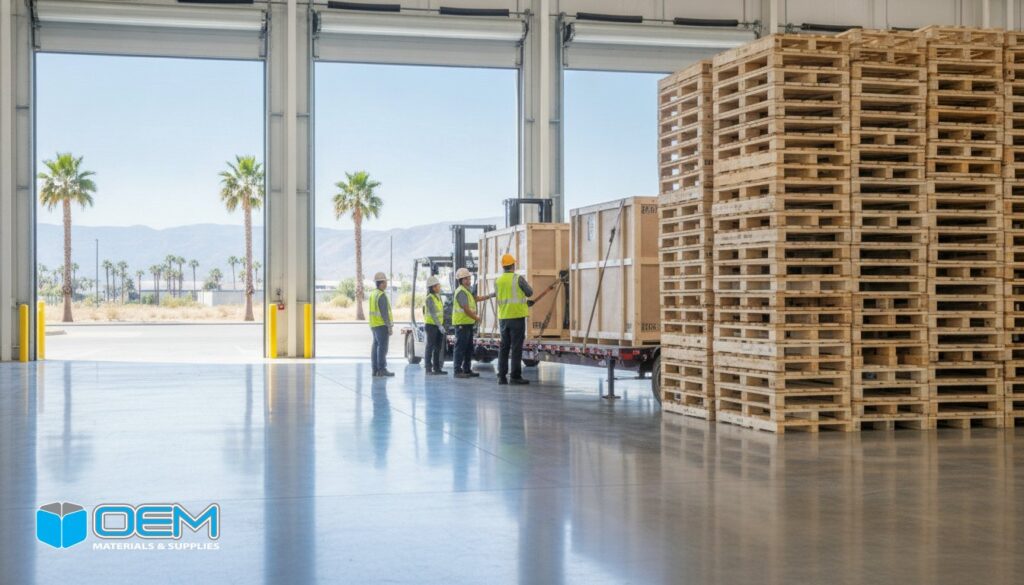
A single non-compliant stamp on a shipping crate can halt a high-value medical device or aerospace delivery at an international border, leading to immediate quarantine and thousands of dollars in storage fees. Procuring the right heat-treated export pallets is not just a logistical checkbox; it is a critical safeguard for your global supply chain. For manufacturers in Los Angeles and Orange County, the cost of a rejected shipment far outweighs the price of the pallet itself.
We understand the frustration of navigating shifting phytosanitary regulations, especially when a minor documentation error or an incorrect IPPC mark leads to a rejected shipment at customs. This guide provides a clear roadmap for mastering ISPM 15 technical requirements and securing a reliable supply of compliant wood packaging. You will learn the exact heat treatment standards required for international transit, the updated IPPC marking rules effective in 2026, and how a strategic partnership with a Southern California supplier can eliminate customs delays while maintaining cost-effective compliance for high-volume export programs.
Key Takeaways
- Master the technical core temperature and duration requirements necessary for ISPM 15 certification to ensure your wood packaging is legally compliant.
- Learn how to accurately verify the IPPC mark on heat-treated export pallets to prevent shipments from being quarantined or rejected at international borders.
- Understand the critical 2026 update to ISPM 15 marking standards and how it affects your current inventory of wood packaging.
- Evaluate when to utilize custom wood crates versus standard pallets for high-value aerospace and medical equipment shipments in Southern California.
Understanding Heat-Treated Export Pallets and Global Logistics
A heat-treated pallet is more than just standard lumber. It is a specialized piece of industrial packaging engineered to meet rigorous international biosecurity standards. In the logistics sector, these are defined as wood packaging materials that have undergone a specific thermal process to comply with global phytosanitary regulations. While many manufacturers in Los Angeles and Orange County use kiln-dried wood for structural stability, there is a distinct difference between kiln-dried and certified heat-treated export pallets. Kiln-drying focuses on reducing moisture content to prevent warping. Heat treatment is a sterilization process designed to eliminate wood-boring pests and pathogens.
International customs authorities mandate these standards because raw wood acts as a primary vector for invasive species. Pests like the Emerald Ash Borer or the Asian Longhorned Beetle can devastate local ecosystems if introduced via untreated shipping crates. To mitigate this risk, global trade agreements require all solid wood packaging thicker than 6 mm to be treated and stamped. If your shipment arrives at a foreign port without the proper certification, customs agents have the authority to quarantine the cargo or deny entry entirely, often at a significant cost to the exporter.
The Role of ISPM 15 in International Trade
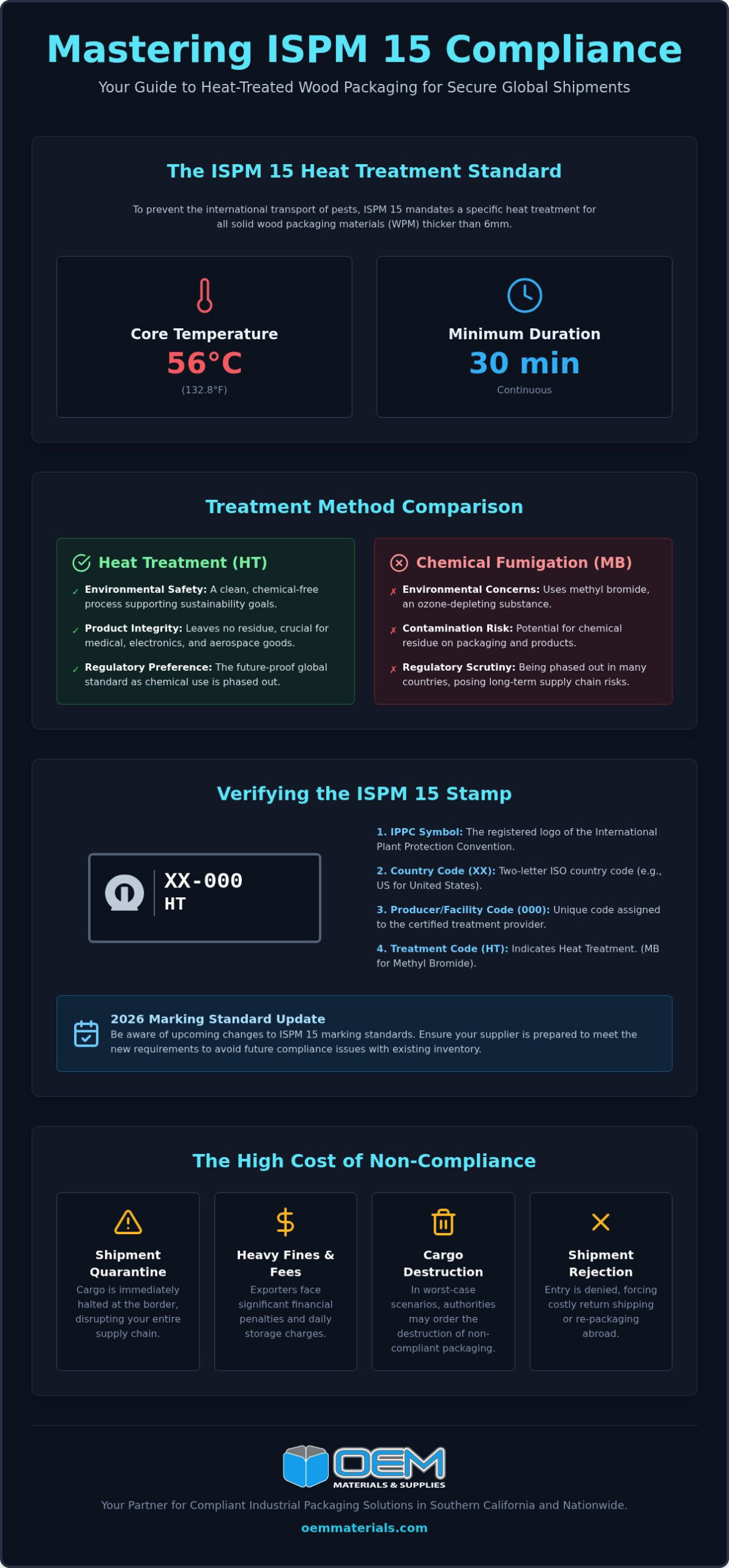
The International Standards for Phytosanitary Measures No. 15 provides the essential framework for these regulations. This standard ensures that wood packaging is treated at a core temperature of 56 degrees Celsius for at least 30 continuous minutes. This uniform approach allows for the seamless movement of goods between participating countries without the need for individual bilateral agreements. For companies managing high-volume export programs, non-compliance is a major financial risk. Beyond the immediate logistical delays, shippers may face heavy fines and the mandatory destruction of non-compliant pallets or crates, which can compromise the integrity of the products they carry.
Heat Treatment vs. Chemical Fumigation
Manufacturers must choose between thermal heat treatment and chemical fumigation, typically using methyl bromide. Heat treatment has become the preferred industry standard for several practical reasons:
- Environmental Safety: Thermal heating is a clean process that uses no toxic chemicals, supporting corporate sustainability goals.
- Product Integrity: Heat treatment leaves no chemical residue. This is a critical requirement for the medical device, electronics, and aerospace sectors where contamination is a primary concern.
- Regulatory Preference: Many countries are phasing out methyl bromide due to its status as an ozone-depleting substance, making heat treatment the most future-proof compliance strategy.
By prioritizing heat-treated wood, Southern California exporters ensure their supply chain remains efficient and compliant with the latest global biosecurity demands.
Structural Integrity of Heat-Treated Wood
Beyond meeting wood packaging industry standards, the heat-treatment process significantly alters the physical properties of the lumber. By subjecting the wood to high temperatures, the moisture content is naturally reduced. This transition from “green” lumber to a drier state offers several logistical advantages. Drier wood is lighter, which can reduce total freight costs for high-volume air or ocean shipments. Additionally, the reduction in moisture increases the wood’s structural strength and provides a natural resistance to mold and fungal growth. For manufacturers shipping sensitive electronics or medical devices, using pallets that won’t harbor moisture or spores is a critical quality control measure.
Documentation and Facility Certification
Compliance isn’t just about the physical treatment; it’s about the paper trail. Facilities that provide heat-treatment services must be audited and certified by a National Plant Protection Organization (NPPO). In the United States, this oversight is managed through third-party inspection agencies that conduct monthly, unannounced audits of the facility’s kilns and records. Suppliers must maintain detailed logs for every heat-treatment cycle, including date, time, and probe readings. When you source heat-treated export pallets, you should verify that your partner holds an active certification. A breakdown in this documentation can lead to the same customs rejections as a missing stamp. If you need to ensure your next shipment meets these rigorous technical standards, you can request a quote for certified wood packaging tailored to your specifications.
Identifying and Verifying the ISPM 15 Export Stamp
The permanent stamp on heat-treated export pallets acts as an official passport for wood packaging. It is the only universally recognized evidence that the material has been sterilized to prevent the spread of pests across international borders. International regulations demand that this mark be applied to at least two opposite sides of the pallet or crate. This placement ensures that customs inspectors can verify compliance regardless of how the units are oriented in a shipping container or warehouse. Without these legible marks, the wood is classified as raw timber, which can lead to immediate shipment rejection.
Components of a Compliant Pallet Stamp
A legitimate IPPC mark must contain four mandatory components organized in a specific layout. The left side features the IPPC wheat symbol, followed by the ISO two-letter country code, such as US for the United States. Next is a hyphen and the unique facility identification number assigned by the national inspection agency. Finally, the HT abbreviation must be clearly visible, signifying that the wood underwent the required thermal process. Legibility is non-negotiable. If a stamp is blurred, incomplete, or applied using prohibited red or orange ink, the pallet is technically non-compliant. Common red flags include hand-drawn markings or stamps that appear to be altered, which can trigger an intensive customs audit.
Verifying Supplier Credentials
For manufacturers in the Inland Empire and San Diego County shipping sensitive electronics, verifying a supplier’s credentials is a necessary step in risk management. You can cross-reference the facility number on the stamp with official regulatory databases to ensure the provider maintains an active certification and is subject to regular audits. The stamp is the primary proof of compliance for customs officials, but professional exporters often request a formal certificate of treatment for high-value cargo. This document serves as a secondary verification of the treatment date and facility status. When sourcing pallets or custom wood crates, partner with suppliers who provide transparent access to their audit history. This level of diligence prevents the logistical nightmare of a shipment being rejected due to an expired or fraudulent facility identification number.
Strategic Packaging for Southern California Manufacturers
Southern California serves as a primary gateway for global trade, making the regional supply chain both highly efficient and strictly regulated. For aerospace, medical, and electronics firms in Orange County and San Diego, heat-treated export pallets are the mandatory foundation of a larger protective system. Rather than viewing the pallet as a standalone commodity, industrial managers should treat it as one component of an engineered solution. This approach addresses the high-stakes nature of international distribution where a single failure in packaging can halt entire production lines or lead to significant inventory losses.
Custom Export Solutions for Specialized Industries
High-precision industries require tailored protection that standard wood packaging cannot provide on its own. In San Diego, electronics manufacturers frequently integrate HT pallets with custom foam inserts to dampen vibration and prevent electrostatic discharge during transit. Companies in Orange County often pair these pallets with custom corrugated boxes designed for specific weight distributions and stacking requirements. To secure these loads for the rigors of ocean freight, the use of edge protectors is a standard practice. These components distribute strapping pressure evenly, preventing the primary packaging from collapsing under the tension required to unify the load. This level of stabilization is critical for maintaining the integrity of the unit load from the warehouse floor to the final international destination.
Value-Added Services for Industrial Supply Chains
Logistical efficiency for manufacturers in Los Angeles and the Inland Empire is often achieved through Vendor Managed Inventory (VMI). By utilizing a local partner to monitor and replenish stock levels, operations can reduce the amount of capital tied up in on-site inventory. Just-in-time delivery ensures that heat-treated export pallets and custom crates are available exactly when a shipment is ready for pickup, which is vital for facilities in Riverside and San Bernardino where warehouse space is at a premium. Packaging kits further streamline operations by providing pallets, cushioning, and outer boxes in a single SKU, reducing the labor required for assembly. While these programs are designed to reduce labor and material expenses, it is important to clarify that total cost savings depend on specific variables such as product dimensions, the materials selected, and individual shipping requirements. To evaluate how these services can benefit your operation, you can request a quote for a customized analysis of your current packaging workflow.
Sourcing Heat-Treated Pallets and Custom Wood Crates
Procurement teams must decide between new and recycled wood when securing heat-treated export pallets. New pallets offer the highest level of structural consistency and are typically required for high-precision aerospace and medical equipment. Recycled HT pallets can be a cost-effective alternative for many industrial applications, but it’s important to understand that the actual savings and performance results depend on variables such as pallet dimensions, wood species, and specific shipping requirements. For operations that require a completely non-regulated material, heavy duty plastic pallets are an effective substitute. Since plastic is exempt from ISPM 15 standards, it removes the need for thermal treatment logs and permanent stamps entirely.
Custom Wood Crating for Oversized Exports
When standard pallets cannot accommodate the size or weight of heavy machinery, custom wood crates provide the necessary structural containment. Unlike basic pallets, these crates require an engineered approach to ensure every internal component, including blocking and bracing, meets ISPM 15 standards. Designing for oversized exports requires a precise calculation of load-bearing points to ensure safe handling at international ports. Effective crate design also incorporates internal cushioning and moisture barriers to protect against the fluctuating humidity and vibrations common in long-haul maritime transport.
Choosing a Long-Term Packaging Partner
Selecting a supplier for export packaging requires evaluating their technical expertise and ability to maintain reliable lead times. A dependable partner understands the intricacies of aerospace and medical compliance and provides the documentation necessary to clear customs without friction. When requesting a quote for a new export program, providing specific data points is essential for an accurate recommendation. We typically request the following information to facilitate a consultation:
- Exact product dimensions and total load weight
- Projected annual usage and typical order frequency
- Destination country and preferred mode of transport
This data allow us to design a solution that balances material durability with operational efficiency. Contact us today to discuss your specific requirements or to request a prototype for your next international shipment.
Optimizing Your International Export Strategy
Achieving zero customs delays depends on a precise understanding of ISPM 15 standards and a reliable inventory of certified wood packaging. By integrating heat-treated export pallets with custom foam and corrugated solutions, manufacturers in Los Angeles and Orange County protect high-value aerospace and medical equipment throughout the international shipping cycle. Our focus on technical accuracy ensures that your shipments meet global phytosanitary requirements every time.
OEM Materials & Supplies provides the industrial expertise and inventory management programs needed to streamline your logistics. We specialize in serving the aerospace, medical, and electronics sectors with full-service kitting and vendor managed inventory (VMI) programs tailored to your specific production schedule. Our team is ready to help you eliminate logistical friction and reduce the risk of rejected cargo at international borders.
To receive a detailed recommendation for your next project, contact OEM Materials & Supplies for a quote on heat-treated export pallets. Please provide your product dimensions, total weight, and annual usage to facilitate an accurate assessment. We look forward to serving as your dependable partner for compliant international distribution.
Frequently Asked Questions
What is the difference between kiln-dried and heat-treated pallets?
Kiln-drying is a process used to reduce moisture content for structural stability, while heat treatment is a sterilization standard required for heat-treated export pallets. While kiln-dried lumber might reach the necessary 56 degrees Celsius, it isn’t legally compliant for international trade unless it’s processed in a certified facility and carries the official IPPC stamp. For manufacturers in Orange County, using certified HT wood is the only way to satisfy global biosecurity regulations.
Do I need heat-treated pallets for shipping between the United States and Canada?
Yes, ISPM 15 requirements apply to all wood packaging material crossing the border between the United States and Canada. While there was historically a bilateral exemption, current regulations require all pallets and crates to be heat-treated and stamped. This rule helps prevent the cross-border spread of invasive species like the Emerald Ash Borer. Exporters in Los Angeles should ensure all Canadian shipments utilize compliant wood packaging to avoid costly border delays.
How long does an ISPM 15 heat-treated stamp remain valid?
An ISPM 15 stamp remains valid for the entire life of the pallet, provided no repairs or structural modifications are made to the wood. If a pallet is repaired by replacing boards, the entire unit must be re-treated and re-stamped by a certified facility to maintain its export status. For high-volume distribution centers in Riverside, tracking the integrity of your pallet pool is essential to ensure that every unit remains compliant for international transit.
Can I heat-treat my own wood pallets for export?
You cannot heat-treat your own pallets for export unless your facility is officially certified by a recognized inspection agency. The process requires specialized kilns equipped with thermal probes and data logging software to verify that the wood core reached the mandatory temperature. Certified suppliers in Southern California undergo monthly unannounced audits to maintain their status. Attempting to apply a stamp without certification is a violation of international trade laws and can lead to severe penalties.
Are plastic pallets exempt from ISPM 15 requirements?
Plastic pallets are entirely exempt from ISPM 15 requirements because they’re considered a processed, non-wood material. This makes them an excellent alternative for companies in San Diego shipping to countries with extremely strict biosecurity protocols. Because plastic doesn’t harbor wood-boring pests, these pallets don’t require heat treatment or IPPC stamps. This exemption can simplify the documentation process for medical and electronics manufacturers who prioritize sterile and predictable shipping platforms.
What happens if a shipment arrives at customs without the ISPM 15 stamp?
If a shipment arrives at an international port without a legible ISPM 15 stamp, customs authorities will typically deny entry. The non-compliant packaging may be quarantined, returned to the point of origin, or destroyed at the exporter’s expense. These actions often lead to significant storage fees and missed delivery deadlines. Partnering with a reliable supplier for heat-treated export pallets in Los Angeles is the most effective way to prevent these logistical and financial risks.
Does the heat-treatment process affect the weight or strength of the pallet?
The heat-treatment process generally improves the performance of the wood by reducing its moisture content. This reduction in moisture makes the pallet lighter, which can lead to lower freight costs for air and ocean shipments. Additionally, drier wood is less prone to mold growth and fungal decay, providing a cleaner surface for sensitive cargo. For aerospace and medical manufacturers, these secondary benefits contribute to better product protection and overall supply chain hygiene.
Are there specific requirements for the ink used in the ISPM 15 stamp?
The ink used for the ISPM 15 stamp must be permanent, non-bleeding, and highly legible to pass customs inspections. While most suppliers use black ink, the most critical rule is the prohibition of red or orange ink. These colors are reserved for hazardous materials and other specific regulatory warnings. If a stamp is faded or smeared, it’s often deemed invalid. Ensuring that your wood packaging provider uses high-quality, compliant marking systems is vital.