
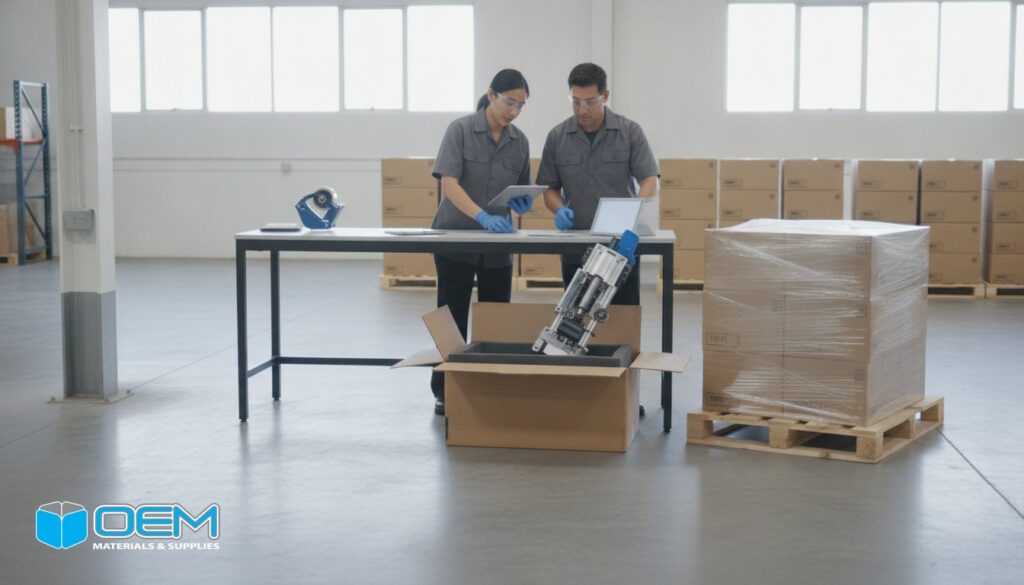
In Southern California’s competitive manufacturing landscape, a disorganized packing station is more than just an eyesore; it’s a direct drain on your bottom line. With the statewide minimum wage reaching $16.90 in 2026, and rates in Los Angeles County climbing to $18.47, every second wasted on inefficient packing translates to significant overhead. You’re likely managing the dual pressures of high labor turnover and the excessive material waste caused by over-boxing. Understanding how to streamline your packaging process is no longer an optional improvement, but a necessity for maintaining operational stability and protecting your margins.
We agree that a cluttered warehouse and inconsistent packing methods slow down high-volume production runs. This guide provides practical, industrial-grade strategies to identify hidden bottlenecks and implement standardized procedures that reduce your physical footprint. You’ll discover how optimizing custom corrugated designs and integrating logistics strategies like vendor-managed inventory can lower your total cost per shipment. By the end of this article, you’ll have a clear roadmap to transform your packaging area into a high-efficiency operation that meets rigorous industry standards.
Key Takeaways
- Learn how to streamline your packaging process by identifying labor bottlenecks and quantifying material waste caused by oversized corrugated boxes.
- Discover how custom-engineered foam inserts and right-sized packaging eliminate the need for excessive void-fill while speeding up product placement.
- Understand the impact of standardized packing station layouts and ergonomic material positioning on achieving consistent warehouse throughput.
- Explore how vendor-managed inventory (VMI) and assembly kitting services reduce production time and prevent costly stockouts of critical supplies.
- Identify the strategic benefits of partnering with a local Southern California supplier to manage everything from rapid prototyping to high-volume production.
Auditing Your Current Industrial Packaging Workflow
Efficiency in the warehouse isn’t about working faster; it’s about removing the obstacles that force employees to work slower. Before you can determine how to streamline your packaging process, you must conduct a rigorous audit of your existing workflow. This assessment should go beyond a simple visual check. It requires quantifying labor hours, material consumption, and the physical footprint of your inventory. By grounding your audit in the fundamentals of packaging, you can identify where technical failures or logistical gaps are draining your resources.
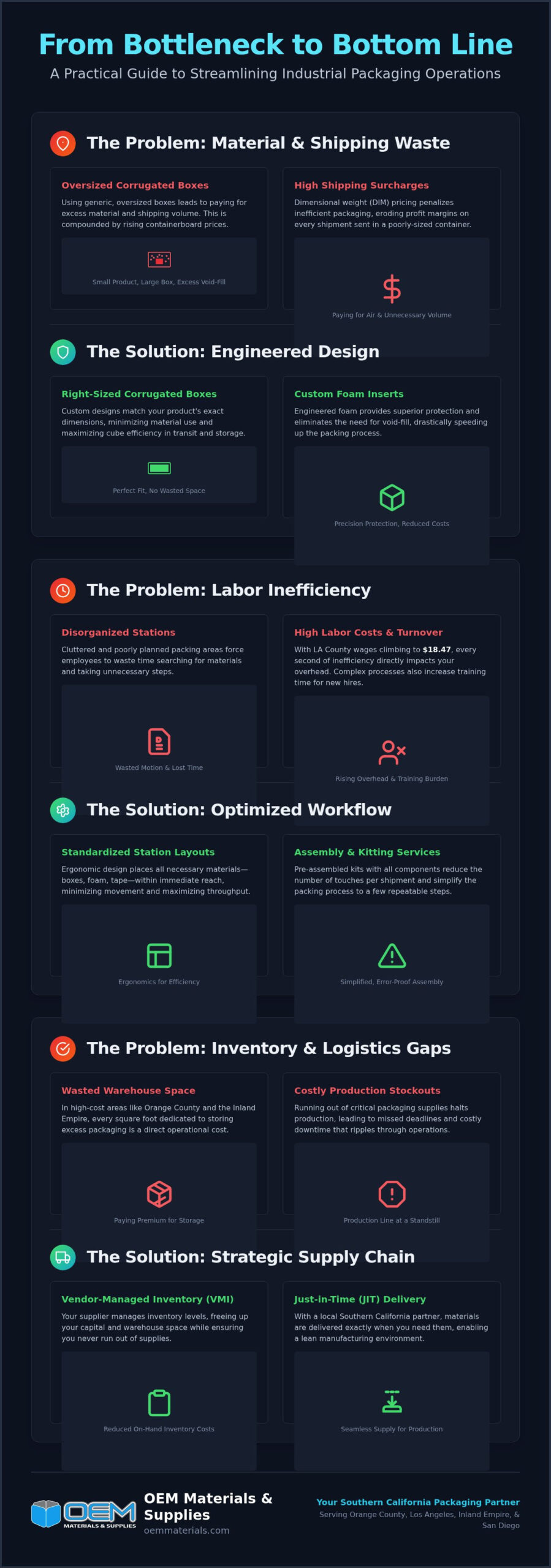
Structural failures often manifest as high damage rates or excessive “over-boxing.” If your team is using oversized corrugated boxes for small components, you’re paying for air twice: once for the extra material and again for the shipping volume. In Southern California, where warehouse space in the Inland Empire and Orange County is at a premium, every square foot occupied by unused packaging supplies represents a missed opportunity for production. Analyzing damage rates will also reveal if your current materials are failing to protect products during transit, leading to costly returns and secondary logistics expenses.
Measuring Labor Friction Points
Labor is often the highest variable cost in any packing operation. Track the exact time spent on manual tasks like void-fill application and taping to identify bottlenecks. If a packer walks more than three steps to retrieve a box or a roll of stretch film, those redundant movements compound over a shift. High labor turnover in Los Angeles and San Diego makes simplified workflows essential. Standardized procedures reduce training time for new warehouse staff and help you scale effectively during high-volume production runs.
Tracking Material and Shipping Waste
Material waste is frequently hidden within shipping invoices. Dimensional weight (DIM) surcharges erode margins if boxes are larger than necessary. Audit your current variety of box sizes to see if they match product dimensions. With North American containerboard prices rising by $100 per ton through the first half of 2026, reducing material consumption is a direct financial win. Transitioning to custom foam packaging or right-sized containers can eliminate the need for secondary void-fill entirely, reducing both waste and shipping costs.
Implementing Custom-Engineered Design Solutions
Engineering is the catalyst for speed on the production line. While many operations rely on stock boxes and generic cushioning, these one-size-fits-all solutions often create the very bottlenecks identified in your audit. Transitioning to custom-engineered designs allows you to eliminate the time-consuming process of measuring and cutting void-fill. When you focus on the engineering phase, you discover how to streamline your packaging process by removing the need for auxiliary materials like bubble wrap or loose-fill peanuts.
Integrated kits and die-cut designs further reduce labor. A box designed to snap together without excessive taping, or one that incorporates built-in dividers, significantly decreases the number of touches per shipment. This is especially critical for manufacturers in the aerospace and electronics sectors where precision and speed are equally weighted. By reducing the complexity of the assembly, you minimize the risk of human error during high-volume production runs.
The Role of Protective Foam Inserts
Custom foam inserts provide a repeatable, high-speed solution for protecting sensitive components. Unlike manual wrapping, which varies in quality from one worker to the next, a custom insert ensures every product is secured identically every time. Selecting the correct foam density is vital for sensitive electronics to prevent shock damage during transit. For technical material specifications and material selection advice, you can refer to The Industrial Guide to Foam Inserts. Utilizing Custom Foam Packaging also helps reduce the overall box size, which directly lowers dimensional weight shipping costs.
Prototyping for High-Volume Efficiency
Before moving to high-volume production, rapid prototyping allows you to test the physical workflow of a new design. You can measure exactly how many seconds it takes to assemble a box and insert the product, allowing for fine-tuning before the design is finalized. This phase also ensures that box strength meets industrial stacking requirements, preventing collapse in the warehouse or during long-haul shipping. Implementing custom designs is a primary method for those researching how to streamline your packaging process while maintaining product integrity. If you’re ready to optimize your current workflow, you can request a custom prototype to see these efficiency gains firsthand. Our Custom Packaging Design services focus on creating functional, durable solutions for complex logistics needs.
Optimizing the Physical Packing Environment
The physical configuration of a packing station is a primary driver of hourly throughput. If your team spends time searching for supplies or navigating a cluttered workspace, your labor costs will inevitably rise. Standardizing every station ensures that any employee can step into any position and maintain the same level of output without a learning curve. This consistency is essential for operations in the Inland Empire or Orange County that face fluctuating seasonal demand and high labor turnover.
When evaluating how to streamline your packaging process, consider the primary reach zone. This is the semi-circle area in front of a worker that can be reached with minimal torso movement. High-velocity items, such as labels and printing supplies, should reside in this space. Lower-velocity items, like heavy-duty crates or specialized edge protectors, should sit in secondary or tertiary zones to minimize micro-delays that accumulate over a shift.
Ergonomic Station Design
Operator fatigue is a silent killer of productivity on high-volume lines. Adjustable height tables allow workers of different body types to maintain a neutral posture, reducing the risk of repetitive strain injuries. Gravity feeders for corrugated boxes and custom foam inserts ensure that materials are always presented at the point of use. By reducing the travel distance between the product staging area and the final packing table, you eliminate non-value-added movement and keep the focus on the task at hand.
Automation and Material Handling
For operations in Southern California manufacturing hubs, manual pallet wrapping often becomes a significant bottleneck. Transitioning to automatic stretch wrappers ensures consistent tension and significantly reduces material waste compared to hand-wrapping. You can refer to our guide on How to Optimize Stretch Film to understand how machine-grade Stretch Film improves load stability. Integrating dispensers for tape and protective cushioning also speeds up the final sealing process. These investments are key steps for those looking at how to streamline your packaging process while scaling production without a proportional increase in headcount.
Leveraging Advanced Logistics and Kitting Services
True efficiency extends beyond the packing table; it involves the entire lifecycle of your packaging materials. If you want to know how to streamline your packaging process, you must evaluate how materials enter your facility and how they are staged for use. Managing a fragmented supply chain with separate vendors for boxes, foam, and tape creates administrative friction and increases the risk of inventory gaps. Consolidating these requirements into a single industrial partner simplifies the procurement cycle and ensures all components are engineered to work together seamlessly.
Logistics strategies like vendor consolidation and inventory management are functional remedies for the hidden costs of procurement. By reducing the number of purchase orders and shipments you manage, you lower your administrative overhead and improve the predictability of your supply chain. This is particularly critical for manufacturers in Southern California hubs like the Inland Empire and Orange County, where rapid production cycles demand a highly responsive supply of packaging materials.
Labor Savings via Kitting and Assembly
Outsourcing the assembly of complex protective inserts allows your warehouse team to focus on final product fulfillment rather than material preparation. Instead of workers spending hours folding corrugated dividers or manually fitting foam into boxes, they receive “ready-to-pack” units. For example, in the aerospace and medical device sectors, high-value components often require multi-layered packaging kits. Receiving these as a single, pre-assembled SKU reduces the number of touches required by your staff, which directly lowers labor costs. This approach is essential for maintaining throughput in San Diego and Los Angeles, where rising labor rates make every manual touch a significant expense.
Inventory Optimization Strategies
Warehouse space is a finite resource that should be reserved for finished goods, not empty boxes. Packaging VMI Services transfer the burden of inventory tracking and replenishment to the supplier. We monitor your stock levels and deliver supplies before a shortage occurs, effectively preventing stockouts that could halt a production line. This data-driven approach to inventory ensures you always have the right materials without over-ordering.
For manufacturers with limited square footage, JIT Packaging provides a solution to warehouse clutter. Just-In-Time delivery ensures that bulky items, such as large wood crates or plastic pallets, arrive exactly when they are needed for a specific production run. This minimizes the warehouse footprint dedicated to packaging inventory and improves cash flow. To see how these logistics strategies can be tailored to your annual usage and product dimensions, you can request a quote for a logistics consultation to identify specific areas for improvement.
Partnering with a Full-Service Southern California Supplier
Local presence is more than a convenience; it’s a strategic asset for operational continuity. When you partner with a full-service supplier based in Southern California, you gain an ally that understands the specific regulatory and logistical environment of the region. From the implementation of California’s SB 54 packaging regulations to managing the logistics of the Inland Empire’s vast warehouse networks, local expertise is irreplaceable. This proximity allows for a seamless transition from initial Custom Packaging Design prototypes to high-volume production without the delays associated with overseas or out-of-state vendors.
Proximity also provides the stability needed during global market fluctuations. When containerboard prices or resin costs shift, a local partner with deep inventory reserves can help buffer your operation against sudden price spikes. This reliability is a functional remedy for the supply chain volatility that often disrupts manufacturing schedules. Establishing a relationship with a seasoned industry partner ensures you have the technical support required to solve complex logistical problems as they arise.
Regional Logistical Advantages
Shipping costs represent a significant portion of the total cost per shipment. By utilizing a supplier with local delivery routes in Riverside, San Diego, and Los Angeles, you can significantly lower freight expenses. Proximity also enables faster response times for design changes or urgent orders that arise during peak production cycles. For a detailed breakdown of what to look for in a partner, see our guide on Choosing a Wholesale Packaging Supplier. Local support means you can conduct on-site packaging reviews to identify exactly how to streamline your packaging process through material consolidation and physical workflow adjustments.
Custom Solutions for Specialized Industries
Industrial sectors like aerospace, medical devices, and electronics require more than just a box. They require engineered solutions that meet strict cleanliness and protection standards. Whether you need ESD-safe materials for electronics or heavy-duty wood crates for automotive parts, a specialized supplier provides the technical expertise to ensure compliance and safety. Utilizing custom Foam Packaging and precision-cut edge protectors ensures that even the most delicate instruments arrive without damage. This level of technical support is a key component for those determining how to streamline your packaging process in high-stakes manufacturing environments.
A comprehensive packaging review is the most effective way to uncover hidden inefficiencies. By analyzing your annual usage, product dimensions, and shipping requirements, we can recommend specific adjustments that lower your warehouse footprint and reduce material waste. This technical approach transforms packaging from a commodity purchase into a strategic tool for business growth and long-term operational stability.
Optimizing Your Industrial Packaging Lifecycle
Achieving true operational efficiency requires a transition from reactive purchasing to proactive engineering. By auditing your current workflow and implementing custom-engineered foam and corrugated solutions, you eliminate the labor-intensive manual wrapping and void-fill processes that drain your margins. Standardizing your physical packing stations and leveraging advanced logistics like Vendor-Managed Inventory further reduces your warehouse footprint and prevents costly production delays.
Understanding how to streamline your packaging process is essential for manufacturers across Los Angeles, Orange County, and San Diego who are facing rising labor costs and volatile material prices. At OEM Materials & Supplies, we specialize in providing the technical expertise and full-service kitting support required to scale your operations from initial prototypes to high-volume production. Our local presence ensures faster lead times and a more stable supply chain for critical industrial sectors like aerospace and medical devices.
If you’re ready to reduce your total cost per shipment, contact OEM Materials & Supplies for a custom packaging audit. Please provide your product dimensions, weight, and annual usage so our team can develop a tailored recommendation for your specific application. We look forward to helping you build a more resilient and efficient packaging operation.
Frequently Asked Questions
What are the most common bottlenecks in an industrial packaging process?
Manual void-fill application and disorganized station layouts are the primary culprits. When workers must repeatedly reach for supplies or manually wrap items in bubble film, throughput drops significantly. Redundant movements and inconsistent box sizes also create delays during high-volume production runs. Identifying these friction points is the first step when researching how to streamline your packaging process to improve labor efficiency in your Southern California warehouse.
How can custom packaging design reduce my total shipping costs?
Custom design eliminates the need for excessive void-fill and reduces the overall volume of the shipment. By engineering a box that fits the product exactly, you consume less material and lower your dimensional weight charges. This precision also reduces the labor time required for assembly. While custom solutions require an initial design phase, the long-term savings in freight and material consumption often outweigh the setup costs for high-volume manufacturers.
What is the difference between kitting and traditional packaging?
Traditional packaging involves shipping individual components that require assembly at the destination or staging area. Kitting consolidates all necessary packaging materials, such as custom foam inserts and corrugated dividers, into a single SKU. This “ready-to-pack” approach minimizes warehouse labor and reduces the number of touches per shipment. It is an effective strategy for aerospace and medical device manufacturers in Southern California who need to maintain strict quality control.
When does it make sense to implement Vendor-Managed Inventory (VMI)?
VMI is most effective when you have high-volume, predictable usage of specific items like stretch film or stock corrugated boxes. It transfers the responsibility of inventory tracking and replenishment to your supplier. This prevents stockouts that could halt production and frees up warehouse space previously reserved for safety stock. For manufacturers in Orange County or Riverside with limited square footage, VMI provides a functional remedy for warehouse clutter and administrative friction.
How do I choose between different foam materials for protective packaging?
Material selection depends on product weight, fragility, and surface sensitivity. Polyethylene foam offers excellent durability for heavy machinery, while Polyurethane is better for cushioning lighter, delicate electronics. For cleanroom or electronics applications, specialized anti-static or ESD-safe foams are required. Consulting with a technical expert ensures you select the correct density to prevent shock damage during transit while minimizing the total amount of material used for your specific industrial application.
Can streamlining my packaging process help reduce product damage rates?
Yes, standardized procedures and engineered inserts directly reduce the risk of human error and structural failure. When you understand how to streamline your packaging process, you replace inconsistent manual wrapping with repeatable, precision-cut foam or corrugated components. This ensures every product is secured identically, providing predictable protection. Reduced damage rates lower your total cost per shipment by eliminating the secondary logistics expenses associated with returns, replacements, and customer dissatisfaction.
What data should I provide to a supplier for a custom packaging quote?
Accurate recommendations require specific technical data to ensure the solution meets your needs. You should provide the exact dimensions (length, width, and height) and the weight of the product. Additionally, include information on annual usage, shipping destination, and any specific protection requirements like moisture resistance or ESD safety. Providing this data allows a supplier to prototype a solution that balances material strength with cost efficiency for your specific production scale.
How does right-sizing boxes impact dimensional weight charges?
Dimensional weight is calculated based on the volume of the box rather than its actual weight. Right-sizing your corrugated boxes eliminates the empty space that carriers charge for at higher rates. By reducing the external dimensions of your packaging even by an inch, you can often drop into a lower pricing tier. This strategy is essential for mitigating the impact of rising freight costs and ensuring you aren’t paying to ship air across the country.