
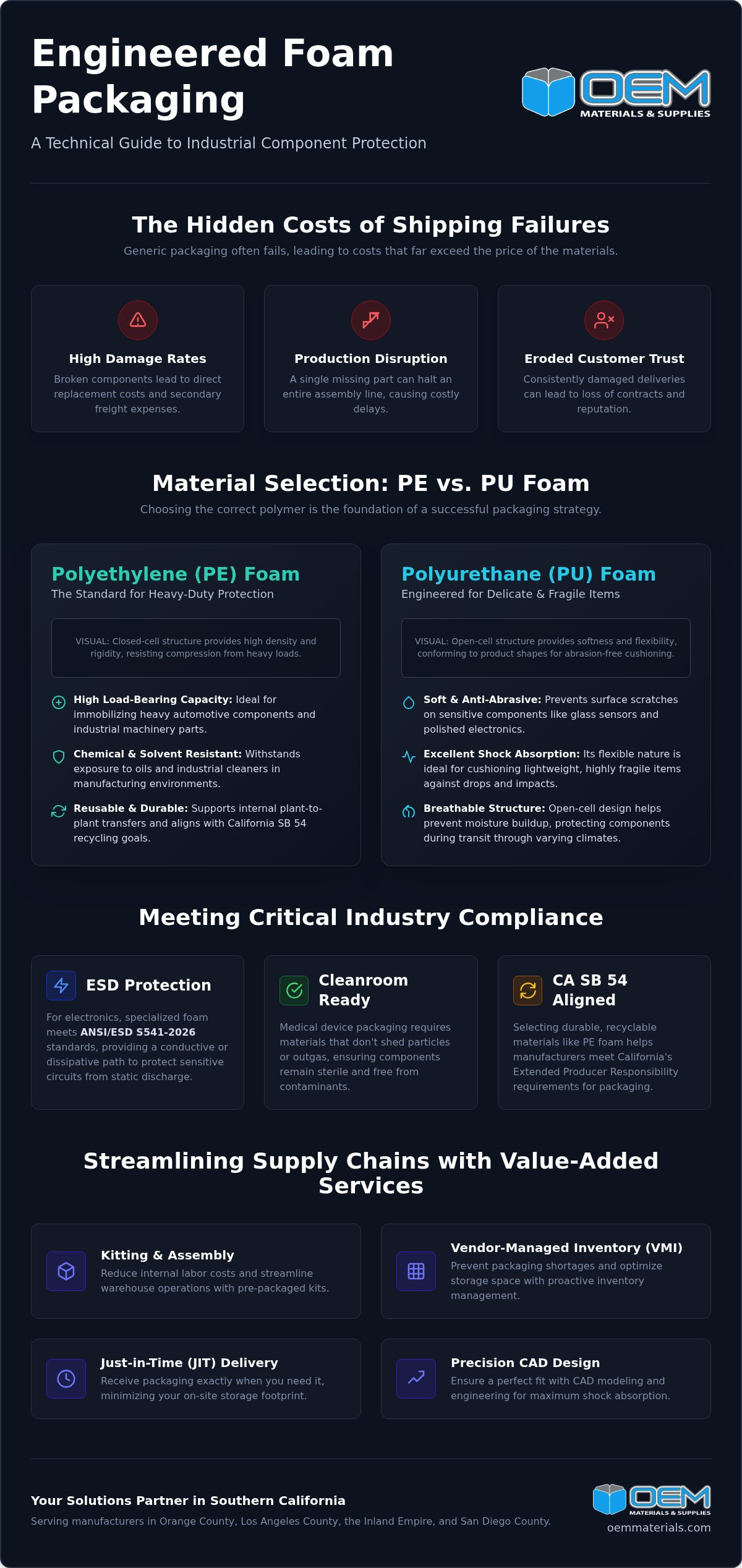
A single damaged component during transit does more than just break a product; it disrupts production schedules and erodes customer trust. For manufacturers in Orange County and Los Angeles, the hidden costs of shipping failures often far exceed the price of the packaging itself. You likely recognize that generic cushioning is rarely sufficient for complex industrial kitting. Relying on basic foam inserts instead of engineered solutions frequently leads to high damage rates and inefficient warehouse processes that drain your operational budget.
Precision-engineered packaging is a necessity for maintaining supply chain stability. This article explains how custom foam inserts provide critical protection for high-value industrial components through precise material selection and custom design. We will examine technical specifications like ANSI/ESD S541-2026 standards for electronics, the impact of California’s SB 54 regulations on material selection, and how a localized Southern California partner helps you achieve zero-damage shipping cycles.
Key Takeaways
- Understand the technical differences between closed-cell polyethylene and open-cell polyurethane to select the optimal cushioning for your product weight and fragility.
- Learn how precise CAD modeling and engineering ensure that custom foam inserts provide maximum shock absorption and vibration dampening for high-value industrial components.
- Identify critical industry standards, such as ESD protection for electronics and sterile kitting for medical devices, to ensure full regulatory compliance during transit.
- Discover how localized kitting and assembly services in Southern California can reduce internal labor costs and streamline your warehouse operations.
- Explore how vendor-managed inventory strategies prevent packaging shortages and optimize storage space for manufacturers in Los Angeles and Orange County.
Understanding Engineered Foam Inserts in Industrial Packaging
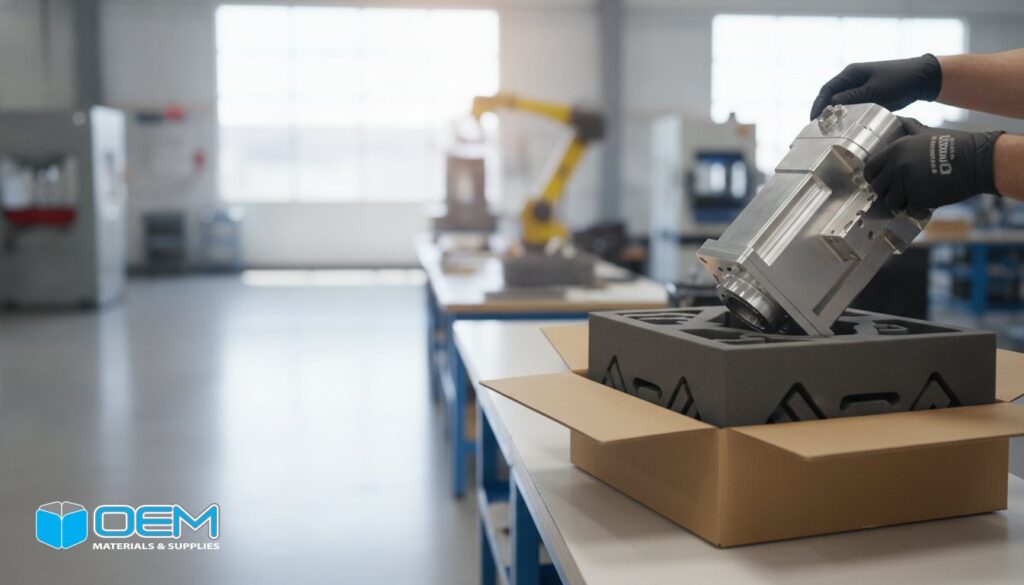
Engineered foam inserts are far more than simple padding. They are custom-shaped materials designed to immobilize and protect sensitive items within a shipping container. Their primary function involves shock absorption, vibration dampening, and abrasion resistance. Unlike generic solutions, these components are engineered to the specific geometry of the product. Engineered foam acts as a critical component for reducing the Total Cost of Ownership in logistics by preventing product replacement and secondary freight costs. Utilizing high-quality foam packaging ensures that industrial components survive the rigors of the Southern California supply chain.
The Role of Precision in Protective Packaging
Generic materials like bubble wrap or packing peanuts often fail when protecting high-value electronics. These materials shift during transit, creating gaps that allow the product to collide with the outer box. Effective Package cushioning materials rely on a precise relationship between product weight, fragility, and foam thickness. If the foam is too soft, it bottoms out; if it’s too firm, the shock is transmitted directly to the component. Precision-cut foam inserts eliminate internal movement during turbulent transit, ensuring the item remains suspended in its protective “sweet spot.” This level of accuracy is essential for manufacturers in Orange County and Los Angeles who deal with high-precision instruments.
Beyond Cushioning: Anti-Static and Cleanroom Requirements
For semiconductor and electronics manufacturing, physical impact isn’t the only threat. Electrostatic discharge (ESD) can destroy sensitive circuits without any visible damage. Specialized foam inserts are treated to meet ANSI/ESD S541-2026 standards, providing a conductive or dissipative path for static. Similarly, medical device packaging requires materials that don’t shed particles or outgas. Cleanroom-compatible materials are manufactured to ensure they don’t introduce contaminants into sterile environments. These technical specifications are vital for meeting industry-specific compliance and protecting your bottom line. We focus on providing these high-performance materials to sectors where precision is non-negotiable.
Material Selection: Comparing Polyethylene and Polyurethane Foam
Selecting the correct polymer is the foundation of any successful packaging strategy. It isn’t just about softness; it’s about how the material reacts to repeated impacts and environmental stressors. Material selection dictates the protective performance and cost-efficiency of foam inserts. Engineers must weigh the product weight against the expected number of drops and the total shipping distance. Choosing the wrong material can lead to “bottoming out,” where the foam compresses completely and allows the shock to transfer directly to the component. We help you evaluate these variables to ensure your packaging remains functional throughout the entire product life cycle.
Polyethylene Foam for Heavy Duty Protection
Polyethylene (PE) foam is a closed-cell material defined by its high density and structural integrity. It possesses a superior load-bearing capacity, making it the standard for automotive components and heavy industrial machinery parts. Because PE resists chemicals and solvents, it’s ideal for manufacturing environments where oils or industrial cleaners might be present. This material is also highly reusable, which supports internal plant-to-plant transfers and reduces long-term waste. With California SB 54 regulations now in effect as of May 1, 2026, selecting durable, recyclable PE grades helps producers align with new Extended Producer Responsibility requirements. For high-volume production, PE provides a stable and predictable protection level that withstands the rigors of the Southern California logistics network.
Polyurethane Foam for Delicate Electronics
Polyurethane (PU) foam is an open-cell material ideal for lightweight, highly fragile items. Its softness and flexibility prevent surface abrasions on sensitive components like glass sensors or polished electronics. According to the current ASTM D3575 standards for flexible open-cell foams, this material is crucial for evaluating density and resilience in cushioning applications. The breathable structure of PU foam is particularly useful in preventing moisture buildup during transit through varying climates. While PU foam doesn’t offer the same load-bearing strength as PE, its cost-effectiveness makes it a preferred choice for short-run or one-way shipping programs where the packaging won’t be returned. Testing these materials against ASTM D3574 standards ensures they meet the specific tensile strength and compression requirements for your application.
For the most rigorous applications, cross-linked polyethylene (XLPE) serves as the premium choice for medical and aerospace sectors. Its fine cell structure and superior thermal properties provide a clean, non-abrasive surface that meets the highest industry standards. If you’re uncertain which density or polymer type fits your specific requirements, you can request a technical consultation to review your product dimensions and annual usage data. Selecting the right foam inserts early in the design phase prevents costly redesigns and shipping damage later in the production cycle.
Engineering Custom Foam Solutions for Fragile Components
Effective protection starts with data. The design process for foam inserts begins with the collection of accurate product dimensions and weight data. We don’t guess at clearances; we use precise measurements to ensure the component remains immobilized. Utilizing advanced CAD software, we create 3D models of the insert to visualize how it interacts with the product and the outer shipping container. This digital foundation is essential for custom packaging design, allowing us to identify potential failure points before any material is cut. By integrating your product’s CAD files, we ensure that every contour is accounted for, providing a level of precision that generic packaging simply cannot match.
Manufacturing Methods: Die-Cutting vs. CNC Routing
Once the design is finalized, we select the manufacturing method that aligns with your production volume and complexity. Die-cutting is the standard for high-volume, cost-effective production runs. It uses a custom steel rule die to stamp out thousands of identical pieces with high repeatability. For complex geometries or rapid prototyping, CNC routing is often the superior choice. It allows us to create intricate shapes without the lead times or costs associated with custom tooling. In cases involving thick foam sections or specialized industrial materials, water-jet cutting provides a clean finish without the heat distortion sometimes found in other methods. This flexibility in manufacturing ensures we can scale from a single prototype to thousands of units without compromising on accuracy.
Prototyping and Testing Protocols
Prototyping is a non-negotiable step for high-value industrial procurement. We produce a first-article sample for inspection to verify fit and finish before committing to a full production run. This phase allows us to simulate real-world shipping stresses common in Southern California logistics corridors, where packages face frequent handling, stacking, and vibration. If the initial prototype reveals that the foam is too rigid or too soft, we adjust the foam density based on that performance. This iterative process ensures that high-volume production only begins after the design is proven to protect your specific component under actual shipping conditions. Accurate foam inserts reduce the risk of returns and rework, directly protecting your operational margins.
Sector-Specific Applications for Protective Foam
Protecting industrial components requires a deep understanding of the specific operational environment. In the automotive sector, foam inserts act as durable dunnage for transporting heavy engine components between facilities. These inserts must withstand repeated use and exposure to industrial fluids while maintaining their structural integrity. For electronics, protection goes beyond physical impact; it involves using ESD-safe materials to safeguard circuit boards and sensitive diagnostic equipment from static discharge. Each application demands a unique approach to density and material geometry to ensure the safety of the payload throughout the Southern California logistics network.
Aerospace and Defense Logistics
Aerospace and defense logistics prioritize precision and accountability. We design foam inserts specifically for Tool Control and Foreign Object Debris (FOD) prevention. Shadow boards and custom kitting improve assembly line efficiency by providing a dedicated, visible space for every tool. This organization allows technicians to identify missing items instantly, preventing them from being left inside an aircraft or engine. Additionally, these inserts comply with rigorous military and defense packaging specifications, utilizing high-durability foam for the long-term storage of critical spare parts. These solutions are essential for contractors in the Los Angeles and Orange County aerospace hubs.
Medical and Life Science Packaging
Medical and life science packaging must balance organization with strict cleanliness standards. Sterile packaging kits organize multi-component sets for surgical use or laboratory testing, ensuring that every piece is accessible and protected. We utilize non-toxic, non-abrasive materials that are compatible with sterile environments. These custom inserts often integrate seamlessly with corrugated boxes to create a comprehensive, ready-to-ship solution. This level of integration reduces packing time and ensures that fragile medical instruments arrive in perfect working order. By standardizing these kits, manufacturers can lower labor costs and improve the speed of delivery to hospitals and clinics.
If your industry requires specialized compliance or complex kitting, contact our engineering team for a technical review of your project requirements.
Streamlining Supply Chains with Custom Foam Sourcing
Procuring foam inserts is often treated as a commodity purchase, yet the logistics of how those materials enter your facility significantly impact your bottom line. Efficient supply chain management requires moving beyond unit price to evaluate Total Cost of Ownership. By integrating value-added services like kitting and assembly, manufacturers can drastically reduce the labor hours spent on the warehouse floor. Managing multiple vendors for boxes, foam, and tape creates administrative friction and increases the risk of stockouts. Consolidating your protective packaging with a single Southern California partner ensures that all components arrive ready for immediate use, allowing your team to focus on production rather than packaging preparation.
Kitting and Assembly Efficiency
Pre-assembled packaging kits offer a functional remedy for inefficient packing lines. When foam inserts are pre-inserted into their corrugated containers, the time required to pack a finished product is cut by a measurable margin. This approach eliminates the need for warehouse staff to source and fit individual cushioning components during the final assembly stage. Sourcing both your boxes and foam from one partner also simplifies your procurement cycle and ensures a perfect fit every time. For a broader perspective on selecting a production partner, see our guide for corrugated packaging box manufacturers. Utilizing Just-In-Time (JIT) delivery models further improves speed by providing the exact amount of packaging needed for a specific production run, reducing the amount of capital tied up in inventory.
Local Southern California Support
Sourcing from a local supplier in Orange County or San Diego provides a logistical advantage that national vendors cannot match. Proximity allows for onsite consultations in Los Angeles, Riverside, and the Inland Empire, where our engineers can observe your packing process firsthand to identify hidden inefficiencies. This local presence enables rapid response times for design changes or urgent production increases. When a manufacturing hub faces a sudden spike in demand, a regional partner can deliver industrial-grade supplies without the delays of cross-country freight. Additionally, Vendor-Managed Inventory (VMI) programs allow Southern California manufacturers to lower overhead by shifting the burden of stock monitoring and storage to the supplier. This ensures you never face a line down situation due to a lack of packaging materials.
Optimizing Your Industrial Shipping Cycle
Precision engineered packaging is the most effective defense against the operational costs of damaged goods and inefficient kitting. By selecting the correct polymer density and utilizing CAD driven prototypes, you ensure that high-value components remain secure from the assembly line to the end user. Transitioning to a localized supply chain model in Southern California further reduces lead times and simplifies inventory management through integrated kitting and Vendor Managed Inventory (VMI) programs. These foam inserts are not just cushioning; they are essential tools for maintaining the stability and profitability of your distribution network.
OEM Materials & Supplies serves manufacturers throughout Orange County, Los Angeles, San Diego, and Riverside with expert design and engineering support. Whether you require ESD safe protection for electronics or heavy duty dunnage for automotive parts, we provide the technical expertise needed to stabilize your logistics. We handle everything from initial prototypes to high volume production runs with a focus on accuracy and speed.
Contact us today for a custom foam insert quote. To help us provide an accurate recommendation, please include your product dimensions, weight, and annual usage in your request. We look forward to helping you protect your products and streamline your operations.
Frequently Asked Questions
What is the difference between open-cell and closed-cell foam inserts?
Open-cell foam, like polyurethane, features interconnected air pockets that make it soft and highly flexible. It’s ideal for lightweight, fragile items requiring gentle cushioning. Closed-cell foam, such as polyethylene, has sealed cells that provide high structural strength and moisture resistance. This makes it the standard for heavy-duty industrial components. Selecting between them depends on the product weight and the sensitivity of the surfaces being protected during transit through the Los Angeles logistics network.
How do I determine the correct foam density for my industrial product?
Correct density is determined by calculating the static load, which is the product weight divided by the surface area in contact with the foam. Engineers also consider the product’s fragility rating, or G-factor. If the density is too low, the item may bottom out during a drop; if it’s too high, the foam won’t compress enough to absorb the shock. We use these technical variables to engineer foam inserts that provide optimal deceleration during impact.
Can custom foam inserts be made to fit existing corrugated boxes?
Yes, we design custom inserts to integrate perfectly with your existing corrugated boxes. This approach is common for manufacturers who want to upgrade their internal protection without changing their entire outer packaging inventory. Our engineering team takes the internal dimensions of your current container and creates a 3D CAD model of the insert to ensure a snug, secure fit. This prevents internal movement and improves the overall structural integrity of the shipping unit for local delivery.
What information is needed to get a quote for custom foam packaging?
To provide an accurate recommendation and quote, we require specific data including the product dimensions, total weight, and estimated annual usage. Information regarding the product’s fragility and the typical shipping environment is also helpful. For manufacturers in San Diego or Orange County, knowing the final destination and handling requirements allows us to select the most cost-effective material. Providing a CAD file or a physical sample of the component ensures the highest level of precision.
Is there a minimum order quantity for custom die-cut foam inserts?
OEM Materials & Supplies handles a wide range of production scales, from initial prototypes to high-volume manufacturing programs. While minimum order quantities can vary based on the specific material and manufacturing method, such as die-cutting or CNC routing, we focus on serving industrial B2B requirements. We work with purchasing managers to find the right balance between order volume and unit cost. This flexibility supports both specialized medical device kits and large-scale automotive production cycles.
What are the benefits of using anti-static foam for electronics?
Anti-static foam prevents the buildup of triboelectric charges that can cause electrostatic discharge (ESD) damage to sensitive circuits. These materials are treated to meet ANSI/ESD S541-2026 standards, providing a controlled path for static to dissipate safely. This is a critical requirement for semiconductor and medical diagnostic equipment manufacturers. Using ESD-safe foam inserts ensures that your electronics arrive functional, preventing the hidden failures that often occur when static damage happens during the shipping process.
How does foam kitting reduce labor costs in manufacturing?
Foam kitting reduces labor costs by delivering pre-assembled packaging components directly to your production line. Instead of warehouse staff spending time sourcing boxes and fitting loose cushioning, they receive a complete kit ready for immediate use. This streamlines the packing process and significantly decreases the time spent per unit. For manufacturers in Riverside or Los Angeles, utilizing our kitting and assembly services allows them to reallocate labor to higher-value production tasks while maintaining speed.
What types of foam are best for heavy automotive or aerospace parts?
High-density polyethylene (PE) foam is the most effective material for heavy automotive and aerospace parts. Its closed-cell structure provides the necessary load-bearing capacity to support significant weight without collapsing. For aerospace applications requiring Tool Control or Foreign Object Debris (FOD) prevention, cross-linked polyethylene (XLPE) is often preferred due to its durability and fine cell structure. These materials resist industrial chemicals and oils, making them suitable for long-term storage or repeated plant-to-plant transfers within Southern California.