
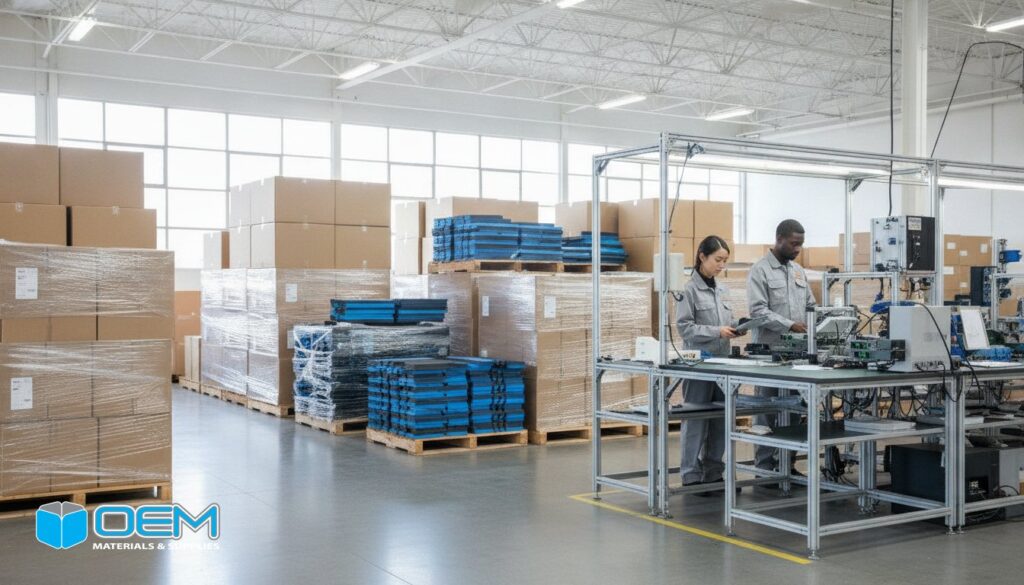
How much does a single hour of downtime cost your facility when a production line stops because of a missing corrugated box or a custom foam insert? For many manufacturers across Southern California, the answer is measured in thousands of dollars and damaged customer relationships. You likely recognize the frustration of seeing capital tied up in slow-moving stock while simultaneously risking a shutdown due to manual counting errors. Understanding what is vendor managed inventory is the first step toward offloading these logistical burdens to a trusted partner.
We agree that your team’s time is better spent on production and engineering rather than tracking packaging levels. This guide shows how a VMI program eliminates stockouts, reduces carrying costs, and optimizes supply chain efficiency for your industrial operations. We will examine the mechanics of seamless replenishment, the reduction of your warehouse footprint, and how to achieve a lower total cost of ownership for your packaging materials. Moving the responsibility of inventory accuracy to the supplier allows your operation to remain lean and responsive. By integrating these systems, you can replace manual ordering with a data-driven process that ensures availability without the burden of excessive overhead.
Key Takeaways
- Understand what is vendor managed inventory and how this strategy transfers the responsibility of stock monitoring from your internal team to a specialized partner.
- Learn how to establish precise minimum and maximum inventory thresholds based on a technical audit of your usage rates and storage capacity.
- Identify methods to lower the total cost of ownership by reducing administrative labor and avoiding expensive production line shutdowns caused by missing materials.
- Recognize the importance of data transparency and formal agreements in building a reliable, high-performing supply chain partnership built on trust.
- Discover how manufacturers in Southern California use VMI to streamline the procurement of essential supplies like corrugated boxes, stretch film, and protective cushioning.
Defining Vendor Managed Inventory for Industrial Operations
In the industrial sector, efficiency isn’t just a goal; it’s a requirement for survival. When manufacturers ask what is vendor managed inventory, they’re looking at a strategic shift in how materials enter their facility. In this model, the vendor takes full responsibility for maintaining inventory levels based on agreed-upon parameters. Instead of your team manually checking pallet counts of corrugated boxes or stretch film, the supplier monitors stock levels at your site and triggers replenishment automatically. This approach effectively transitions your operation from a reactive order-and-wait model to a proactive partnership. It eliminates the friction of traditional procurement by placing the burden of stock accuracy on the entity that provides the materials.
Vendor managed inventory is a collaborative strategy that optimizes product availability through shared data and shared responsibility between the manufacturer and the supplier.
VMI vs. Traditional Procurement Models
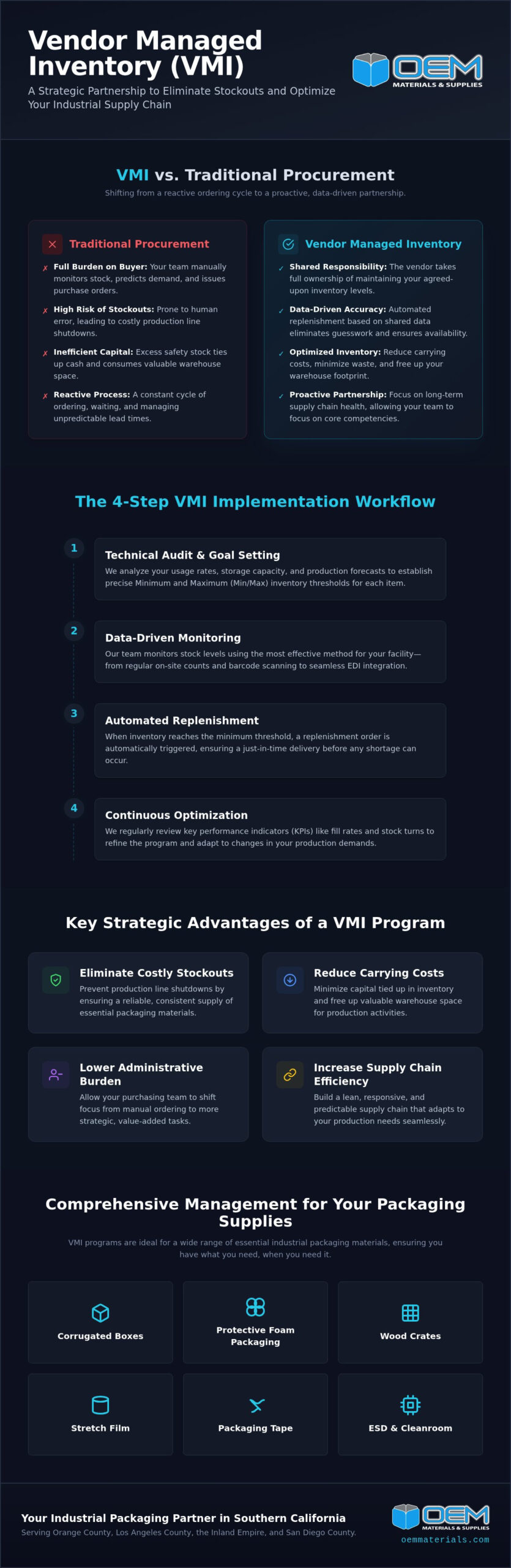
Traditional procurement models place the entire burden on the buyer. Purchasing managers must monitor stock, predict demand, and issue purchase orders with enough lead time to avoid a shortage. This manual process is prone to human error and often leads to excessive safety stock or, worse, production shutdowns. In contrast, VMI services reduce the administrative burden on purchasing departments by automating the replenishment cycle. By removing the need for individual purchase orders for every shipment, lead time management becomes more predictable. The supplier, having visibility into your usage rates, can adjust deliveries before a shortage occurs, allowing for a leaner warehouse footprint.
The Role of the Supplier as an Inventory Partner
Under a VMI agreement, the supplier acts as a technical consultant rather than a simple order taker. This relationship relies on high levels of transparency regarding production schedules and inventory turnover. According to the foundational definition of Vendor-Managed Inventory, the supplier makes the main inventory decisions for the buyer based on real-time data. This allows the manufacturer to focus on core competencies like engineering and assembly while the expert supplier manages the logistical details. The focus shifts from individual transactions to long-term supply chain health. This stability is critical for sectors like aerospace and medical device manufacturing where material consistency and availability are non-negotiable. It transforms the supplier into a dependable extension of your own operations team.
The Practical Workflow of a VMI Program
Implementing a successful program requires more than just a software link; it requires a deep understanding of your facility’s physical requirements. Effective execution begins with a technical audit where we examine your current usage rates and storage capacity for items like corrugated boxes and foam packaging. This baseline data allows us to establish clear minimum and maximum stock thresholds, often called Min/Max levels. By defining these boundaries, the system ensures you never run out of critical supplies while preventing warehouse clutter. Many companies investigating what is vendor managed inventory find that the benefits of VMI extend far beyond simple restocking. It is about creating a predictable, data-driven cycle that mirrors your actual production pace.
Establishing Inventory Thresholds and Goals
Determining safety stock levels is essential to prevent production line stoppages. We align these goals with your annual usage forecasts to account for peaks and valleys in demand. Key performance indicators such as fill rates and stock turns provide an objective measure of the program’s success. This structured approach ensures your inventory levels remain optimized for your specific manufacturing volume, whether you are producing medical devices or automotive components. If you are ready to modernize your supply chain, you can request a quote for a customized inventory assessment.
Data Integration and Communication Methods
Communication is the backbone of any VMI partnership. While some programs rely on Electronic Data Interchange (EDI) for seamless digital communication, others benefit from physical on-site bin management. Our team performs regular on-site counts and uses barcode scanning for precise physical tracking. This hybrid approach ensures that the digital data matches the physical reality on your warehouse floor, a step often overlooked by software-only providers. Regular reporting and review meetings allow us to adjust thresholds for seasonal demand or new product launches, keeping your VMI services aligned with your evolving needs.
The Logistics of Automatic Replenishment
Once consumption data is verified, automated replenishment triggers the delivery process. This often involves Just-In-Time delivery schedules designed to minimize warehouse footprint. Supplier-managed shipping means our team handles the offloading and placement of materials at your facility. Integrating these logistics with JIT packaging services ensures that materials like stretch film and crates arrive exactly when needed. This eliminates the need for long-term storage of bulky packaging items, freeing up valuable square footage for your primary manufacturing operations.
Strategic Advantages for Manufacturing and Distribution
The financial impact of a supply chain disruption often outweighs the cost of the materials themselves. When operations leaders evaluate what is vendor managed inventory, they find its primary value lies in risk mitigation and financial optimization. By shifting the responsibility of stock maintenance to the supplier, you eliminate the risk of stockouts that cause expensive production delays. This reliability is particularly critical for high-volume items like corrugated boxes and custom foam packaging, where a single missing component can halt an entire assembly line. Moving toward a VMI model allows you to optimize warehouse space for more profitable manufacturing activities rather than using square footage for long-term material storage.
Reducing Total Cost of Ownership
VMI lowers the total cost of ownership by decreasing the administrative overhead of your purchasing department. Instead of processing dozens of small purchase orders, your team manages a single, streamlined replenishment program. This consolidation lowers transportation and receiving costs, as shipments are grouped based on actual consumption rather than speculative ordering. Better inventory rotation also reduces material waste, ensuring that items like stretch film or adhesive tapes don’t exceed their shelf life while sitting in your warehouse. These efficiencies contribute to a healthier bottom line by improving cash flow and reducing the amount of capital tied up in excess safety stock.
Operational Efficiency and Labor Savings
Labor is one of the most significant expenses in any Southern California manufacturing facility. Implementing a VMI program frees up your warehouse personnel from the tedious task of performing manual inventory counts and reconciliation. Instead, these employees can be redirected to higher-value tasks such as kitting, assembly, or quality control. The receiving process is also simplified; shipments arrive pre-labeled and organized according to your facility’s specific layout. This level of organization reduces the time spent offloading trucks and moving materials to the production floor, creating a more disciplined and efficient work environment.
Enhanced Supply Chain Visibility
Predictable supply leads to more accurate production planning and scheduling. When your supplier has visibility into your usage trends, they can act as a technical partner rather than just a vendor. For example, if we notice a spike in consumption for certain cushioning materials, we can suggest cost-saving material changes or design adjustments before costs spiral. This proactive approach builds a stronger resilience against market-wide material shortages. A well-managed VMI program ensures that your facility in Orange County or the Inland Empire remains operational even when global supply chains face volatility.
Establishing a Successful VMI Partnership
A successful partnership relies on a high degree of trust and transparent data exchange between the manufacturer and the supplier. When defining roles and responsibilities, a formal VMI agreement must outline exactly who owns the inventory at each stage of the process. The ‘Min/Max’ system serves as the core engine of VMI success, providing the mathematical boundaries that trigger replenishment before a stockout occurs. Understanding what is vendor managed inventory in a practical sense means recognizing it as a shared commitment to operational excellence rather than a simple purchase agreement. This relationship requires a partner that views your production goals as their own.
Criteria for Selecting a VMI Provider
Evaluating a potential partner requires a thorough look at their physical infrastructure. You should assess the supplier’s warehouse capacity and the reliability of their delivery fleet to ensure they can handle your peak production volumes. A provider should offer more than just storage; they must possess the technical expertise to offer custom packaging design that optimizes your material usage. Checking industry-specific references is essential to verify their accuracy in replenishment and their ability to solve complex logistical problems in sectors like aerospace or medical device manufacturing.
The Role of Proximity in VMI Performance
Proximity is a critical factor in how well a program functions. Local suppliers in Southern California often provide better service than national resellers because they understand the regional logistics landscape of Orange County, Los Angeles County, and the Inland Empire. Faster response times are possible when the supplier is only a short drive away, which is vital during unexpected spikes in production. Additionally, local deliveries result in a lower carbon footprint and reduced transportation costs. This geographic advantage ensures that your what is vendor managed inventory strategy remains responsive to real-time changes on your factory floor.
Maintaining Accountability and Performance Reviews
Accountability is maintained through scheduled audits and data verification. These checks ensure that the physical stock on your shelves matches the numbers in the system, preventing discrepancies that could lead to shortages. Quarterly business reviews provide a structured opportunity to evaluate program effectiveness and adjust stock levels as your product lines evolve. This flexibility allows the VMI program to grow with your business, ensuring that your packaging supply chain remains lean and efficient. To see how a tailored program can support your specific facility, you can request a quote for a comprehensive inventory consultation.
Integrated Packaging VMI Solutions in Southern California
OEM Materials & Supplies provides specialized VMI programs designed specifically for the rigorous demands of industrial manufacturers. For organizations seeking a wholesale industrial packaging supplier, the decision often centers on the ability to manage complex inventories without fail. Our comprehensive management includes high-volume essentials such as corrugated boxes, stretch film, and protective cushioning. By positioning ourselves as a dedicated partner, we help regional manufacturers answer what is vendor managed inventory through tangible results: zero stockouts and optimized floor space. We serve the primary industrial hubs of Southern California, focusing on sectors like aerospace and medical devices where precision and material availability are critical to the production cycle.
Customized Programs for SoCal Manufacturing Hubs
We provide tailored inventory solutions that address the logistical nuances of specific regions. For distribution centers in Riverside and the Inland Empire, we focus on high-turnover replenishment that keeps pace with rapid shipping schedules. Our team provides on-site support for aerospace facilities in Los Angeles County, ensuring that specialized components are always protected and ready for assembly. In San Diego, we facilitate just-in-time delivery for medical device manufacturers who operate within strict cleanroom environments and tight production windows. This regional expertise allows us to provide a level of responsiveness that national resellers cannot match, keeping your facility in Orange County or San Diego County running at peak efficiency.
Beyond Inventory: Value-Added Packaging Services
Effective management goes beyond simply restocking shelves. We integrate VMI with value-added services like kitting and assembly to further reduce your internal labor costs. This approach allows your team to receive pre-assembled sets of packaging materials, ready for immediate use on the line. Our managed inventory framework also includes durable solutions like custom crates and pallets, ensuring your shipping platform is as reliable as the product it carries. Through continuous packaging design optimization, we identify ways to reduce material waste and improve protection levels. This holistic view of the supply chain ensures your operation remains lean, efficient, and focused on its core manufacturing objectives.
Streamlining Your Industrial Supply Chain
Transitioning to a managed inventory model allows your facility to shift from reactive ordering to a proactive, data-driven partnership. By now, the answer to what is vendor managed inventory is clear: it’s a strategic transfer of logistical responsibility that protects your production lines from costly stockouts. Implementing this system reduces administrative labor and frees up valuable warehouse square footage for core manufacturing activities.
OEM Materials & Supplies specializes in serving the aerospace and medical industries throughout Southern California, including Los Angeles, Orange County, and San Diego. Our team provides the technical expertise and custom design prototypes necessary to optimize your packaging workflow. We handle the complexities of inventory thresholds so you can focus on engineering and assembly. Contact our team today to Request a VMI Consultation and Packaging Audit. To facilitate an accurate assessment, please provide your product dimensions, weight, and annual usage data. We look forward to building a more resilient and efficient supply chain with you.
Frequently Asked Questions
How does vendor managed inventory reduce labor costs?
VMI reduces labor costs by removing the need for internal staff to perform manual inventory counts and process individual purchase orders. Instead of warehouse personnel spending hours tracking corrugated boxes or stretch film, the supplier handles monitoring and replenishment. This allows your team to focus on higher-value tasks like kitting and assembly. By automating these logistical steps, you decrease the administrative overhead associated with traditional procurement cycles.
What types of products are best suited for a VMI program?
High-volume items with predictable consumption rates are the best candidates for a VMI program. This includes industrial packaging essentials like corrugated boxes, stretch film, custom foam inserts, and cushioning materials. When manufacturers ask what is vendor managed inventory for their specific facility, they usually find that items with frequent turnover provide the greatest return on investment. Standardizing these components ensures that replenishment triggers are accurate and consistent.
Is VMI only for large corporations or can small manufacturers benefit?
Any manufacturer with consistent production volumes can benefit from a VMI program, regardless of the company’s size. Small to mid-sized manufacturers often see a significant impact because they have fewer personnel to manage complex supply chains. By offloading inventory management to a partner, smaller firms can operate with a leaner administrative team. This allows them to compete more effectively by focusing resources on engineering and production rather than logistics.
How often does the supplier check inventory levels on-site?
The frequency of on-site inventory checks is determined by your specific production volume and the volatility of your demand. For many industrial facilities in Orange County and Los Angeles, we perform these checks on a weekly or bi-weekly basis. This regular cadence ensures that the physical stock levels match the system data. Maintaining a consistent schedule is essential for preventing discrepancies and ensuring that replenishment orders are triggered before levels reach the minimum threshold.
What happens if there is a sudden spike in product demand?
A well-designed VMI program uses safety stock and localized logistics to handle unexpected spikes in demand. The established ‘Min/Max’ levels are calculated with a buffer to absorb short-term increases in consumption. Because OEM Materials & Supplies is a local partner in Southern California, we can provide rapid replenishment from our regional warehouses. This proximity allows us to respond to production surges in the Inland Empire or San Diego much faster than national distributors.
Does the manufacturer still maintain ownership of the inventory in VMI?
Inventory ownership depends on the specific terms of the VMI agreement. In many industrial packaging programs, the supplier maintains ownership of the stock until it’s delivered to your facility or scanned for use on the production line. This arrangement can improve your company’s cash flow by reducing the amount of capital tied up in sitting inventory. We work with each manufacturer to define clear ownership transfer points that align with their accounting requirements.
How do I know if my company is ready for a VMI partnership?
Your company is ready for a VMI partnership if you experience frequent stockouts, high administrative costs, or inefficient warehouse space usage. If your purchasing team spends a disproportionate amount of time on repetitive orders for corrugated boxes or stretch film, it’s time to automate. A history of consistent usage data is also a strong indicator of readiness. We recommend a comprehensive packaging audit to evaluate if your current volumes justify an integrated management program.
Can VMI help reduce warehouse space requirements?
VMI significantly reduces warehouse space requirements by optimizing stock levels and facilitating Just-In-Time delivery. Instead of storing months of safety stock, you only keep what’s necessary for immediate production needs. This approach is especially valuable for bulky items like wooden crates or pallets that consume significant floor space. Freeing up this square footage allows manufacturers in high-cost areas like Southern California to expand their production capacity without increasing their building footprint.