
Your production floor shouldn’t double as a sorting facility. When highly skilled technicians spend their time hunting for individual components or correcting picking errors, your per-unit labor costs skyrocket. Manufacturing leaders across Southern California, from aerospace hubs in Los Angeles to medical device firms in Orange County, often struggle with warehouse clutter and assembly line bottlenecks caused by disorganized inventory. It’s a logistical drain that slows down production cycles and impacts the bottom line.
Understanding how kitting services improve efficiency is the first step toward reclaiming your floor space and stabilizing your supply chain. By consolidating multiple SKUs into a single, production-ready kit, you eliminate the friction of manual assembly and reduce the footprint of your raw materials. This article explains how industrial kitting streamlines production lines, lowers labor overhead, and optimizes logistics through strategic SKU consolidation and custom packaging solutions. We’ll examine how transitioning non-core assembly tasks to a packaging partner creates a faster, more accurate manufacturing process that supports high-volume production requirements.
Key Takeaways
- Learn how kitting services improve efficiency by shifting non-core assembly tasks from your production line to an experienced packaging partner.
- Identify ways to reduce high-cost labor hours and eliminate assembly line bottlenecks by delivering ready-to-use component units directly to the floor.
- Discover how SKU consolidation reduces warehouse clutter and simplifies inventory tracking through the use of custom corrugated boxes and foam inserts.
- Understand the impact of standardized pre-assembled kits on reducing picking errors and maintaining high quality control standards in complex manufacturing environments.
- Explore the logistical benefits of partnering with a Southern California provider for custom packaging design and high-volume kitting assembly.
Defining Kitting Services in an Industrial Manufacturing Context
Industrial kitting is the process of grouping individual components into a single, ready-to-use unit. While retail kitting often focuses on bundling consumer goods for e-commerce, industrial kitting manages the complex logistics of manufacturing parts and sub-assemblies. This process begins with receiving a variety of individual components and ends with a single consolidated SKU delivered directly to the assembly line. Effective material handling is essential to this transition; it ensures that parts are organized, protected, and staged for immediate use without unnecessary movement or delay.
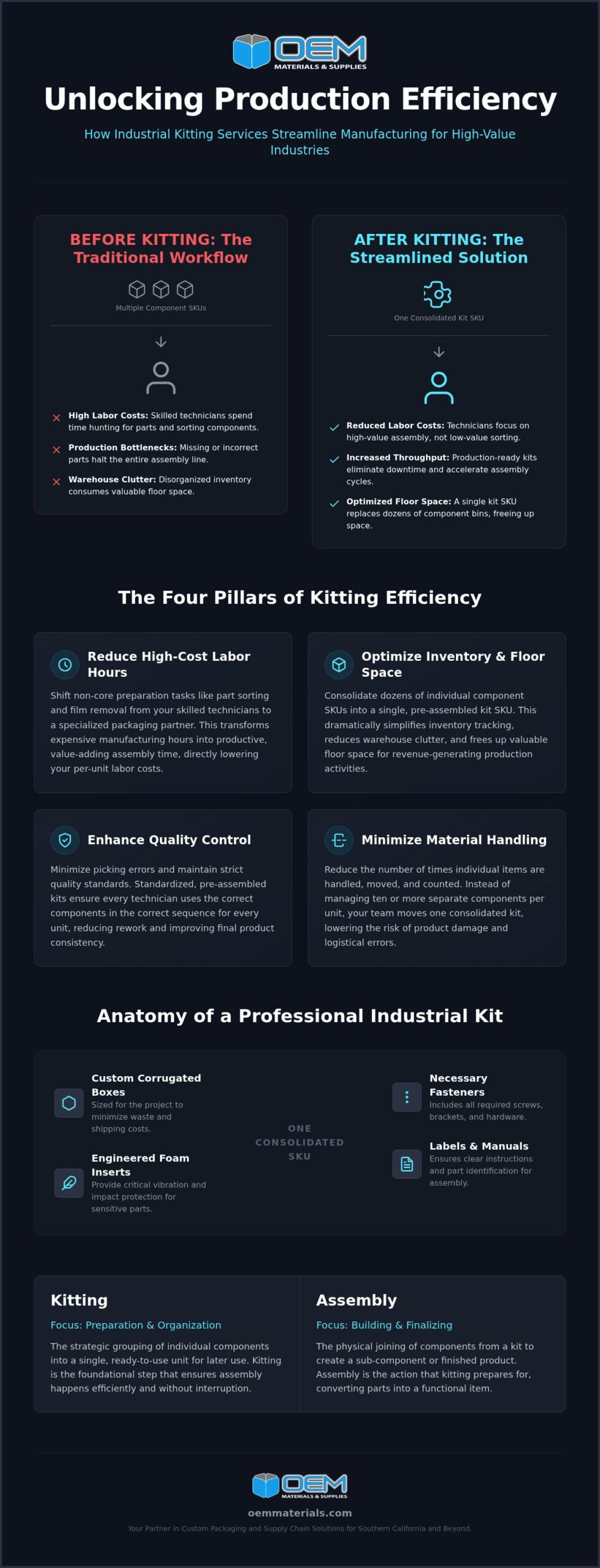
Moving from a pick-to-order model to a pre-assembled kit model significantly reduces production friction. In a traditional pick-to-order system, technicians spend valuable time searching for small parts, fasteners, or protective packaging. By implementing a kitting strategy, you move these non-core tasks off the manufacturing floor. This shift is a primary driver in how kitting services improve efficiency by allowing your skilled labor to focus on technical manufacturing rather than logistical sorting. It transforms a variable, error-prone process into a predictable, standardized workflow.
The Difference Between Kitting and Assembly
It is easy to confuse kitting with assembly, but they serve distinct roles in the supply chain. Kitting focuses on the strategic grouping of parts for later use. It is about preparation and organization. Assembly involves the physical joining of those parts into a sub-component or a finished product. For example, a kit might include all the screws, brackets, and custom foam needed for a medical device housing, while assembly is the act of putting those pieces together. Both services work together to streamline the manufacturing workflow, but kitting is the foundational step that ensures assembly happens without interruption.
Common Components in an Industrial Packaging Kit
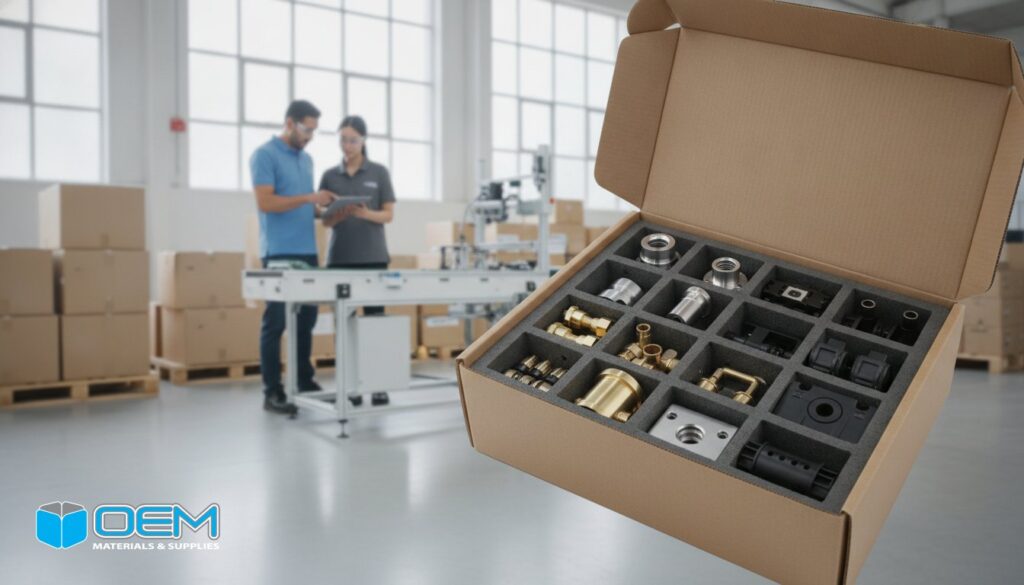
A robust kitting program relies on professional custom packaging design to ensure components remain secure and accessible throughout the journey. Industrial kits often include custom corrugated boxes sized specifically for the project to minimize wasted space and shipping costs. For sensitive aerospace or electronics components, engineered foam inserts provide critical vibration and impact protection. Beyond the main parts, these kits typically house necessary fasteners, labels, and instruction manuals under one SKU. This level of organization ensures that every technician has exactly what they need for a specific production run without leaving their station.
Reducing Labor Costs and Production Line Bottlenecks
Manufacturing labor is one of the most significant expenses in any production environment. In industrial hubs like Los Angeles County and the Inland Empire, the cost of skilled technicians continues to rise. When these high-value workers spend their shifts performing low-value tasks, such as hunting for fasteners or removing protective film from individual components, your per-unit labor costs increase. This inefficiency creates a bottleneck that limits your total output. By shifting these preparation tasks to a packaging partner, you convert expensive manufacturing hours into productive assembly time. This strategic labor shift is a fundamental example of how kitting services improve efficiency for high-volume manufacturers.
Eliminating the search for individual components directly reduces downtime on the line. In a traditional setup, a missing bolt or a damaged bracket can halt an entire production cell. Pre-assembled kits arrive ready for immediate integration, ensuring that every part needed for a specific sub-assembly is present and protected. This allows your team to scale production without the need for additional staff or expanded logistics teams. You gain the ability to handle demand spikes by relying on the external capacity of your kitting partner rather than increasing your internal head count.
Minimizing Material Handling Touches
Every touchpoint in a factory adds cost and increases the risk of product damage. Standard workflows often require parts to be received, moved to a warehouse, picked for an order, and finally transported to the assembly station. Kitting reduces the number of times individual items are handled. Instead of managing ten separate components, your team handles one consolidated SKU. This streamlined flow from receiving to the assembly station minimizes the opportunity for human error and physical damage, particularly for sensitive aerospace or medical device components.
Improving Throughput and Cycle Times
Focusing on Improving Assembly Efficiency requires a critical look at cycle times. When parts arrive in organized packaging, such as custom die-cut inserts or custom foam packaging, they’re staged in the exact order needed for assembly. This eliminates non-value-added tasks like unboxing multiple individual packages or sorting through mixed bins. Faster movement through production stages allows you to meet tight deadlines for high-volume programs with greater consistency. If you’re ready to evaluate your current assembly workflow, you can request a quote for a custom kitting program designed to optimize your specific line speed and production requirements.
Optimizing Inventory Management and Warehouse Floor Space
Floor space is a premium asset in Southern California manufacturing hubs. With industrial real estate asking rents in Los Angeles averaging $1.30 per square foot in 2026, every square inch of your facility must contribute directly to production. Storing hundreds of individual components in separate bins or on bulky racking is an inefficient use of high-cost space. Consolidating these items into a single, compact unit is a practical example of how kitting services improve efficiency by maximizing your available square footage. By moving the storage of raw components to an external partner, you free up floor space for additional assembly lines or revenue-generating activities.
Integrating these services with vendor-managed inventory (VMI) programs further optimizes your overhead. Instead of managing large quantities of safety stock for every individual fastener or bracket, your partner monitors usage and replenishes kits as needed. This reduces the capital tied up in inventory and lowers the administrative burden on your procurement team. You no longer need to coordinate multiple shipments from various vendors; instead, you receive a single, production-ready SKU precisely when it’s required.
SKU Consolidation and Accuracy
Managing one SKU instead of dozens reduces the likelihood of inventory discrepancies and simplifies the auditing process. For purchasing managers, this consolidation means fewer purchase orders to track and fewer vendor relationships to maintain. Order accuracy improves because the kitting process includes a standardized picking and verification stage before the kit ever reaches your facility. Ensuring that all necessary parts are present in a single kit eliminates the “part-shortage” delays that often occur when individual components are managed across disparate warehouse locations.
Synergy with Just-In-Time Delivery
Kitting is a natural extension of JIT packaging strategies. It allows manufacturers to reduce on-site storage requirements for bulky materials like corrugated boxes or large foam inserts. By coordinating kit delivery with your specific production schedules, you ensure that materials arrive just as they’re needed on the line. This lean approach is particularly effective in counties like Orange and San Diego, where warehouse vacancy rates remain tight. You gain the benefits of high-volume production without the burden of maintaining a massive warehouse footprint for component storage.
Enhancing Quality Control Through Pre-Assembled Component Kits
Quality control is not just a final inspection step; it must be integrated into every phase of the supply chain. Standardized kitting processes ensure that every kit contains the exact same components in the correct quantities. This consistency is a primary factor in how kitting services improve efficiency, as it virtually eliminates human error during the picking and packing stages at the factory. When parts are pre-verified by a packaging partner, your assembly team can trust that they have the right tools for the job without double-checking every bin or bag.
Implementing inspection protocols at the kitting stage allows for early defect detection. Instead of discovering a faulty component at the end of the assembly line, the discrepancy is caught during the initial kit build. This proactive approach protects your production schedule and reduces the costs associated with downstream rework. By the time a kit reaches your facility, it has already passed a layer of verification that your internal team no longer has to manage.
Protection for Sensitive Industrial Goods
Maintaining the integrity of aerospace and medical parts requires specialized handling and engineered protection. Custom foam inserts play a critical role here. They prevent damage during internal transport by securing components in place and providing a barrier against vibration. For engineers, selecting the right material is vital to prevent chemical reactions or static discharge. You can refer to our industrial guide to foam inserts for detailed material selection criteria. These kits are designed to meet rigorous industry cleanliness and safety standards, ensuring that sensitive electronics or surgical components arrive in pristine condition.
Standardization Across High-Volume Programs
Large-scale production runs demand absolute uniformity to maintain throughput. Uniform kit presentation reduces variability in the assembly process, allowing technicians to develop a faster, more repetitive rhythm. When every part is in the same place every time, the cognitive load on the worker decreases, which naturally leads to higher accuracy. Kitting accuracy is defined as the successful delivery of complete, defect-free component sets that eliminate production line rejects and downstream rework. Catching defects before the kit is sealed ensures that your high-volume programs run without the friction of missing or damaged components. If your current process is yielding too many rejects, request a quote for a standardized kitting program tailored to your quality standards.
Implementing Kitting with a Southern California Packaging Partner
Selecting a partner with proximity to Los Angeles, Orange County, and San Diego hubs ensures your supply chain remains responsive. This regional synergy is a core component of how kitting services improve efficiency by reducing the time and cost associated with transporting bulk components. When your packaging partner is located within the same industrial corridor, you gain the ability to implement tighter production schedules and react quickly to shifts in demand. Proximity isn’t just about distance; it’s about the ability to integrate your partner’s output directly into your daily manufacturing workflow.
A critical first step in any successful program involves custom packaging design to ensure components are protected and staged correctly. You shouldn’t simply throw parts into a box; they must be engineered into a layout that matches your specific assembly sequence. Transitioning from small-scale prototype kits to high-volume production schedules requires a partner capable of scaling with your demand while maintaining rigorous quality standards. This transition ensures that the efficiency gains found in the testing phase are maintained as you ramp up your output.
Collaborating with a wholesale industrial packaging supplier provides the scale needed for cost-effective material sourcing. By leveraging their purchasing power for corrugated materials and foam, you reduce the per-unit cost of your kits. This partnership transforms your packaging from a simple expense into a strategic asset that supports your broader manufacturing goals. It allows you to focus on your core competencies while your partner manages the complexities of material sourcing and kit assembly.
Local Logistics and Rapid Prototyping
Suppliers located in the Inland Empire or Riverside offer a distinct advantage for manufacturers requiring fast turnarounds. Reducing transportation costs is a practical way to protect your margins, and sourcing kitting services near your manufacturing site eliminates the delays of cross-country shipping. Local partnerships also facilitate face-to-face consultations, which are invaluable for developing complex kitting designs for aerospace or medical device sub-assemblies. These direct interactions lead to faster iterations and a more precise final product.
Getting Started with a Kitting Consultation
To begin, identify the products that cause the most friction or labor hours on your assembly line. Gather data on product dimensions, weight, and annual usage to facilitate an accurate quote from your provider. By analyzing these variables, you can see exactly how kitting services improve efficiency across your entire operation. Requesting a prototype kit is the most effective way to test efficiency on the production floor before committing to a full-scale implementation. This trial period allows your team to provide feedback and ensures the kit design perfectly complements your existing assembly process.
Optimizing Your Assembly Line for Scalability
Strategic kitting is a functional remedy for high labor costs and production bottlenecks. By moving non-core sorting tasks to a specialized partner, you reclaim valuable manufacturing hours and stabilize your supply chain against demand volatility. This transition demonstrates how kitting services improve efficiency by consolidating complex inventory into standardized, production-ready units. Whether you’re managing high-volume aerospace components or sensitive medical devices; SKU consolidation reduces warehouse clutter and improves picking accuracy across your facility.
OEM Materials & Supplies provides the technical expertise and local Southern California support needed to design and implement these programs. We specialize in custom engineered foam and corrugated solutions that protect your products while streamlining your workflow in Los Angeles, Orange County, and San Diego. Our team understands the rigorous standards of the aerospace and medical sectors; we focus on precision to ensure your assembly line never stops due to a missing or damaged part.
Contact OEM Materials & Supplies for a kitting and assembly consultation to discover the cost-saving potential of a customized industrial packaging program. When requesting a quote; please provide your product dimensions, weights, and estimated annual usage to help us develop the most accurate recommendation for your operation. We look forward to building a more reliable production process with you.
Frequently Asked Questions
How do kitting services reduce labor costs in manufacturing?
Kitting reduces labor costs by shifting non-core sorting and preparation tasks from high-cost manufacturing technicians to a specialized packaging partner. This allows your assembly line staff to focus exclusively on technical production rather than hunting for fasteners or unboxing individual parts. This strategic shift is a primary way how kitting services improve efficiency; it maximizes your throughput without requiring additional internal headcount or expanded training for warehouse staff in Riverside.
What industries benefit most from industrial kitting?
Industrial kitting is highly effective for sectors with complex sub-assemblies; including aerospace, medical devices, electronics, and automotive manufacturing. These industries often require multiple small components or delicate parts to be delivered in a specific sequence. For Southern California manufacturers in Los Angeles and Orange County; kitting provides the organization needed to manage high-volume production schedules while maintaining the strict quality standards required by these highly regulated industrial sectors.
Can kitting services handle sensitive medical or aerospace components?
Yes; industrial kitting services are specifically designed to handle sensitive medical and aerospace components using engineered protection. We utilize custom foam inserts and die-cut corrugated boxes to secure fragile items and prevent damage from vibration or impact during internal transport. Our protocols include early defect detection and inspection at the kitting stage; ensuring that only verified, pristine parts reach your assembly line in San Diego or Los Angeles.
How does kitting improve inventory accuracy?
Kitting improves inventory accuracy through SKU consolidation; which replaces dozens of individual component entries with a single, production-ready unit. Managing one SKU instead of a fragmented list of fasteners and brackets reduces the likelihood of picking errors and inventory discrepancies. This simplified tracking system allows operations managers in San Diego to maintain a clearer view of their stock levels and reduces the administrative burden associated with frequent cycle counts and audits.
What is the difference between kitting and assembly services?
Kitting is the process of grouping individual parts into a ready-to-use unit; whereas assembly involves the physical joining of those parts into a finished product. Kitting is a preparatory logistical service that streamlines the workflow by delivering organized components to the station. Assembly is the technical manufacturing step that follows. Both services work together to optimize line speed and reduce the time your technicians in Orange County spend on non-value-added preparation.
How does kitting integrate with vendor-managed inventory (VMI)?
Kitting integrates with vendor-managed inventory (VMI) by allowing your partner to monitor usage levels and replenish pre-assembled kits automatically. This lean approach reduces the amount of safety stock you must store on-site and frees up warehouse floor space for active production. By combining these services; you lower your overhead and ensure that your assembly line in Los Angeles always has the necessary components without the need for manual ordering or inventory tracking.
Is kitting cost-effective for short production runs?
Kitting is cost-effective for short production runs and prototyping because it provides a standardized framework for complex assemblies. Even for low-volume projects; the reduction in picking errors and setup time often outweighs the initial kitting costs. This flexibility allows Southern California manufacturers to test new designs or fulfill niche orders in Riverside with the same level of organizational efficiency and quality control found in high-volume manufacturing programs.
What information is needed to get a quote for kitting services?
To provide an accurate quote for kitting services; we require specific data including product dimensions, component weights, and your estimated annual usage. It’s also helpful to understand your current assembly sequence and any specific material requirements; such as anti-static foam or custom corrugated box strengths. This information allows us to design a kit that maximizes your floor space and provides a concrete example of how kitting services improve efficiency for your operation.