
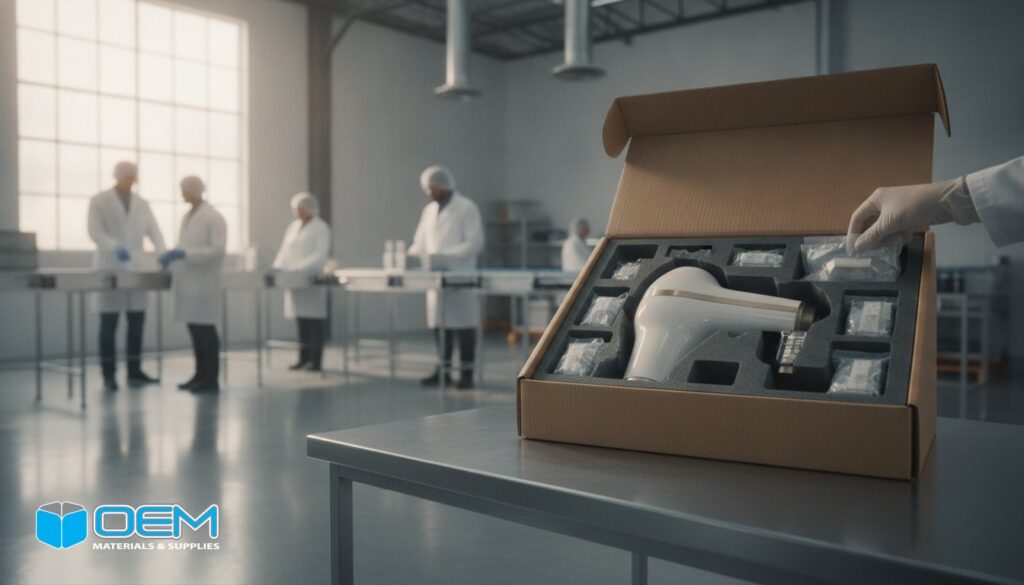
Managing a medical device supply chain in Southern California often feels like a balancing act between rising labor costs and the absolute necessity for technical precision. For many manufacturers, the internal expense of manual assembly and the logistical headache of juggling separate vendors for corrugated boxes, custom foam, and labeling creates a significant operational bottleneck. Utilizing specialized medical device kitting services los angeles allows your team to shift focus back to core engineering and development while a dedicated partner handles the intricacies of the final package. It’s a strategic move that addresses both operational overhead and the physical protection of sensitive equipment during transit to hospitals and laboratories.
You already know that a single damaged shipment or a mislabeled kit can lead to costly returns and compromised reputations. This article explains how integrated kitting and assembly services help Los Angeles manufacturers reduce labor expenditures and enhance product safety through engineered packaging design. We’ll examine the benefits of consolidating your supply chain, the impact of the 2026 FDA Quality Management System Regulation (QMSR) and ISO 13485:2016 standards, and how local vendor-managed inventory can stabilize your production schedule.
Key Takeaways
- Reclaim warehouse floor space and reallocate internal labor by shifting manual assembly tasks to a specialized kitting partner.
- Protect sensitive instrumentation using custom-engineered foam inserts and high-grade corrugated materials tailored to specific device dimensions.
- Utilize specialized medical device kitting services los angeles to consolidate multiple vendors into a single point of contact for assembly and packaging.
- Implement Vendor Managed Inventory (VMI) to stabilize the supply chain and ensure professional, damage-free delivery to hospitals and labs.
Understanding Medical Device Kitting Services in Los Angeles
Medical device kitting is the technical process of bundling individual components, such as vials, swabs, surgical tools, and instructions, into a single, ready-to-use unit. This approach is a specialized product bundling strategy designed to ensure that clinical professionals have everything they need for a specific procedure in one package. By consolidating these items, manufacturers reduce the risk of assembly errors at the point of care or in a high-pressure clinical lab. Common applications include diagnostic test kits, orthopedic surgical sets, and complex laboratory supplies. Utilizing medical device kitting services los angeles allows local manufacturers to streamline their final assembly stage and ensure every kit meets rigorous quality standards before it reaches a hospital.
The Local Manufacturing Landscape
Los Angeles County remains a primary hub for medical device innovation; however, the region presents unique logistical hurdles for growing companies. Local OEMs often struggle with high facility costs and a competitive labor market that makes scaling an in-house assembly team difficult. Proximity is a critical factor in the Southern California medical supply chain. Working with medical device kitting services los angeles ensures that prototypes can be reviewed quickly and production runs can be adjusted without the delays associated with long-distance shipping. It allows for a more responsive manufacturing process that can adapt to sudden changes in demand or design while keeping transportation costs between the warehouse and the lab to a minimum.
Key Benefits of Professional Kitting
Outsourcing the assembly process provides immediate relief for operational overhead. Instead of dedicating valuable square footage to manual packing stations, manufacturers can use that space for higher-value engineering or production tasks. Professional kitting also improves inventory accuracy. When a partner manages the assembly, they provide professional lot tracking and management for every component within the kit. This level of oversight is essential for maintaining compliance and ensuring that expired or incorrect components never reach the end user.
This transition simplifies procurement significantly. Instead of purchasing, tracking, and storing dozens of individual components, the manufacturer manages a single SKU. To further optimize this, many firms implement Vendor Managed Inventory (VMI) programs. This ensures that kits are always available for just-in-time delivery, preventing stockouts without requiring the OEM to maintain massive safety stocks on-site. The result is a leaner, more efficient operation that prioritizes precision and speed above all else.
Engineering the Perfect Medical Device Kit
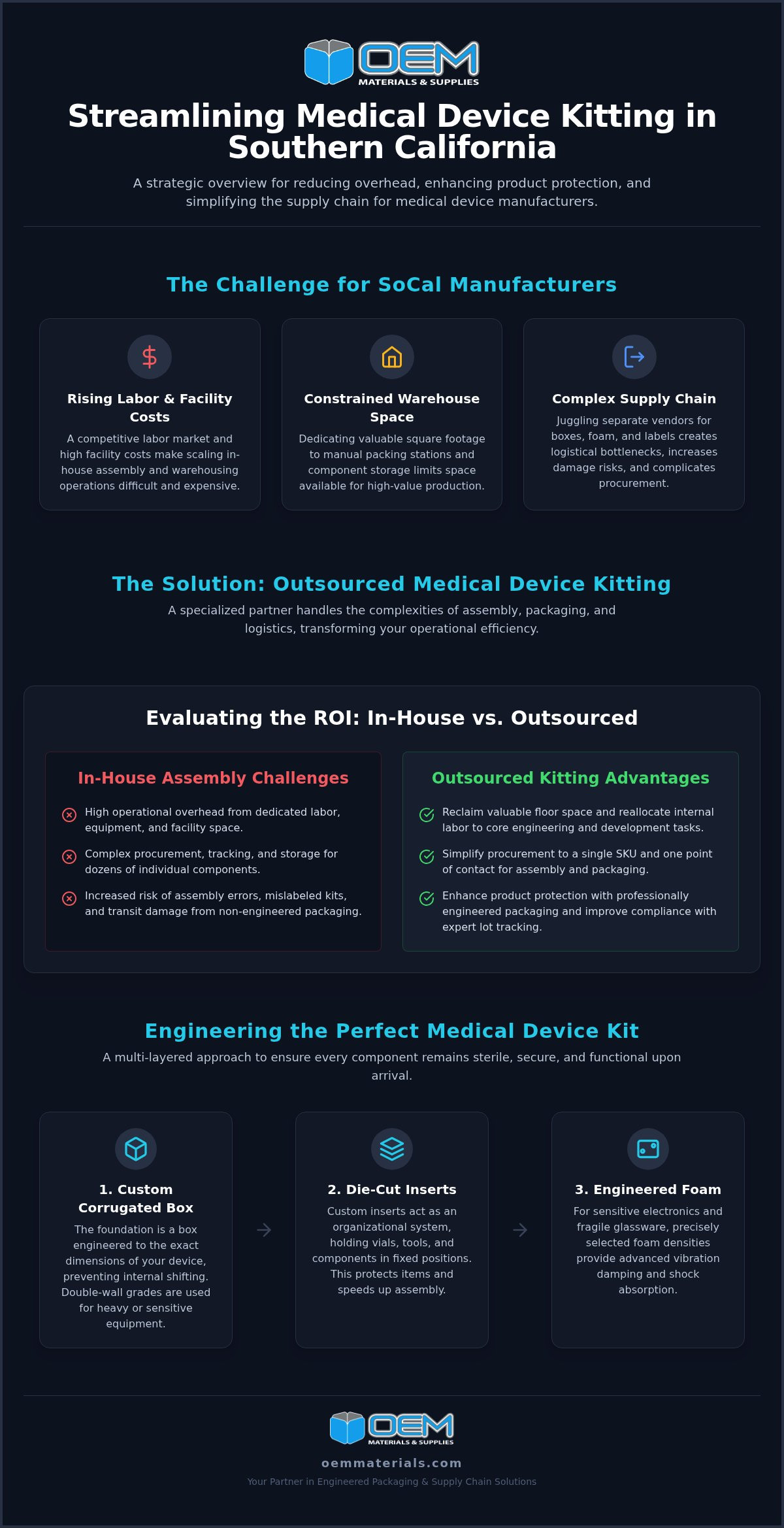
Effective medical device kitting services los angeles require more than simple assembly. They demand a deep understanding of packaging engineering to ensure every component remains sterile, secure, and functional upon arrival. High-value medical technology requires a robust supply chain efficiency playbook that prioritizes the structural integrity of the kit. By engineering the package to fit the product exactly, manufacturers can eliminate the need for excessive dunnage and reduce the overall footprint of the shipment. This precision reduces material waste and lowers shipping costs simultaneously.
Custom Corrugated and Die-Cut Solutions
The foundation of any medical kit is the outer container. Utilizing custom corrugated boxes tailored to the specific dimensions of your device prevents internal shifting that often leads to product damage. For kits containing multiple components, die-cut inserts are essential. These inserts act as a specialized organization system, holding everything from surgical tools to diagnostic reagents in a fixed position. This level of organization doesn’t just protect the items; it also speeds up the assembly process by providing a clear, repeatable layout for workers. High-value equipment often requires double-wall corrugated grades to withstand the rigors of heavy-duty transit through regional distribution hubs.
Engineered Foam Inserts for Sensitive Components
Sensitive electronics and fragile glassware require advanced foam packaging solutions to survive the supply chain. We select foam densities based on the specific weight and vibration dampening requirements of the device. For example, electronic medical devices often require Anti-Static or ESD (Electrostatic Discharge) foam to prevent damage from static buildup during handling. Precise, die-cut cavities ensure that components do not migrate or collide during shipping. This level of protection is vital for maintaining the calibration of sensitive instruments. If you’re struggling with high damage rates or inefficient packing processes, you can request a custom prototype to test how engineered materials can improve your results.
Designing for assembly speed is another critical factor. When a kit is engineered correctly, the components should snap into place with minimal effort. This reduces the labor time required per unit, directly lowering your total cost of goods sold. Every kit must be tested against rigorous standards for transit and storage, ensuring that the structural integrity remains intact even in humid warehouse environments. By focusing on the engineering phase, providers of medical device kitting services los angeles can help manufacturers build a more resilient and cost-effective supply chain.
Evaluating the ROI: In-House vs. Outsourced Kitting
Deciding whether to maintain an internal assembly line or utilize specialized medical device kitting services los angeles often comes down to a total cost of ownership analysis. In-house operations frequently carry hidden expenses that aren’t immediately visible on a standard balance sheet. These include facility maintenance, specialized equipment depreciation, and the administrative burden of managing a large manual labor force. By outsourcing, medical device companies can reallocate their capital and talent toward core competencies like research, development, and clinical engineering. It’s a shift from managing a warehouse to managing innovation.
Compliance is another critical factor in this ROI calculation. Following the FDA Guidance on Convenience Kits requires meticulous attention to labeling and Unique Device Identification (UDI) systems. Professional kitting partners are built to handle these specific regulatory requirements as part of their standard operating procedures. This reduces the risk of non-compliance and the potential for costly product recalls or delays in distribution.
Labor and Operational Savings
Specialized kitting labor is fundamentally different from general warehouse work. It requires high levels of accuracy and repetitive precision. When you outsource, you eliminate the need for constant training and the HR overhead associated with high-turnover manual roles. Professional assembly facilities utilize specialized equipment that increases throughput beyond what is typically achievable with a makeshift internal line. This allows for rapid production ramps when a new product launches or during seasonal demand spikes, providing a level of scalability that fixed internal teams cannot match. You pay for the output rather than the overhead.
Space Optimization and Inventory Management
Real estate in Los Angeles and Orange County is among the most expensive in the nation. Using manufacturing floor space for kitting and storage is often an inefficient use of a high-cost asset. Shifting this work to a partner allows you to convert fixed facility costs into variable costs that scale with your actual production volume. This flexibility is essential for startups and established OEMs alike.
Consolidating multiple vendors for boxes, foam, and assembly into a single kitting partner further streamlines the process. This is often managed through Vendor Managed Inventory (VMI), which reduces the need for on-site safety stock and prevents inventory shortages. Professional packaging engineering also directly impacts the bottom line by reducing product damage and returns. When a kit is designed by experts, it withstands the rigors of transit far better than a generic solution, ensuring that hospitals and labs receive functional, professional instrumentation every time.
Optimizing Logistics for Southern California Manufacturers
Logistical efficiency for Southern California medical device manufacturers depends on the ability to move products rapidly between production facilities and major distribution hubs. Utilizing medical device kitting services los angeles provides a central point for assembly that services Orange County, San Diego, and Riverside with minimal transit times. This geographic proximity is vital for navigating the congestion near the Port of Los Angeles, especially when finished kits are destined for international markets. By centralizing assembly near these hubs, manufacturers can reduce the total miles traveled and lower their overall carbon footprint. For many local OEMs, medical device kitting services los angeles act as a critical link between the factory floor and the global clinical market.
Strategic Supply Chain Programs
To eliminate the risk of stockouts, we implement Vendor Managed Inventory (VMI). In this model, the kitting partner monitors stock levels of corrugated boxes, foam inserts, and other components, automatically replenishing them before they reach critical lows. This automation removes the administrative burden from your procurement team and ensures that production never halts due to a lack of packaging materials. For manufacturers operating in lean environments, JIT packaging services further reduce on-site storage requirements by delivering exactly what is needed for that day’s production run. This strategy is particularly effective for facilities in Riverside and San Diego that need to maximize their usable floor space for assembly rather than material storage.
Protective Materials in Transit
Maintaining kit integrity during the final leg of the journey requires high-quality secondary packaging. For cleanroom and medical environments, heavy duty plastic pallets are preferred over wood because they don’t harbor pests or mold and are easily sanitized. Once kits are palletized, the load must be stabilized using high-performance stretch film for pallet wrapping. This prevents shifting during transit, which is a primary cause of internal component damage and kit disorganization. We also utilize edge protectors to reinforce the corners of bulk shipments, ensuring the structural integrity of the corrugated boxes remains intact even under the pressure of stacking in a distribution center. If you need to streamline your distribution process, contact us for a logistics consultation to review your current shipping requirements and annual usage data.
Implementing a Medical Kitting Program with OEM Materials
Transitioning from internal assembly to professional medical device kitting services los angeles requires a methodical approach to ensure continuity of supply and regulatory compliance. We begin the process by analyzing your current bill of materials and identifying specific opportunities for component consolidation. By shifting this responsibility to a specialized partner, you eliminate the logistical friction of managing multiple raw material vendors for boxes, foam, and labels. This phase involves establishing clear quality control protocols and lot tracking requirements that align with your existing Quality Management System (QMS) and the latest 2026 FDA standards.
Prototyping and Testing
The foundation of a successful kitting program is custom packaging design. For new medical device launches, rapid prototyping is essential to validate the fit and function of every component within the kit. We use these prototypes to conduct rigorous testing, including drop tests and vibration analysis, to simulate the stresses of the Southern California distribution network. This testing phase also allows us to refine assembly instructions. By optimizing the sequence of assembly, we maximize both accuracy and speed, ensuring that every kit is professional and ready for immediate clinical use. This proactive engineering prevents costly field failures and protects your brand reputation at the point of care.
Next Steps for Los Angeles OEMs
To begin the transition to medical device kitting services los angeles, your team should gather specific data points to facilitate an accurate assessment. We require precise product dimensions, weights, and projected annual usage to provide a tailored recommendation. It’s also helpful to conduct an internal facility audit to pinpoint exactly where kitting and assembly bottlenecks are occurring on your manufacturing floor. This data allows us to design a program that addresses your specific labor and space constraints while converting fixed overhead into a manageable variable cost.
Once the initial assessment is complete, we move into the development of a comprehensive kitting and packaging quote. This proposal includes a detailed breakdown of materials, assembly labor, and any value-added services like Vendor Managed Inventory (VMI). Our goal is to act as a reliable guide through the implementation process, ensuring a seamless handover that improves your operational efficiency from day one. Contact our team to schedule a consultation and begin the prototype development process for your next medical device project.
Advancing Your Medical Device Supply Chain Efficiency
Optimizing your assembly process is a strategic necessity for maintaining a competitive edge in the Southern California medical market. Professional medical device kitting services los angeles provide the technical precision required to protect sensitive instrumentation while significantly reducing in-house labor costs. By utilizing engineered materials like custom foam inserts and high-grade corrugated boxes, your team ensures that every kit arrives at its destination in professional, ready-to-use condition. This shift doesn’t just save money; it reclaims valuable manufacturing floor space for higher-value engineering tasks.
Our specialized expertise in medical and aerospace packaging allows us to act as a seasoned industry partner rather than a simple vendor. With local Southern California manufacturing, we offer faster lead times and the agility to handle everything from initial prototypes to high-volume production runs. Implementing comprehensive VMI and JIT programs further automates your replenishment, ensuring that packaging shortages never disrupt your delivery schedule. If you’re ready to consolidate your supply chain and improve product reliability, contact OEM Materials for a medical kitting consultation to discuss your product dimensions and annual usage. We’re prepared to help you build a more resilient and efficient operation.
Frequently Asked Questions
What is the difference between kitting and assembly?
Kitting is the process of bundling related items into a single unit, whereas assembly involves putting parts together to create a finished product. For medical device kitting services los angeles, this usually means organizing vials, tools, and instructions into one ready-to-use package. This distinction is important for supply chain managers who need to streamline the final stage of their production without adding internal labor overhead or complex inventory tracking.
Can OEM Materials handle sterile medical device packaging?
We provide specialized cleanroom and ESD packaging materials designed to maintain the integrity of sensitive devices. While we handle the kitting and final packaging assembly using these technical materials, manufacturers are responsible for the initial sterilization of the devices themselves. Our role is to ensure the secondary and tertiary packaging provides the necessary structural protection to keep the sterile barrier intact throughout the distribution process.
How does kitting reduce shipping costs for medical manufacturers?
Kitting reduces shipping costs by consolidating multiple components into a single, optimized footprint, which lowers dimensional weight. By engineering custom corrugated boxes and foam to fit the product exactly, we eliminate wasted space and excess dunnage. This efficiency lowers the total number of shipments and optimizes pallet density. It’s a practical way for manufacturers to reduce their overall transportation spend while improving product safety during transit.
What information is needed to get a quote for kitting services?
To provide an accurate quote for medical device kitting services los angeles, we require the physical dimensions and weight of each component. We also need projected annual usage and monthly production volumes. Providing details on the sensitivity of the instruments helps us recommend the correct foam density and corrugated grade. This data ensures we engineer a solution that maximizes both protection and cost efficiency for your specific application.
Do you provide kitting services for small production runs?
Yes, we support the full product lifecycle, from rapid prototyping and short run production to high volume manufacturing programs. This flexibility allows medical device startups in the Inland Empire and Los Angeles to scale their kitting operations as demand grows. We design our assembly processes to remain cost effective regardless of the specific production scale, ensuring that smaller batches receive the same level of technical precision as large runs.
How do you ensure quality control during the kitting process?
We implement rigorous quality control protocols, including lot tracking and component verification, to ensure every kit is complete and accurate. Our processes align with industrial standards for medical packaging. By utilizing standardized assembly instructions and multi point inspections, we minimize the risk of missing items or incorrect labeling. This level of oversight is essential for maintaining compliance with the latest FDA Quality Management System Regulations and ISO standards.
What geographical areas in Southern California do you serve?
We provide local distribution and support throughout Southern California, specifically serving manufacturers in Los Angeles County, Orange County, San Diego County, and Riverside. Our local footprint allows for faster lead times and just in time delivery. We also offer nationwide service for clients with distribution requirements that extend beyond the regional market, providing a consistent supply chain partner for companies with facilities in multiple states.
Can you integrate custom foam inserts into the medical kits?
Yes, we specialize in designing and manufacturing engineered foam inserts tailored to the specific geometry of your medical devices. We use materials like polyethylene or polyurethane, including ESD safe options for sensitive electronics. These inserts are integrated directly into your custom corrugated kits to prevent component migration and dampen vibrations. This ensures that sensitive instruments remain calibrated and damage free during the final leg of the supply chain journey.