

A single shipment of corroded metal parts can erase an entire quarter’s profit margin. You likely know that standard corrugated boxes aren’t enough to stop humidity from infiltrating your supply chain, especially when shipping through high-humidity regions or across oceans. It’s essential to implement a technical strategy for preventing moisture damage in packaging to avoid costly insurance claims and customer rejections.
This guide provides the technical strategies and material selections required to protect industrial goods from humidity, condensation, and corrosion during transit. We’ll examine advanced desiccant use, the role of high-performance stretch film, and how specific barrier materials help you meet the rigorous shipping standards required for aerospace and medical devices, including the latest EN IEC 60749-20-1:2026 requirements. We will also look at how custom engineered foam and VMI programs can stabilize your internal atmosphere. By the end of this article, you’ll have a repeatable process that eliminates moisture risk and secures your inventory from the warehouse to the final destination.
Key Takeaways
- Understand how the condensation cycle and hygroscopic materials like wood pallets introduce unwanted moisture into your cargo.
- Select high-test corrugated boxes with moisture-resistant coatings and non-absorbent engineered foam to shield sensitive components.
- Apply high-micron stretch film and edge protectors to create a structural vapor barrier during transit.
- Integrate active moisture control through desiccants and Volatile Corrosion Inhibitors (VCI) for preventing moisture damage in packaging.
- Reduce environmental exposure by utilizing Just-In-Time delivery and vendor-managed inventory (VMI) to keep sensitive materials in climate-controlled conditions.
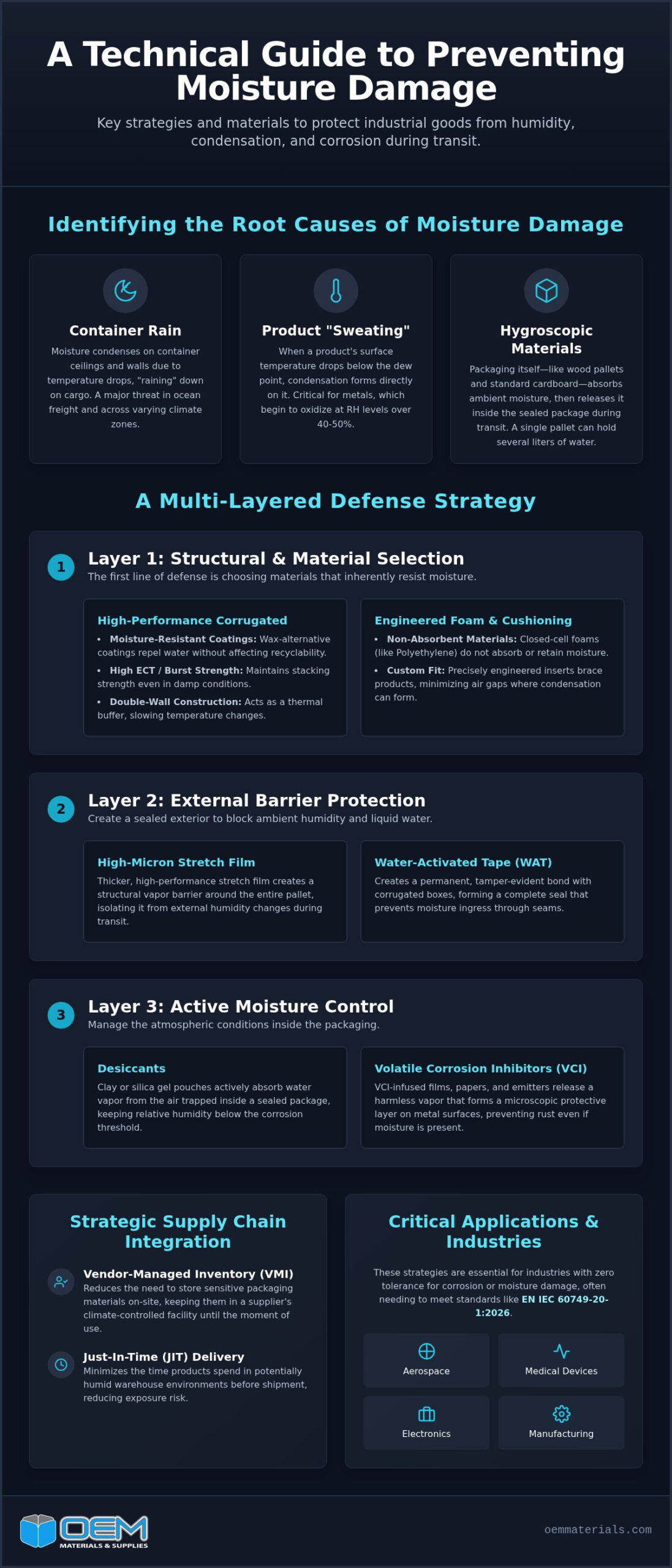
Identifying the Root Causes of Moisture Damage in Industrial Logistics
Container rain is a destructive phenomenon that occurs when the air inside a shipping container reaches its dew point. As temperatures drop during the night, the air’s capacity to hold water vapor decreases. This causes moisture to condense on the ceiling and walls, eventually dripping onto the cargo like actual rain. It’s a persistent threat for shipments moving through varying climate zones or crossing oceans where day-to-night temperature swings are extreme.
Preventing moisture damage in packaging requires an understanding of these atmospheric shifts and the materials involved. Metals typically begin to oxidize when relative humidity (RH) levels exceed 40% to 50%. Organic materials and sensitive electronics are even more vulnerable, sometimes sustaining damage at lower thresholds. In Southern California, coastal humidity from the marine layer in areas like San Diego and Orange County can saturate materials before they even leave the warehouse. This ambient moisture becomes trapped once the goods are sealed for transit, creating a micro-environment ripe for corrosion. High-traffic port areas like Long Beach often see high ambient humidity that can compromise inventory stored in standard warehouse environments.
The Role of Temperature Fluctuations
The dew point is the temperature at which air becomes saturated with water vapor. When industrial goods move from a warm loading dock into a cold cargo hold, the temperature of the product surface may fall below the dew point of the surrounding air. This leads to “sweating,” where liquid water forms directly on metal components. For the aerospace and electronics sectors, even microscopic levels of condensation can lead to catastrophic failure or non-compliance with rigorous quality standards. These industries don’t just face the cost of the part; they face the cost of specialized inspections and potential project delays.
Hygroscopic Packaging Materials
Many manufacturers overlook the fact that their own packaging can be a primary moisture source. Materials like wooden crates and standard corrugated boxes are hygroscopic, meaning they naturally absorb water from the air. A single wood pallet can hold several liters of water depending on its seasoning and storage history. If these materials are stored in damp conditions, they act as a reservoir, releasing moisture into the sealed environment of the package during transit. Effective Active packaging systems are designed to mitigate these risks by managing the internal atmosphere. Working with a partner that provides technical material analysis ensures that your secondary packaging doesn’t compromise your primary product. This is why many manufacturers in the Inland Empire and Los Angeles County prioritize treated materials that resist ambient absorption to maintain a dry environment from the point of assembly.
Selecting Moisture-Resistant Packaging Substrates and Materials
Material selection is the first line of physical defense in a comprehensive strategy for preventing moisture damage in packaging. Standard paper-based materials often fail in high-humidity transit because they lack the structural integrity to resist saturation. By choosing engineered substrates, manufacturers can create a barrier that actively repels liquid water and vapor before it reaches the product surface. This is particularly important for Southern California manufacturers shipping from coastal areas like San Diego or Orange County, where the marine layer provides a constant source of ambient humidity.
High-Performance Corrugated Solutions
Standard corrugated boxes lose significant stacking strength as they absorb moisture. To counter this, high-test boxes utilize wax-alternative coatings that provide a water-repellent surface without compromising recyclability. These coatings prevent liquid water from wicking into the fibers of the board. When selecting these materials, engineers must prioritize the Edge Crush Test (ECT) and burst strength ratings, as these metrics dictate how the box will perform under the weight of a pallet in damp conditions. Double-wall construction also serves as a thermal buffer, slowing down the rate of temperature change inside the box and reducing the risk of reaching the dew point.
Engineered Foam and Cushioning
The type of cushioning used inside the box is just as critical as the outer shell. Traditional paper-based dunnage can trap humidity against the product, accelerating corrosion. In contrast, closed-cell foam packaging, such as polyethylene, is non-absorbent and provides a moisture-proof barrier. Closed-cell structures don’t allow water to migrate through the material, which is why they’re the preferred choice for medical devices and sensitive electronics. Utilizing technical methods like modeling moisture uptake allows engineers to determine exactly how much protection is needed based on the expected transit duration and environmental exposure.
Beyond the immediate container, the choice of pallets influences the internal micro-environment. While wood pallets are common, they are hygroscopic and can release liters of water vapor inside a shipping container. For high-humidity or cleanroom environments, plastic pallets are a superior alternative because they don’t harbor moisture or organic contaminants. Additionally, custom packaging design can minimize the “headspace” or air volume inside a box. By reducing the amount of air trapped with the product, you directly limit the total volume of water vapor that can condense during temperature shifts. If you’re unsure which material combination is right for your specific transit route, a custom material evaluation can help identify the most cost-effective protective strategy.
Utilizing Barrier Films and Sealing Methods for External Protection
While internal substrates provide a primary defense, external barriers are what isolate the entire load from the surrounding environment. Creating a hermetic or near-hermetic seal is the most effective way of preventing moisture damage in packaging during long-haul transit. This requires a systematic approach to wrapping and sealing that goes beyond simply securing the load for stability. You must treat the external layer as a technical shield against vapor transmission.
Follow these five steps to establish a robust external moisture barrier:
- Step 1: Select a high-micron stretch film. Thicker gauges provide a lower water vapor transmission rate (WVTR) and higher puncture resistance.
- Step 2: Apply edge protectors to the vertical and horizontal corners of the load. This maintains structural integrity even if ambient humidity begins to soften the underlying corrugated board.
- Step 3: Ensure a 100 percent seal on all corrugated seams. Use industrial-grade packaging tape with high-tack adhesive that won’t flag or peel in damp conditions.
- Step 4: Use pallet covers or top sheets. These prevent moisture from settling on the top surface of the load, which is a common point of entry for “container rain.”
- Step 5: Implement a consistent wrapping tension. Using a machine with pre-stretch capabilities eliminates air pockets between the product and the film where condensation could otherwise form.
Optimizing Stretch Film Application
The choice between blown and cast stretch film significantly impacts moisture protection. Blown film is generally preferred for industrial goods because it offers superior puncture resistance and higher load-holding force. These properties are essential when shipping heavy machinery or parts with sharp edges that could easily breach a thinner barrier. A proper wrap cycle is also critical. Ensure the film overlaps by at least 50 percent on each rotation to create a continuous, multi-layered shield. For detailed technical specifications, refer to our guide on how to optimize stretch film for pallet wrapping.
Edge Protection and Structural Support
Humidity is the enemy of compression strength. As corrugated fibers absorb moisture, they lose their ability to support vertical weight. Heavy-duty edge and corner protectors act as an external skeleton for the pallet. For shipments moving through extreme moisture environments, such as those originating in San Diego County or Orange County coastal ports, consider using plastic edge protectors that are entirely impervious to water. These components prevent the boxes from collapsing, which in turn prevents the stretch film from sagging and losing its tension. A stabilized load is less likely to shift, reducing the risk of the film puncturing against the pallet or neighboring cargo during transit.
Integrating Active Moisture Control and Desiccant Solutions
Active moisture control moves beyond passive barriers by managing the internal atmosphere of the container. Even with a perfect external seal, residual humidity remains trapped inside the package at the time of assembly. By introducing chemical agents that regulate this environment, you can neutralize vapor before it condenses on sensitive surfaces. This is a critical final step in preventing moisture damage in packaging for long-term storage or international transit.
To determine how much desiccant your shipment requires, you must calculate the total surface area of the moisture barrier material. A standard industrial framework involves multiplying the area of the barrier by the expected water vapor transmission rate (WVTR) and the total transit time. You also need to account for the volume of air trapped within the package and the moisture content of internal components like cushioning materials. If you don’t use enough desiccant, the medium will reach its saturation point mid-transit, leaving your goods unprotected for the remainder of the journey.
Types of Desiccants for Industrial Use
Choosing the right desiccant depends on your product’s sensitivity and the expected temperature range during shipping. Silica gel is the most common choice for electronics and medical devices because it’s chemically inert and can absorb up to 40 percent of its weight in water vapor. However, silica gel performs best at room temperature. For general industrial parts stored in large crates, montmorillonite clay is often more cost-effective and remains stable across a wider temperature spectrum. In high-demand scenarios where you need to reach extremely low humidity levels very quickly, a molecular sieve is the preferred technical solution. For monitoring, it’s best practice to include humidity indicator cards (HICs). These cards provide a visual audit of the internal RH levels without requiring you to breach the seal of the package.
VCI and Specialized Chemical Protection
For the automotive and aerospace sectors, desiccants are often paired with Volatile Corrosion Inhibitors (VCI). VCI products, available as films, papers, or emitters, release specialized vapors that form a molecular-thin protective layer on metal surfaces. This layer prevents the electrochemical reaction that causes oxidation and rust. It’s important to select a VCI formula compatible with your specific metal alloys, whether ferrous, non-ferrous, or multimetal. For VCI to function correctly, the environment must be completely sealed; if air is allowed to circulate freely, the protective vapors will dissipate, leaving the metal vulnerable to the ambient humidity found in coastal regions like San Diego or Los Angeles. You can request a custom desiccant and VCI calculation to ensure your specific product dimensions and transit routes are fully protected.
Developing a Customized Moisture Prevention Strategy for Your Supply Chain
Effective moisture protection is not just about selecting the right materials; it is about managing the entire lifecycle of the package. A technical approach to preventing moisture damage in packaging requires looking beyond the shipping container to the logistics and storage of the packaging supplies themselves. When you treat moisture prevention as a supply chain discipline, you move from a reactive stance to a proactive, engineered system that secures your inventory from the assembly line to the final user.
Adopting a total cost of ownership (TCO) approach is essential for high-value sectors like aerospace and medical device manufacturing. While a moisture-resistant coating or a high-micron stretch film may have a higher unit price than standard alternatives, the cost is negligible compared to the expense of a rejected shipment or a corroded electronic component. Your strategy should factor in the potential for insurance claims, expedited replacement shipping, and the long-term impact on customer trust. By investing in a robust prevention system, you minimize the variables that lead to unpredictable product damage.
Vendor-Managed Inventory and Environmental Control
One of the most overlooked risks in industrial logistics is the degradation of packaging materials before they are even used. Hygroscopic materials like corrugated board and wood crates can absorb significant ambient moisture if stored in unmanaged, non-climate-controlled environments. In Southern California, the coastal humidity of San Diego and Orange County can saturate inventory sitting in a warehouse for months. A packaging VMI program solves this by ensuring that your supplies are stored in optimal conditions and delivered only when needed.
By utilizing JIT packaging services, manufacturers in the Inland Empire and Los Angeles County can drastically reduce inventory dwell time. This minimizes the window of environmental exposure for both the packaging and the finished goods. Professional supply chain management ensures that your team is never forced to use damp or contaminated materials because of a stockout, maintaining the integrity of your moisture barrier from day one.
Custom Design and Prototyping
Every product has a unique sensitivity profile and transit route. A custom packaging design process allows you to engineer a solution that accounts for specific variables like product dimensions, metal alloy composition, and expected temperature shifts. Through rapid prototyping, engineers can test different combinations of engineered foam, desiccants, and barrier films to find the most efficient protection level. This data-driven selection process often results in significant packaging cost savings by eliminating over-packaging while ensuring the product remains well within its safe humidity threshold. We invite you to consult with our engineering team for a comprehensive audit of your current packaging to identify vulnerabilities and optimize your moisture prevention protocols.
Optimizing Your Industrial Moisture Protection Strategy
Protecting industrial assets from humidity requires a multi-layered approach that integrates material science with logistical precision. By shifting from standard boxes to high-test materials with moisture-resistant coatings and non-absorbent engineered foam, you establish a primary defense against ambient vapor. Integrating active controls like desiccants and VCI emitters ensures any residual humidity is neutralized before it causes oxidation or mold. These technical strategies are essential for maintaining the integrity of sensitive electronics and precision metal parts.
Successfully preventing moisture damage in packaging also depends on how you manage your supply chain. Utilizing VMI and JIT delivery programs in Southern California ensures your packaging supplies remain in climate-controlled conditions until the moment they are needed. This comprehensive approach reduces product rejections and lowers the total cost of ownership for aerospace, medical, and automotive OEMs. If you’re ready to secure your transit routes, Contact OEM Materials & Supplies for a Custom Moisture Protection Consultation. Provide your product dimensions and annual usage to receive a technical recommendation tailored to your specific logistics requirements. We look forward to helping you build a more resilient supply chain.
Frequently Asked Questions
What is the most effective desiccant for shipping electronics?
Silica gel is the most effective desiccant for electronics because it’s chemically inert and offers high absorption at room temperature. It doesn’t release any corrosive byproducts, making it safe for delicate circuit boards. For surface-mount devices, you should ensure compliance with the EN IEC 60749-20-1:2026 standard. This requires using moisture barrier bags in conjunction with desiccants to maintain an internal environment that prevents soldering heat damage and oxidation.
How many desiccant packets do I need for a standard corrugated box?
The required amount isn’t based on box size alone. You must calculate it based on the surface area of the barrier material, the material’s water vapor transmission rate (WVTR), and the total transit duration. A common starting point is one unit of desiccant per cubic foot of volume. However, shipments moving through humid coastal areas like San Diego or Los Angeles often require a higher concentration for preventing moisture damage in packaging.
Can stretch film completely prevent moisture damage?
Stretch film is a powerful vapor barrier, but it isn’t a standalone solution. It protects against external liquid water and reduces vapor transmission, but it can’t remove the humidity already trapped inside the package. For complete protection, you must combine high-micron film with internal desiccants. This is especially true for manufacturers in Riverside or Orange County, where ambient humidity is often high during the initial wrapping and loading process.
What is the difference between VCI and standard desiccants?
Desiccants are passive absorbers that pull water vapor out of the air to lower relative humidity. Volatile Corrosion Inhibitors (VCI) are active agents that emit a protective vapor to form a molecular layer on metal surfaces, preventing the electrochemical process of rust. Combining these technologies is often the most effective strategy for preventing moisture damage in packaging when shipping high-value metal components for the aerospace and automotive sectors.
How does container rain affect industrial shipping in Southern California?
Container rain is a major risk for Southern California logistics. Goods frequently travel from warm, inland warehouses in the Inland Empire to cooler coastal ports in San Diego or Los Angeles. This temperature fluctuation causes moisture to condense on the container ceiling and drip onto the cargo. Using moisture-resistant corrugated boxes and pallet covers prevents this condensation from reaching your product and causing structural failure or surface corrosion during transit.
Do I need a special type of tape for moisture-resistant packaging?
Standard adhesives can fail in damp environments. You should use industrial-grade packaging tape with a synthetic rubber adhesive designed for high-humidity conditions. This ensures a permanent seal on all corrugated seams, which is the first line of defense against vapor infiltration. In coastal regions like Orange County, where the marine layer increases ambient moisture, using a high-performance tape prevents the box flaps from flagging and exposing the internal contents to humidity.
How can I tell if my products were exposed to moisture during transit?
Humidity indicator cards (HICs) provide the most accurate visual evidence of moisture exposure. These cards are placed inside the primary packaging and feature sensitive spots that change color when specific relative humidity levels are reached. This allows your receiving team to verify the integrity of the internal environment immediately upon arrival. It’s a vital quality control step for medical and electronic goods where invisible moisture damage could lead to long-term product failure.
Does using plastic pallets instead of wood help prevent moisture?
Switching to plastic pallets significantly reduces moisture risk. Unlike wood, which is hygroscopic and can release liters of water vapor into a sealed shipping container, plastic is entirely non-absorbent. This prevents the “pallet sweat” that often occurs during temperature shifts. For manufacturers in San Diego or Los Angeles shipping sensitive goods, using plastic pallets eliminates a primary source of internal humidity and helps maintain a dry micro-environment throughout the supply chain.