
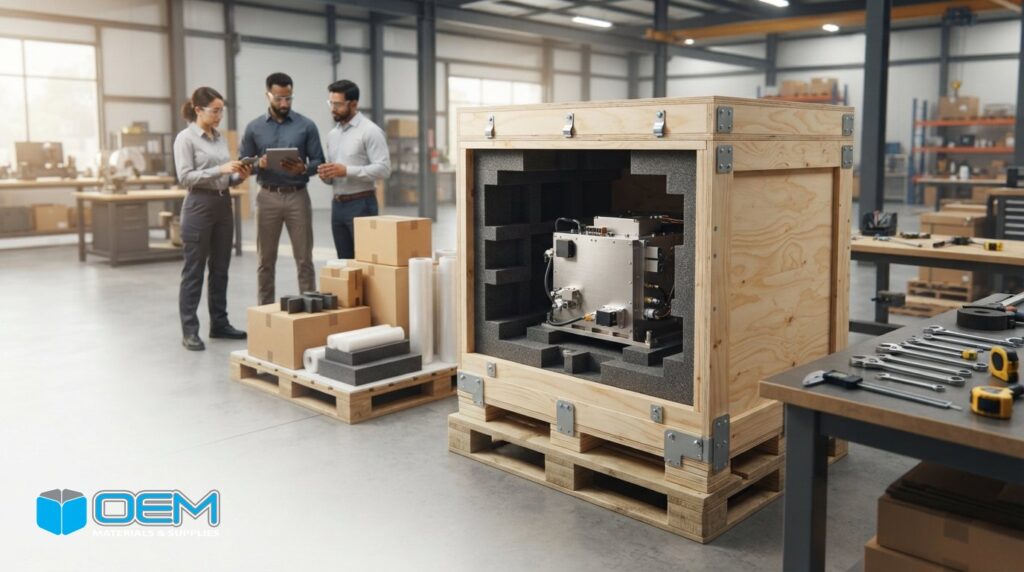
A packaging print is an engineering specification, not a rough approximation. When you procure build-to-print custom crates for sensitive electronics, medical devices, or aerospace machinery, even a minor discrepancy in cleat positioning or internal blocking can halt loading operations immediately. You already know the operational headaches caused by vendors who treat industrial crating like backyard carpentry. The consequences are costly: missing ISPM 15 heat-treatment stamps that stall international freight at port, long lead times for specialty foam inserts, and inadequate bracing that leads to transit damage.
Protecting high-value capital equipment requires packaging fabricators who respect strict drawing fidelity. In this guide, you will learn how to evaluate, specify, and procure precision build-to-print custom crates that match exact CAD drawings and heavy-duty shipping requirements. We will cover active lumber standards, hardware tolerances, multi-material foam integration, and regional staging solutions that streamline procurement while keeping your critical shipments completely secure.
Key Takeaways
- Learn how procuring build-to-print custom crates protects capital equipment by enforcing zero unauthorized substitutions against your CAD drawings and bill of materials.
- Identify the core lumber grades, structural plywood thicknesses, and ISPM 15 heat-treatment standards required to clear international freight customs without quarantine delays.
- Determine whether your payload requires strict print-accurate manufacturing or collaborative packaging design based on compliance baselines and internal engineering resources.
- Use our structured vetting checklist to evaluate manufacturer tooling, multi-material foam integration capabilities, and hardware assembly standards.
- Discover how demountable knockdown crates and regional vendor-managed inventory programs free up valuable manufacturing plant floor space while stabilizing delivery schedules.
What Are Build-to-Print Custom Crates and When Are They Required?
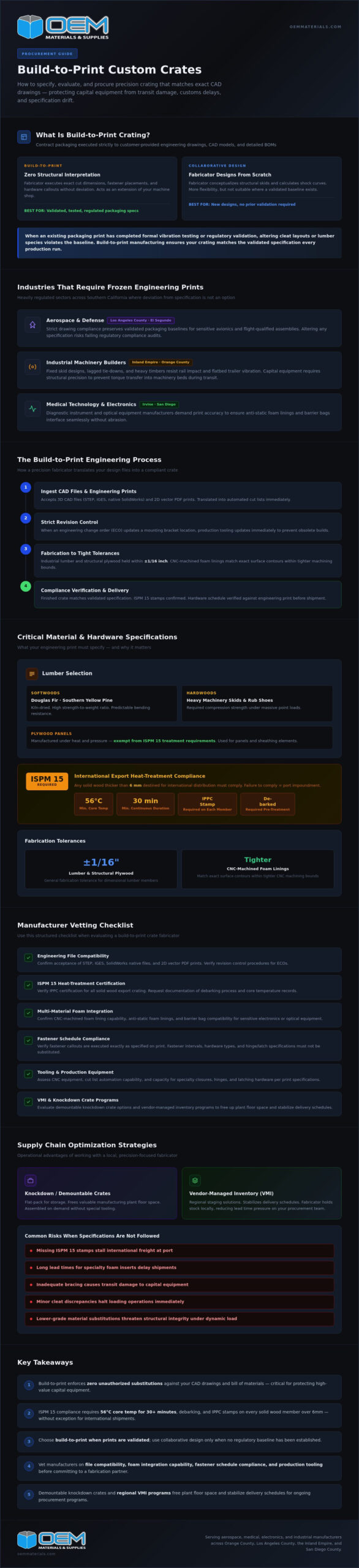
In industrial manufacturing, build-to-print custom crates represent contract packaging built strictly to customer-provided engineering drawings, CAD models, and detailed bills of materials (BOM). Unlike collaborative packaging design where a fabricator conceptualizes structural skids or calculates shock curves from scratch, build-to-print execution leaves zero room for structural interpretation. The crate fabricator acts as an extension of your machine shop or assembly plant, executing exact cut dimensions, fastener placements, and hardware callouts without deviation.
Standard commercial boxes and catalog containers fail when shipping precision capital goods. They lack the structural deflection resistance required to prevent torque transfer into heavy machinery beds during transit. When you ship high-value machinery or calibrated flight components across highway or ocean routes, off-the-shelf packaging introduces major fitment, clearance, and load-distribution risks. Precision custom crates eliminate these variables by locking down internal clearances and blocking locations.
Understanding the Build-to-Print Engineering Process
The manufacturing process begins by translating client 3D CAD files (STEP, IGES, or native SolidWorks files) and 2D vector PDF prints into automated cut lists. Professional crate fabricators maintain tight revision control systems. When an engineering change order (ECO) updates a mounting bracket location, production tooling updates immediately to prevent obsolete builds. Fabrication tolerances for industrial lumber and structural plywood generally hold within plus or minus 1/16 inch, while CNC-machined foam linings match exact surface contours within tighter machining bounds.
Industries That Rely on Frozen Crate Prints
Frozen engineering prints are mandatory across heavily regulated industrial sectors throughout Southern California:
- Aerospace and Defense: Contractors in Los Angeles County and El Segundo require strict drawing compliance to preserve validated packaging baselines for sensitive avionics and flight-qualified assemblies.
- Industrial Machinery Builders: Capital equipment builders across the Inland Empire and Orange County depend on fixed skid designs, lagged tie-downs, and heavy timbers to resist rail impact and flatbed trailer vibration.
- Medical Technology and Electronics: Diagnostic instrument and optical equipment manufacturers in Irvine and San Diego demand print accuracy to ensure anti-static foam linings and barrier bags interface seamlessly without abrasion.
When an existing packaging print has already completed formal vibration testing or regulatory validation, altering cleat layouts or lumber species violates the baseline. Build-to-print manufacturing ensures your crating matches the validated specification every production run.
Critical Material and Hardware Specifications in Crate Fabrication
Procuring build-to-print custom crates requires an uncompromising view of physical materials. When a design print specifies load-bearing timbers, exact fastener intervals, or specialized closure hardware, substituting lower-grade alternatives threatens structural integrity. A custom crate is a load-bearing structure engineered to transfer dynamic stresses away from delicate internal equipment into heavy skid runners and reinforced vertical cleats.
Lumber Selection and ISPM 15 Export Compliance
Base structural members rely heavily on kiln-dried softwoods such as Douglas fir and Southern yellow pine, which deliver high strength-to-weight ratios and predictable bending resistance. For heavy machinery skids and rub shoes, structural hardwoods provide the required compression strength under massive point loads. Any solid wood thicker than 6 mm destined for international distribution must comply strictly with ISPM 15 standards. This requires debarking and heat-treating the wood to a minimum core temperature of 56 degrees Celsius for at least 30 continuous minutes. Each timber member must display the official IPPC heat-treatment stamp to clear customs without port impoundment. Plywood panels, manufactured under heat and pressure, remain exempt from these treatment rules.
Fastener Schedules, Hinges, and Latching Hardware
Fastener callouts on engineering prints ensure joints do not separate under highway transit vibration or crane lifting. Fabricators follow precise schedules rather than arbitrary nailing:
- Coated Ring-Shank Nails: Used for exterior sheathing and plywood cleating, delivering substantially higher withdrawal resistance than smooth nails.
- Structural Lag Bolts: Threaded directly into hardwood skids through pre-drilled pilot holes to anchor heavy structural corner brackets and heavy base uprights.
- Quick-Release Hardware: Demountable crates utilize recessed butterfly twist latches (link-locks) or spring-loaded Klimp fasteners, eliminating the wood damage caused by repeated pry-bar opening.
- Inspection Ports: Transparent windows let customs officers or receiving teams check internal desiccants and shock indicators without unsealing the crate.
Integrating Blocking, Bracing, and Engineered Foam
Internal timber blocking isolates the equipment, aligning its center of gravity directly between designated forklift entry pockets. For finished surfaces, high-performance foam packaging like fabricated polyurethane or cross-linked polyethylene prevents cosmetic scuffing and absorbs road shocks. When protecting sensitive electronics or bare metal tooling against moisture, fabricators incorporate heat-sealed vapor barrier bags, activated clay desiccants, and rust-inhibiting films. If you are preparing detailed CAD packages for fabrication, you can submit your crate drawings for a review to confirm lumber selections, foam densities, and fastener specifications meet production tolerances.
Build-to-Print vs. Collaborative Packaging Design: Choosing the Right Path
Deciding between frozen engineering prints and custom design services centers on drawing ownership, lead time, and operational liability. When ordering build-to-print custom crates, the customer assumes full design liability. If a physical machine component interferes with an internal cleat because an engineer updated the equipment chassis without issuing a packaging ECO, the crate builder isn’t at fault. Conversely, collaborative packaging shifts structural and shock-attenuation responsibility to the packaging supplier, who engineers the crating around your payload dimensions.
Consider this practical decision framework when selecting your procurement workflow:
- Design Ownership: Build-to-print keeps CAD models and bills of materials entirely in-house. Collaborative design delegates structural skid modeling and cushion calculations to the vendor.
- Lead Times: Build-to-print procurement bypasses prototype iteration phases, moving straight to cut lists. Collaborative workflows require sample fitting, drop testing, and revision sign-offs.
- Dimensional Liability: Under build-to-print terms, the crate fabricator warrants dimensional compliance against the drawing. In design-build contracts, the supplier warrants transit protection and product fitment.
- Engineering Costs: Build-to-print eliminates non-recurring engineering (NRE) charges from the supplier, while collaborative development bundles design, physical modeling, and drop testing services.
When to Maintain In-House Drawing Control
Retaining internal control of crate documentation is essential when managing contractually mandated packaging specifications. Prime aerospace contracts, military transport requirements, and multi-site manufacturing networks rely on standardized drawings to ensure every regional facility builds or receives identical containers. Internal ownership also protects proprietary machinery layouts, ensuring sensitive equipment dimensions remain strictly within your corporate engineering firewall.
When to Request Packaging Engineering Support
External engineering assistance becomes valuable when chronic transit shock claims occur or when introducing entirely new machinery platforms. If recurring damage indicates that current skid stiffness or internal bracing is inadequate, partnering on custom packaging design lets packaging engineers recalculate static loading, tune foam cushioning curves, and optimize total crate tare weight. In many hybrid cases, an experienced industrial fabricator can review an existing print to recommend design-for-manufacturability (DFM) adjustments, suggesting standard dimensional lumber sizes that lower production costs without compromising structural safety.
Procurement Checklist: Vetting a Build-to-Print Crate Manufacturer
Selecting the wrong crate fabricator risks costly equipment fitment failures on the loading dock. A capable partner treats manufacturing build-to-print custom crates as an engineered industrial process, not ad-hoc woodwork. When auditing suppliers across Southern California, procurement teams should evaluate hard shop capabilities, material sourcing networks, and physical quality systems.
Use this evaluation checklist to vet prospective crating vendors during technical reviews:
- Machining and Tooling Infrastructure: Does the supplier operate automated panel saws, multi-spindle cross-cut saws, and multi-axis CNC routers for cutting precision plywood panels and matching foam cavities?
- Assembly Tooling: Are assembly cells equipped with pneumatic, depth-controlled nailing systems and calibrated torque drivers to prevent fasteners from over-sinking or splitting structural lumber?
- Raw Material Inventories: Does the shop maintain on-demand inventory of structural softwood, heavy hardwood timbers, OSB, industrial plywood, and multi-density foams?
- Logistics and Handling: Can the facility stage large finished crates, maneuver multi-ton skids using overhead bridge cranes, and operate dedicated delivery trucks for regional freight transit?
Quality Assurance and Drawing Adherence Checks
Drawing fidelity requires documented quality gates. Qualified fabricators conduct first-article inspections (FAI) against your engineering prints, measuring diagonal squareness, internal clearances, and cleat spacing prior to production runs. They should provide full heat-treatment documentation trails, matching stamp certifications to specific raw lumber lots. In addition, ask how the shop quarantines non-conforming timber, such as lumber exhibiting excessive bark, severe grain twists, or deep checks that violate structural specifications.
Assessing Manufacturing Capacity and Footprint
High-mix packaging programs require suppliers that scale smoothly from low-volume prototypes to recurring production runs. A manufacturer must possess sufficient crane capacity, wide-span staging bays, and high dock clearances to safely maneuver massive machinery bases without floor damage. Regional fleet operations are equally important. A fabricator running company-owned flatbeds and box trucks throughout Orange County, Los Angeles County, the Inland Empire, and San Diego ensures reliable transit control without common-carrier handling delays.
If your team is currently qualifying suppliers for scheduled equipment runs, request a custom crating quote to review our Southern California fabrication capacities, equipment specs, and lead times.
Optimizing Crate Supply Chains with Local Manufacturing and Staging
Storing fully assembled industrial packaging consumes immense square footage. In prime Southern California industrial corridors across Orange County and the Inland Empire, commercial warehouse space commands a high premium. Staging dozens of completed build-to-print custom crates directly on the manufacturing floor ties up valuable production space and creates bottleneck congestion. To solve this operational strain, high-volume equipment manufacturers rely on demountable knockdown crates and prefabricated panel sets that store flat until final equipment integration.
Solving Plant Floor Congestion with JIT and VMI
Manufacturing floor space should generate production value, not store empty wooden boxes. Implementing dedicated packaging VMI programs shifts bulky inventory management entirely offsite. Your fabrication partner maintains buffer stocks of finished crates or flat-packed panels at a regional warehouse, releasing shipments based on your actual shop floor usage.
Coupled with just-in-time delivery schedules, heavy-duty wood crates arrive precisely when completed machines roll off final assembly lines. Many facilities streamline this process further with complete packaging kitting. Rather than purchasing timber frames, cushioning foam, and barrier bags separately, kits arrive pre-assembled with CNC foam inserts and hardware packs under a single SKU. This eliminates multi-vendor coordination, reduces crate assembly labor, and prevents staging area clutter.
Preparing Drawings for Rapid Quoting
Procuring build-to-print custom crates starts with clean technical documentation. Preparing an organized drawing package ensures fast quoting and eliminates back-and-forth engineering reviews. Your procurement package should include:
- 2D PDF Engineering Prints: Dimensioned views showing overall exterior dimensions, skid configurations, cleat spacing, and lumber grades.
- 3D CAD Models: Vector files or 3D models (such as STEP or Parasolid files) detailing complex interior bracing or contoured foam pockets.
- Bill of Materials (BOM): Complete callouts for specific latching hardware part numbers, lag bolt schedules, lifting eyes, and paint or stenciling instructions.
- Volume and Delivery Terms: Target annual run volumes, release batch sizes, and required delivery intervals.
Clear documentation ensures your fabricator cuts accurate panels on day one. Submit your specifications to request a custom crate quote today to review fabrication options, production schedules, and regional staging solutions.
Scale Your Industrial Packaging with Reliable Print Fidelity
Protecting sensitive machinery and calibrated instruments requires packaging that matches your engineering prints down to the sixteenth of an inch. Precision lumber grading, certified ISPM 15 heat treatment, and seamless integration between structural timber and CNC-machined foam inserts are essential to eliminate transit damage. When your packaging partner maintains strict revision control, loading dock fitment issues and customs delays disappear.
OEM Materials & Supplies fabricates precision build-to-print custom crates engineered directly from your CAD models and cut sheets. Backed by full-service fabrication across heavy timber, industrial plywood, and cushioning foam, our technical team executes your exact specifications without unauthorized material substitutions. With dedicated delivery fleets and regional warehousing serving industrial corridors across Orange County, Los Angeles, San Diego, and Riverside, we align flat-pack or fully assembled crate deliveries directly with your plant schedule. You don’t have to sacrifice valuable floor space or risk structural failure during transport. Request a custom crate quote with your prints, payload dimensions, and release schedule to secure dependable crating for your next production run.
Frequently Asked Questions
What CAD file formats are preferred when ordering build-to-print custom crates?
Neutral 3D CAD formats like STEP (.stp) and IGES (.igs), alongside native SolidWorks or Inventor files, are ideal for structural modeling and CNC routing. Pair these 3D models with 2D dimensioned PDF prints that clearly state lumber grades, fastener schedules, and critical tolerances. If your design includes CNC foam cavities or routed plywood panels, providing 2D DXF or DWG vector files accelerates machine programming and avoids conversion errors.
Can a build-to-print manufacturer source custom internal foam inserts and hardware?
Yes. A full-service industrial packaging supplier integrates heavy structural lumber with precision internal components. Fabricators routinely source and convert polyurethane, cross-linked polyethylene, and anti-static foams directly against your print specifications. They also procure specified hardware such as butterfly twist latches, heavy lag bolts, lifting handles, and desiccant inspection ports, delivering a complete, ready-to-load container under a single bill of materials.
How do manufacturers verify ISPM 15 compliance for international wood crates?
Compliance is verified through traceable heat-treatment certifications and official quality stamps. All solid wood packaging thicker than 6 mm must be heat-treated to reach a minimum core temperature of 56 degrees Celsius for at least 30 continuous minutes. Fabricators verify this by sourcing lumber from certified mills and applying the registered IPPC HT mark to each structural component. Engineered panel products like plywood remain exempt from heat-treatment stamping.
What dimensional tolerances are standard in custom industrial crate manufacturing?
Standard commercial dimensional tolerances for industrial lumber and plywood fabrication hold within plus or minus 1/16 inch. For internal CNC-routed foam pockets and precision machined blocking, tolerances tighten to approximately plus or minus 1/32 inch to ensure snug equipment fitment. If your payload demands tighter tolerances across specific interface points, highlight these critical dimensions directly on the engineering print before submitting for quoting.
Is it more practical to ship custom crates assembled or flat-packed as knock-down kits?
That depends on your plant floor space, handling labor, and shipping distance. Assembled crates eliminate on-site setup labor and are ready for immediate equipment staging. However, flat-packed knock-down kits drastically reduce inbound freight costs and save precious warehouse floor space in dense manufacturing corridors like Orange County and Los Angeles. Facilities with minimal storage space often prefer knockdown designs staged through regional just-in-time delivery programs.
What happens if our equipment drawing revisions change after crate production begins?
When drawing revisions occur during manufacturing, the buyer must issue an Engineering Change Order (ECO) immediately. The fabricator pauses cutting operations, audits existing WIP against new prints, and updates tooling programs. Any finished panels that cannot be reworked become scrap, which may alter final project costs. Open communication between design engineers and crating fabricators ensures rapid print adjustments before lumber cut lists execute on the floor.
How much lead time is typically required for custom build-to-print crating runs?
Lead times depend on order volume, lumber availability, and internal hardware complexity. Standard build-to-print custom crates using in-stock softwoods and basic cleated plywood move through fabrication quickly once drawings are approved. Complex builds requiring custom multi-density foam routing, specialty drop-leaf latches, or heavy hardwood skids require additional procurement time. Establishing regional inventory buffers or VMI replenishment agreements prevents production downtime for recurring equipment runs.