
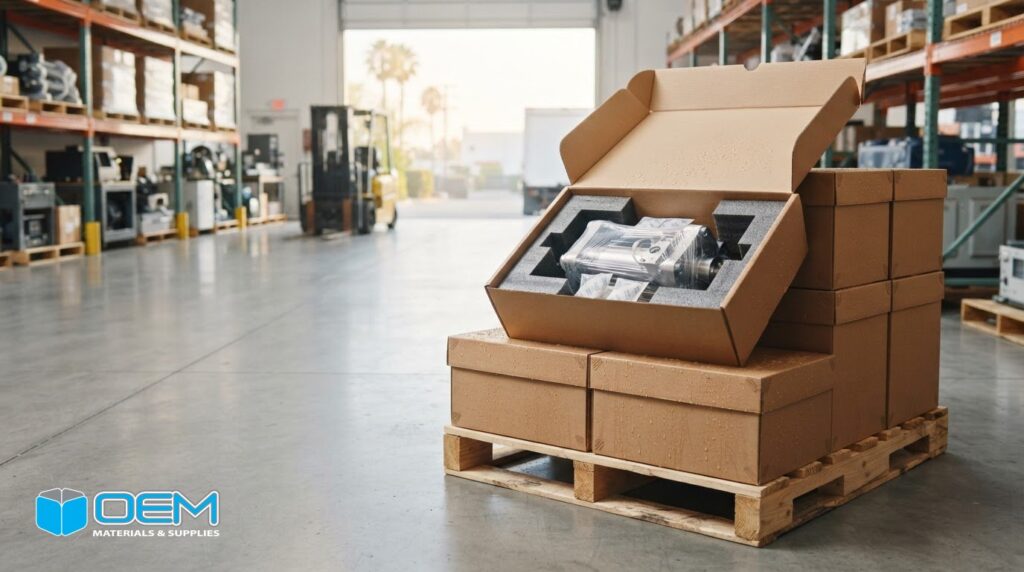
A single collapsed pallet in a high-humidity warehouse can represent thousands of dollars in lost inventory and wasted labor hours. For operations managers across Southern California, moisture is not just a weather concern; it is a constant threat to structural integrity during coastal transit and long-term storage. You already know that standard packaging often fails when exposed to the marine layer or temperature fluctuations in the Inland Empire. Protecting high-value industrial goods requires more than a generic container; it demands a technical solution engineered for durability.
This guide explains how to select the right water-resistant corrugated boxes in Los Angeles to achieve zero moisture-related product losses. We will examine how to evaluate specialized coatings and water-resistant adhesives that meet rigorous standards like ASTM D4727. You will also learn how to navigate California SB 54 compliance requirements while maintaining a lean supply chain. Our goal is to provide the technical context you need to choose materials that withstand marine environments and heavy stacking loads. By the end of this article, you will understand how custom-engineered packaging and vendor-managed inventory can reduce your total cost of ownership and protect your bottom line from environmental damage.
Key Takeaways
- Understand how the Southern California marine layer impacts standard fiberboard and why specialized containers are essential for port logistics.
- Evaluate the differences between aqueous coatings and wax-cascaded technologies to select the most effective water-resistant corrugated boxes in Los Angeles for your specific application.
- Learn why Edge Crush Test (ECT) ratings provide a more accurate prediction of stacking strength than Mullen Burst Strength in humid warehouse conditions.
- Identify the cost and lead time benefits of sourcing custom packaging from a local partner capable of providing Just-in-Time delivery and vendor-managed inventory.
- Discover how to integrate desiccants and custom foam packaging to create a multi-layered moisture barrier for sensitive aerospace and medical components.
The Role of Water-Resistant Packaging in Southern California Logistics
Southern California operates as a primary gateway for global trade. The high volume of freight moving through the region exposes industrial packaging to harsh environmental conditions. Standard paper packaging often lacks the structural integrity required to withstand these regional climate challenges. For logistics managers, implementing water-resistant corrugated boxes in Los Angeles is a operational necessity to prevent predictable material degradation during storage and transit.
The economic consequences of structural box failure during palletized storage are severe. When a bottom box absorbs moisture and loses its rigidity, the entire pallet stack can lean or collapse. This structural failure leads to crushed products, torn stretch film, and immediate inventory losses. Beyond material damage, collapsed pallets create safety hazards in high-bay racking systems and require extensive manual labor to restack and audit. Local manufacturers in Orange County and San Diego County require specialized moisture barriers to maintain stack stability and ensure predictable performance throughout the supply chain.
Combating the Marine Layer and Coastal Humidity
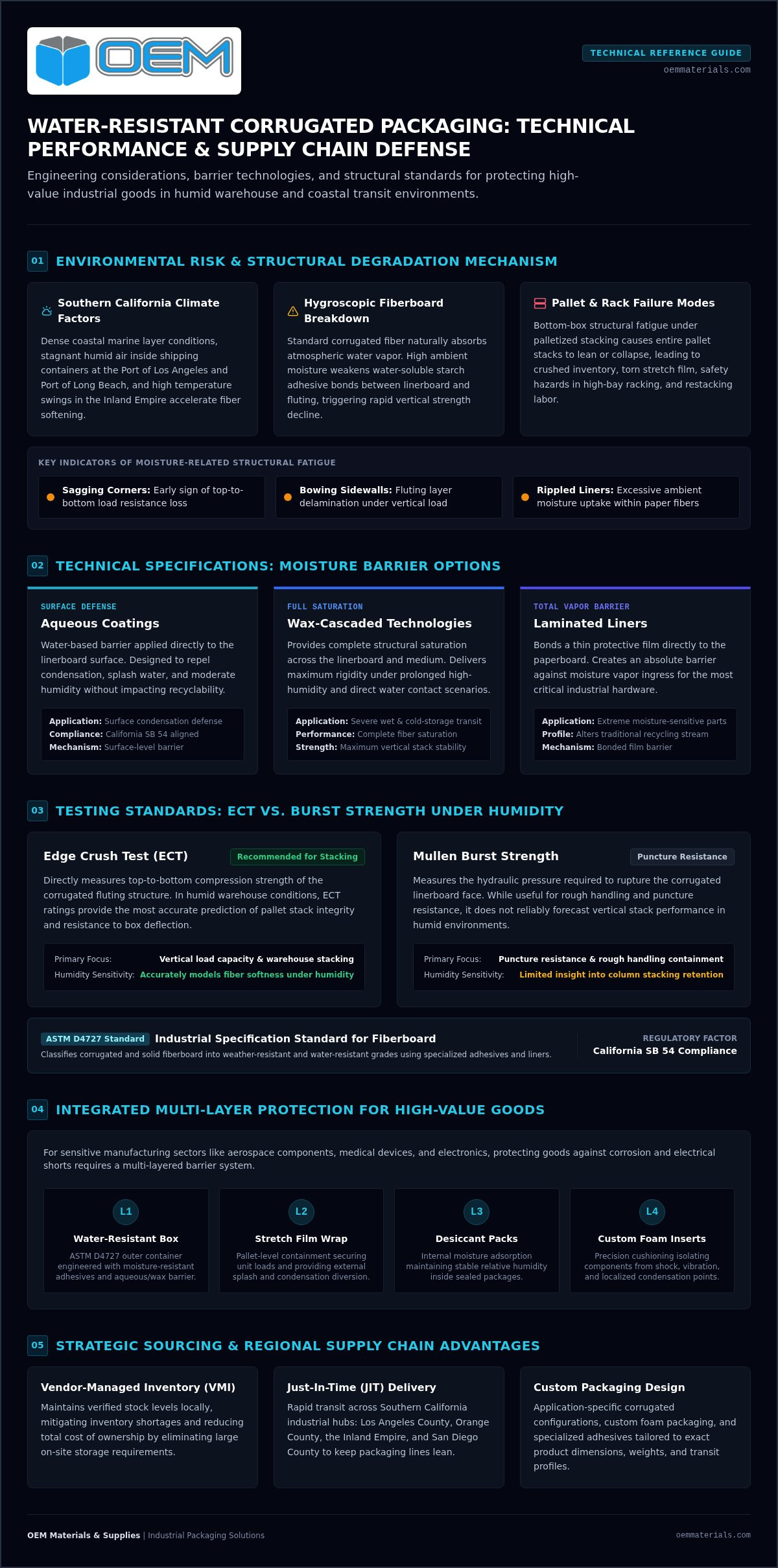
The Southern California marine layer brings cool, dense, high-humidity air miles inland every day. Standard corrugated fiberboard is inherently hygroscopic, meaning it naturally absorbs moisture from the surrounding atmosphere. High ambient moisture weakens the water-soluble starch adhesive bonds that hold the linerboard and fluting layers together. As the material absorbs water vapor, its fiber structure softens, causing a rapid decline in vertical stacking strength. Identifying signs of moisture-related structural fatigue, such as sagging corners, bowing sidewalls, or rippled liners, allows warehouse managers to intervene before a catastrophic pallet collapse occurs.
Protecting High-Value Industrial Goods in Transit
The humidity challenges at the Port of Los Angeles and Port of Long Beach are particularly acute during extended staging periods. Stagnant, humid air inside shipping containers can accelerate the degradation of standard packaging. This environment presents specific risks for aerospace components, medical devices, and electronic equipment, where even minor moisture ingress can cause corrosion or electrical shorts.
To mitigate these risks, procurement professionals utilize advanced corrugated boxes engineered with moisture-resistant barriers. These boxes prevent water vapor from penetrating the container walls, keeping the internal environment stable. For a broader context on selecting heavy-duty packaging for manufacturing environments, consult our Industrial Guide for OEMs. Utilizing the correct material specification protects high-value industrial goods during coastal transit and eliminates the hidden costs of transit-related product damage.
Technical Specifications: Understanding Moisture Barrier Technologies
Industrial packaging requires precise material selection based on environmental exposure. Generic terms like waterproof often mask critical performance differences between barrier types. To ensure predictable performance, industrial buyers specify materials using the ASTM D4727 standard, which classifies fiberboard into specific weather-resistant and water-resistant grades. Choosing the correct technology depends on whether your application requires full structural saturation or a surface-level barrier to shed condensation.
Laminated liners provide an absolute vapor barrier by bonding a thin plastic film directly to the paperboard. This method creates a highly reliable shield for sensitive components but changes the recycling profile of the container. For applications requiring high-volume compliance and reliable environmental defense, selecting the right combination of coatings and adhesives is essential. Procurement teams can work with our engineering team to request a technical consultation regarding custom material specifications for industrial programs.
Wax-Cascaded vs. Curtain-Coated Methods
Wax cascading involves passing a pre-cut corrugated box vertically through a continuous stream of molten wax. This process ensures full structural impregnation, saturating both the inner fluting and the linerboards. The result is maximum saturation designed for extreme wet environments, such as automotive parts storage or heavy machinery transit where standing water is present.
Conversely, curtain coating applies a thin, continuous layer of wax or polymer strictly to the surface of the linerboard. This surface-level treatment causes water to bead and slide off, preventing immediate absorption from rain or direct splashes. While curtain coating protects the exterior, it does not fully impregnate the internal fluting, making it less suitable for prolonged submersion than the cascaded method.
Aqueous and Sustainable Moisture Barriers
The regulatory landscape in California has shifted significantly with the implementation of the SB 54 permanent regulations on May 1, 2026. This law mandates a 25% reduction in single-use plastic packaging by 2032 and requires all single-use packaging to be fully recyclable or compostable. Traditional wax-coated boxes are notoriously difficult to recycle, forcing a major industry shift toward aqueous coatings.
Aqueous coatings utilize water-based polymer dispersions that create a sustainable moisture resistance layer for high-humidity storage. Performance comparisons show that modern aqueous treatments effectively repel water vapor and prevent fiber softening without compromising the repulpability of the box. For medical devices and electronics packaging, these sustainable barriers provide the necessary moisture defense while ensuring full compliance with state recycling mandates and corporate environmental initiatives.
Performance Metrics: Edge Crush Test and Moisture Standards
Industrial buyers often focus on the Edge Crush Test (ECT) as the primary indicator of box strength. However, standard ratings assume a controlled environment with low humidity. When evaluating water-resistant corrugated boxes in Los Angeles, you must account for how moisture absorption fundamentally alters these structural metrics. A box rated at 32 ECT under dry conditions can lose significant compressive strength if the fibers become saturated, leading to pallet failure in high-humidity coastal transit.
The industry is increasingly favoring ECT over the older Mullen Burst Test because ECT is a more accurate predictor of a container’s stacking performance. While the Mullen Test measures the force required to puncture the box wall, it doesn’t account for the vertical load-bearing capacity that modern warehouses require. In wet or humid environments, the failure mode is almost always structural collapse rather than a burst. Standardized testing, such as the TAPPI/ANSI T 811 om-23 for edgewise compressive strength, provides the technical baseline, but water-resistant adhesives (WRA) are necessary to maintain these ratings when the material is exposed to damp air.
Packaging design for sensitive industrial goods also requires monitoring the Moisture Vapor Transmission Rate (MVTR). This metric measures the passage of water vapor through a barrier material over a specific time. For aerospace and electronic components, a low MVTR is essential to prevent internal corrosion. By combining high ECT ratings with low MVTR coatings, manufacturers can ensure their packaging serves as both a structural support and an environmental shield.
Stacking Strength and Humidity Calculations
Calculating safe stack heights requires more than just knowing the weight of your product. Operations managers must apply a safety factor that accounts for environmental degradation. In humid warehouse conditions, a safety factor of 4:1 is often required to prevent long-term structural fatigue. The choice of fluting also impacts performance; while C-flute offers excellent vertical compression, B-flute provides a flatter surface that can improve the consistency of moisture-resistant coatings. Higher ECT safety margins are mandatory when pallets are staged in non-climate-controlled zones near the ports.
Industrial Standards for Aerospace and Medical Packaging
Aerospace and medical manufacturers operate under rigorous quality standards where packaging failure can lead to catastrophic inventory loss. Meeting these specifications requires consistent material sourcing to ensure that every production run performs exactly as prototyped. We offer custom packaging design services that integrate these performance metrics into the initial engineering phase. This approach ensures that your high-value equipment remains protected through every stage of the logistics cycle, from the assembly line to final delivery in high-humidity regions.
Strategic Sourcing for Southern California Manufacturers
Efficiency serves as the primary benchmark for industrial procurement. For manufacturers in the Southland, sourcing water-resistant corrugated boxes in Los Angeles provides a direct logistical advantage. Relying on generic packaging resellers often introduces unpredictable lead times and inconsistent coating quality. A local partnership ensures that technical specifications meet the exact requirements of your production line without the delays associated with long-distance freight. Proximity allows for faster prototyping and more responsive adjustments to material grades as environmental conditions shift.
Reducing lead times is critical for maintaining high-volume industrial programs. Local manufacturing and distribution centers allow for tighter control over the supply chain. This responsiveness is particularly vital when sudden spikes in humidity or unexpected marine layer density require a rapid shift to higher-performance moisture barriers. By eliminating the friction of transcontinental shipping, operations managers can maintain leaner inventory levels while ensuring that critical components remain protected from coastal moisture. To optimize your procurement process, request a quote for a custom inventory program tailored to your annual usage.
Local Supply Chain Advantages
Freight costs represent a significant portion of the total cost of ownership in industrial packaging. Minimizing these expenses between Riverside, San Diego, and Los Angeles requires a strategically located supplier. A regional partner understands the specific traffic patterns and port congestion issues that affect delivery schedules at the Port of Long Beach. Implementing VMI services allows manufacturers to offload the burden of inventory tracking to their supplier, ensuring that water-resistant stock is always available when production ramps up. For more information on evaluating regional partners, refer to our Wholesale Packaging Supplier guide.
Inventory Management and Cost Control
Warehouse space in Southern California is expensive and often limited. Just-In-Time (JIT) delivery strategies allow manufacturers to optimize their floor space for production rather than bulk storage. VMI programs further lower the total cost of ownership by reducing the labor hours spent on manual inventory audits and purchase order processing. These programs are designed to scale seamlessly from initial prototypes to high-volume production runs, providing stability through every phase of the product lifecycle. While results depend on specific variables like product dimensions and shipping requirements, you can explore potential packaging cost savings by streamlining your material specifications. Reliable local sourcing transforms packaging from a commodity expense into a strategic asset that supports operational efficiency.
Integrated Solutions: Beyond the Water-Resistant Box
Achieving total moisture protection requires looking beyond the container itself. While water-resistant corrugated boxes in Los Angeles serve as the primary structural defense, they are often part of a multi-layered protective system. For industries like aerospace and medical device manufacturing, internal humidity control is just as critical as external water resistance. Integrating desiccants and moisture-absorbing packets inside the container helps manage localized humidity spikes that occur during temperature shifts in transit.
Streamlining production lines often involves kitting and assembly services. By receiving fully assembled packaging kits that include the box, internal cushioning, and required documentation, manufacturers reduce labor costs and minimize handling errors. This integrated approach ensures that every component of the packaging system is compatible and performs to the required engineering standards. It transforms the box from a simple commodity into a functional component of the manufacturing process.
Custom Foam Packaging for Sensitive Electronics
Selecting the right internal cushioning is essential to prevent moisture-related damage. Standard foams can sometimes trap condensation against the product surface if they aren’t specified correctly. Engineers must select foam packaging with densities that provide shock protection without creating a microclimate that encourages corrosion. Our Industrial Guide to Foam Inserts provides deeper insight into material selection for sensitive hardware. Using closed-cell foams often provides a better moisture barrier than open-cell alternatives, especially when shipping through the high-humidity environments found in San Diego County and the Inland Empire.
Pallet Stabilization and Exterior Protection
The external defense of a shipment begins with high-performance stretch film. This layer acts as a primary shield against direct rain and coastal mist before moisture ever reaches the corrugated wall. In humid environments, standard fiberboard corners can soften, leading to strap failure or pallet shifting. Utilizing edge protectors maintains the vertical integrity of the load and prevents the film from puncturing at high-stress points.
For heavy-duty export requirements, coordinating water-resistant corrugated with plastic pallets or heat-treated wood crates provides the highest level of security. Plastic pallets are particularly effective in maritime logistics because they don’t absorb moisture or harbor pests, unlike standard wood. By combining these elements into a single engineered solution, operations managers can eliminate the variables that lead to transit damage and ensure their high-value goods arrive in pristine condition.
Securing Your Industrial Supply Chain Against Moisture Damage
Protecting high-value industrial goods requires a transition from reactive packaging to an engineered, proactive system. You’ve seen how selecting the right moisture barrier technology prevents structural collapse and inventory loss in the unique Southern California climate. Implementing specialized water-resistant corrugated boxes in Los Angeles ensures your products withstand the marine layer and port humidity. By focusing on technical metrics like ECT ratings and MVTR, you can maintain stack stability and eliminate the hidden costs of moisture damage.
Operational efficiency is achieved through a combination of expert packaging design and strategic local sourcing. OEM Materials & Supplies supports aerospace and medical manufacturers with rigorous standards and reliable inventory management. Our VMI programs and JIT delivery capabilities are designed to streamline your supply chain and optimize warehouse space. Contact us to request a quote for custom water-resistant corrugated boxes tailored to your specific product dimensions and annual usage. We look forward to partnering with you to secure your logistics operations.
Frequently Asked Questions
What makes a corrugated box water-resistant versus waterproof?
Water-resistant boxes are engineered to repel moisture and maintain structural integrity under high-humidity conditions or light splashing. This is achieved through specialized surface coatings or water-resistant adhesives that prevent fiber softening. Conversely, waterproof containers require non-porous materials like plastic to withstand full submersion. Most industrial applications in Southern California rely on water-resistant corrugated boxes in Los Angeles to defend against the marine layer without the excessive cost of fully waterproof systems.
How does humidity affect the stacking strength of standard shipping boxes?
High humidity causes standard corrugated fibers to absorb water vapor, which weakens the starch-based adhesive bonds and softens the linerboard. This absorption can lead to a loss of up to 50% of the box’s original Edge Crush Test rating in extreme conditions. In coastal regions like Long Beach, this degradation often results in sagging corners and pallet collapse during vertical stacking in non-climate-controlled warehouses, leading to significant inventory damage.
Are water-resistant corrugated boxes recyclable in Los Angeles?
Recyclability depends on the specific barrier technology applied to the fiberboard. Aqueous-coated boxes are generally fully recyclable and repulpable, meeting the strict requirements of California SB 54 regulations. However, traditional wax-cascaded boxes are typically not accepted in standard recycling streams because the wax contaminates the paper pulp. Industrial buyers should specify aqueous-based water-resistant treatments to ensure compliance with local waste management standards and corporate sustainability initiatives in Orange County.
What is the typical lead time for custom water-resistant boxes in SoCal?
Lead times vary based on the complexity of the die-cut design and current material availability for specialized coatings. Industrial buyers should verify current lead times for custom die-cut water-resistant runs directly with their supplier during the engineering phase. Sourcing from a local manufacturer in the Inland Empire or San Diego County typically reduces transit times. Implementing a vendor-managed inventory program can further eliminate lead time concerns by maintaining a consistent safety stock.
Can I get custom printing on water-resistant coated boxes?
Yes, custom branding and technical specifications can be printed on moisture-resistant containers. The printing process usually occurs before the water-resistant coating is applied to ensure the ink adheres properly to the linerboard. This sequence is critical for aerospace and medical manufacturers who require clear, durable labeling for tracking and compliance. Finalizing artwork during the design phase ensures high-visibility results that remain legible even after exposure to humid coastal environments.
Which coating is best for long-term outdoor storage?
Wax-cascaded treatments provide the highest level of protection for long-term outdoor exposure or environments where standing water is present. This process fully impregnates the fluting and liners, offering maximum saturation resistance. While aqueous coatings are excellent for high-humidity warehouse storage and are more sustainable, they don’t withstand direct, prolonged saturation as effectively as a fully cascaded wax box. The choice depends on your specific logistics cycle and environmental exposure risks.
Do I need a special adhesive or tape for water-resistant boxes?
Standard packaging tape often fails to adhere to wax-coated or heavily treated surfaces. Industrial buyers should specify water-resistant adhesives during the box manufacturing process and use high-tack, moisture-stable acrylic or hot-melt tapes for final sealing. For heavy-duty applications, reinforced water-activated tape or specialized stretch film can provide additional security. Ensuring the closure method matches the moisture-resistant properties of the box is essential for maintaining a reliable environmental barrier.
How do I determine if I need wax-cascaded or aqueous-coated boxes?
The decision is based on your environmental exposure levels and sustainability requirements. Aqueous coatings are ideal for high-humidity transit and storage while remaining fully recyclable under California regulations. Wax-cascaded boxes are necessary for extreme conditions where boxes might sit in standing water or face direct saturation. Operations managers should evaluate their entire supply chain, including port staging and final delivery locations, to determine the necessary level of structural saturation resistance.