

For packaging supplier lead time reduction Los Angeles teams can sustain, start with the order plan, not simply a request for a supplier to move faster. Clear specifications, realistic usage information, and delivery plans that match the facility’s workflow can make replenishment more predictable. The right packaging plan also needs to protect products and fit the way they are handled and shipped.
Packaging delays can disrupt production and outbound shipments. Unclear requirements or late design changes can slow quoting and fulfillment. Extra stock may reduce shortage risk, but it can also use valuable storage space and tie up inventory. A better first step is to identify where time is being lost, then address the cause without compromising package fit or product protection.
This article covers practical ways to reduce delays across specifications, ordering, inventory, and delivery. It explains how to plan replenishment around actual demand and assess suppliers by operational fit and communication, not promises alone. The goal is a more reliable packaging supply process for operations in Los Angeles, Orange County, San Diego, and Riverside, with fewer urgent orders and less risk of disruption.
Key Takeaways
- Break lead time into order-specific stages to pinpoint delays, from specification approval through delivery.
- Connect confirmed packaging requirements with demand patterns and clear replenishment signals.
- Compare suppliers on specification support, communication, replenishment planning, and delivery coordination, not speed claims alone.
- Review stockouts, approval bottlenecks, and late specification changes before deciding whether to change suppliers.
- Packaging design support and custom corrugated boxes can help align requirements with procurement planning.
Why Packaging Supplier Lead Times Disrupt Los Angeles Operations
A packaging delay can interrupt production, hold finished goods, or push outbound shipments off schedule. When materials arrive later than planned, purchasing teams may need to place reactive orders or consider alternatives before confirming they meet product requirements. For Los Angeles operations, reducing supplier lead times starts with identifying where time is actually spent, rather than assuming manufacturing is the only source of delay.
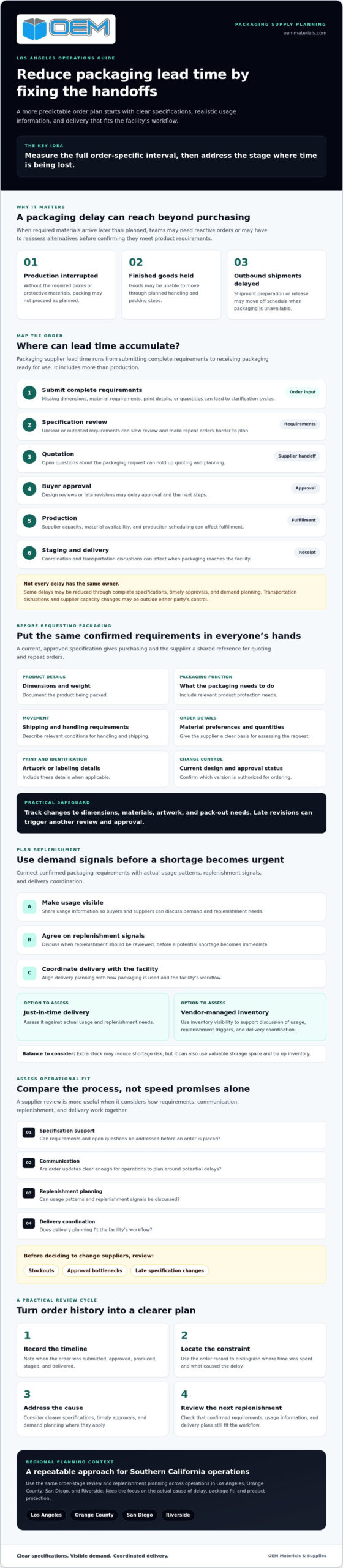
Packaging supplier lead time is the full order-specific interval from submitting complete requirements to receiving packaging ready for use. It can include specification review, quotation, buyer approval, production, staging, and delivery. This broader view follows the supply-chain concept of lead time, where elapsed time reflects the stages involved in fulfilling an order, not just manufacturing.
Which stages of a packaging order can create delays?
Each stage is easier to assess when its handoff is clear. Suppliers need confirmed dimensions, materials, print details when applicable, and order quantities to quote and plan accurately. Missing information can trigger clarification cycles. Buyer-side design reviews or late revisions may delay approval, while supplier-side capacity, material availability, or production scheduling can affect fulfillment after approval.
Some delays can be reduced through complete specifications, timely approvals, and demand planning. Others, such as transportation disruptions or changes in supplier capacity, may be outside either party’s control. Record when an order is submitted, approved, produced, staged, and delivered. This timeline helps distinguish causes and identify where a process change could help.
How do packaging delays affect production and fulfillment?
Packaging availability is part of line readiness. Without the required boxes or protective materials, a team may be unable to pack finished products as planned, prepare goods for handling, or release outbound shipments. Reliable order updates and delivery coordination give operations time to adjust schedules or inventory plans before a potential delay becomes an immediate shortage.
Hypothetical example: A Los Angeles manufacturer has finished goods ready to pack, but a revised box specification is still awaiting approval. If the order cannot proceed until approval is complete, shipment preparation may need to wait. Reviewing the design earlier and clarifying approval status can help the team plan around the constraint. Buyers seeking shorter supplier lead times should evaluate communication and delivery coordination alongside product availability. Options such as just-in-time packaging may also be worth assessing against actual usage and replenishment needs.
How Packaging Specifications, Inventory, and Delivery Shape Lead Time
Suppliers can plan more accurately when packaging requirements are settled before an order is placed. Confirmed dimensions, material requirements, print details, and order quantities define what needs to be quoted and fulfilled. Complete, approved specifications help prevent avoidable order clarification. For Los Angeles manufacturers, keeping one current specification for both purchasing and the supplier to reference can help prevent outdated details from carrying into repeat orders.
A design revision after an order has been planned may require another review of requirements and approvals. Track changes to dimensions, materials, artwork, or pack-out needs, and confirm which version is authorized for ordering. For corrugated applications, consult this corrugated box resource when defining the packaging requirement.
What information should buyers finalize before requesting packaging?
Document product dimensions and weight, the packaging function, and relevant shipping or handling requirements. Add material preferences, artwork or labeling details, order quantities, and the approval status of the current design when applicable. This gives the supplier a clearer basis for assessing the request and identifying open questions. Packaging design support can help resolve specification gaps before a repeat order is placed.
When can JIT delivery or VMI support replenishment planning?
Inventory visibility helps buyers and suppliers discuss usage, replenishment triggers, and delivery coordination before a shortage becomes urgent. Just-in-time delivery and vendor-managed inventory (VMI) are planning approaches, not guarantees of a fixed delivery time. Their suitability depends on demand patterns, storage capacity, receiving needs, and the packaging program.
Agree on what usage information will be shared, who monitors inventory, what prompts a replenishment discussion, and how delivery changes will be communicated. These decisions connect purchasing, inventory, and delivery as parts of supply chain management. For operations in Los Angeles, Orange County, San Diego, and Riverside, assess any JIT or VMI arrangement against actual consumption and facility constraints. Buyers can request a packaging quote with product dimensions, weight, current specifications, and usage patterns to support a focused discussion.
How to Evaluate a Packaging Supplier for Faster, More Predictable Service
A supplier’s quoted lead time is useful only when you understand what it includes. Compare the assumptions behind each quote, then assess whether the supplier can support your packaging requirements, production volume, and receiving process. For packaging supplier lead time reduction in Los Angeles, operational fit and clear communication matter as much as product availability.
| Evaluation area | What to confirm |
|---|---|
| Specification support | Can the supplier review your dimensions, materials, packaging function, and approved design details? |
| Communication | How are order confirmations, specification changes, and possible delays shared? |
| Replenishment planning | Can you discuss usage visibility, order cadence, and replenishment signals that fit your operation? |
| Delivery coordination | Can delivery planning be aligned with your facility’s receiving process and production needs? |
What should a Los Angeles packaging supplier confirm upfront?
Ask what information the supplier needs to assess the packaging and order cadence. Confirm how changes and order updates are handled, who communicates potential delays, and what delivery details need coordination. For service in Los Angeles, Orange County, San Diego, or Riverside, confirm that the supplier can support your location and receiving requirements. Local coverage should be verified, not assumed.
Also confirm that the supplier can handle the packaging types and production volumes your operation requires. A supplier may suit a corrugated box program but not necessarily every other packaging need. Match capabilities to your actual specifications and demand.
How can buyers compare suppliers without relying on promises?
Review each quote’s scope, including approved specifications, order quantity, production assumptions, approval steps, and delivery destination or requirements. A quoted interval may not be comparable if one offer begins after final approval while another includes earlier order stages. Ask suppliers to explain assumptions in writing, and compare how each manages updates instead of relying on unverified speed claims.
Evaluate packaging design support, corrugated supply, and replenishment planning against your operation’s specific requirements. These are practical elements of resilient supply chain strategies, especially when supplier communication helps teams respond to changing conditions. For broader selection criteria, see this Southern California packaging supplier guide.
Use the same questions with each prospective supplier, then compare documented capabilities and assumptions. To discuss packaging requirements and planning needs, request a packaging quote with your specifications, expected order quantities, and delivery requirements.
A Practical Process for Packaging Supplier Lead Time Reduction Los Angeles Teams Can Use
A reliable improvement plan starts with evidence, not an immediate supplier change. Review how orders move through purchasing, engineering, operations, and receiving. Assign clear ownership for specifications, approvals, demand updates, and delivery communication. This gives teams a basis for reducing packaging supplier lead times without defaulting to excess inventory or urgent orders.
How should teams identify the cause of recurring packaging delays?
Review recent orders and note where time was spent: incomplete specifications, approval waits, order revisions, production constraints, or delivery coordination. Separate one-time exceptions from recurring process issues before choosing a corrective action. Record the operational effect, such as a shipment held for packaging or an adjusted production schedule, without assuming every delay has the same cause.
- Review delay history. Gather order dates, approval points, changes, delivery updates, and any stockout or schedule effects. Look for recurring patterns.
- Confirm specifications. Assign an owner to maintain approved dimensions, materials, artwork, and revision details so purchasing and the supplier use the same requirements.
- Map demand. Compare packaging use with production plans and actual order patterns. Account for storage limits and receiving capacity rather than choosing a universal inventory level.
- Agree on replenishment signals. Define which usage or inventory information will be shared, who monitors it, and what prompts a replenishment discussion or order.
- Review performance. Check whether orders followed the agreed process, where changes occurred, and whether communication supported timely decisions. Adjust the plan based on observed results.
How can teams establish a workable replenishment plan?
Purchasing can coordinate order status, engineering can confirm specification changes, operations can share demand shifts, and receiving can communicate facility constraints. Agree with the supplier on responsible contacts, the communication cadence, and how potential delays will be escalated. Assess a just-in-time or vendor-managed inventory approach against real demand variation and receiving capacity. Neither approach should be treated as a fixed-time guarantee.
Planning checklist:
- Are current packaging specifications and revisions approved?
- Which recurring delays, stockouts, or approval bottlenecks need attention?
- Who shares demand updates and receives order-status communications?
- Do replenishment signals fit actual usage, storage, and receiving constraints?
- How will the team review order performance and revise the plan?
Use these findings to discuss a replenishment plan grounded in your packaging requirements and usage patterns. Discuss a packaging replenishment plan with OEM Materials & Supplies.
How OEM Materials & Supplies Supports Packaging Supply Planning in Los Angeles
OEM Materials & Supplies serves manufacturers in Los Angeles and throughout Southern California, including Orange County, San Diego, and Riverside, with industrial packaging and supply-planning support. For packaging supplier lead time reduction in Los Angeles, a useful starting point is aligning packaging specifications with purchasing and replenishment needs. Lead times and outcomes depend on the materials, product requirements, shipping needs, and order plan.
Which OEM Materials & Supplies capabilities may fit a lead-time reduction plan?
Custom corrugated boxes and packaging design support can help teams define packaging requirements and resolve specification questions before repeat orders. Clear dimensions, materials, and approved design details give purchasing and suppliers a shared reference for quoting and planning.
Buyers can also discuss just-in-time delivery or vendor-managed inventory in relation to actual usage, storage capacity, and the receiving process. These are planning approaches, not promises of a fixed delivery time. Kitting and assembly may be relevant when a documented packing workflow includes those tasks. Their fit depends on the specific process and requirements.
The objective is not to apply the same inventory or delivery model to every packaging program. Match supplier support to the products being packed, production volumes, and replenishment conditions. This keeps decisions grounded in operational needs rather than general speed claims.
What should buyers include in a quote or consultation request?
Provide enough detail for a supplier to understand both the packaging application and ordering pattern. Useful information includes:
- Product dimensions and weight
- Packaging function and requirements, including relevant shipping or handling needs
- Approved design files or current specifications, if available
- Anticipated usage and current ordering patterns
- Recurring order challenges, such as approval delays or stockouts
- Facility delivery considerations, including receiving constraints
This information helps frame a practical discussion about packaging options and supply planning. It also shows which details still need review before a quote or replenishment approach can be evaluated. Share the application and usage context, not just the requested item, so recommendations can account for the specific packaging and order requirements.
Request a packaging quote or consultation with product dimensions, weight, packaging requirements, and anticipated usage to start a focused conversation with OEM Materials & Supplies.
Build a More Predictable Packaging Supply Plan
Reducing packaging delays takes more than a faster quote. Clear specifications, shared demand information, and defined communication responsibilities help purchasing, engineering, operations, and suppliers plan around the same requirements. These are practical foundations for packaging supplier lead time reduction Los Angeles teams can sustain without compromising fit, protection, or production needs.
OEM Materials & Supplies serves manufacturers in Los Angeles and throughout Southern California. Support includes custom corrugated packaging and packaging design, along with JIT delivery, vendor-managed inventory, kitting, and assembly services to discuss based on your program. The right approach depends on packaging requirements, usage patterns, materials, and shipping needs, so no single plan fits every operation.
Start with product dimensions and weight, current packaging requirements, anticipated usage, and recurring ordering or delivery challenges. Request a packaging quote or consultation to review your needs and identify a practical path toward more reliable replenishment. With the right information and a coordinated plan, your team can make packaging supply more predictable.
Frequently Asked Questions
How can a Los Angeles manufacturer reduce packaging supplier lead time?
A Los Angeles manufacturer can reduce packaging delays by providing approved specifications, sharing realistic demand information, and agreeing with the supplier on order updates and replenishment signals. For packaging supplier lead time reduction in Los Angeles, first review where previous orders stalled, such as during approval, specification changes, or delivery coordination. Assign clear internal owners for specifications and demand updates. These steps improve visibility, but actual timing depends on materials, order requirements, and logistics.
What information should I provide to a packaging supplier for an accurate lead-time assessment?
Provide product dimensions and weight, the packaging function, material requirements or preferences, shipping and handling needs, and the quantity required. Include approved drawings, artwork, or other design files if they apply. State whether specifications are final or still under review, since pending approvals or revisions may affect the order plan. Sharing expected usage and requested delivery details also helps the supplier assess the order in the context of your operation.
Can vendor-managed inventory reduce packaging delays?
Vendor-managed inventory may help reduce packaging delays when the buyer and supplier have useful visibility into consumption and agree on how replenishment will be coordinated. The arrangement can clarify who monitors inventory information, what signals prompt action, and how order updates are shared. It is not a guarantee of fixed delivery timing or uninterrupted supply. Its suitability depends on demand patterns, packaging requirements, available storage, receiving capacity, and the responsibilities both parties agree to manage.
Is just-in-time packaging right for every manufacturer?
No. Just-in-time packaging may support closer coordination between packaging replenishment and production needs, but it requires a workable plan for demand and delivery. Manufacturers should assess how much usage varies, whether receiving can handle the planned delivery pattern, and how packaging requirements or schedules may change. They should also confirm the supply and communication assumptions behind the arrangement. Compare those factors with storage constraints and shortage risks before deciding whether the approach fits.
What causes custom packaging orders to take longer?
Custom packaging orders can take longer when specifications are incomplete, dimensions or materials change, or design approvals remain open. Order quantity, supplier planning requirements, and delivery coordination may also affect the timeline. The causes vary by order, so review each stage rather than assuming production is the only constraint. A clear, approved specification and prompt communication about revisions help purchasing, engineering, and the supplier work from the same requirements.
How do I compare packaging suppliers in Los Angeles?
Compare suppliers against your packaging types, production volumes, and operating requirements. Ask how they support specifications, communicate order changes, plan replenishment, and coordinate delivery. Check the assumptions behind quoted timing, including quantity, approvals, and delivery details. For operations in Los Angeles, Orange County, San Diego, or Riverside, confirm service coverage and facility coordination directly. Assess documented processes and demonstrated fit, not an unsupported promise of faster fulfillment.
Does switching packaging suppliers automatically reduce lead time?
No. Changing suppliers alone does not guarantee shorter packaging lead times. First identify whether recurring delays stem from unclear specifications, internal approval steps, demand planning, supplier capacity, or delivery coordination. Then assess whether a prospective supplier’s capabilities and communication practices address those specific constraints. Compare order assumptions and confirm that packaging requirements, quantities, and receiving needs are understood. A supplier change is most useful when it resolves a verified mismatch or process bottleneck.