
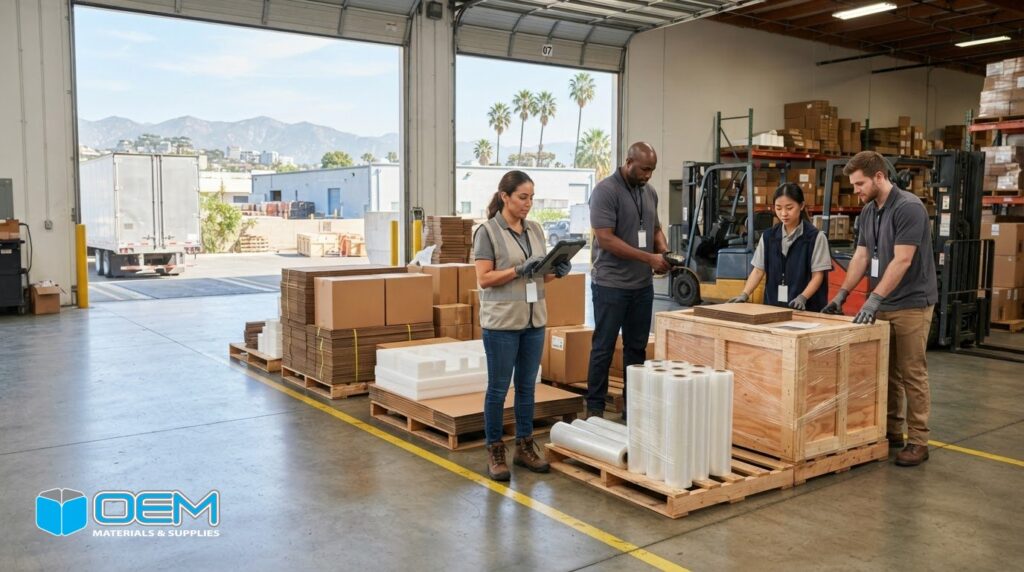
A delivery promise alone can’t prevent a packaging shortage. Reliable supply depends on clear replenishment plans, accurate demand information, and shared responsibility between your operation and its supplier. If you’re searching for “on-time packaging supply delivery los angeles,” look beyond the promised arrival date.
A late shipment of boxes, foam, cushioning, or stretch film can disrupt production and fulfillment. The challenge is finding a supplier whose products and inventory approach fit your facility, with clear communication about delivery schedules and replenishment responsibilities.
This guide explains how to evaluate supplier reliability, plan replenishment around actual usage, and reduce avoidable material shortages at your Los Angeles operation. You’ll learn what to clarify about delivery schedules and inventory arrangements, and what demand information to share as requirements change. The goal is a dependable supply process, not reliance on promises alone.
Key Takeaways
- Assess how a supplier confirms packaging specifications, quantities, order status, and requested delivery dates instead of relying on promises alone.
- Compare buyer-managed replenishment, scheduled ordering, just-in-time delivery, and vendor-managed inventory to clarify who tracks stock and triggers orders.
- Use the on-time packaging supply delivery los angeles framework to assess whether a supplier’s delivery coordination fits your operation.
- Document receiving hours, site access, unloading requirements, and order contacts, then confirm service coverage and schedule feasibility with the supplier.
- Share packaging requirements and usage information so you can discuss product fit and a replenishment approach for your facility.
On-Time Packaging Supply Delivery in Los Angeles Starts with Operational Fit
A shortage of corrugated boxes can hold up a production run. Missing foam packaging or cushioning materials can leave finished goods waiting to be packed, while an incomplete stretch film order can affect warehouse staging and outbound plans. The impact can reach beyond purchasing: teams may need to reschedule work, rearrange storage, or coordinate fulfillment around materials that haven’t arrived.
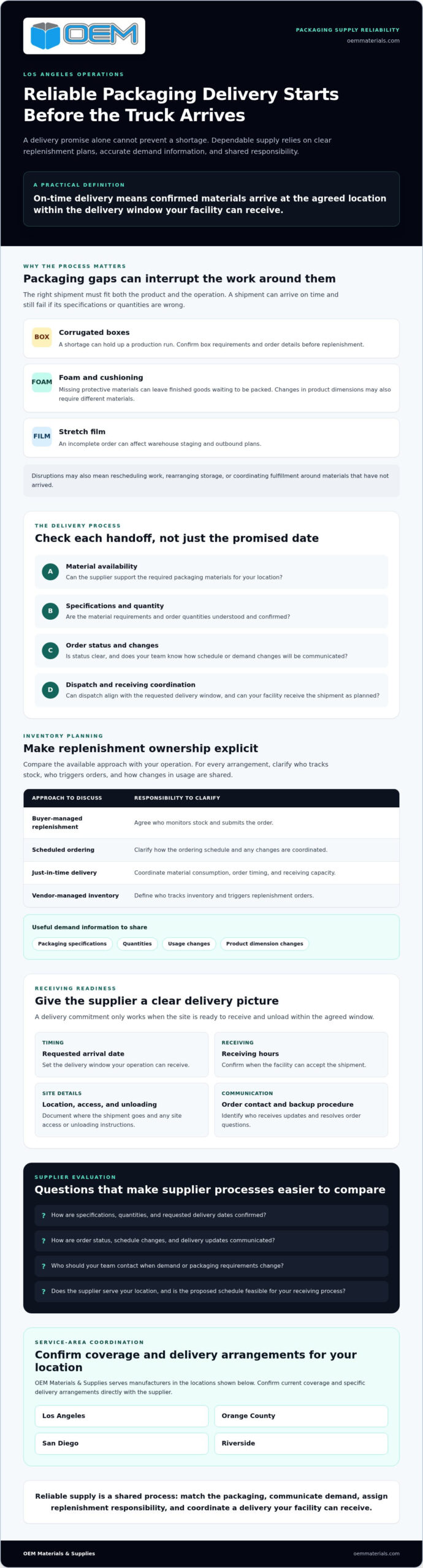
Dependable delivery is a process buyers can assess, not an unconditional guarantee. Check each handoff: Is the required material available? Has the supplier confirmed the specifications and quantity? Is the order status clear? Has dispatch been coordinated with the requested delivery date, and can your facility receive the shipment as planned? These steps reflect the coordination involved in supply chain management.
Which packaging supply risks can disrupt operations?
Replenishment becomes harder when order signals are inconsistent. If different teams place requests through separate channels, changes in usage aren’t shared, or reorder responsibility is unclear, the supplier may not have a complete picture of demand. Set a process that identifies who monitors stock, who submits orders, and how changes in quantities or packaging requirements are communicated.
For example, a change in product dimensions may require different boxes or protective materials. If the buyer updates the specification but the order still reflects the old one, the shipment may arrive on time and still fail to support the work. Confirm both material requirements and order details to reduce that risk.
What does on-time delivery mean for your facility?
Define a delivery window your operation can receive. Specify the requested arrival date, receiving hours, delivery location, and any site access or unloading instructions. Name the person responsible for receiving updates and resolving order questions. A supplier’s delivery commitment is only one part of the plan; your team must be ready to receive and unload the shipment within the agreed window.
A practical definition is simple: on-time delivery means the confirmed materials arrive at the agreed location within the delivery window your facility can receive. That gives both parties a shared reference point without treating timing as a blanket guarantee.
For on-time packaging supply delivery in Los Angeles, confirm that the supplier serves your location and can coordinate with your facility’s requirements. OEM Materials & Supplies serves manufacturers in Los Angeles, Orange County, San Diego, and Riverside. Discuss whether its just-in-time packaging information is relevant to your products, ordering process, and receiving schedule. Confirm current coverage and specific delivery arrangements directly with the supplier.
How to Evaluate a Los Angeles Packaging Supplier’s Delivery Process
Evaluate the process behind the delivery date, not just the date itself. A supplier’s ability to support your operation depends on product fit, order accuracy, communication, replenishment planning, and coordination with your receiving team. Ask each potential supplier the same questions so you can compare how clearly responsibilities and schedule changes are handled.
Questions to ask before placing a packaging order
Start with the items your program needs. Confirm which packaging materials and quantities the supplier can support for your location, and verify that specifications match the products your team will pack. For corrugated packaging, check that box requirements and order details are understood before placing a replenishment order. Review the available corrugated box options as a starting point for discussing product fit.
Then ask how the supplier acknowledges an order, communicates changes, and shares order status or delivery updates. Clarify how the requested delivery date is confirmed, who to contact if demand changes, and how schedule changes are escalated. Document the primary contact and backup procedure so your team knows where to direct questions. Before relying on a schedule or service term, ask for clarification and confirm what applies to your account and location.
How just-in-time delivery fits replenishment planning
Just-in-time delivery requires coordination between material consumption, order timing, and receiving capacity. Buyers should share useful demand information, flag production changes promptly, and agree on how order quantities and delivery windows are reviewed. OEM Materials & Supplies provides information about just-in-time packaging delivery. Confirm directly whether this approach is available for your requirements and whether the schedule is feasible. Don’t assume a fixed lead time or guaranteed arrival schedule.
For a practical assessment, ask the supplier to walk through a normal order and a change scenario. How are specifications and quantities checked? When does an order become confirmed? How will your team learn about a schedule adjustment? The Port of Los Angeles describes tools that digitize maritime shipping data to support cargo flow and predictability. For packaging orders, focus on the communication and status information your supplier can provide for your shipment.
These questions make on-time packaging supply delivery los angeles a measurable operating process rather than a broad promise. If you’re comparing packaging needs and replenishment options, share your requirements for a quote, including item specifications, quantities, and expected usage.
Compare Inventory Programs and Delivery Options Before You Commit
Packaging replenishment can be buyer-managed, ordered on a recurring schedule, coordinated through just-in-time delivery, or supported by vendor-managed inventory (VMI). Each approach assigns ordering and inventory tasks differently. The right fit depends on how consistently materials are used, how much storage your facility has, which packaging items you need, and the supplier’s confirmed terms.
Use this comparison to identify what to clarify before choosing a program:
| Approach | Responsibilities and information needed | Questions to confirm |
|---|---|---|
| Buyer-managed | Your team monitors stock and places orders. Share specifications, quantities, and usage changes. | How are orders acknowledged, and how are delivery dates confirmed? |
| Scheduled ordering | Both parties plan recurring orders. Agree on order quantities, timing, and how to handle demand changes. | How can the schedule be adjusted if usage shifts? |
| Just-in-time delivery | Coordinate consumption, order timing, and receiving capacity. Provide current demand information. | What information and notice does the supplier need to plan delivery? |
| Vendor-managed inventory | Define how inventory is monitored, what records are shared, and who approves replenishment. | Who maintains inventory records, and how are proposed orders reviewed? |
When should a buyer consider vendor-managed inventory?
VMI may suit a facility seeking closer coordination with its packaging supplier, but responsibilities need to be explicit. Agree on how the supplier will access inventory levels or usage, who keeps the authoritative records, and whether replenishment requires buyer approval. OEM Materials & Supplies offers vendor-managed inventory services. Confirm the program’s scope and terms for your location and materials before relying on it.
How to choose between scheduled and just-in-time replenishment
Scheduled ordering can make sense when usage is predictable and the facility can accommodate planned deliveries. Just-in-time replenishment calls for closer coordination between consumption, order timing, and receiving availability. It may reduce the need to hold as much packaging onsite, but it depends on current usage information and confirmed supplier arrangements. Neither model is best for every operation.
Assess each material separately. A frequently used box may follow a different replenishment pattern than protective packaging used for occasional orders. For on-time packaging supply delivery los angeles, compare storage capacity, demand variability, receiving constraints, and the supplier’s specific terms. Then assign clear ownership for monitoring stock and communicating changes.
Plan Los Angeles Packaging Deliveries Around Your Facility’s Requirements
A delivery plan needs to fit the receiving operation, not just the purchase order. A shipment arriving at the wrong dock, outside receiving hours, or without clear unloading instructions can create avoidable delays even if the order is ready. For on-time packaging supply delivery in Los Angeles, confirm that the supplier can serve your specific location and that the proposed schedule works for both parties.
What information should you prepare for a delivery plan?
Give the supplier a clear picture of what your operation uses and where materials need to go. Prepare packaging types, product dimensions and weights, order quantities, and estimated annual usage. Note demand variation, production schedule changes, or storage limits that could affect order timing or shipment size.
Also document receiving details that can affect delivery coordination:
- Delivery point: Provide the facility address and the correct dock, entrance, or receiving area.
- Receiving conditions: State receiving hours, site access instructions, and any unloading requirements.
- Order contacts: Identify who submits purchase orders, confirms delivery details, and receives schedule updates.
Share these details early, then ask the supplier to confirm current coverage in Los Angeles, Orange County, San Diego, or Riverside and whether the requested schedule is feasible for your location and packaging needs. Verify delivery arrangements directly rather than assuming that service to a region means every location or schedule can be accommodated.
How can teams reduce avoidable receiving and replenishment delays?
Assign an owner for each handoff. Purchasing may manage forecasts and purchase orders, while operations reports changes in consumption and receiving confirms delivery readiness. Make sure everyone knows how to submit order changes and who communicates schedule updates or delivery exceptions. Clear ownership helps prevent conflicting instructions and unanswered questions.
Review actual consumption with the supplier when production plans, packaging specifications, or product mix change. A revised product size may affect the packaging required, while a shift in output may change the quantities your team needs. Keep order details and facility instructions current so replenishment discussions reflect operating conditions rather than outdated assumptions.
For a packaging supply quote, share the material types, product dimensions and weights, expected quantities, annual usage, and delivery requirements. Request a packaging supply quote to start a discussion based on your facility’s needs.
Build a Reliable Los Angeles Packaging Supply Relationship with OEM Materials & Supplies
Dependable packaging supply comes from matching materials to the product, establishing a clear ordering process, and coordinating replenishment with real facility requirements. A supplier relationship should clarify who confirms specifications, tracks demand, communicates order changes, and verifies delivery arrangements. Those working practices support on-time packaging supply delivery in Los Angeles without relying on an unqualified promise.
OEM Materials & Supplies provides corrugated boxes and other packaging materials, along with custom packaging design, kitting and assembly, and vendor-managed inventory. Which options fit depends on your operation, packaging requirements, and agreed program terms. Confirm current product availability, location coverage, delivery schedules, and service details directly with the supplier before planning around them.
When is a broader packaging program worth discussing?
Consider a broader discussion if your operation manages recurring orders for several packaging materials or if preparing packages requires coordination across the floor. Custom packaging design may be relevant when standard packaging does not match product or shipping needs. Kitting and assembly may also be worth discussing when a defined group of packaging components must be brought together for an operation. The right scope depends on your products, workflow, and specifications.
What should Los Angeles buyers include in a quote request?
Give the supplier enough information to assess product fit and replenishment needs. Include the items you use, product dimensions and weight, packaging requirements, expected quantities, and estimated annual usage. Add the delivery location, receiving hours or other facility constraints, and how often you expect to replenish materials. If demand varies with production schedules, explain that pattern so it can be considered in the discussion.
Ask which materials and programs can be supported for your facility, and confirm the delivery arrangements and terms that apply to your location. Sharing these details helps focus the conversation on workable options rather than assumptions. It also gives the supplier a clearer basis for discussing packaging fit and order coordination.
OEM Materials & Supplies serves manufacturers in Los Angeles, Orange County, San Diego, Riverside, and across the United States. To discuss your packaging requirements and confirmed options, request a quote or packaging consultation. Include product dimensions, weight, packaging needs, and annual usage to support an informed review.
Make Packaging Supply Reliability Part of Your Plan
Reliable packaging delivery starts with a process your team and supplier can both follow. Define what “on time” means for your facility, confirm order specifications and status, and make responsibilities for replenishment and schedule updates clear. Then choose an inventory approach that reflects your usage patterns, storage capacity, and receiving requirements.
These steps give your operation a practical foundation for on-time packaging supply delivery in Los Angeles. OEM Materials & Supplies serves Los Angeles, Orange County, San Diego, and Riverside, with capabilities that include corrugated boxes, custom packaging, and vendor-managed inventory. Confirm specific product availability, service coverage, delivery schedules, and program terms for your location and requirements.
To discuss packaging needs and replenishment options, request a packaging quote or consultation. Sharing product dimensions, weight, packaging requirements, and estimated annual usage can help start a focused conversation. With clear information and coordinated expectations, you can build a supply relationship better suited to your operation.
Frequently Asked Questions
How can I find a packaging supplier that delivers on time in Los Angeles?
Evaluate how the supplier confirms packaging specifications, quantities, order status, and requested delivery dates. Ask how schedule changes are communicated and what demand information your team needs to provide. Verify service coverage for your facility and confirm the delivery arrangements that apply to your location. For on-time packaging supply delivery los angeles operations can plan around, look for a clear, shared process rather than relying on a general promise.
What should I ask a packaging supplier about delivery reliability?
Ask how orders are acknowledged, how requested dates are confirmed, and how your team receives updates. Clarify who handles specification or quantity changes, whom to contact about schedule issues, and how delivery exceptions are communicated. Confirm the delivery window, facility access requirements, and receiving details before placing an order. Ask the supplier to explain any schedule or program terms that apply to your order and location.
Can just-in-time packaging delivery prevent material shortages?
Just-in-time delivery can help coordinate replenishment with expected material use, but it cannot eliminate shortage risk. The approach depends on accurate usage information, timely communication, supplier arrangements, and your facility’s readiness to receive materials. If production demand changes, share the update promptly and confirm how it affects replenishment. Review consumption patterns with the supplier and agree on how demand changes and delivery schedules will be handled.
What is the difference between just-in-time delivery and vendor-managed inventory?
Just-in-time delivery coordinates packaging arrivals with expected use. Vendor-managed inventory, or VMI, focuses on how inventory is monitored and replenishment is initiated. With either approach, clarify what usage or stock information is shared, who maintains inventory records, whether orders require buyer approval, and how schedule changes are communicated. Confirm the program’s scope and terms with the supplier before relying on a particular process.
How much packaging inventory should a Los Angeles warehouse keep?
There is no single inventory quantity that fits every warehouse. Base the decision on actual usage, demand variability, storage capacity, material requirements, and the replenishment schedule confirmed with your supplier. Assess each packaging item separately because a regularly used box may need a different plan than material used for occasional shipments. Track consumption and review inventory targets when production plans or packaging specifications change.
What information should I provide to get an accurate packaging quote?
Provide the packaging types you need, product dimensions and weight, required quantities, and estimated annual usage. Include packaging or product-protection requirements, the delivery location, receiving hours, and any site access or unloading constraints. Note expected replenishment needs and demand changes. These details help the supplier assess product fit and discuss options, availability, and delivery arrangements for your facility.
Does OEM Materials & Supplies provide packaging delivery in Los Angeles?
OEM Materials & Supplies serves manufacturers in Los Angeles, Orange County, San Diego, and Riverside. Its capabilities include corrugated boxes, custom packaging, and vendor-managed inventory. Confirm current product availability, delivery coverage for your specific location, schedules, and program terms directly with the company. Your delivery point, receiving requirements, and packaging needs can help clarify which arrangements may fit your operation.
To discuss your facility’s packaging requirements and delivery options, request a packaging quote or consultation. Include product dimensions, weight, and estimated annual usage to help start a focused conversation.