

A cleanroom claim on a packaging quote isn’t proof that the packaging fits your process. If you’re searching for “medical device packaging supplier riverside,” check how materials are specified, handled, and documented for your intended ISO Class 8 workflow. Suitability depends on your requirements and the supplier’s confirmed capabilities, not a label alone.
Packaging should protect the device and support your internal quality requirements while remaining available when production needs it. This guide covers practical criteria to review before requesting quotes, including material suitability, handling practices, design support, and supply continuity.
You’ll also learn how to match packaging design to the device, its handling steps, and your cleanroom process, as well as what to ask about prototypes, production volumes, and replenishment. OEM Materials & Supplies serves manufacturers in Riverside and throughout Southern California and can discuss packaging design and production requirements. Confirm any cleanroom-specific controls and documentation directly with a potential supplier before qualification.
Key Takeaways
- Evaluate a medical device packaging supplier riverside by its ability to explain relevant materials, handling practices, and supporting documentation, not by a cleanroom claim alone.
- Compare packaging options with your device’s protection needs and process requirements, then confirm cleanroom-specific suitability directly with the supplier.
- Bring product dimensions, weight, fragility, handling requirements, and annual usage to supplier discussions to get more useful proposals.
- Assess design support, prototype options, production capacity, and replenishment planning together to determine whether a supplier fits your operation.
- OEM Materials & Supplies can discuss packaging design, corrugated boxes, foam packaging, kitting, and assembly. Confirm application fit and requirements before requesting a quote.
What Riverside Medical Device Buyers Should Confirm About ISO Class 8 Packaging
Buyers searching for a medical device packaging supplier in Riverside need to assess more than whether a package is described as “cleanroom-ready.” The key question is whether a specific packaging configuration fits the facility, device, handling process, and quality system. A supplier’s location or product description doesn’t establish that fit.
What does ISO Class 8 mean for a packaging buyer?
ISO Class 8 is a cleanroom air-cleanliness classification under ISO 14644-1:2015. The standard classifies cleanrooms and controlled environments by airborne particle concentration. In practical terms, an ISO Class 8 facility controls airborne particles to meet the applicable classification limits. A cleanroom maintains a very low concentration of airborne particulates, but the required controls vary by classification and facility.
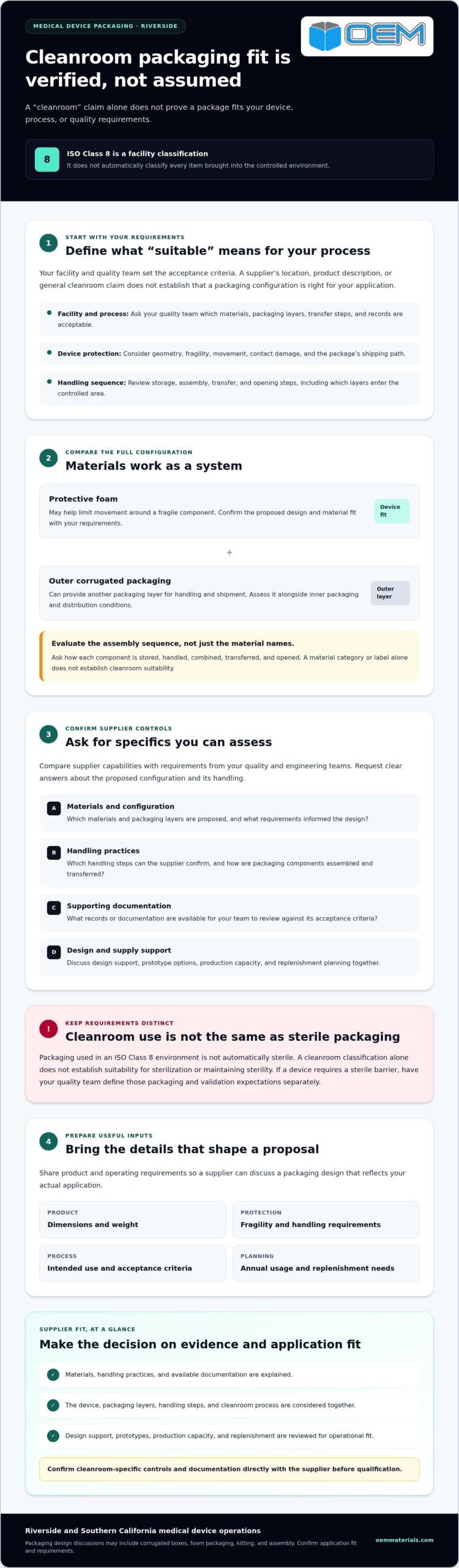
Start with your facility and process requirements. Ask your quality team which materials, packaging layers, transfer steps, and records are acceptable. A facility’s ISO classification does not automatically classify every item brought inside. Likewise, a supplier’s general cleanroom claim doesn’t confirm that its packaging or handling controls meet your requirements.
Why does packaging suitability depend on the application?
Packaging must suit both the device and its path through production. A delicate component may need cushioning to limit movement or contact damage. Packaging used at a workstation may have different handling and transfer requirements from packaging assembled outside the controlled area. Consider the full configuration: the device, inner packaging, outer packaging, and opening sequence.
Packaging suitability depends on documented buyer requirements and confirmed supplier capabilities. Ask a prospective supplier to identify which materials and handling steps it can confirm, and what supporting documentation is available. Compare those details with your quality team’s acceptance criteria before approving a packaging configuration.
Keep cleanroom-use requirements separate from sterile barrier and sterilization requirements. Packaging used in an ISO Class 8 environment isn’t automatically sterile, and a cleanroom classification alone doesn’t establish that packaging is suitable for sterilization or maintaining sterility. If the device requires a sterile barrier, have your quality team define the applicable packaging and validation expectations separately.
Device protection may require balancing fit, cushioning, and handling needs. OEM Materials & Supplies offers foam packaging and can discuss design requirements, but buyers should confirm cleanroom-specific materials, handling controls, and documentation directly. Share the intended use and acceptance criteria so the supplier can clarify whether its capabilities align with the application.
How to Evaluate ISO Class 8 Packaging Materials and Supplier Controls
Material selection is only one part of a cleanroom packaging decision. Buyers also need to understand how packaging is configured, assembled, handled, and documented. Compare suppliers against requirements set by your quality and engineering teams. A material category or product description alone doesn’t establish cleanroom suitability.
Which packaging materials and configurations should buyers compare?
Assess corrugated packaging and foam packaging in relation to the device and its distribution path. A foam insert may help limit movement around a fragile component, while an outer corrugated box may provide another packaging layer for handling and shipment. The right configuration depends on device geometry, fragility, protection needs, and shipping conditions. Ask suppliers to explain their proposed design and the information used to develop it.
Review the full assembly sequence, not just the materials. Consider how each component is stored, handled, combined, and transferred before use. If the package has multiple layers, clarify how it will be opened and which components enter the controlled area. Avoid prescribing a material grade or accepting a cleanroom claim without specifications and evidence your team can assess.
OEM Materials & Supplies offers custom foam packaging options. Discuss the proposed design and confirm any cleanroom-specific requirements for your application.
What supplier evidence and process details should you request?
Ask each supplier to identify the materials in the proposed configuration, describe relevant handling and assembly steps, and list the documentation available for review. Be specific about what your quality team needs. For example, ask how materials are identified and what information the supplier can provide about its packaging process. A verbal assurance isn’t a substitute for the evidence your organization requires.
The FDA’s current Quality Management System Regulation includes packaging and labeling controls in Section 820.45. Review the FDA regulation on device labeling and packaging controls with your quality team’s interpretation of applicable requirements. Use your organization’s approved criteria to assess supplier documentation and capabilities.
For a medical device packaging supplier in Riverside, record open questions and assign them to the right stakeholder. Procurement can compare responses and supply terms; engineering can assess fit and protection; quality can determine whether materials, handling, and documentation meet internal acceptance criteria. This separates a design that appears workable from one your organization has qualified for its process.
If you’re assessing a design or need a proposal, share the device dimensions, weight, fragility, shipping conditions, and applicable requirements through OEM Materials & Supplies’ quote request page. Confirm cleanroom-specific fit and supporting documentation before approval.
How to Compare Medical Device Packaging Suppliers Near Riverside
A supplier comparison should show how well each candidate can support your packaging program over time, not just whether it can quote a box or insert. For Riverside and Inland Empire operations, assess design communication, prototype steps, production capacity, delivery expectations, and replenishment planning. Confirm each point directly. A supplier’s location or general marketing language doesn’t establish cleanroom capabilities or suitability for your process.
Which supplier capabilities matter for a Riverside-area program?
Ask how design requirements are documented and revisions managed. If engineering changes a device dimension or handling requirement, clarify how the supplier will review the change, update the proposed packaging, and communicate any effect on production. Discuss prototype options and how a design would move into recurring orders or higher-volume production. Confirm the points of contact for design questions, order updates, and supply issues.
Check service-area coverage and delivery expectations for your specific Riverside-area location, order volume, and schedule. Don’t assume regional presence means a supplier can meet your required cadence. Ask how replenishment is planned and what information the supplier needs to assess ongoing demand. If packaging shortages could interrupt a line, discuss whether just-in-time delivery or vendor-managed inventory is appropriate, and confirm the details before relying on either approach.
Review the full packaging configuration. Can the supplier coordinate corrugated boxes with foam or other packaging components, or will you need to manage separate sources? The answer can affect design handoffs, purchasing workload, and replenishment coordination. For a visual starting point on insert planning, see this industrial foam insert design guide.
How should procurement compare supplier responses?
Send each candidate the same specification set. Include device dimensions and weight, protection needs, handling steps, packaging configuration, expected order volume, and delivery requirements. Request clear responses on design support, prototype availability, production capacity, communication, and replenishment. Consistent inputs make it easier to compare proposals and reduce the risk of evaluating different assumptions.
Use a comparison record that separates confirmed capabilities from open questions. “Cleanroom-ready” isn’t a substitute for information your quality team can review. Record which requirements each supplier has addressed, what details or evidence are outstanding, and who will follow up. Include engineering, operations, warehouse, procurement, and quality stakeholders so the review covers design fit, packing workflow, receiving, and internal acceptance criteria.
OEM Materials & Supplies serves manufacturers in Riverside and throughout Southern California. Buyers can discuss packaging design, corrugated boxes, foam packaging, and supply requirements with the team, then confirm whether the proposed capabilities and delivery cadence fit their program. Treat any ISO Class 8 requirement as something to verify, not an assumed supplier qualification.
A Practical Qualification Checklist for Cleanroom Packaging Procurement
Prepare application details before requesting proposals. A clear specification helps suppliers respond to the same requirements and gives procurement, engineering, operations, and quality a shared basis for review. Use this workflow to identify design needs, acceptance criteria, and supply expectations before comparing quotes.
- 1. Document the product. Gather drawings or dimensions, weight, fragility, and features that affect contact or support. Include annual usage and typical order quantities so suppliers can assess the program’s expected scale.
- 2. Describe the current process. Share how the device is handled, stored, packed, and shipped, including relevant shipping conditions and route information. Note known damage, excessive packing labor, or other issues the proposed packaging should address.
- 3. Define the packaging configuration. Identify the components and layers currently used or under consideration, such as cushioning, foam, and an outer box. Explain how the package is assembled and opened, and which parts enter the controlled environment.
- 4. Set cleanliness and quality criteria. Provide buyer-defined cleanroom requirements and identify the internal quality approver. Specify what supplier information or documentation your team needs to review. Don’t assume a general cleanroom claim meets your facility’s acceptance criteria.
- 5. Confirm design and evaluation steps. Ask how proposed changes will be reviewed and how prototypes or samples can be assessed, if available. OEM Materials & Supplies offers custom packaging design support. Discuss the application and confirm any cleanroom-specific requirements and documentation directly.
- 6. Align supply expectations. Discuss forecast visibility, order quantities, delivery cadence, and who is responsible for monitoring inventory. Consider just-in-time delivery or vendor-managed inventory only if the arrangement fits your operating process. Confirm the details, responsibilities, and capacity before relying on it.
Use the same information when approaching each potential medical device packaging supplier riverside. Ask suppliers to separate confirmed capabilities from unanswered questions, then route open items to the appropriate engineering, operations, procurement, and quality contacts. This makes gaps visible before a packaging choice moves into production.
The right design and supply arrangement depend on the device, materials, handling, shipping requirements, and program volume. To discuss your specifications and potential packaging options with OEM Materials & Supplies, discuss your packaging requirements.
Working with a Packaging Supplier for Riverside Medical Device Operations
A packaging program needs to work across design, production, packing, and replenishment. OEM Materials & Supplies serves manufacturers in Riverside and throughout Southern California. Its capabilities include packaging design, corrugated boxes, foam packaging, kitting, and assembly. These services can be discussed as part of a packaging program, with fit, production requirements, and cleanroom-specific needs confirmed for each application.
Where can OEM Materials & Supplies support a packaging program?
OEM Materials & Supplies can discuss packaging requirements and design options, including prototypes through high-volume production. Corrugated boxes and engineered foam packaging may be considered together to address device protection and shipping needs. Kitting and assembly may also help organize packaging components for production workflows. The right configuration depends on the device, process, and handling requirements, ensuring sensitive products stay secure whether shipped directly to clinical settings or supplied through healthcare distributors such as Novus Medical.
Replenishment planning matters as well. Depending on the operation, just-in-time packaging services or vendor-managed inventory may help align packaging supply with production needs. Discuss forecasts, ordering cadence, inventory responsibilities, and delivery expectations before selecting an approach. Confirm that the program can support your required volumes and schedule.
For medical device operations, cleanroom claims require particular care. Treat OEM Materials & Supplies as a potential packaging partner, not as a supplier with assumed ISO Class 8 certification or confirmed cleanroom controls. Share your requirements and ask what materials, handling practices, and documentation can be confirmed for your application before qualification. For procurement teams also seeking reliable sourcing for specialized clinical devices and components from major manufacturers, click here to view medical supply options from GetMedicalDevice.
What should buyers include in a first supplier conversation?
Give a prospective medical device packaging supplier riverside the information needed to assess your program. Include product dimensions and weight, annual usage, shipping requirements, current or target packaging configuration, and known protection or handling concerns. If prototypes or design revisions are part of the evaluation, describe the expected review process and identify the internal stakeholders involved.
Describe the ISO Class 8 context clearly. Explain where packaging will be used, how it moves into the controlled area, and which cleanliness or documentation criteria your quality team requires. Ask the supplier to distinguish confirmed capabilities from items that need further review. This keeps discussions grounded in your acceptance criteria rather than broad labels.
A complete specification makes it easier to discuss design, materials, production needs, and replenishment in one conversation. For a quote or consultation, share product dimensions, weight, annual usage, shipping requirements, and cleanroom criteria with OEM Materials & Supplies.
Build a Packaging Program Around Your Requirements
Choosing a medical device packaging supplier riverside starts with fit, not a general cleanroom claim. Define your ISO Class 8 criteria with your quality team, then compare suppliers on materials, handling, documentation, design support, and supply continuity. The package also needs to protect the device through its actual handling and shipping process.
OEM Materials & Supplies serves manufacturers in Riverside and throughout Southern California. Its capabilities include custom packaging design, corrugated boxes, foam packaging, kitting, and assembly. Just-in-time delivery and vendor-managed inventory are also available services. Confirm program fit and delivery cadence against your operation’s needs, and verify cleanroom-specific controls and documentation before qualification.
To start a practical conversation, share product dimensions, weight, annual usage, shipping requirements, target packaging configuration, and cleanroom criteria. These details help clarify what needs review and support a more relevant proposal. Request a packaging quote or consultation with OEM Materials & Supplies.
Frequently Asked Questions
What does ISO Class 8 mean for medical device packaging?
ISO Class 8 describes a cleanroom air-cleanliness classification based on airborne particle concentration. It applies to the controlled environment, not automatically to every package or supplier operating within it. Work with your quality team to define facility and process criteria, including packaging transfer and handling requirements. Then assess whether a supplier’s proposed materials, configuration, practices, and documentation can be reviewed against those criteria.
Does packaging used in an ISO Class 8 cleanroom need to be sterile?
No, ISO Class 8 use does not automatically mean packaging must be sterile. Cleanroom-use requirements and sterile barrier or sterilization requirements are separate considerations. Whether a device requires sterile packaging depends on its application and the manufacturer’s quality requirements. If sterility is required, ask your quality team to define the applicable acceptance criteria and confirm that a prospective supplier can support the specified packaging needs.
How can I verify whether a packaging supplier supports ISO Class 8 requirements?
Ask the supplier to identify which materials, handling steps, and documentation it can confirm for your specified application. A medical device packaging supplier riverside search result or general cleanroom claim isn’t evidence of fit. Compare the supplier’s written responses with buyer-defined criteria, and have your quality team review outstanding questions before approval. Confirm requirements for the specific facility, packaging configuration, and process rather than relying on broad claims.
What information should I provide when requesting a medical device packaging quote?
Provide product dimensions, weight, fragility, annual usage, and the current or target packaging configuration. Include shipping requirements, handling and storage conditions, and any known damage or packing workflow concerns. Describe the ISO Class 8 context and the cleanliness criteria your team needs to verify. Also identify documentation requirements and expected delivery cadence. Complete information helps suppliers assess the application and clarify which requirements they can address.
Can a Riverside packaging supplier provide custom foam and corrugated packaging?
Yes. OEM Materials & Supplies offers foam packaging and corrugated boxes, along with custom packaging design. The team supports programs from prototypes through high-volume production. Share device dimensions, weight, protection needs, and shipping conditions to discuss a suitable configuration. Any ISO Class 8 material or handling requirements must be confirmed for the application; foam or corrugated packaging alone does not establish cleanroom suitability.
How do I compare cleanroom packaging suppliers in Southern California?
Give each supplier the same specifications, then compare design support, prototype options, production capacity, communication, delivery expectations, and replenishment planning. Ask for clear information about relevant materials, handling, and documentation, and separate confirmed capabilities from unanswered questions. For programs in Riverside, Orange County, Los Angeles, or San Diego, confirm service coverage and delivery expectations for your location and required schedule directly with each supplier.
Can packaging design and inventory services help reduce production interruptions?
They may help align packaging with production needs, but results depend on the program and its requirements. Custom design can address packaging fit and workflow, while kitting and assembly may organize components for use. Just-in-time delivery or vendor-managed inventory may support replenishment when forecast visibility, order cadence, and inventory responsibilities are agreed upon. Confirm operating details and supplier capacity before relying on these services to support continuity.