

The strongest corrugated board isn’t automatically the safest or most efficient choice. Choosing the right corrugated board grade starts with what the package must withstand: product weight, stacking pressure, handling, and transit conditions. For shipments moving through Orange County, Los Angeles, Riverside, or San Diego, those demands depend on the product and its actual distribution route. Too little strength can increase damage risk; too much can mean unnecessary material.
A grade label is a useful starting point, but it won’t tell you how a box will perform in your operation. Board construction, box design, product fit, and storage and shipping conditions all matter. A package that works for a short local delivery may face different demands during longer distribution or warehouse stacking.
This guide explains how to match board construction and performance requirements to your product, shipping conditions, and packing process. You’ll learn what to compare, how to build a specification around actual distribution demands, and what information makes a custom packaging review more useful. The goal is a practical fit: reliable protection without specifying more material than the job requires.
Key Takeaways
- Choosing the right corrugated board grade means matching board construction to product needs and distribution conditions, not relying on a grade label alone.
- Compare flute, liner, and wall construction as connected design choices that affect package performance and packing operations.
- Document product dimensions, weight, fragility, orientation, and handling constraints to create a useful packaging specification.
- Review board options against each shipment’s demands to avoid both inadequate protection and unnecessary material use.
- Plan for package validation and the transition from prototypes or short runs to repeat production.
What Choosing the Right Corrugated Board Grade Actually Means
Choosing the right corrugated board grade means matching the board’s construction and documented performance to the application, not selecting a label that simply sounds strong enough. A grade describes material characteristics, but it doesn’t guarantee how a complete box will protect every product in every shipping environment.
Protection depends on three factors working together: the product, the package design, and the distribution environment. A board that performs adequately for a well-fitted product with internal cushioning may not suit a heavier item with open space inside the box. Specifying too little performance can raise damage risk; specifying more board than the application requires can add avoidable material and expense. Cost outcomes depend on product dimensions, materials, and shipping requirements.
Board grade is also just one part of box design. Box dimensions, style, closure, product fit, and internal cushioning affect how the package supports and protects its contents. Corrugated fiberboard combines paper liners with a fluted inner layer. The grade describes aspects of that construction, while the box design determines how it works for a particular product.
What information does a corrugated board grade describe?
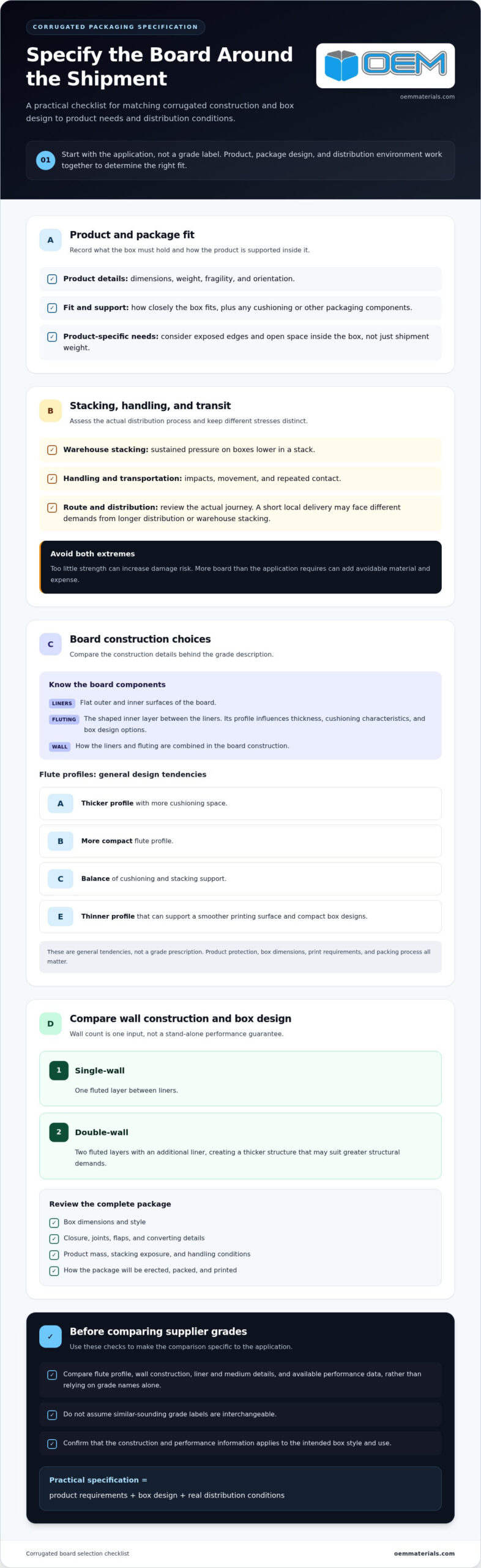
Linerboard forms the flat outer and inner surfaces. Fluting medium is shaped into arches between those liners. The flute profile influences board thickness, cushioning characteristics, and box design options. Wall construction describes how the liners and fluting are combined.
Grade names and supplier descriptions may not be directly interchangeable. Compare the construction details and available performance data behind a label rather than assuming two similar-sounding grades are equivalent. This gives purchasing and engineering teams a clearer basis for review and keeps specifications from relying on shorthand alone.
Why does the right grade depend on a Southern California shipment?
Start with the product’s weight, fragility, dimensions, and orientation. Then consider how closely the box fits and whether cushioning or other packaging components support the item. A compact, sturdy component and a fragile product with exposed edges can need different packaging approaches, even if their shipment weights are similar.
Separate warehouse stacking demands from handling and transportation exposure. Stacking puts sustained pressure on lower boxes; handling and transit can introduce impacts, movement, and repeated contact. For shipments through Southern California, assess the actual route and distribution process rather than relying on the destination label alone. No single grade is automatically suitable for every product or route. A packaging design review can connect those shipment details to a box specification built for the application.
How Flutes, Liners, and Wall Construction Affect Board Performance
Board performance comes from the interaction of its components, not one feature in isolation. Liners form the flat faces of the board, while fluting medium is shaped into arches between them. The flute profile and number of layers affect thickness, cushioning, structural behavior, and how the finished box can be designed. The Fibre Box Association’s overview of corrugated board components provides a useful reference for these construction terms.
When comparing supplier descriptions, ask for the actual construction and performance information behind each grade. Similar labels don’t guarantee identical liner or medium combinations, flute profiles, or test values. Compare equivalent specifications, and confirm that the information applies to the intended box style and use.
How do flute profiles change the package?
A, B, C, and E flutes describe different flute profiles, each with practical design implications. A flute is thicker and can provide more cushioning space. B flute is more compact, while C offers a balance of cushioning and stacking support. E flute is thinner and can support a smoother surface for printing and compact box designs.
These are general tendencies, not a grade prescription. The right fit depends on product protection needs, box dimensions, print requirements, and how the package will be erected and packed. A profile that suits a compact retail-style box may not be right for a package designed around cushioning or a specific converting process.
When should buyers compare single-wall and double-wall board?
Single-wall board uses one fluted layer between liners. Double-wall construction combines two fluted layers with an additional liner, creating a thicker structure that may suit greater structural demands. Wall count alone, however, doesn’t prove that one box will perform better for a particular shipment.
Compare product mass, box dimensions, stacking exposure, and handling conditions together. A large box can behave differently from a compact one, even with similar contents. Joints, flaps, and converting details also affect the finished package. Packaging design connects these choices to the actual application. To discuss a corrugated box design, share the product dimensions, weight, and shipping conditions through a packaging quote request.
How to Compare Corrugated Board Grades Without Over-Specifying
Compare board options against the shipment, not against a vague “heavy-duty” label. A useful review records what each specification describes: flute profile, wall construction, liner composition, and available performance data. It should also distinguish board properties from finished-box design. Two suppliers may use similar grade names for different constructions, so compare documented details rather than assuming the labels are equivalent.
| Shipment profile | Construction considerations | Questions for design review |
|---|---|---|
| Lightweight product in a compact, close-fitting box | Consider whether a lighter construction meets handling and stacking demands without excess board. | Does the product fit securely? Is interior cushioning needed? |
| Compact product with greater mass or warehouse stacking exposure | Review wall construction, liner and medium details, and documented performance data together. | What loads will the box support in storage and transit? |
| Large, fragile, or irregularly shaped product | Assess box dimensions, fit, flute profile, and protective packaging as a complete system. | Could movement inside the box or exposed edges create damage risk? |
Which variables make two board specifications meaningfully different?
Start with the product’s weight, fragility, dimensions, and how tightly it fits. Then compare flute profile, wall construction, liner composition, and any performance data supplied for the board or box. Check whether the specification covers the board material alone or the finished package, including its dimensions and design features. That distinction matters: a board rating does not automatically describe how a specific box performs.
Does heavier or stronger board always provide better protection?
No. Stronger board can support a demanding application, but it can’t correct poor fit, weak box geometry, or inadequate interior protection. A fragile item that can shift inside an oversized carton may still need a better-fitted design or cushioning. Foam packaging can be part of that protective system when the product needs support or separation inside the box.
Over-specifying can add material without addressing the actual failure risk. A heavier or more cumbersome package may also complicate packing and handling. Identify the shipment’s limiting condition, such as stacking, product movement, or impact exposure, then assess whether the proposed construction addresses it. Review the complete package rather than relying on grade names alone. The right specification is the one supported by the application’s requirements, not simply the strongest option available.
A Practical Process for Specifying Corrugated Board Grade
A repeatable specification starts with shipment facts, not a preferred grade label. Use this workflow to give packaging design, purchasing, and warehouse teams the same basis for evaluating a box.
1. Define the product. Record its length, width, height, weight, orientation, and fragile areas. Note features that affect support, such as protrusions or surfaces that should not bear pressure. Include how the product sits inside the package and whether cushioning or inserts are used.
2. Map the shipment. Document how the package moves from packing through delivery. Capture palletization and stacking patterns, warehouse storage conditions, transportation duration, handling points, and shipment configuration. For a shipment moving through Los Angeles, describe the actual route and distribution steps rather than treating the destination alone as a measure of handling exposure. If available, include damage records, returns, or packing observations that point to recurring problems.
3. Compare board construction. Review the proposed flute profile, wall construction, liner and medium details, and available performance data against the product and route requirements. Confirm whether the information describes the board material or the finished box. Consider board construction alongside box dimensions, closure, product fit, and interior protection. OEM Materials & Supplies provides custom packaging design to align packaging decisions with the documented application.
4. Validate the complete package. Use a prototype to check fit, assembly, and packing steps before standardizing the design. When the shipment’s risk profile calls for it, assess the complete package under conditions that reflect its intended use. A board specification alone cannot show whether the finished box, closure, and interior components work together as intended.
What should the specification capture?
Keep the product, shipment, and design details together in one controlled record. Include the selected construction, box dimensions and style, packing orientation, cushioning requirements, pallet pattern, and handling constraints. Record the basis for the decision and update it when the product, packing method, or distribution route changes. This helps purchasing and warehouse teams work from the same assumptions.
How does validation support consistent production?
Review the prototype with the people who pack, store, and ship the product. Confirm that the box can be assembled as intended, the product stays positioned as designed, and the package suits the planned shipment configuration. Once approved, document the specification so it can carry from initial runs into repeat production. For a board and box design review, submit your product and shipping details for a packaging discussion.
Turn the Board Grade Decision Into a Production-Ready Packaging Plan
A board grade decision becomes useful to the operation when it’s recorded as part of a complete packaging specification. A stable specification gives purchasing a consistent basis for repeat orders, helps warehouse teams pack the product the same way, and supports production planning as volumes change. It also reduces the chance that teams rely on different assumptions about box construction or product fit.
Project scale can shape the design process. A prototype helps teams assess fit and packing steps before committing to a repeat design. Short runs may call for a practical specification that meets the immediate requirement while allowing for review. High-volume programs need a clear, repeatable design that purchasing and production can use consistently. In each case, choosing the right corrugated board grade is part of a broader packaging plan that connects construction to the product and workflow.
What should a corrugated packaging project brief include?
Prepare a concise brief with the information needed to review the package as a working system:
- Product dimensions, weight, fragile areas, orientation, and special handling constraints
- Packaging quantity, expected annual usage, prototype needs, and planned production volume
- Shipping routes and conditions, pallet configuration, stacking demands, and known damage concerns
- Packing-line limits, including available space and steps that affect how the box is assembled or loaded
Include relevant operational records where available. Recurring damage, product movement inside the box, or packing delays can help identify what the design review should address. Packaging design uses these inputs to align board construction, box dimensions, and packing methods rather than treating grade selection as a standalone decision.
How can packaging design support consistent supply?
Once a package has been reviewed and approved, document its construction and packing method so repeat orders maintain the same requirements. That record connects prototypes and short runs to ongoing production, while giving purchasing and warehouse teams a shared reference. For manufacturers in Orange County, Los Angeles County, Riverside County, and San Diego County, this approach can support local packaging projects from initial design through repeat supply planning.
Vendor-managed inventory may also support supply planning when it fits the operation’s usage patterns and storage needs. OEM Materials & Supplies offers vendor-managed inventory for packaging programs. To discuss a corrugated packaging project, request a packaging quote with product dimensions, weight, shipping conditions, and expected annual usage.
Build a Corrugated Specification That Works in Practice
Choosing the right corrugated board grade means looking beyond the grade label. Match flute, liners, and wall construction to the product, box design, and shipping conditions, then review the complete package for fit, protection, and packing requirements. A documented specification helps purchasing and warehouse teams apply the same requirements across repeat orders.
OEM Materials & Supplies develops custom corrugated packaging and packaging designs around specific products, with support for prototypes, short runs, and high-volume production programs. Manufacturers in Southern California, including Orange County, Los Angeles, Riverside, and San Diego, can use this process to carry a packaging decision from initial evaluation into ongoing production planning.
For a project-specific recommendation, request a corrugated packaging quote and include your product dimensions, weight, shipping conditions, and annual usage. Those details provide a practical starting point for reviewing your packaging requirements. Contact OEM Materials & Supplies to discuss a specification that fits your product and operation.
Frequently Asked Questions
What does corrugated board grade mean?
Corrugated board grade describes the material’s construction and specified performance characteristics. Construction can include the liners, fluting medium, flute profile, and wall type. A grade label alone may not tell you how a finished box will perform, since box dimensions, closure, product fit, and shipping conditions also matter. Compare the documented construction and performance information behind the label rather than treating similar grade names as interchangeable.
How do I choose the right corrugated board grade for my product?
Start with product dimensions, weight, fragility, orientation, and how securely it fits inside the box. Then account for warehouse stacking, pallet configuration, handling, and transportation conditions. Choosing the right corrugated board grade means matching those demands to board construction and the complete box design, not selecting the heaviest option by default. For shipments across Los Angeles, Orange County, Riverside, or San Diego, assess the actual distribution route and handling process.
What is the difference between single-wall and double-wall corrugated board?
Single-wall board has one fluted layer between two liners. Double-wall board combines two fluted layers with three liners, creating a thicker construction that may suit packages with greater structural demands. Wall count alone doesn’t establish which box will perform better. Product mass, package dimensions, stacking exposure, fit, and shipment conditions all affect the choice. Review the construction as part of the complete box design rather than using wall type as a stand-alone measure.
Is ECT or burst strength more important when choosing corrugated board?
Neither measure is universally more important. Edge Crush Test (ECT) measures a board’s resistance to compression along its edge and is commonly used to evaluate stacking-related strength. Burst strength measures resistance to rupture under pressure. The more relevant measure depends on the package’s demands, and neither test alone describes how every finished box will perform. Compare test information with box design, stacking conditions, product fit, and handling exposure before specifying a grade.
Does a heavier corrugated board always protect products better?
No. Heavier board may support an application with greater structural demands, but it won’t correct a box that is oversized, poorly fitted, or missing needed interior cushioning. Product movement inside the package can remain a damage risk even when the board is robust. Review board construction alongside box dimensions, closure, and internal protection. Over-specifying may add material without solving the actual packaging issue, so base the choice on product and shipment requirements.
Can corrugated board grade affect shipping damage?
Yes. If board construction doesn’t suit the product, package design, or distribution demands, the box may not provide appropriate support during stacking and handling. Damage can also result from poor fit, inadequate cushioning, or a pallet configuration that exposes packages to risk. Review damage records for patterns, such as crushed corners or product movement, then assess the complete package. A board change may help when it addresses the observed cause.
What information should I provide when requesting a corrugated box quote?
Provide product dimensions, weight, fragility, orientation, required packaging quantity, and expected annual usage. Include shipping conditions, destination or route, pallet configuration, stacking demands, known damage concerns, and packing-line constraints. Note whether you need a prototype, short run, or high-volume program. OEM Materials & Supplies supports custom packaging projects for manufacturers in Orange County, Los Angeles, Riverside, and San Diego, from prototype work through production programs.