
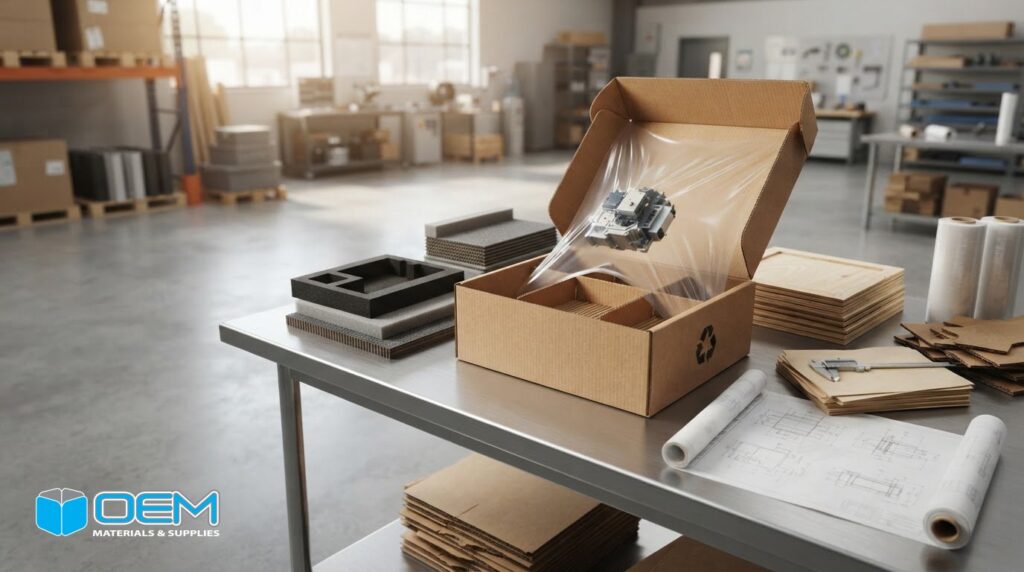
Could packaging designed to hold a product in place still be the wrong fit for your shipping operation? Protection depends on more than a brand or package style. When evaluating custom suspension packaging supplier southern california options, manufacturers should weigh product risk, shipping conditions, and packing workflow before choosing a format. Those factors matter when products shift or sustain damage in transit, or when a complex pack-out slows the line.
Suspension packaging may suit some products, while engineered foam, corrugated packaging, or a combination may better fit others. The right choice depends on product dimensions and fragility, how it moves through distribution, and whether staff can pack it consistently.
This Korrvu buying guide explains how to assess suspension packaging alongside other protective formats, define practical requirements, and prepare for a productive supplier discussion. OEM Materials & Supplies supports packaging design from prototype through production, helping manufacturers in Orange County, Los Angeles County, the Inland Empire, and San Diego County align protection with labor, production scale, and inventory needs.
Key Takeaways
- Assess product dimensions, weight, orientation, vulnerable areas, and shipping conditions before deciding whether suspension packaging fits.
- Compare suspension packaging with foam and corrugated options based on protection needs, packing steps, and storage requirements.
- Review how the package will be assembled and handled at the packing line to catch workflow issues before production.
- For a custom suspension packaging supplier southern california project, prepare product samples or drawings, annual usage, packaging volume, and known damage concerns.
- Match the packaging plan to product risk and program scale, and consider custom foam and corrugated approaches alongside suspension packaging.
What Is Suspension Packaging, and When Does It Fit Southern California Shipments?
Suspension packaging holds a product away from the outer package’s surfaces using internal supports that position it during shipment. The goal is to limit unwanted movement and direct contact with the box. The format still needs to be evaluated against the product and its shipping conditions.
How Suspension Packaging Holds and Protects a Product
Suspension packaging supports an item within an outer container and maintains separation between the product and that container. How well a design controls movement depends on the item, its support points, and the forces it may encounter. The underlying package cushioning principles apply to suspension formats as well as other protective materials: packaging must account for shock and vibration during handling and transit.
Korrvu is a brand-associated term buyers may use when discussing suspension packaging. Designs can differ, so the name alone does not establish a particular construction or performance. Evaluate the actual package against product and distribution requirements.
Which Products and Shipping Conditions May Benefit?
Controlled positioning may be worth evaluating for fragile, irregularly shaped, or presentation-sensitive items. An aerospace buyer, for example, may need to keep a precision component from shifting against the box. An automotive operation may ship a finished part with vulnerable edges, while an electronics manufacturer may want to limit contact with a sensitive assembly. These are possible applications, not guaranteed fits.
Start with product weight and dimensions. Identify vulnerable areas and the points that can safely bear contact. Then consider orientation, handling, and the shipment conditions the package will encounter. Parcel shipments, palletized freight, and repeated handling through distribution can place different demands on a package. A design that positions a product well in one workflow may be awkward or inconsistent to pack in another.
Geometry matters. A compact item with defined support areas presents different design considerations from a large, uneven part. So does the packing process: operators need to position the product correctly and close the package consistently. Compare suspension packaging with alternatives such as custom foam packaging, considering both protection needs and pack-out steps.
For manufacturers seeking a custom suspension packaging supplier in Southern California, start with a clear product and shipment profile rather than the brand name alone. Fit depends on geometry, fragility, handling, shipping conditions, and the practical demands of the packing line.
How to Evaluate Korrvu Suspension Packaging for Your Product
Use a repeatable evaluation process before settling on a suspension-style package. The Korrvu name may guide your research, but the decision should rest on documented product requirements, shipment conditions, and how the package performs in your packing process. A Southern California packaging supplier can use those details to assess design options alongside production needs.
Product and Shipment Inputs That Shape the Design
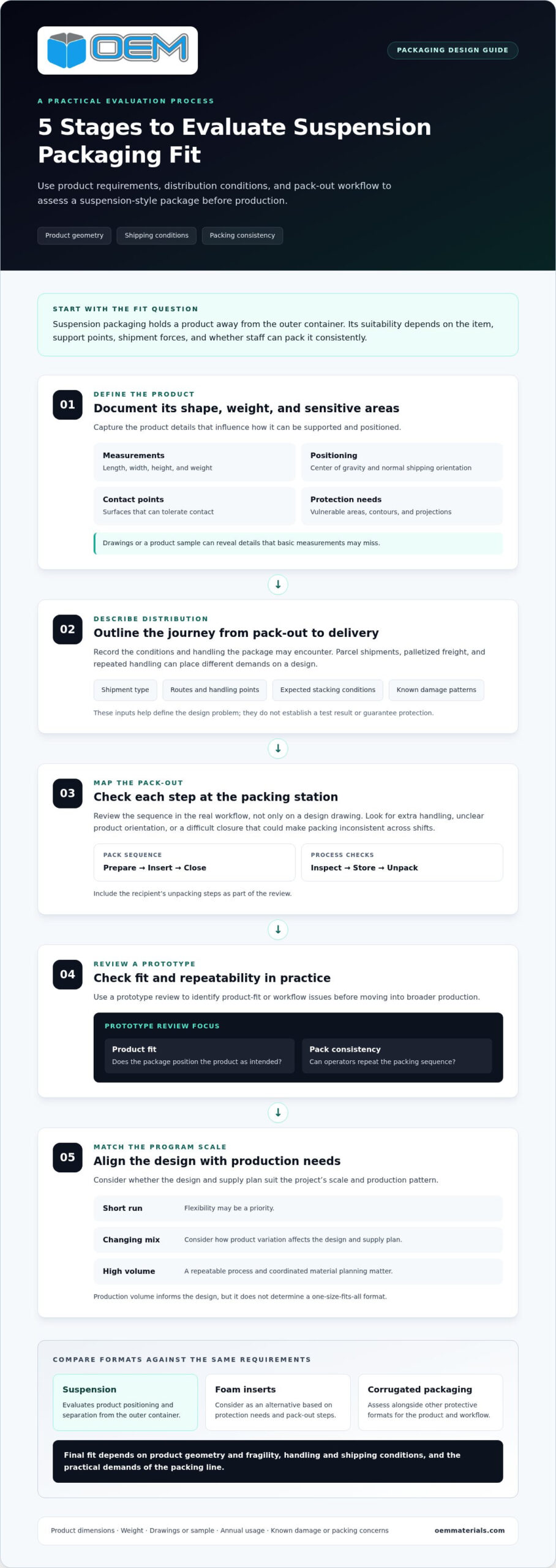
Record the product’s length, width, height, weight, and normal shipping orientation. Note its center of gravity, surfaces that can tolerate contact, and areas that need protection. Drawings and product samples can reveal contours or projections that basic measurements may miss.
Next, describe the distribution path. Include shipment type, known handling steps, expected stacking conditions, and damage patterns associated with current packaging. These inputs help define the design problem, but they do not establish a test result or guarantee protection. OEM’s custom packaging design work can be tailored to project details, from product geometry to program scale.
Packing Workflow, Prototypes, and Production Volume
Evaluate the package at the packing station, not only on a design drawing. Map the sequence from preparing the package to inserting the product, closing it, and inspecting the finished pack. Include the recipient’s unpacking steps. Extra handling, unclear product orientation, or difficult closure can lead to inconsistent packing across shifts.
- 1. Define the product. Document dimensions, weight, center of gravity, orientation, and vulnerable areas.
- 2. Describe distribution. Record shipment routes, handling points, stacking conditions, and known damage concerns.
- 3. Map the pack-out. Review insertion, closure, inspection, storage, and end-user unpacking.
- 4. Review a prototype. Check product fit and whether operators can repeat the packing sequence consistently.
- 5. Match the program scale. Consider whether the design and supply plan suit a short run, a changing product mix, or high-volume production.
A prototype review gives the team a practical way to identify fit or workflow issues before moving into broader production. Short-run projects may prioritize flexibility, while high-volume programs need a repeatable process and coordinated material planning. Production volume should inform the design, but it does not determine a one-size-fits-all format.
Bring drawings or a sample, dimensions, weight, annual usage, and known shipping or packing concerns to the design discussion. To start shaping a project around those requirements, send your packaging project details.
Suspension Packaging vs. Foam Inserts and Corrugated Packaging
No protective format suits every product. The decision depends on product geometry, vulnerable areas, shipping conditions, packing steps, and how packaging materials are stored and replenished. Compare the complete pack-out, not just the insert: an outer box and an internal protective system perform different roles and may be used together.
| Format | Product fit and protection needs | Packing steps | Storage considerations |
|---|---|---|---|
| Suspension packaging | May suit products that need controlled positioning away from the outer package. Fit depends on geometry, weight, and support points. | Review how the item is positioned, secured, and checked for consistent placement. | Consider the storage footprint of the package components and how they are supplied to the packing area. |
| Engineered foam inserts | Can provide shaped support or cushioning around selected product areas. The design should account for surfaces that can safely make contact. | Check how the product aligns with the insert and whether operators can place it consistently. | Evaluate insert and finished-package storage needs alongside the outer box. |
| Corrugated packaging | Provides the outer enclosure. Its design should suit the product’s size and shipment needs, while internal protection addresses product-specific contact and movement. | Assess box setup, insertion of protective components, closure, and handling. | Plan storage for flat boxes and any separate internal components based on the operation. |
When to Compare Suspension Packaging with Foam
Consider foam when the product needs shaped support around particular contours or contact areas. Compare it with suspension packaging by looking at how each option positions the item, the materials used in the complete pack, the number and order of packing steps, presentation at opening, and storage requirements. OEM’s custom foam packaging can be evaluated alongside other protective approaches based on the project details.
For example, a part with defined surfaces that can safely rest against shaped supports may need a different internal design from an item that must remain separated from the surrounding package walls. Do not assume the right format from the product category alone. Dimensions, weight, shipping conditions, and the actual pack-out all matter.
How Corrugated Packaging Complements Internal Protection
The corrugated box encloses the shipment; the internal system positions or cushions the product inside it. Evaluate box dimensions, closure, stacking, and handling needs as parts of the complete package, without relying on an unverified strength rating. Even a well-chosen internal design needs an outer enclosure suited to the shipment.
For buyers comparing options with a custom suspension packaging supplier southern california, reviewing suspension, engineered foam, and corrugated packaging as a coordinated system can clarify tradeoffs in protection, pack-out, presentation, and storage.
What to Discuss with a Southern California Suspension Packaging Supplier
A productive packaging discussion starts with useful project information. Product samples and drawings communicate features that measurements alone may miss, while dimensions and weight establish basic design requirements. Include the product’s orientation, surfaces that need protection, and areas that can safely make contact with internal supports.
How to Prepare a Useful Packaging Brief
Summarize the shipment profile as well as the product. Note destinations, shipment methods, handling points, stacking conditions, and recurring damage concerns. Describe the current pack-out from preparation through closure and inspection, including bottlenecks such as inconsistent placement or extra handling. This gives a packaging team a practical basis for reviewing design and workflow together.
- Product details: Samples or drawings, dimensions, weight, orientation, and fragile or sensitive areas.
- Program scale: Annual usage, packaging volume, demand patterns, and expected production changes.
- Operations: Packing steps, staffing or equipment constraints, storage space, and unpacking requirements.
- Shipment history: Destinations, known handling conditions, and damage patterns that need attention.
OEM Materials & Supplies serves manufacturers in Orange County, Los Angeles County, the Inland Empire, and San Diego County. A clear brief helps the team assess packaging design against product protection, pack-out consistency, and production scale. To discuss a project or request a quote, submit your packaging requirements.
Design, Kitting, and Inventory Support
Packaging design can bring product fit and packing steps into the same review. Kitting and assembly can help organize components or packaging materials for the intended pack-out, while prototype work lets teams review the process before broader production. The right scope depends on the product mix, volume, and how work is organized at the packing station.
For ongoing programs, vendor-managed inventory can help coordinate packaging supply with usage needs. If delivery timing is part of the operational challenge, just-in-time packaging support may be relevant to replenishment planning. A custom suspension packaging supplier southern california manufacturers work with should consider design, packing workflow, and supply planning as connected parts of the project, rather than treating the package as an isolated component.
Build a Practical Suspension Packaging Plan with OEM Materials & Supplies
A sound packaging plan starts with the product and the route it will travel. Review vulnerable areas, weight, orientation, and how the item will be handled in transit. Then consider the packing workflow and program scale. These factors help determine whether suspension packaging, custom foam, corrugated packaging, or a combination is the right direction.
From Product Requirements to a Packaging Recommendation
OEM Materials & Supplies works with manufacturers to assess protective packaging approaches against specific product and shipping requirements. Custom foam and corrugated packaging can be considered alongside suspension formats, with the comparison grounded in fit, packing steps, handling needs, and storage. Evaluate the actual application rather than treating any material choice as a guaranteed performance outcome.
Project details also shape the path from concept to production. OEM supports packaging programs from prototypes through high-volume production, with design, kitting, and assembly capabilities that can help align the package with the operation. For ongoing programs, vendor-managed inventory can support packaging supply coordination. The right approach depends on the product mix, usage, and replenishment needs.
For manufacturers in Orange County, Los Angeles County, the Inland Empire, and San Diego County, working with a custom suspension packaging supplier southern california operation can make it easier to assess packaging requirements alongside local production and distribution workflows. The goal is a package and supply plan that reflect product risk, shipment conditions, packing processes, and program scale.
Request a Quote or Packaging Consultation
To begin a packaging review, share the product’s dimensions and weight, estimated annual usage, and any available drawings or samples. Include shipping requirements, known damage concerns, and current packing steps. These details help OEM evaluate the project and discuss suitable packaging approaches based on the application.
Request a packaging quote or consultation and include your product dimensions, weight, and annual usage to start the discussion.
Turn Packaging Requirements into a Practical Plan
Suspension packaging is one option, not a default. Base the decision on product geometry and risk, shipment conditions, packing steps, and program scale. Compare it with foam and corrugated approaches as a complete packaging system, then review how the design works for operators and end users.
OEM Materials & Supplies supports manufacturers throughout Southern California and across the United States, from prototype development through high-volume programs. Custom packaging design, kitting, assembly, and vendor-managed inventory can connect package requirements with production and supply needs. For companies evaluating a custom suspension packaging supplier southern california, the goal is a practical recommendation grounded in the product and operation.
Share your product dimensions, weight, annual usage, shipping requirements, and current packing steps to start a focused discussion. Request a packaging quote or consultation and put those project details to work. A clear brief is a practical first step toward packaging that supports protection and a consistent workflow.
Frequently Asked Questions
What is Korrvu suspension packaging?
Korrvu is a brand-associated term used in searches for suspension packaging, a format that supports a product inside an outer container while limiting direct contact with surrounding surfaces. The name alone does not establish a specific design or performance. To assess whether this format suits your application, document product dimensions and weight, anticipated handling and shipping conditions, and the steps operators follow to pack it consistently.
Is suspension packaging suitable for fragile products?
Suspension packaging may suit some fragile products if the design holds the item securely and accounts for vulnerable areas. It is not a guaranteed solution for every product or shipment. Fit depends on product geometry and weight, shipment conditions, and handling requirements. Include a representative product and review the pack-out steps during a packaging design discussion to assess product positioning and whether the process can be repeated reliably.
How does suspension packaging compare with foam inserts?
Suspension packaging and foam inserts position and cushion products in different ways. Suspension designs hold a product within an outer package, while foam can provide shaped support around selected areas. The right choice depends on product geometry, protection priorities, packing steps, storage, and production requirements. Compare the complete package and workflow, using product and shipment details to assess which approach, or combination, fits the application.
Can suspension packaging be customized for a product?
Packaging design can be tailored to a product’s dimensions, weight, vulnerable areas, orientation, shipping conditions, and packing workflow. The design should follow the item’s requirements and the operation’s needs. Share product drawings or a sample, current packing steps, and estimated usage to inform the discussion. These details help assess product positioning and whether the pack-out can be performed consistently across the intended production program.
What information should I provide to a suspension packaging supplier?
Provide product dimensions and weight, along with drawings or a sample and a description of fragile or sensitive areas. Include the shipping context, current packaging materials, pack-out steps, known damage concerns, and estimated annual usage. These details help frame a practical design discussion and comparison with alternatives such as foam inserts or custom corrugated packaging. Include any shipment-handling or storage constraints as well.
Where can manufacturers find suspension packaging support in Southern California?
OEM Materials & Supplies serves manufacturers in Orange County, Los Angeles County, San Diego County, and Riverside County, as well as customers across the United States. Its custom packaging capabilities include packaging design, corrugated packaging, and engineered foam inserts, supporting projects from prototypes through high-volume programs. To begin a discussion, share product dimensions, weight, shipment requirements, and estimated usage for a project-specific review.
Does suspension packaging reduce packing labor or shipping damage?
Packaging design can affect packing steps and product movement, but labor and damage outcomes depend on the product, materials, shipment requirements, and existing workflow. Do not assume savings or damage reduction without project-specific evidence. Compare the pack-out process and product condition under relevant operating conditions, and assess any projected results against the needs of the specific program. Product dimensions and shipping context are important inputs to that review.