
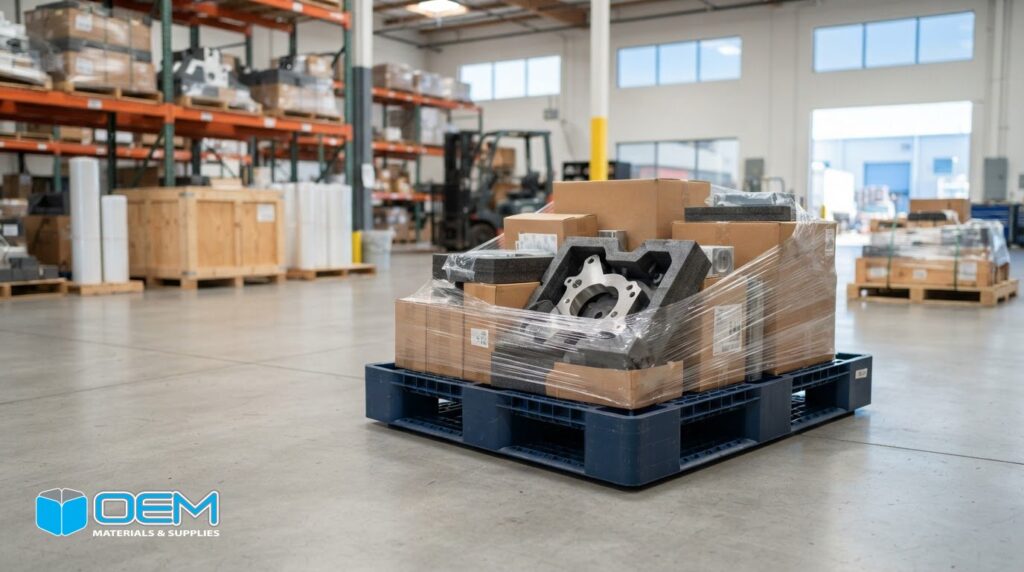
A pallet can fit your product and still create problems on the line or in the warehouse. Choosing custom plastic pallets Southern California businesses can use effectively starts with more than a footprint. The pallet also needs to suit the load, handling equipment, and movement of goods through your operation.
Standard dimensions and configurations work for many applications, but they may not align with every product or workflow. Before comparing options, define what the pallet must support and how it will be handled. This guide explains what information to gather, when a custom pallet may be more appropriate than a standard option, and how to consider pallet needs alongside packaging and logistics.
From Orange County and Los Angeles County to the Inland Empire and San Diego County, operations face varied material-handling and distribution demands. The details to share when planning a pallet project include product dimensions, weight, equipment, and annual usage. Considering pallets alongside boxes, crates, and protective packaging can also help reveal fit issues early.
Key Takeaways
- Start a pallet specification with the product and its shipping or storage task, then document how the load is supported and handled.
- Custom plastic pallets may suit unusual footprints, repeatable loads, or workflow constraints that standard configurations don’t address.
- Compare custom, standard, and used options against the same load and handling requirements to assess fit, availability, and repeatability.
- For custom plastic pallets southern california projects, include receiving locations, shipping lanes, and facility workflows in the project brief.
- Share product dimensions, weight, and annual usage to help connect pallet needs with related packaging such as boxes, crates, and protective materials.
When Custom Plastic Pallets Make Sense for Southern California Operations
A custom plastic pallet is specified around a product or handling requirement rather than selected only by standard dimensions. That distinction matters when a product has an unusual footprint, loads need consistent positioning, or a pallet creates friction in an established workflow. A custom pallet project should address a real operational constraint, not simply a preference for a particular size or configuration.
Plastic is one of several materials used for pallets, alongside plastic, metal, paper, and recycled materials. Material is only one part of the decision. The right fit depends on the product, how the load is handled, and the conditions it encounters during shipping and storage. OEM Materials & Supplies offers plastic pallets as part of its industrial packaging solutions.
What operational problem should a custom pallet solve?
Start with the load. Record product dimensions, how items are arranged, and how weight is distributed across the pallet. A footprint that leaves products unsupported or makes loads difficult to position may point to a design requirement. Then map the handling steps: forklift entry, pallet-jack access, transfers between work areas, and storage. Each piece of equipment and each handoff can affect the fit.
For example, a manufacturer shipping a long component should assess how it sits on the pallet, how the load is secured, and how operators move it from packing to dispatch. These are questions to resolve against the actual product and process, not a guarantee of a particular outcome. A pallet should be evaluated as part of the complete load.
When should buyers consider a standard or used pallet instead?
Custom design isn’t necessary for every operation. If products fit a standard footprint, loads are repeatable, and current equipment handles the pallet without workflow issues, a standard option may meet the documented requirement. A preference for a different color or configuration alone doesn’t establish a functional need for a custom design.
Used-pallet listings in California may organize options by type or dimensions, which can help buyers compare what is available. However, a listed size doesn’t show whether a pallet suits a specific load, handling process, or shipping conditions. Compare custom, standard, and used options against the same requirements. Choose custom when a defined product or workflow constraint remains unresolved; otherwise, an established option may be the practical fit.
How to Specify Custom Plastic Pallets for Your Load and Workflow
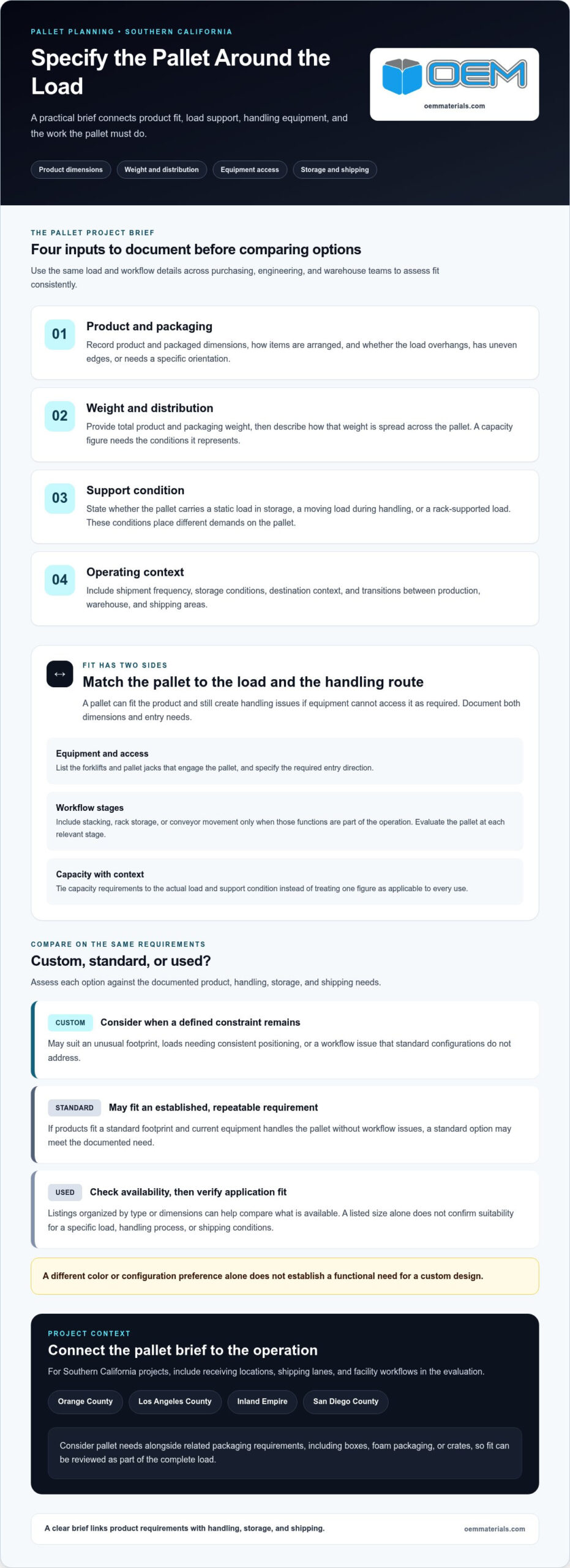
A useful pallet brief starts with the job the pallet must perform. Document the product, the shipping or storage task, and each handling step before discussing a configuration. This gives purchasing, engineering, and warehouse teams a shared basis for evaluating fit.
Build the brief around the load
- Describe the product and packaging. Record product dimensions, packaged dimensions, and how items are arranged on the pallet. Note whether the load overhangs, has uneven edges, or needs a specific orientation.
- Document weight and distribution. Provide the total product and packaging weight, then explain how that weight is spread across the pallet. Avoid relying on a single capacity figure without stating the conditions it represents.
- Define the support condition. Distinguish a static load in storage, a moving load being handled, and a rack-supported load. These conditions place different demands on a pallet. Share the relevant use case rather than assuming one capacity applies to all three.
- Describe the operating context. Include shipment frequency, storage conditions, destination context, and transitions between production, warehouse, and shipping areas.
Capture capacity needs and any material requirements in the brief, but treat them as project inputs to be evaluated against the actual load and operating conditions. A number without context can lead to a misleading comparison. For shipments that use different pallet dimensions, the international pallet standards reference can help teams account for dimensional compatibility.
Match pallet fit to handling equipment
List the equipment that will engage the pallet, including forklifts and pallet jacks, and specify the required entry direction. Dimensions and entry points need to work together: a pallet can fit the load but still create handling issues if equipment cannot access it as required.
Include stacking, rack storage, or conveyor movement only when those functions are part of the workflow. For example, a component pallet moving from production to rack-supported storage should be evaluated for both stages, not just the initial pickup. Document equipment and support conditions at each stage, and tie any capacity requirements to those conditions.
For custom plastic pallets southern california operations, a clear brief connects product and load requirements with receiving, storage, and shipping processes. OEM Materials can consider pallet needs alongside related packaging requirements, such as boxes, foam packaging, or crates.
Custom vs. Standard Plastic Pallets: Compare Fit Before You Source
Compare sourcing options against the same documented load and workflow requirements. Evaluate dimensions, load arrangement, handling equipment, storage conditions, and shipping needs consistently, rather than judging one option by fit and another by availability alone.
| Option | Fit | Availability | Repeatability |
|---|---|---|---|
| Custom | Can be specified around a defined product or handling requirement. | Depends on project details and the sourcing process. | A documented configuration can support recurring, consistent use. |
| Standard | Fits applications that work with established dimensions and configurations. | Depends on the inventory and sourcing option being considered. | Can suit repeatable loads and workflows if the same configuration meets the requirements. |
| Used | Must be assessed by available dimensions, condition, and suitability for the load. | Varies by listing. | Condition and dimensions may vary between available pallets, so assess them against the repeat-use need. |
When does a custom design justify its specification work?
Custom design is worth evaluating when a recurring mismatch affects handling or load support. A pallet that consistently fails to fit the product arrangement or equipment workflow presents a clearer design need than a preference based only on appearance. A defined configuration may help make repeated handling more consistent, but its suitability depends on the actual application.
Compare the full project requirements before drawing cost conclusions. Results depend on product dimensions, materials, and shipping requirements. A custom option isn’t automatically more economical, just as a standard or used pallet isn’t automatically the better fit.
How do used and standard pallets compare with custom sourcing?
Standard pallets can be practical when their dimensions and configuration suit an established process. A used pallet can also match a defined need if its dimensions and condition work for the intended load and handling. Neither option should be accepted on size alone. Evaluate each against the same documented requirements used to assess a custom design.
Material choice is another project consideration. Plastic and wood have different characteristics, but neither is the right choice for every operation. Evaluate the pallet and load together, including how stacked materials will be stored. OSHA’s material handling standard addresses safe storage, including the need to secure tiered materials against sliding or collapse. This reinforces the importance of assessing pallet fit within the actual storage process.
Sourcing Custom Plastic Pallets Across Southern California
A useful pallet project brief reflects where products are packed, handled, stored, and shipped. For manufacturers in Orange County, Los Angeles County, the Inland Empire, and San Diego County, receiving locations and shipping lanes can affect pallet dimensions, load arrangement, and how the pallet moves through each facility. Document those details alongside the handling process so the proposed solution reflects actual operating conditions.
OEM Materials supports manufacturers across Southern California with plastic pallet solutions. Pallet selection can also be considered alongside the protective packaging and shipping materials used with the product, helping teams identify fit issues before they become routine handling problems.
What should Southern California buyers prepare for a quote?
Bring the core load and operating details together in one project brief. Include product and packaged dimensions, pallet dimensions if there is an existing target, product weight, and how the load is arranged. Add annual usage, delivery locations, and the intended handling process, including relevant forklift or pallet-jack use, storage, and shipping steps.
Note packaging that must work with the pallet. A box that overhangs, a foam insert that changes the product footprint, or a crate that must be secured as part of the load can affect the overall configuration. Sharing these details gives the project team a clearer picture than pallet measurements alone.
How can pallet sourcing fit a broader packaging program?
Evaluate the pallet as part of the complete shipping unit. Corrugated packaging may need to sit securely on the pallet, while foam or other cushioning protects the product inside the box. Crates may also be part of the shipping configuration when that packaging approach suits the product. Coordinating these elements can help identify mismatches in dimensions, load arrangement, or handling before materials are specified.
For recurring packaging requirements, annual usage and delivery locations can inform planning around vendor-managed inventory. This is a program consideration, not an automatic outcome; the right approach depends on the operation’s usage patterns and delivery needs.
To request a quote for custom plastic pallets southern california operations, share product dimensions, weight, annual usage, delivery locations, and any packaging that must fit or travel with the load through the OEM Materials quote request.
Plan a Custom Plastic Pallet Project with OEM Materials
A clear pallet project starts with a defined load, handling process, and operating context. Document how the product is packaged, how it moves through the facility, and where it will be stored or shipped. This gives purchasing, engineering, and operations teams a shared basis for evaluating the pallet as part of the complete packaging system.
OEM Materials & Supplies partners with manufacturers across Southern California on industrial packaging requirements. Pallet planning can be considered alongside packaging design, crates, and protective materials, helping teams assess how each component works together rather than treating the pallet as an isolated purchase.
What information helps turn a pallet need into a clear project brief?
Bring together the details that shape the load and its route through your operation. A useful brief includes:
- Product dimensions, packed dimensions, weight, and loading arrangement.
- How frequently the product ships or moves, the handling equipment involved, and storage conditions.
- Receiving and destination locations, plus any relevant shipping or facility requirements.
- Related corrugated boxes, foam packaging, crates, or kitting needs that affect how the load is assembled and protected.
Include existing packaging drawings, photos, or handling notes when available. These details can clarify how the product sits on the pallet and where the packaging interfaces with it. For recurring projects, annual usage helps frame the scale of the requirement and supports a more informed quote.
How can OEM Materials support the wider packaging workflow?
Custom packaging design can help align the pallet with the product’s protective packaging and shipping configuration. Corrugated boxes, foam packaging, and crates may each serve a different role in containing or protecting a load. Kitting and assembly can also be relevant when packaging components need to be brought together as part of a defined workflow. The appropriate combination depends on the product and its shipping requirements.
For ongoing programs, vendor-managed inventory can be considered in relation to packaging usage and delivery needs. This supply approach should reflect the operation’s actual requirements. No pallet or packaging configuration guarantees a particular performance or cost result; outcomes depend on product dimensions, materials, shipping conditions, and how the system is used.
To develop a quote for custom plastic pallets in Southern California, share your product and packed dimensions, weight, annual usage, handling process, destinations, and related packaging requirements. Request a quote for your pallet project.
Build Your Pallet Project Around the Operation
The right pallet decision starts with a documented load and workflow. Compare custom, standard, and used options against the same requirements, including product dimensions, weight distribution, handling equipment, storage conditions, and shipping needs. A custom design makes sense when a recurring operational mismatch calls for a project-specific fit, not simply a preferred appearance.
For custom plastic pallets southern california projects, OEM Materials & Supplies works with manufacturers across Southern California and throughout the United States. Pallets can be considered alongside protective packaging, crates, and packaging design, with kitting, assembly, and vendor-managed inventory as relevant parts of a broader packaging program.
Share your product dimensions, packaged dimensions, weight, annual usage, handling process, and delivery context to define the project and support an informed quote. Request a quote for your custom plastic pallet project.
Frequently Asked Questions
Are custom plastic pallets worth it for a manufacturing operation?
They can be worth evaluating when a recurring mismatch between the pallet, product, or handling process creates an operational problem. An unusual product footprint, a repeatable load arrangement, or equipment access constraints may justify a project-specific design. If a standard pallet already supports the load and works through the workflow, customization may not be necessary. Any cost comparison depends on product dimensions, materials, shipping requirements, and how the pallet is used.
What information do I need to request a custom plastic pallet quote?
Provide product and packed dimensions, product weight, and the load arrangement. Include annual usage, the shipping or storage task, delivery locations, and the handling equipment and process. Note relevant conditions such as stacking, rack storage, or conveyor use. Also identify boxes, foam packaging, or crates that must work with the pallet. For custom plastic pallets southern california projects, these details connect the pallet requirement with the operation and shipping context.
Can custom plastic pallets be designed for forklift or pallet jack handling?
Yes. Handling requirements can be included in the pallet brief. Specify whether forklifts, pallet jacks, or both will move the pallet, and describe the required entry direction. Include the points where equipment engages the pallet and any transitions between production, storage, and shipping. If the load will be stacked or rack-supported, document those conditions too. The appropriate configuration depends on the equipment and actual load, so avoid relying on a capacity number without its use conditions.
How do custom plastic pallets compare with standard pallets?
Custom pallets are specified around a defined product or workflow requirement, while standard pallets use established dimensions and configurations. A standard option may be suitable if it fits the load and works with the equipment and process. Custom sourcing is worth considering when a repeated mismatch remains. Compare both choices against the same documented requirements, including dimensions, load arrangement, handling, storage, and shipping. Custom design isn’t automatically the better choice for every manufacturing operation.
Are used plastic pallets available in Southern California?
Used plastic pallets can appear in Southern California listings, but dimensions, condition, and available inventory can vary. Evaluate a used option against the intended load and workflow rather than relying on its listed size or general type alone. Consider whether it suits the required handling process and whether its condition fits the planned use. If consistent dimensions and repeatable handling are important, include those requirements when comparing standard and custom options.
What is the difference between rackable, stackable, and nestable pallets?
Rackable pallets are intended for use on warehouse rack supports, while stackable pallets are configured to allow loaded pallets to be stacked. Nestable pallets are designed so empty pallets fit into one another for storage or return handling. These terms describe different handling or storage functions, not a complete specification. Identify which function your operation needs, then evaluate the pallet against the load, equipment, and storage conditions involved.
Does OEM Materials serve businesses outside Southern California?
Yes. OEM Materials & Supplies serves manufacturers across the United States, as well as businesses in Southern California. Its local service area includes Orange County, Los Angeles County, San Diego County, and Riverside. Packaging support includes plastic pallets, corrugated boxes, foam packaging, and crates, with capabilities such as packaging design, kitting, assembly, and vendor-managed inventory. Project requirements guide which packaging and supply-chain capabilities are relevant.