
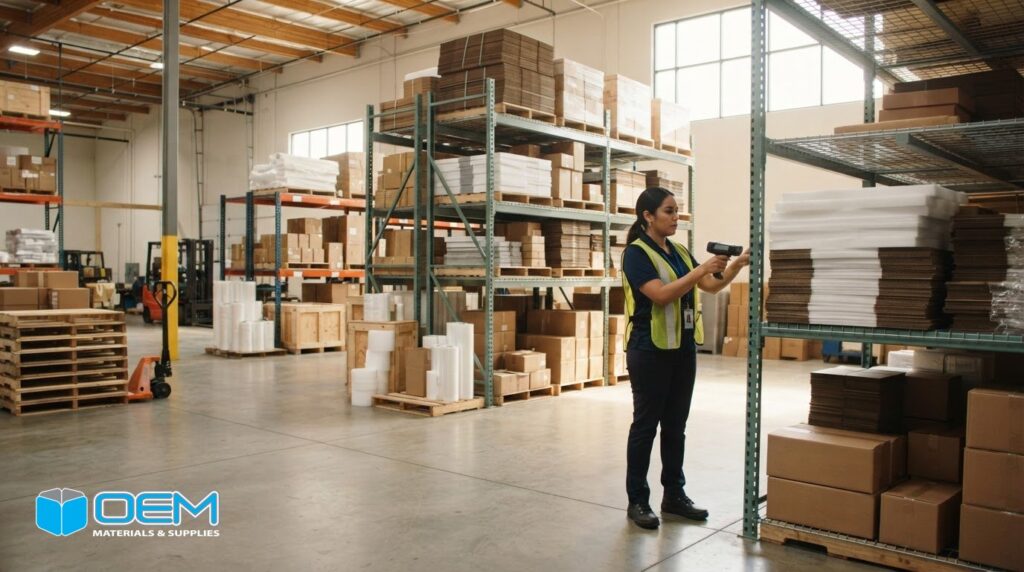
Could packaging replenishment become more reliable without adding another layer of work for your team? For Orange County manufacturers, VMI solutions can coordinate packaging inventory with production needs, helping reduce stockouts and manual ordering. The right approach depends on clear demand information and replenishment practices that fit your operation. VMI solutions for manufacturing Orange County facilities should support the workflow, not complicate it.
It’s understandable to be cautious. Packaging shortages can interrupt production or delay shipping, while excess stock takes up space and purchasing attention. Demand changes can make both problems harder to manage. Vendor-managed inventory gives a packaging supplier a role in coordinating replenishment, with the aim of keeping essential materials available as needs shift.
This guide explains how packaging VMI works, what to evaluate in a local partner, and how to decide whether it fits your operation. You’ll also see how VMI can relate to packaging design, kitting and assembly, and just-in-time delivery. These services can support a more coordinated supply approach for items such as corrugated boxes, foam packaging, crates, pallets, and stretch film.
Key Takeaways
- Identify how packaging stockouts, repeated purchase orders, and manual inventory checks affect your operation.
- Learn the basic steps for coordinating replenishment, from defining packaging items to reviewing performance.
- Compare VMI with buyer-managed stock and understand why agreed oversight still matters.
- Use a readiness review to organize packaging specifications, demand history, storage locations, and usage responsibilities.
- Explore how VMI solutions for manufacturing orange county operations can connect packaging supply with corrugated boxes, foam, kitting, and assembly.
Why Orange County Manufacturers Consider VMI for Packaging Inventory
A shortage of corrugated boxes can leave finished goods waiting to be packed. If protective foam runs short, a product may not be ready for its planned shipping handoff. And when pallet supplies need frequent checks or repeat purchase orders, staff spend time managing packaging instead of production priorities. These issues can affect several stages of an operation, from receiving and production through to shipping.
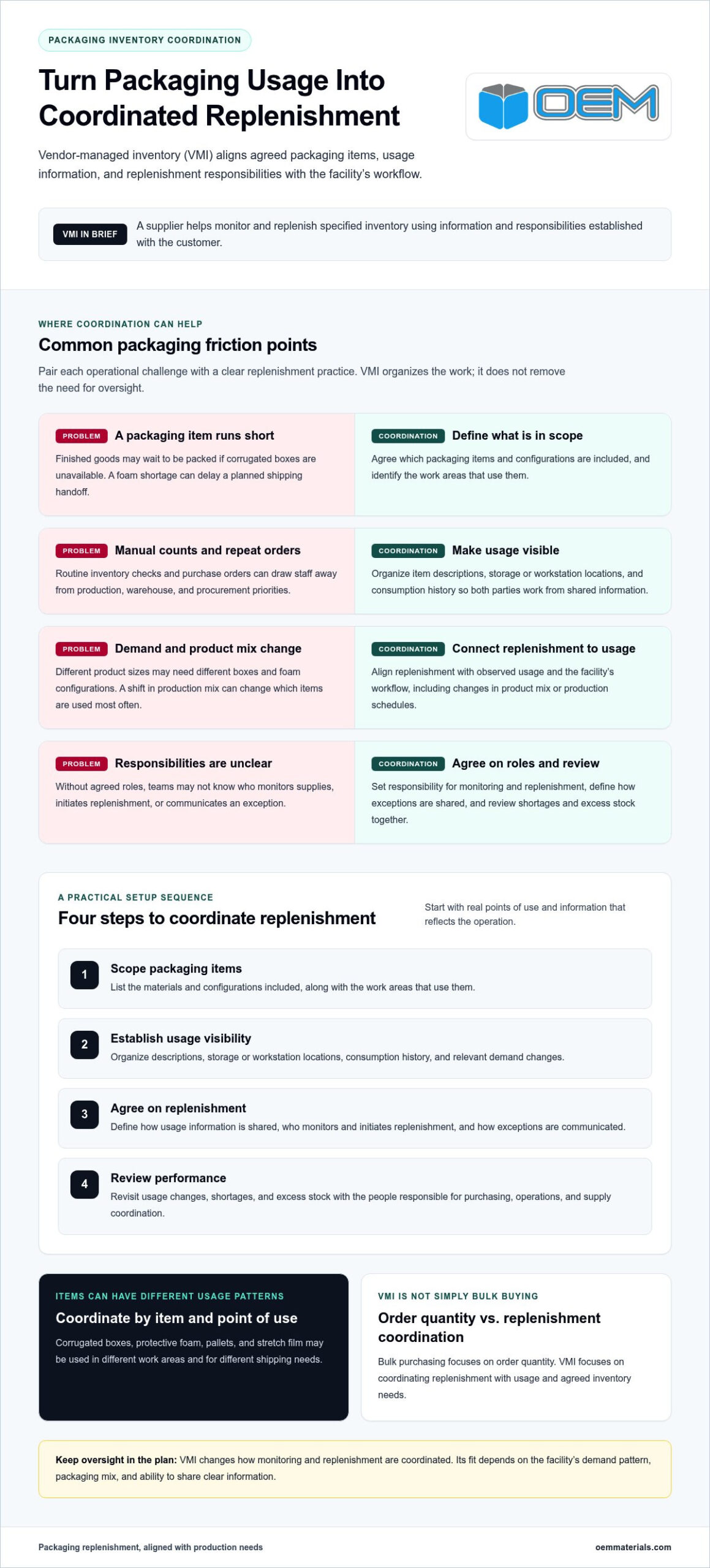
Vendor-managed inventory is an agreed replenishment arrangement in which a supplier helps monitor and replenish specified inventory using information and responsibilities established with the customer. It differs from buying packaging in bulk: bulk purchasing focuses on order quantity, while VMI focuses on coordinating replenishment with usage and agreed inventory needs. The Vendor-managed inventory (VMI) overview provides a foundation for understanding how this model differs from buyer-led inventory management.
Packaging inventory challenges across an Orange County production operation
Packaging demand is tied to what a facility makes, how products move through it, and how orders are packed. A manufacturer shipping several product sizes may use different corrugated boxes and foam configurations. A change in production mix can shift which items are consumed most often. Pallets also need to be available where teams prepare loads for storage or shipment.
When one packaging item is unavailable, the impact can carry into the next handoff. Finished products may wait for packing, or a shipping team may need to adjust its sequence while supplies are located or reordered. Meanwhile, routine counts and purchase orders can pull staff away from other warehouse and procurement tasks. VMI can organize those replenishment responsibilities, but its fit depends on the facility’s demand pattern, packaging mix, and coordination needs.
What a packaging VMI arrangement is designed to coordinate
A VMI arrangement starts with scope. The customer and supplier agree which packaging items are included and how each party will support replenishment. Effective coordination also requires a shared understanding of what is being used and where it is needed. That visibility may draw on organized item descriptions, storage locations, and consumption history. The process and responsibilities should reflect the operation.
From there, the parties align replenishment with observed usage and the facility’s workflow. For example, corrugated boxes used at a packing station may need different attention than foam used for a specific product line. Defining those distinctions keeps the program relevant to the operation instead of treating every supply as interchangeable. VMI doesn’t remove the need for oversight. It changes how monitoring and replenishment are coordinated.
For manufacturers evaluating VMI solutions for manufacturing orange county, suitability comes down to whether packaging demand can be understood and replenishment responsibilities can be coordinated clearly. OEM Materials & Supplies supports Southern California manufacturers with packaging VMI and just-in-time delivery. Its packaging VMI service can be part of a broader supply approach for packaging materials and manufacturing workflows.
How VMI Solutions Coordinate Packaging Replenishment
A practical VMI process turns packaging usage into a coordinated replenishment plan. The supplier and manufacturer define what falls within scope, how usage will be visible, who handles each replenishment task, and how the arrangement will be reviewed. The process should reflect actual points of use and demand, not assumptions based on a broad product category.
Accurate item descriptions and usage history give replenishment planning a dependable basis by showing what is consumed, where it is needed, and how demand changes. Before setting up a process, manufacturers can organize these details so both parties work from the same information.
- Scope packaging items. Identify the materials and packaging configurations included in the program, along with the work areas that use them.
- Establish usage visibility. Organize item descriptions, storage or workstation locations, and consumption history. Note changes in product mix or production schedules that affect demand.
- Agree on replenishment. Define how usage information will be shared, who is responsible for monitoring and initiating replenishment, and how exceptions will be communicated.
- Review performance. Revisit usage changes, shortages, and excess stock with the people responsible for purchasing, operations, and packaging supply coordination.
Map packaging items and points of use
Start by tracing packaging through production, assembly, and shipping. A corrugated box may be staged near a packing station, while protective foam is used earlier to prepare a product for shipment. Stretch film and cushioning materials may be consumed at different work areas for different shipping needs. Recording each item and its point of use helps distinguish similar supplies and clarifies where replenishment information should come from.
For custom packaging, include the specification or approved design reference used by the operation. Packaging design can help keep box and foam configurations aligned with product and shipping requirements. If a design changes, update the item information used for inventory planning so replenishment reflects the current configuration.
Agree on visibility, replenishment, and review
VMI requires agreement on how inventory status and usage will be communicated, which party monitors the information, and how replenishment decisions are made. Set out the process, responsibilities, and review frequency for the specific operation. This gives purchasing and operations a shared reference for routine replenishment and exceptions.
Routine reviews help the team discuss meaningful changes: a production shift that alters consumption, a shortage that interrupts a workstation, or supplies accumulating faster than expected. Adjust the plan using operational information rather than assuming demand stays constant. For manufacturers whose packaging plan also depends on delivery timing, OEM Materials provides just-in-time packaging delivery as a related supply service. Coordinated VMI solutions for manufacturing orange county operations begin with clear item data and responsibilities, then adapt through ongoing review.
VMI vs. Buyer-Managed Stock: How Much Inventory Control Changes
VMI changes who coordinates routine inventory monitoring and replenishment. It doesn’t automatically transfer every packaging decision to the supplier, remove the buyer’s oversight, or guarantee lower costs. The central question is how responsibilities are divided and whether the arrangement suits the facility’s demand patterns and procurement process.
In a buyer-managed model, purchasing or warehouse staff typically check stock, decide when to reorder, and initiate purchase orders. With VMI, the supplier takes on an agreed role in monitoring or coordinating replenishment for specified items. The buyer still needs visibility into the process and a way to address changes, exceptions, and operational priorities.
| Area | Buyer-managed stock | VMI arrangement |
|---|---|---|
| Workflow | Buyer monitors usage and initiates replenishment. | Supplier supports monitoring and replenishment under agreed responsibilities. |
| Buyer involvement | Staff handle routine checks and ordering decisions. | Staff maintain oversight, share relevant operating information, and manage agreed approval or escalation points. |
| Potential fit | Packaging needs are straightforward and easy for the team to track. | Replenishment coordination could help address recurring monitoring or ordering demands. |
Does VMI mean giving up control of packaging inventory?
No. Shared visibility is not the same as handing every inventory decision to a supplier. The parties can define which items are covered, what information is visible, which actions require buyer approval, and how an exception is escalated. For example, a manufacturer may want routine replenishment coordinated while retaining approval authority when a packaging specification changes or an unusual demand shift occurs.
Those controls need to be explicit. The arrangement should identify who can act, what decisions remain with the buyer, and how issues are brought to the right people. Specific inventory access, approval points, and escalation procedures depend on the program agreed by both parties. VMI works best as a defined operating relationship, not an informal transfer of responsibility.
When buyer-managed replenishment may remain the better fit
Buyer-managed stock can be practical when packaging needs are stable, the item mix is limited, and staff can monitor supplies without difficulty. Keeping the existing process may make sense if reorder decisions are clear and don’t demand substantial ongoing attention.
Other conditions call for closer assessment. Frequent product or packaging changes can make past usage less useful for planning. Limited consumption records can also make it difficult to distinguish a temporary fluctuation from a lasting shift in demand. In those cases, improve item and usage visibility before relying on a replenishment arrangement.
The right choice depends on workflow, not on the label. Manufacturers evaluating VMI solutions for manufacturing orange county operations can compare the time their team spends checking and ordering packaging with the oversight a VMI arrangement would still require. VMI is an option to assess, not a universal replacement for procurement. Keep the buyer’s role clear, define decision boundaries, and choose the model that supports dependable packaging availability without obscuring accountability.
A Practical VMI Readiness Checklist for Orange County Manufacturers
A useful readiness review starts with the information your team already has, then identifies gaps that could affect replenishment planning. Before discussing a program, bring purchasing, warehouse, and production perspectives together. This connects packaging records to how materials are actually used at your facility.
Prepare the packaging and production information
Build an item list that reflects what each packaging material does and where it is used. Include available specifications and demand context rather than relying on a general label such as “shipping supplies.” For each item, collect:
- Item details: Description, dimensions, packaging configuration, and intended use. Note relevant handling requirements that affect how the material is stored or used.
- Usage information: Available consumption history, purchasing records, and known changes in demand. Flag seasonal patterns, production-driven fluctuations, or changes in product mix.
- Facility locations: Storage areas and points of use, such as production, assembly, or shipping workstations. Identify access or space constraints that may shape replenishment.
- Additional packaging needs: Items that may require custom design, or packaging kits that involve coordinated components, kitting, or assembly.
Review the information for inconsistencies. Similar item descriptions can conceal different uses or specifications, while outdated records may not reflect current packaging. If a box or foam configuration needs to be designed around a product or shipping requirement, custom packaging design can help establish a defined solution for the planning discussion.
Align purchasing, warehouse, and production stakeholders
Inventory records alone don’t explain who acts on them. Identify the people responsible for tracking stock, approving changes, and communicating shifts in production demand. Include warehouse staff who understand where packaging is stored and how replenishment can reach the relevant area. Clear ownership helps prevent conflicting assumptions about who monitors usage or responds when plans change.
Use an ordered review to prepare for a program discussion:
- Confirm which packaging items and facility locations are in scope.
- Compare available consumption history with current production and shipping needs.
- Assign owners for usage updates, specification changes, approvals, and issue escalation.
- Document storage constraints and any access considerations that could affect replenishment.
- Agree on how the arrangement will be reviewed and adjusted as requirements change.
Keep expectations grounded. Potential savings and service outcomes depend on the packaging selected, product dimensions, materials, shipping requirements, demand variability, and facility operations. A readiness review clarifies these variables; it doesn’t establish guaranteed results. For manufacturers assessing VMI solutions for manufacturing orange county operations, organized specifications and clear stakeholder responsibilities make it easier to discuss a program tailored to actual packaging needs.
Bring your packaging list, usage history, and facility requirements together, then discuss your packaging and VMI requirements with OEM Materials & Supplies.
Working with OEM Materials & Supplies on Manufacturing VMI in Orange County
Packaging inventory is tied to more than purchase orders. The materials have to suit the product, protect it through its shipping process, and be available where production or fulfillment teams use them. OEM Materials & Supplies serves manufacturers in Orange County, Los Angeles, Riverside, and San Diego, as well as across Southern California, with industrial packaging, vendor-managed inventory, and just-in-time delivery. Its role is to help connect packaging supply with the operation’s requirements.
For manufacturers considering VMI solutions for manufacturing orange county operations, start with the packaging mix and how it supports production and shipping. A tailored discussion can account for product and packaging requirements, facility use, and changes in demand. No single replenishment approach fits every operation.
Packaging capabilities that can support a VMI program
The packaging scope may include corrugated boxes, engineered foam, crates, pallets, and stretch film. Each category serves a different role in a packaging workflow. For example, corrugated packaging can support product packing and shipping, while foam can provide product-specific protection. Reviewing corrugated box options alongside other packaging needs helps clarify which items belong in a coordinated supply discussion.
Packaging design, kitting, and assembly may also connect the supply plan to how products are prepared for shipment. Design work can help define packaging configurations for an application. Kitting and assembly can support workflows where multiple packaging components are brought together. Considering these needs with inventory planning gives purchasing and operations a broader view than evaluating each supply item in isolation.
OEM Materials & Supplies provides VMI and just-in-time delivery as value-added services for Southern California manufacturers. Packaging recommendations should reflect the product being protected, materials used, shipping requirements, and the facility’s workflow. Cost and service outcomes depend on those operating variables, so evaluate them in the context of the actual application rather than assuming results in advance.
What to include when requesting a VMI discussion or quote
Useful project information makes it easier to discuss packaging requirements in operational terms. Include product dimensions and weight, how the packaging is used, and annual usage for each relevant item. If specifications or usage vary across product lines, identify those differences rather than combining them into a single estimate.
Also describe the facility locations that use or store the materials, current supply challenges, and production changes that could affect demand. Note whether packaging design, kitting, or assembly is part of the requirement. These details connect the conversation to the way packaging moves through the operation.
Contact OEM Materials & Supplies to request a project-specific VMI discussion or quote. Share product dimensions, weight, packaging use, and annual usage so the conversation can be grounded in your manufacturing and shipping requirements.
Put Your Packaging Inventory Plan into Motion
Before changing an ordering routine, identify the operational issue you most want to address, such as repeated urgent orders or time spent on manual checks. Agreeing on that priority gives your team a practical basis for evaluating whether a proposed approach fits the way work moves through the facility.
Use that priority to frame a project-specific conversation with OEM Materials & Supplies. Request a quote for your packaging needs and outline the challenge you want to solve. Share your packaging list, usage history, and facility requirements to help focus the discussion on a useful next step.
Frequently Asked Questions
Is VMI a good fit for a small or mid-sized manufacturer?
It can be, if the arrangement is proportionate to the operation. A manufacturer might assess one facility or packaging family first, then consider whether the proposed coordination is manageable for its team. For VMI solutions for manufacturing orange county operations, company size matters less than whether the scope is clear and the expected coordination addresses a real operational need. A broad program isn’t necessary to evaluate the approach.
Can VMI support changing production demand?
It can support demand changes when production updates are communicated in time to inform packaging planning. For example, a revised schedule for a product launch may affect packaging needs differently from a temporary increase in orders for an established product. Sharing the reason and expected duration of a change helps distinguish a lasting shift from a short-term fluctuation. No replenishment approach can make unpredictable demand disappear.
What information should a manufacturer prepare for a VMI discussion?
In addition to packaging details, clarify which usage figures represent recurring production and which relate to one-time projects, launches, or unusual orders. This distinction can prevent a temporary event from being treated as the normal demand pattern. It’s also useful to identify known upcoming changes, such as a product transition or planned production pause, so the discussion considers the timing and context of expected use.
Does VMI require a manufacturer to share inventory data?
The parties need to agree on what information supports the arrangement, but that doesn’t automatically mean providing access to an entire inventory or enterprise system. A manufacturer can define the relevant records, the people who may review them, and an appropriate method for sharing. Clear boundaries help protect internal processes while giving both parties a workable basis for coordinating the packaging items in scope.
Can packaging VMI include custom corrugated boxes and foam packaging?
Yes. For custom packaging, establish how revisions will be identified and handled before older and updated configurations are used at the same facility. For instance, a change to a box or foam design may require teams to distinguish revised packaging from remaining stock of the prior version. Clear revision control helps reduce mix-ups during packing and keeps purchasing and production aligned on the intended configuration.
How is just-in-time packaging different from VMI?
Just-in-time packaging focuses on delivery timing, while VMI concerns inventory replenishment coordination. They can complement each other. For example, a facility with limited staging space may need deliveries timed to its workflow while also coordinating replenishment for the packaging it uses. Consider each need separately: how materials are replenished and when they should arrive for use.
Contact OEM Materials & Supplies to discuss your packaging requirements and production context. Share product dimensions, weight, packaging use, and annual usage to start a focused conversation about a supply approach for your operation.