
Could moving repeatable assembly out of your production or warehouse workflow free your team to focus on higher-priority work? For Ontario operations, packaging kitting services can bring components, assembly steps, and packing into a coordinated process. The value depends on how well the service fits your workflow. A practical guide to packaging kitting services Ontario CA buyers can use starts with the details of their operation, not assembly capacity alone.
Manual packing takes labor, and managing packaging components through separate workflows can create handoffs and inventory gaps. A missing box or protective insert can interrupt a packing schedule even when the product is ready to ship. Evaluate the full process, from component supply to kit preparation and replenishment, to identify where coordination could help.
This buyer’s guide covers workflow fit, packaging requirements, supplier coordination, implementation, and the information to include in a quote request. OEM Materials & Supplies provides kitting and assembly alongside packaging design and inventory programs, helping manufacturers coordinate these needs as part of an industrial packaging workflow.
Key Takeaways
- Identify where repetitive assembly, disconnected packaging materials, or packing delays affect your operation before defining a kitting project.
- Align kit contents, packaging design, assembly, and staging with product dimensions, materials, and shipping requirements.
- Compare in-house kitting, outsourced assembly, and coordinated packaging supply by process ownership, staffing, and inventory responsibilities.
- For a useful quote on packaging kitting services Ontario CA, prepare product dimensions and weight, packaging requirements, kit contents, workflow details, and annual usage.
- Consider how kitting, corrugated boxes, foam packaging, and packaging design can work together to support a coordinated process.
Packaging Kitting Services in Ontario, CA: Identify the Workflow Problem
Packaging kitting groups designated components or materials into a prepared set for a specific packing or assembly task. Each kit is organized around a defined process, so employees can begin with the required items together. For a concise general definition, see What is Kitting?
Kitting differs from general packaging supply. Buying corrugated boxes, foam, or cushioning addresses material availability. Kitting connects selected components to a repeatable operation, such as packing a particular product or preparing materials for an assembly step. The kit’s contents and preparation should match how the work is performed.
Common signs that a workflow may benefit from review include:
- Employees repeatedly leave their stations to collect the same packaging or assembly components.
- Materials arrive through separate purchasing or storage workflows, making them harder to bring together at the point of use.
- Packing slows when a required box, insert, or protective material is missing or difficult to locate.
These issues can occur in production areas, warehouses, or shipping operations. Ontario manufacturers evaluating packaging kitting services Ontario CA can map the full Inland Empire and Southern California workflow: where components are received, where kits are prepared, and where employees use them. For operations serving multiple departments or sites, include handoffs and replenishment responsibilities in the map, not just the assembly task.
When does packaging kitting make operational sense?
Kitting is worth evaluating when employees gather the same items for recurring work. A team packing one product configuration, for example, may need a designated box, cushioning, and protective materials for each work cycle. Preparing these items together can support consistent steps. The right approach still depends on the product, process, volume, and shipping requirements.
Start by observing the task. Record which components employees collect, how often the task occurs, where interruptions happen, and what changes between product versions. If kit contents vary frequently or the work is highly customized, the preparation and control process needs to account for those variations. The goal is a kit that reflects the operation, not a fixed bundle imposed on it.
Which packaging and assembly needs can a kit address?
A kit may include corrugated boxes, cushioning, foam, and other protective materials selected for the product and packing sequence. Product dimensions, handling needs, and shipping conditions help define those choices. Foam packaging, for example, can be included when the product’s protection requirements call for it.
Packaging kitting is the preparation of specified components or materials as a coordinated set for a defined packing or assembly task. Kit contents should follow documented product and operating requirements, including differences among product versions. Clear definitions keep preparation aligned with the task and make packaging design and component supply easier to coordinate.
How Packaging Kitting Services Coordinate Components and Assembly
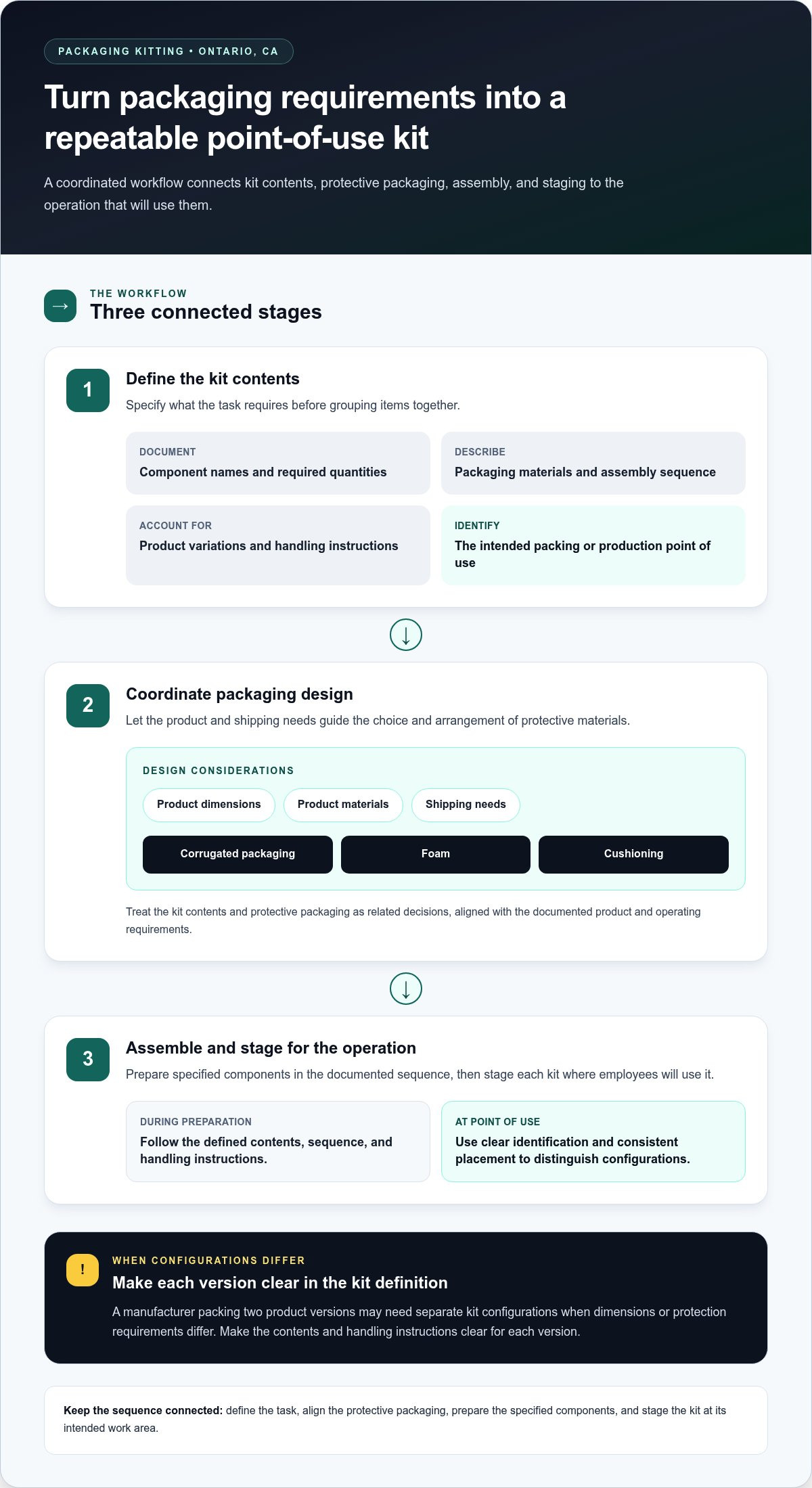
A coordinated kitting workflow turns project requirements into a repeatable sequence: define the kit, align packaging design with the product, assemble the specified components, then stage kits where employees will use them. Each step needs to connect to the next. A complete kit staged at the wrong work area can still add handling and delay.
- Define the contents. Document component names, quantities, packaging materials, and assembly sequence. Identify product variations that require different contents or handling instructions, and record the intended packing or production point of use.
- Coordinate packaging design. Use product dimensions, materials, and shipping needs to guide the choice and arrangement of corrugated packaging, foam, and cushioning. Treat the kit and its protective packaging as related decisions. OEM Materials & Supplies provides custom packaging design as part of this coordination.
- Assemble and stage. Prepare the designated components according to the documented sequence, then stage each kit for its intended operation. Clear identification and consistent placement help employees distinguish configurations and follow the established process.
For example, a manufacturer packing two product versions may need separate kit configurations if their dimensions or protection requirements differ. Make the contents and handling instructions clear for each version. That distinction reduces ambiguity at the work point and gives operations, engineering, and procurement a shared reference.
What information defines a useful kit?
Build the kit definition around what the task requires, not merely what is easiest to group. Record each component, its required quantity, packaging materials, and order of use. Note product variations and handling instructions that affect assembly or packing. Specify where the kit should be delivered within the operation, such as a designated packing station or production area. This point-of-use detail helps align preparation and staging with the actual workflow.
How can replenishment support a kitting workflow?
Kitting and replenishment solve related but distinct problems. Kitting prepares components for a defined task; replenishment restores packaging material as the operation consumes it. Scheduled or just-in-time delivery can be coordinated with demand, while vendor-managed inventory is a separate program that can support material availability. Keeping these roles clear helps teams plan kit preparation without mistaking it for inventory control. For operations assessing packaging kitting services Ontario CA, connecting kit requirements to supply planning can align component availability with work schedules. Just-in-time packaging support can be part of that broader coordination.
To discuss a workflow built around your products and operating requirements, share your packaging project details.
Compare Packaging Kitting Options for Ontario-Area Manufacturers
The right kitting model depends on who owns preparation, how much internal labor is available, and how packaging materials are coordinated. In-house kitting keeps daily control with your team. Outsourced kitting shifts kit preparation and assembly to a service partner. Coordinated packaging supply connects those activities with component sourcing and inventory planning, while your operation retains workflow decisions.
Use this comparison to decide where responsibility should sit. These arrangements can overlap, so assign an owner to each task instead of assuming one model covers every need.
| Option | Process control | Component coordination | Inventory responsibility | Operational fit |
|---|---|---|---|---|
| In-house kitting | Internal team directs preparation and sequence. | Your team gathers materials from existing sources. | Managed internally. | Useful when direct oversight is central and staffing can support the work. |
| Outsourced kitting | Tasks are performed by a service partner to agreed project requirements. | Kit components are brought together for the defined task. | Depends on the agreed supply arrangement. | Can suit operations seeking to shift assembly labor outside their workflow. |
| Coordinated packaging supply | Your operation retains process ownership. | Packaging components and kitting needs are considered together. | May include a separate inventory program. | Useful when packaging supply coordination is a priority alongside kitting. |
Project scale matters, but volume alone doesn’t determine the best fit. Prototype work may call for flexibility while requirements are being refined. Short runs can test a defined configuration, while higher-volume production programs may need consistent preparation and clearer replenishment planning. Consider product variation, internal labor availability, and how often requirements change before choosing an approach.
What should buyers evaluate in a kitting partner?
Evaluate the partner’s ability to coordinate packaging materials with a defined manufacturing or warehouse process. Treat packaging design, assembly, and inventory coordination as distinct capabilities, then identify which the project needs. OEM Materials & Supplies supports manufacturers in Ontario and across Southern California, including Orange County, Los Angeles, Riverside, and San Diego. For a local project, consider how the proposed packaging and kitting process will fit your team’s receiving, staging, and point-of-use requirements.
How do industry requirements shape kit design?
Aerospace, automotive, medical, and electronics products can call for different packaging choices based on the product, materials, handling, and shipping conditions. An industry label alone is not a complete specification. Define the actual product and operating requirements instead. Evaluate packaging kitting services Ontario CA against those project details, not broad assumptions about a sector or unsupported compliance claims.
Project fit depends on product and shipping requirements. Before selecting a model, compare the labor and workflow responsibilities it would change with the coordination it would add. A clear division of work helps purchasing, operations, and engineering assess the same project criteria.
Prepare an Ontario, CA Packaging Kitting Project for a Quote
A clear project brief turns a packing or assembly need into a practical scope. Before requesting a quote, define the product, kit configuration, how employees will use it, and expected usage. For packaging kitting services Ontario CA operations, these details help align the proposed work with the actual process instead of broad assumptions.
Build the project details in sequence:
- Describe the product. Provide product dimensions, weight, handling needs, and shipping requirements. Note variations that could change protective materials, package configuration, or assembly instructions.
- Specify the kit. Identify each component, the quantity needed per kit, and packaging material preferences. Include corrugated boxes, foam, cushioning, or other protective materials relevant to the task.
- Map the workflow. Document current assembly or packing steps, how materials move through the operation, and where kits will be used. Note handoffs or points where missing materials interrupt work.
- Estimate usage. Share annual usage and explain whether demand is steady, seasonal, or tied to production schedules. Include expected changes in product mix when known.
Which project details help scope the work?
Useful quote inputs include product dimensions and weight, handling and shipping requirements, kit components and quantities, preferred packaging materials, and expected annual usage. Describe how the product is packed or assembled today, including the materials employees gather and where the task takes place. If the project covers multiple product versions, document each configuration separately so differences in contents or packaging are clear.
Usage estimates help frame the project, but they don’t establish a guaranteed cost or savings result. Any savings depend on product dimensions, materials, shipping requirements, and the existing process. A complete brief gives the project team a basis for evaluating the work without implying an outcome before those variables are understood.
How can teams plan a controlled rollout?
Start with a representative kit configuration and state its intended point of use. Identify internal owners in purchasing, engineering, operations, and warehouse teams. Purchasing can coordinate sourcing details, engineering can document product and packaging requirements, and operations or warehouse staff can describe handling and workflow needs. Clear ownership keeps decisions connected across departments.
Set practical review measures before rollout. Check whether kit contents match the defined configuration, materials are available when needed, and employees can follow the packing sequence consistently. Record issues and required adjustments. If the operation handles multiple versions or work areas, use the review to clarify which requirements are common and which need separate configurations.
Share your product dimensions, weight, kit requirements, workflow notes, and annual usage to request a packaging kitting quote.
Choose an Integrated Kitting and Packaging Partner for Southern California
A useful packaging relationship should support sound decisions, not just fulfill a component list. OEM Materials & Supplies provides kitting and assembly alongside industrial packaging solutions. For Ontario-area manufacturers, that means coordinating packaging requirements with the practical needs of the operation and the teams that use the materials.
Before moving forward, clarify how project decisions will be shared and reviewed. A defined communication path helps purchasing, engineering, and operations address questions while keeping the intended application in view. This is especially useful when packaging requirements evolve as a project moves from evaluation into regular use.
When should kitting connect with broader packaging support?
Broader packaging support can help when a kit is only one part of a larger packaging decision. For example, a team may need to evaluate how the outer package and protective materials work with the kit’s intended use. Considering these elements together can prevent a decision that solves one task but complicates another part of the packaging process.
Keep the discussion focused on how each decision affects the product and the people handling it. An industrial packaging perspective can help buyers connect these considerations while the manufacturer retains responsibility for internal process decisions.
What can Ontario-area buyers do next?
Use the workflow assessment to identify the central project objective: reduce repetitive handling, clarify how packaging components are selected, or make a packaging process easier to manage. Then define what a workable result needs to accomplish for the teams involved. This gives the discussion direction without assuming that every operation needs the same solution.
For projects where the outer package is part of the kitting decision, review corrugated packaging options for industrial OEMs in relation to the product’s application. A focused conversation can address how packaging and assembly requirements fit together. Start with OEM Materials & Supplies by requesting a packaging kitting quote.
Build a Kitting Process That Can Adapt
A kitting plan should remain useful as products, packaging requirements, and production schedules change. Decide who owns updates to the kit specification and how changes will be communicated to purchasing, engineering, and operations. A defined review point can help teams catch configuration changes before they cause confusion at the packing station or leave materials out of sync with the product.
For manufacturers evaluating packaging kitting services Ontario CA, the next step is to put the project requirements into a quote request. Include product dimensions and weight, kit contents, packaging needs, and annual usage so the proposed scope reflects your operation. Request a packaging kitting quote to discuss the workflow your team needs to support.
A clear specification gives everyone a practical starting point. Share the project details with OEM Materials & Supplies to discuss kitting, assembly, and packaging requirements for your operation.
Frequently Asked Questions
Can packaging kitting support both prototype work and production programs?
Yes. Kitting can be scoped to the program stage and the work the kit needs to support. For a prototype, teams may use the project to refine component selection and packing steps before settling on a repeatable configuration. For established production, the focus may shift to maintaining consistent kit requirements across ongoing work. OEM Materials & Supplies supports packaging projects from prototypes and short runs through high-volume production programs.
What should a packaging kitting standard operating procedure include?
A useful procedure should tell employees how to identify the correct kit, prepare or use it, and report a discrepancy. Along with the configuration and work sequence, specify who owns the document, where the current version is maintained, and how superseded instructions are removed from use. For example, an instruction sheet at a packing station should match the approved version used by the team preparing kits.
Can packaging kits accommodate different product configurations?
Yes. A kit plan can cover product variations by defining which configuration receives which components. For example, a product family with different sizes may require distinct box or cushioning arrangements. Use clear identifiers in the kit documentation and keep similar components distinguishable during preparation. The configuration plan should reflect actual product and order patterns, so employees can select the appropriate kit without relying on informal knowledge.
How should a manufacturer handle engineering changes to a packaging kit?
Handle an engineering change as a controlled revision to the kit requirements. Identify which components, packaging materials, and work instructions change, then establish when the revised configuration takes effect. Consider how existing kit materials will be handled so obsolete items aren’t inadvertently used. Assigning a clear owner for approval and communication helps purchasing, engineering, and operations work from the same revision.
What factors affect the cost of packaging kitting services?
Project cost depends on the kit’s scope and operating conditions, including product dimensions, materials, shipping requirements, component quantities, and the existing process. Companies evaluating packaging kitting services Ontario CA can make a quote request more useful by providing product dimensions and weight, kit contents, packaging needs, and annual usage. Those details support project-specific evaluation, but they don’t establish a universal price or guaranteed savings.
Can packaging kitting use materials from multiple packaging categories?
Yes. A kit can combine packaging components from different categories when each has a defined role in the task. A product configuration might call for a corrugated box, cushioning, and foam protection, for example. For manufacturers coordinating operations in Riverside, Orange County, Los Angeles, or San Diego, documenting each component’s purpose can help keep kit specifications consistent across locations. Final selection should reflect the product and shipping needs.