

More suppliers do not automatically make your packaging supply chain more resilient. If each source depends on the same material, specification, or vulnerable delivery route, the underlying risk remains. De-risking your packaging supply chain starts with identifying those dependencies and choosing safeguards that fit your operation.
Packaging shortages can interrupt production and fulfillment, but holding more inventory is not always the answer. Extra stock uses warehouse space, ties up working capital, and adds handling demands. The right balance depends on how packaging is used, how quickly it can be replenished, and what a disruption would mean for your operation.
This guide shows how to assess packaging vulnerabilities and reduce disruption without adding unnecessary cost or complexity. You’ll compare supplier options, inventory policies, and packaging design changes against your actual requirements. It also explains how vendor-managed inventory and just-in-time delivery can support continuity when they fit usage patterns and operating needs. The goal is a practical improvement plan with clear next steps for strengthening supply continuity while managing storage, labor, and material demands.
Key Takeaways
- Map packaging specifications, usage, replenishment steps, and operational impact in one working view to expose dependencies.
- Prioritize vulnerabilities by their consequences for production and fulfillment, then assign owners and review points.
- Compare supplier options and packaging alternatives based on fit, protection, handling, and specification control, not supplier count alone.
- Choose inventory controls, including just-in-time delivery or vendor-managed inventory, to match actual usage and storage capacity.
- De-risking your packaging supply chain starts with a practical action plan that connects packaging design, materials, and replenishment needs.
Where Packaging Supply Chains Break Down: Identify the Risks Before They Disrupt Production
Packaging risk is not limited to a supplier missing a delivery. A specification change can make materials incompatible with a packing process. A replenishment gap can leave stock below operational needs, while reliance on a package with no practical substitute can make a small delay disruptive. Supply issues can expose weaknesses in design or inventory planning even when a supplier is operating as expected.
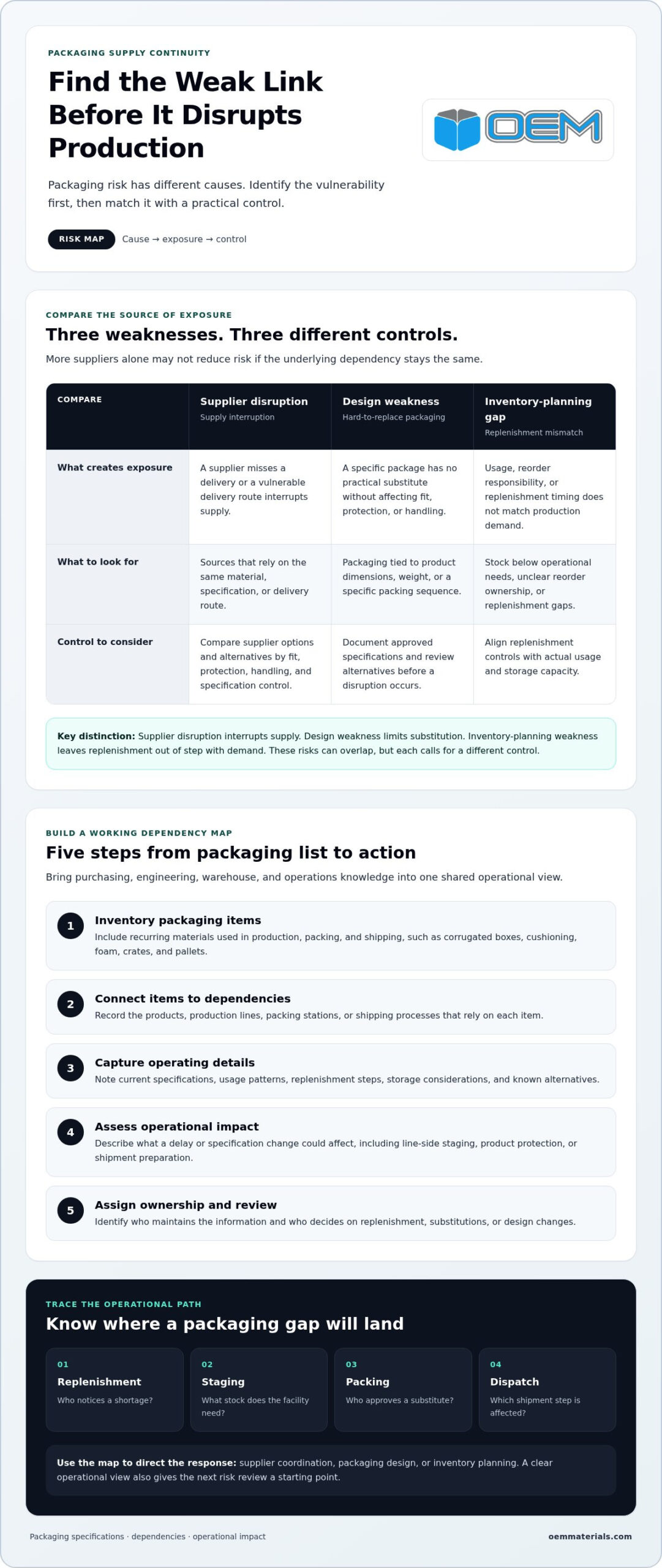
Separate the cause from the vulnerability. A supplier disruption interrupts supply. A design weakness exists when packaging is so specific that a replacement cannot be used without affecting fit, protection, or handling. An inventory-planning weakness occurs when usage, reorder responsibility, or replenishment timing does not match production demand. These risks can overlap, but each calls for a different control.
Which packaging dependencies create operational exposure?
Start with packaging that directly supports production or shipment, such as recurring boxes, cushioning, foam, crates, and pallets. Record each item’s specification, where it is used, its normal usage pattern, and what happens if it is unavailable. For manufacturers operating across Orange County, Los Angeles, San Diego, and Riverside, this view can reveal shared dependencies across sites, production lines, or product families.
Then distinguish high-impact items from materials with workable substitutes. A standard corrugated box used for routine shipments may have alternatives if the dimensions and protection requirements allow. A fitted foam insert for a sensitive assembly may be harder to replace without review. OEM Materials & Supplies designs foam packaging around product and handling requirements, so its specification should be managed as an operational dependency, not just a purchasing detail.
- Fit-dependent items: Identify packaging tied to product dimensions, weight, or a specific packing sequence.
- Workflow-dependent items: Note materials that affect line-side staging, pack-out steps, palletizing, or shipment preparation.
- Substitutable items: Document alternatives only when they can meet the required fit, protection, and handling needs.
How do packaging disruptions affect manufacturing operations?
Consider a production run that is complete but waiting for its specified box or cushioning. Finished goods may occupy staging space while the team searches for a substitute or changes the packing sequence. Warehouse employees may need to handle products more than once, and shipping readiness can slip if replacement materials require extra preparation. An improvised pack-out can also weaken product protection or lead to inconsistent handling.
Packaging supply-chain risk is the possibility that a shortage, specification change, replenishment gap, or operational dependency will prevent products from being packed, protected, or shipped as planned. This practical view complements broader Supply Chain Risk Management principles by connecting risk identification to packaging specifications and factory workflows.
For each critical item, trace the path from replenishment through production staging, packing, and dispatch. Record who notices a shortage, who approves a substitute, and which operational step is affected. This helps identify whether the corrective action belongs with supplier coordination, packaging design, or inventory planning, and gives the next risk review a clear starting point.
How to Map and Prioritize Packaging Risks
A useful risk map brings purchasing, engineering, and warehouse knowledge into one operational view. It should show what each packaging item supports, how it is replenished, and what the facility needs to do if supply or specifications change. To de-risk your packaging supply chain, make the map practical enough to guide decisions, not just document concerns.
Build the working view in a repeatable sequence:
- Inventory packaging items. Include recurring materials used in production, packing, and shipping, from corrugated boxes and cushioning to foam, crates, and pallets.
- Connect items to dependencies. Record the products, production lines, packing stations, or shipping processes that rely on each item.
- Capture operating details. Note current specifications, usage patterns, replenishment steps, storage considerations, and known alternatives.
- Assess operational impact. Describe what a delay or specification change could affect, such as line-side staging, product protection, or shipment preparation.
- Assign ownership and review. Identify who maintains the information and who decides on replenishment, substitutions, or design changes.
Build a packaging dependency map
Keep the information in a shared working view that procurement, engineering, warehouse, and operations teams can use. Procurement tracks sourcing and replenishment, engineering understands specification limits, warehouse teams know storage and handling needs, and operations can identify production consequences. Record where design variation limits substitution, and link each item to its current approved specification. When a packaging change is under consideration, custom packaging design can connect package requirements with the product and workflow it needs to support.
Rank vulnerabilities by business impact
Prioritize through operational judgment rather than an arbitrary score. Compare the consequence of an item being unavailable with how difficult it would be to qualify or implement a suitable alternative. A delay affecting a critical production or fulfillment step deserves closer attention than one involving a material with an established substitute. The right priority depends on the facility’s products, workflows, and delivery commitments.
Repeated shortages, long internal approval paths, and unclear responsibility are signals to review. So is a packaging specification that has changed without corresponding updates to purchasing or warehouse records. Use these signals to decide where to clarify ownership, evaluate design flexibility, or improve replenishment visibility. Record the reason for each priority so teams can revisit it when demand, product mix, or operating requirements change.
Keep the map current as specifications and usage evolve. A brief review tied to purchasing or operations planning can expose outdated assumptions before they affect execution. For an assessment of a packaging requirement or potential design change, the quote request provides a place to share product dimensions, weight, and annual usage.
Compare Packaging Resilience Options: Sourcing, Design, and Material Flexibility
Resilience comes from controlling dependencies, not simply adding suppliers or holding more material. The right response depends on an item’s operational importance, how difficult it is to replace, and what a change would require from engineering, procurement, and the production floor. Use this comparison to frame options before changing a specification or sourcing model.
| Option | Can help when | Trade-offs to manage |
|---|---|---|
| Single-source coordination | Specifications are specialized and close coordination supports consistent supply and change control. | Concentrates exposure if supply is interrupted. Document escalation and replenishment ownership. |
| Multiple sources | An item is critical and more than one source can meet the same operational requirements. | Can add qualification work, coordination, and specification variation. More sources do not guarantee a usable substitute. |
| Qualified alternative | A defined substitute can be approved in advance for a critical item. | Engineering and operations must establish equivalence for fit, protection, and handling before use. |
When does supplier diversification help packaging continuity?
A backup source can be useful when a packaging item is difficult to substitute and an interruption would affect production or shipment readiness. The backup reduces exposure only if it can supply material that meets the required specification and can be introduced through the operation’s approval process. If sources use different dimensions or packing characteristics, teams may face extra checks, separate storage, or line-side confusion. For lower-impact items with practical substitutes, the added sourcing complexity may outweigh the continuity benefit.
How can packaging design improve flexibility?
Review whether specifications can be simplified across products or workflows without weakening fit, protection, or handling. Standard corrugated boxes may suit products with compatible dimensions and shipping needs. Custom corrugated boxes or foam inserts may be necessary when product geometry or protection requirements call for a more tailored fit. Cushioning and crates also involve project-specific choices. The objective is not to standardize every package, but to reduce unnecessary variation while preserving performance.
OEM Materials & Supplies provides custom packaging design that connects material and specification decisions to the product and its handling requirements. Evaluate the full pack-out, including how materials are assembled and how the finished package moves through production and shipping. Potential material or labor savings depend on product dimensions, materials, and shipping requirements, so assess those factors alongside continuity and protection.
For de-risking your packaging supply chain, choose the least complex option that addresses the actual exposure. Document why a source, substitute, or design change is acceptable, then make the decision available to procurement, engineering, warehouse, and operations teams. The quote request can help start a discussion about a specific packaging requirement.
Put Packaging Risk Controls into Practice with Inventory and Replenishment
Inventory controls work when they reflect how packaging is consumed and replenished. A target that ignores production schedules, storage limits, or changing demand can leave a facility short or tie up space with unneeded material. Set a routine that makes ownership and response steps clear.
- Review usage. Compare packaging consumption with production schedules and shipment patterns. Note recurring demand, known fluctuations, and changes in product mix.
- Check replenishment steps. Record how needs are identified, who places orders, and how incoming stock is monitored. Clarify who acts if expected supply is delayed.
- Set practical inventory targets. Balance demand patterns and supply conditions against available storage and handling capacity. Revisit targets when operating requirements change.
- Define escalation. Agree how production, warehouse, procurement, and engineering teams communicate a potential shortage or a change in packaging requirements.
Set up a practical packaging replenishment review
Use the review to connect actual usage with purchasing responsibility and space constraints. Check whether packaging is available where it is needed and whether teams can identify a shortage early enough to respond. For facilities whose operations suit scheduled replenishment, just-in-time packaging delivery can align deliveries with planned usage. This approach depends on reliable information sharing and coordination with operating schedules.
Assess VMI without assuming a one-size-fits-all result
Vendor-managed inventory (VMI) involves shared planning around usage information, replenishment expectations, and inventory visibility. Before adopting it, establish what usage data will be shared, how inventory status will be communicated, and who owns each replenishment action. A VMI program can suit operations that want coordinated oversight, provided the data and responsibilities are clear.
JIT delivery and VMI address replenishment differently. JIT focuses on coordinating delivery timing with operational demand. VMI adds shared inventory planning and visibility. Neither is automatically the better fit. A facility with variable usage, limited storage, or tightly scheduled production needs to weigh those conditions against its replenishment process and ability to coordinate information.
Keep the review grounded in operating evidence. Track whether packaging is available for planned work, whether shortages are escalated through the agreed process, and whether stock levels remain workable for the warehouse. These checks help teams adjust as demand or storage conditions shift, without relying on a fixed inventory target that may no longer fit.
To discuss packaging replenishment for your operation, request a quote with the materials involved, usage patterns, product dimensions, weight, and annual usage.
Build a Packaging Resilience Plan with an Integrated Industrial Packaging Partner
A risk map becomes useful when it leads to assigned actions. For each priority, define an owner, the next step, a review point, and an operational check that shows whether the control is working. For example, track whether packaging is available for planned production, whether approved specifications are current, and whether replenishment issues reach the responsible person before they affect pack-out.
Keep the plan focused. A complex document that no one updates will not improve continuity. Start with the items that could disrupt production or fulfillment, then set a review cadence that fits how often demand, specifications, and replenishment conditions change.
Coordinate packaging materials and services around the operation
Packaging decisions are connected. A box, cushioning, or foam insert affects product fit and protection; pallets and crates influence how goods are staged and shipped. OEM Materials & Supplies provides custom and stock corrugated boxes, foam packaging, crates, pallets, and cushioning, along with packaging design, kitting, and assembly to align materials with production and fulfillment workflows.
For example, packaging design can address product fit, while kitting or assembly can align components with pack-out steps. Coordinating these requirements with supply planning helps teams consider both the package and the process it supports. For corrugated supplier coordination, define the required specifications, communicate expected usage, and keep purchasing and operations aligned on changes.
Create a clear next step for your packaging program
Turn the risk map into a short action register. Name an owner for each action, set its priority based on operational impact, and record a review date. Define observable checks, such as whether a current specification is accessible at the point of use, whether replenishment responsibility is clear, and whether an approved alternative has been evaluated where needed. Review open actions with the teams responsible for purchasing, engineering, warehouse operations, and production.
OEM Materials & Supplies supports manufacturers in Southern California, including Orange County, Los Angeles County, the Inland Empire, and San Diego County. The company also serves manufacturers across the United States. In either case, a useful packaging discussion starts with the products and workflows involved, not a generic inventory target.
For de-risking your packaging supply chain, connect priority actions to packaging design, materials, and replenishment support that fit your operation. To request a quote or discuss a packaging requirement, send your project details, including product dimensions, weight, annual usage, and current packaging requirements.
Turn Packaging Priorities into Your Next Action
Resilience improves through steady follow-through. Choose one packaging dependency to address first, assign an owner, and define a practical check that shows whether the change is working. Build on that progress as operating needs evolve. De-risking your packaging supply chain is an ongoing discipline, not a one-time purchasing decision.
OEM Materials & Supplies supports packaging programs from prototypes through high-volume production. Bring your current requirements and priority concerns into a focused discussion about the next step for your operation.
Request a packaging quote or consultation and include product dimensions, weight, and annual usage to start with useful project details.
Frequently Asked Questions
How do you identify packaging supply-chain risks?
Identify risks by tracing each packaging item from purchasing through its use in production and shipment. To de-risk your packaging supply chain, compare the approved specification with what teams order, store, and use. Look for unclear revision records, recurring substitutions, reorder steps that depend on one person, or packaging shared by several product lines. Ask operators where work slows when an item changes or arrives late. These details can uncover exposure that purchase records alone may miss.
Is using multiple packaging suppliers always the best way to reduce risk?
No. Multiple suppliers help only if each can provide packaging that meets the operational specification and can be incorporated without disrupting pack-out. For example, an alternate box with different dimensions may require new storage locations or adjustments to the packing process. For a routine item with acceptable substitutes, a second source may be practical. For a specialized package, stronger specification control and clear communication with one source may be more manageable.
Can packaging design changes make a supply chain more resilient?
Yes, if a change makes packaging easier to source or use without compromising product fit, protection, or shipping requirements. An engineer might review whether several similar products can use a common box while retaining a product-specific insert where needed. Teams responsible for product protection and pack-out should review a proposed change and assess it in the actual workflow before the revised specification becomes standard. Simplification is useful only when the package still performs its intended job.
How can a manufacturer reduce packaging shortages without increasing inventory?
Improve visibility and coordination before adding stock. Compare packaging demand with the production schedule, clarify who monitors replenishment, and establish a way to flag changes in product mix or shipment timing. Sharing schedule updates with purchasing and the packaging supply partner may help teams respond earlier. Also review whether avoidable specification variation complicates ordering. These steps can improve readiness, though inventory decisions still need to reflect actual demand and supply conditions.
What information should purchasing teams track for critical packaging items?
Track the item’s approved specification and revision, the products or processes that use it, typical usage patterns, replenishment responsibility, and storage location. Record known substitutes and the approval required before using them. Note which operational step depends on the item and whom to notify if requirements change. For a custom package, keep related product dimensions and handling requirements accessible to purchasing, engineering, and warehouse staff.
When is vendor-managed inventory useful for packaging supplies?
Vendor-managed inventory can be useful when packaging usage is recurring and the parties can coordinate consumption information, stock visibility, and replenishment responsibilities. For example, a manufacturer may want replenishment planning for common corrugated packaging while its team focuses on production scheduling. The arrangement needs clear data-sharing practices and agreement about who monitors inventory and communicates changing requirements. If usage is highly variable or information is incomplete, improve visibility and ownership before relying on shared planning.
How often should a manufacturer review its packaging supply-chain risks?
Set a regular review cadence that fits the operation, and revisit the risk map when a meaningful change occurs. Triggers can include a new product or production line, a packaging specification revision, a shift in demand, repeated replenishment problems, or a change in warehouse capacity. Manufacturers operating across Orange County, Los Angeles, San Diego, and Riverside can compare site-specific needs rather than assuming one facility’s inventory or packaging controls suit every location.