
Packaging VMI pays off only when measurable operating benefits exceed the cost of running the program. A cost benefit analysis of VMI packaging can help determine whether improved replenishment coordination and less manual ordering work justify changing your current process. Include more than packaging purchase prices: stockouts can interrupt production or fulfillment, while excess inventory takes up space and ties up working capital.
Before changing an established purchasing process, bring inventory, labor, and disruption costs into the same comparison. These costs are often recorded separately, which makes the total value difficult to assess. A company-specific analysis compares your current operating data with the costs and responsibilities of a proposed VMI arrangement.
This article explains which costs and benefits to measure, how to establish a baseline, and how to compare potential results with your current approach. Use packaging usage, inventory levels, labor time, and replenishment needs to decide whether to pilot VMI, expand a program, or retain existing purchasing practices. Potential savings depend on product dimensions, materials, and shipping requirements.
Key Takeaways
- A useful cost benefit analysis of VMI packaging separates direct program charges from internal operating and transition costs.
- Compare buyer-managed inventory, VMI, and just-in-time delivery by who coordinates replenishment and how inventory decisions are reviewed.
- Use a defined packaging scope and documented baseline to estimate potential changes, then subtract total program and transition costs.
- Test assumptions against your packaging mix, usage patterns, facility needs, and shipping requirements before deciding.
- A focused VMI discussion can connect cost inputs with packaging supply, design, kitting, and assembly needs.
What Is VMI Packaging, and Which Costs Can It Address?
Assess packaging VMI by comparing documented operating benefits with the full cost of running the program. Start with your current process: staff time spent counting and ordering, packaging on hand, and the operational effect when materials are unavailable. This baseline lets purchasing and operations teams evaluate a proposed change without assuming that VMI will automatically reduce costs.
Packaging vendor-managed inventory (VMI) is an arrangement in which a supplier participates in maintaining agreed inventory levels and coordinating replenishment based on information shared with the customer. The parties define how the arrangement works. VMI alone does not determine stock ownership, payment terms, or which party handles each task. Set those terms and responsibilities separately. The broader Vendor-managed inventory (VMI) model provides context for how suppliers and customers coordinate inventory decisions.
How packaging VMI changes the inventory workflow
In a buyer-led process, employees count packaging, track needs, and create purchase orders. With supplier-supported replenishment planning, the customer shares relevant inventory and usage information so the supplier can help plan replenishment against agreed stock parameters. Useful records may include item descriptions, on-hand balances, actual usage, and changes to production requirements. Each program defines its own roles, stock parameters, and review practices. OEM Materials & Supplies provides packaging VMI as part of its packaging supply services.
When a VMI assessment is worth considering
Recurring stockouts, excess packaging inventory, and time-consuming manual counts or orders are practical reasons to review your current process. A closer assessment may be useful when a facility handles multiple packaging items, such as corrugated boxes, foam packaging, and stretch film, or when production requirements change. These conditions do not prove that VMI is the right fit. A measured baseline helps distinguish a recurring operating cost from an occasional issue.
For a manufacturer in Orange County, Los Angeles, San Diego, or Riverside, connect inventory conditions to specific workflow costs. Review staff time spent on cycle counts and purchase orders, storage occupied by packaging, and documented emergency purchases or production disruptions linked to shortages. Compare those costs with the internal work, transition effort, and direct program charges involved in VMI. Keep categories separate to avoid counting the same labor or disruption twice.
Define the scope carefully. Start with packaging items that have reliable usage and inventory records over a consistent period. Note changes in product dimensions, materials, shipping requirements, or production schedules that could affect demand. These factors influence both packaging needs and the value of the comparison. The result should reflect your operation, not a general assumption that every manufacturer benefits from supplier participation.
Build the Full Cost Picture for a Packaging VMI Program
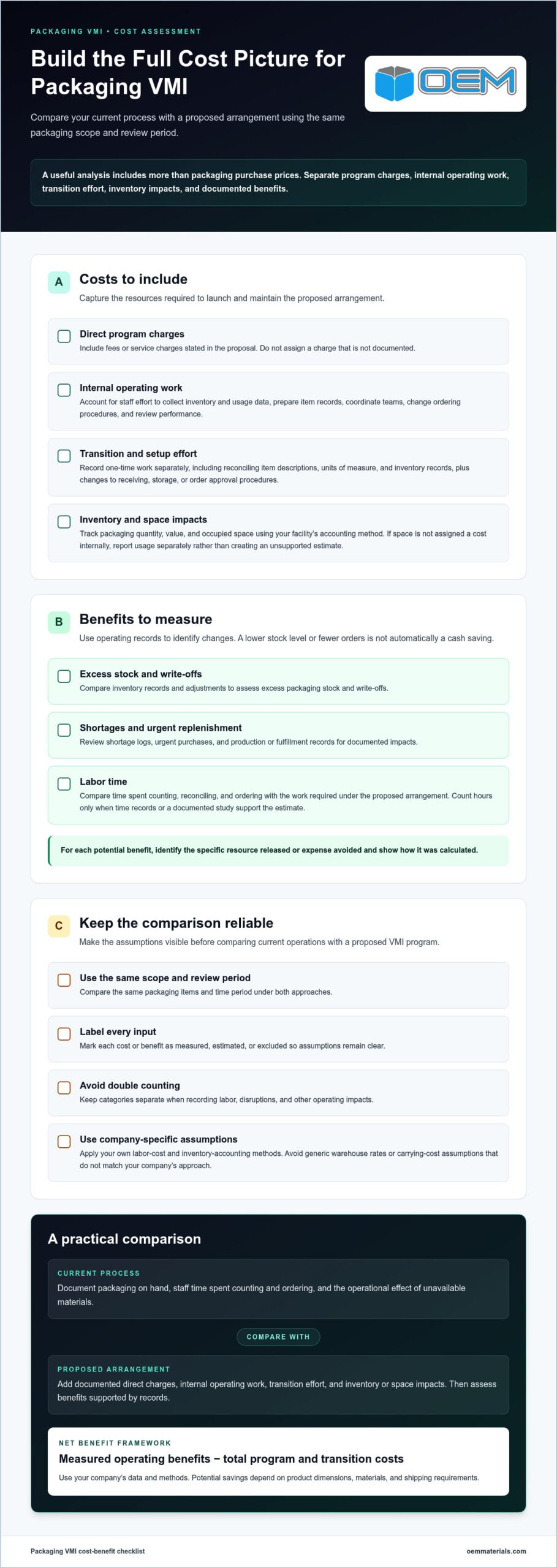
A sound comparison includes the resources needed to operate a VMI program, not only charges listed in a proposal. Use the same packaging items and review period for your current process and the proposed arrangement. Separate one-time transition work from recurring effort, and label costs as measured, estimated, or excluded. This makes assumptions visible and helps prevent double counting.
Costs to include in the comparison
Start with direct program fees or service charges stated in the proposal. Add the internal work required to launch and maintain the arrangement. Depending on your operation, this may include collecting inventory and usage data, preparing item records, coordinating staff, changing ordering procedures, and reviewing performance. Estimate hours by role where practical, then apply your company’s method for calculating labor costs. Do not assign a charge that is not documented.
Include operational changes that require staff time or resources. Adding packaging items to a program, for example, may require reconciling descriptions, units of measure, and existing inventory records. Changes to receiving, storage, or order approval procedures may also require training or coordination. Record implementation work as a transition cost instead of mixing it with ongoing program expense.
Assess inventory and space impacts using your facility’s accounting method. Track the value and quantity of packaging held, along with the space it occupies, but avoid generic warehouse rates or carrying-cost assumptions that do not match your company’s approach. If your accounting method assigns storage cost by area, apply it consistently. If it does not, report space usage separately rather than creating an unsupported dollar estimate.
Benefits to measure without overstating them
Use records to compare excess stock, write-offs, shortages, and urgent replenishment activity. Purchase orders, inventory adjustments, shortage logs, and production or fulfillment records can help substantiate changes. A reduction in orders or stock is not automatically a cash saving. Identify the specific resource released or expense avoided, and show how you calculated it.
Count labor hours only when time records or a documented study support the estimate. If employees currently spend time counting, reconciling, or ordering packaging, compare that measured time with the work required under the proposed process. Treat hours released as added capacity unless your records show an actual expense reduction or a specific redeployment of staff time.
Keep packaging specification changes separate from VMI effects. If redesign or specification work is part of the assessment, record its cost and expected operational impact independently. A custom packaging design review may be relevant when the scope includes evaluating packaging fit or specifications. Compare equivalent requirements, including product dimensions, materials, and shipping needs, so any change in protection, material use, or freight impact is not mistakenly attributed to replenishment planning.
The resulting comparison should show total program and transition costs beside documented benefits, with estimates clearly labeled. This gives your cost benefit analysis of VMI packaging a defensible basis for deciding whether to refine assumptions, assess a defined group of items, or compare the proposal with your current process.
VMI vs. Buyer-Managed Inventory vs. JIT: Compare the Trade-Offs
These models address different parts of packaging procurement. With buyer-managed inventory, the customer primarily handles counts and purchase decisions. VMI adds supplier participation in agreed inventory planning and replenishment. Just-in-time (JIT) focuses on delivery timing relative to need. Compare responsibilities, information, and review practices to identify which operating model fits your facility.
| Model | Who coordinates replenishment | Operating data used | How inventory is reviewed |
|---|---|---|---|
| Buyer-managed purchasing | The buyer tracks stock and initiates orders. | Buyer records for counts, usage, orders, and production needs. | The buyer sets the count and review process. |
| Vendor-managed inventory | The buyer and supplier coordinate replenishment under agreed roles. | Shared inventory, usage, and relevant production information. | The parties define stock parameters and review practices for the program. |
| JIT delivery | Coordination depends on the purchasing arrangement; JIT defines the timing approach. | Usage and timing information needed to align delivery with operational demand. | Delivery timing and replenishment cadence are evaluated against facility needs. |
What changes between buyer-managed purchasing and VMI?
With buyer-managed purchasing, employees count stock, identify requirements, and initiate purchase orders. Under VMI, the supplier participates in an agreed replenishment process using information shared by the customer. This can change the division of administrative work, but it does not automatically transfer ownership or eliminate buyer oversight. Define visibility, decision rights, responsibilities, and how proposed replenishment is reviewed.
For example, a buyer may retain approval authority while sharing packaging usage and inventory information for supplier-supported planning. Other arrangements may assign responsibilities differently. Base the comparison on the actual program terms, not assumptions about what the VMI label means. Include any buyer time still needed to review stock, coordinate changes, or respond to production shifts.
Where JIT delivery fits into the decision
JIT describes when packaging is delivered relative to operational need; VMI describes supplier participation in inventory management. The approaches can work together, but one does not automatically include the other. Replenishment planning may involve supplier participation while deliveries follow a cadence suited to the facility. Consider just-in-time packaging delivery when delivery cadence is part of your assessment.
Compare the planned replenishment cadence with actual consumption and available storage. A facility with limited space may need a different delivery rhythm from one that maintains a larger on-site buffer to manage variable demand. In either case, the plan depends on packaging requirements and operating data. Changes in product dimensions, materials, shipping requirements, or production schedules can affect usage and delivery needs.
For a cost benefit analysis of VMI packaging, assess each model using the same packaging scope and operating assumptions. Suitability depends on demand patterns, packaging requirements, facility constraints, and program terms. Show what work changes, what information supports replenishment, and how inventory and delivery decisions will be reviewed.
Calculate VMI Packaging’s Net Benefit With Your Own Data
A useful model separates recorded results from projections. Keep historical measurements distinct from assumptions, then test whether expected operating improvements could offset the full program cost. This makes the cost benefit analysis of VMI packaging traceable: decision-makers can see which inputs are supported by records and which need validation during a pilot.
Set a comparable baseline before modeling
Choose a period that reflects normal operations and matches the records available. Capture packaging spend, inventory levels, staff time, shortage events, and storage use for the items in scope. Keep product mix, order volume, and calculation boundaries consistent when comparing current purchasing with a VMI scenario. If production or packaging requirements changed during the period, document the change instead of treating the figures as directly comparable.
Build the calculation in sequence
- Define the scope. Identify the facilities, packaging items, and activities included. State exclusions, such as packaging redesign or unrelated purchasing work.
- Establish the baseline. Record current operating costs and outcomes for the selected period. Mark each input as measured, calculated from records, or estimated.
- Estimate changes. Project potential differences in inventory, labor effort, shortages, urgent replenishment, and storage. Use company-specific assumptions and identify the supporting evidence.
- Subtract program and transition costs. Include proposal-based charges and internal implementation or ongoing effort. Separate one-time transition work from recurring costs.
- Test the assumptions. Recalculate using different usage, product mix, labor, and shipping assumptions. Note which changes have the greatest effect on the result.
Estimated net benefit = documented benefits − total program and transition costs. Count a benefit only when it has a clear basis. Fewer recorded shortage events may indicate an operational improvement, but assign a financial value only when company records support the cost avoided. Likewise, hours potentially released from ordering work are not automatically cash savings.
Test the result and define decision thresholds
Build conservative, expected, and higher-impact scenarios using your own assumptions. The conservative case should not rely on unverified labor reductions or avoided disruptions. The expected case can use the most supportable estimates. A higher-impact case can show the effect of planned improvements, but label it as a projection rather than a promised outcome.
Identify the minimum measured improvement needed to offset documented program costs. Then set review measures for stock availability, labor effort, inventory levels, and exception handling. Compare results against the same baseline and scope. If usage changes, product mix shifts, or shipping requirements differ, update the model before drawing conclusions.
OEM Materials & Supplies provides packaging VMI quote requests as a next step for discussing your packaging mix and documented cost inputs.
Evaluate an OEM Materials & Supplies VMI Program and Choose Practical Next Steps
A useful VMI business case reflects your actual packaging mix and facility requirements. OEM Materials & Supplies provides packaging VMI alongside packaging supply, design, kitting, and assembly. For manufacturers in Orange County, Los Angeles, San Diego, and Riverside, the evaluation can connect replenishment planning with the packaging items, usage patterns, and workflows in scope. The company supports packaging needs ranging from prototypes through high-volume production.
Use your cost model to frame the discussion, not to assume a result. OEM Materials & Supplies can discuss packaging VMI support in relation to your purchasing and inventory baseline, including the packaging categories and facilities being considered. A defined scope makes it easier to compare program responsibilities and costs with the operating conditions your team wants to address.
Prepare information for a useful VMI discussion
Gather the information that shows how packaging moves through your operation. Item descriptions and dimensions identify what is in scope; usage history and current replenishment practices show how demand is handled. Include the inventory records your team uses, along with notes on recurring shortages, excess stock, storage constraints, and staff workload. Historical data is more useful when it separates regular demand from production changes and unusual exceptions.
Clarify the boundaries of the assessment before comparing options. Identify the facilities, teams, and packaging categories involved, such as corrugated boxes, foam packaging, crates, or stretch film. Note where sites use the same items and where their requirements differ. Include changes to products, shipping methods, or production schedules so the discussion reflects expected operations, not outdated usage patterns.
Turn the analysis into a scoped next step
Review proposed responsibilities, program costs, information needs, and performance measures together. Confirm which tasks remain with purchasing, warehouse, or operations teams and how inventory performance will be reviewed. Align measures with the business case, such as stock availability, inventory levels, ordering effort, and exception handling. This gives both parties a shared basis for assessing outcomes instead of relying on broad savings expectations.
Consider starting with a defined group of packaging items or a specific facility before extending the model to other categories or sites. A narrower scope can make it easier to compare actual activity with your baseline, identify missing data, and adjust assumptions. Set clear decision criteria: what improvement justifies continuing, what issues need correction, and when results will be reviewed.
If you have item descriptions, dimensions, usage history, and current inventory challenges ready, use the packaging VMI quote request to start a discussion about your operation.
Make the Decision Measurable
A VMI decision does not have to be all-or-nothing. Treat it as an operating change with clear ownership, documented assumptions, and a planned review point. Purchasing, warehouse, and operations teams can then assess performance against the same baseline and adjust the scope if actual conditions differ from the model.
The cost benefit analysis of VMI packaging is most useful when it informs a specific decision: maintain current purchasing practices, test a defined scope, or consider a broader program. Tie the evaluation to your operating priorities and revisit it when packaging needs or production patterns change. A disciplined review helps distinguish measurable results from expectations.
OEM Materials & Supplies can discuss packaging VMI in light of your packaging information and operating priorities. Contact the team to request a quote or discuss a program, and include item dimensions, usage history, and current inventory challenges to make the conversation specific to your needs.
Frequently Asked Questions
Can packaging VMI work when demand changes from month to month?
Yes. Variable demand does not rule out packaging VMI, but the arrangement should define how changes are communicated and handled. A planned production ramp or shutdown may affect packaging needs differently from an unexpected schedule revision. Distinguishing planned changes from actual consumption helps both parties interpret inventory signals and respond to shifts without treating a forecast as a fixed commitment.
Does vendor-managed inventory mean the supplier owns the packaging stock?
No. Stock ownership is separate and should be addressed in the program’s commercial and accounting terms. Before implementation, purchasing and finance teams can align on how packaging stock appears in inventory records, how receipts are reconciled, and what event triggers payment. Clear documentation prevents replenishment records from being mistaken for accounting or invoicing instructions.
What information should a manufacturer share when evaluating packaging VMI?
Provide item-level records that are consistent across purchasing, warehouse, and production systems. Check that item identifiers and units of measure match, and note revisions or substitutions that could make historical usage misleading. Site-level detail helps when the same packaging item is stored or consumed differently across facilities. This data check reduces the risk of mismatched records distorting the comparison.
How can a company assess VMI if it uses only a few packaging items?
A small assortment can still be evaluated, particularly if an item has a dependable usage pattern or a clear operational consequence when unavailable. Consider how easily its consumption can be distinguished from other materials and whether its stock history is reliable. Keep conclusions limited to the items assessed; a process that fits one packaging category may not suit items with different demand or handling needs.
How should a manufacturer account for seasonal packaging demand in a VMI analysis?
Use the production calendar to distinguish predictable seasonal peaks from ramp-ups, shutdowns, and one-time schedule changes. A planned maintenance period may temporarily lower packaging use, while a scheduled production increase may create a predictable rise. Record when these changes occur and how long they typically last. This context helps prevent a temporary low-use period from being mistaken for normal demand.
What should happen if a VMI analysis shows little or no net benefit?
First, check whether the model covers the full evaluation period and separates one-time effects from recurring activity. Then determine whether the result reflects a genuine lack of measurable value or gaps in the records. Some operational improvements may matter to the business but be difficult to express financially. Keep those observations separate from quantified results so decision-makers can consider them without overstating savings.