
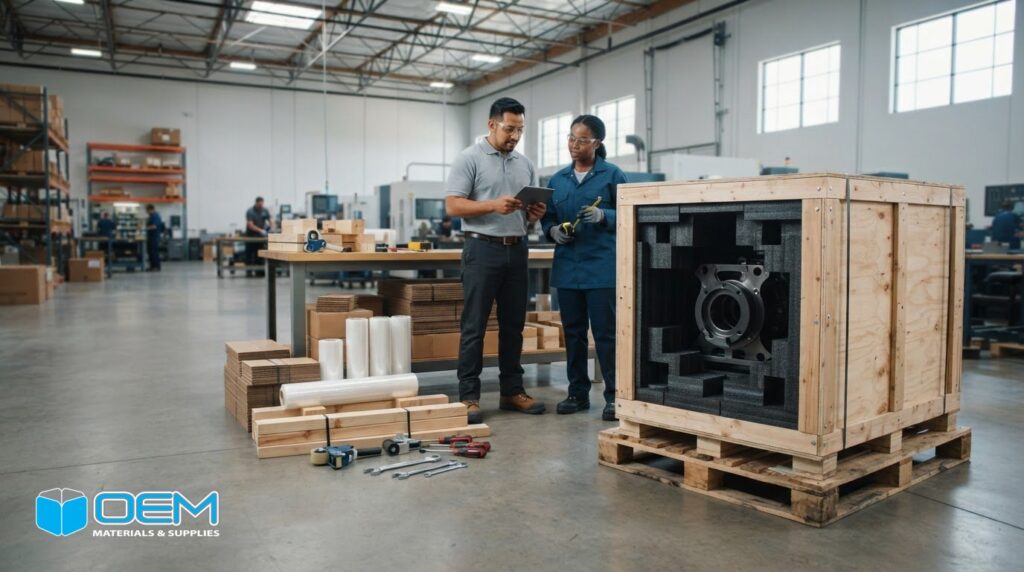
Can a wood crating service near me protect a product and fit the way it moves through production, handling, and shipping? A crate sized without considering those requirements can create avoidable risks, from inadequate load support to extra work on the warehouse floor. Start with the product and its journey, not a standard crate size.
Product dimensions and weight, lifting and handling methods, shipment route, and interior cushioning all help define a practical crate specification. The crate also needs to fit your packing process and shipping schedule. For a useful design review, collect these details before requesting a quote, and flag any measurements that are still preliminary.
OEM Materials & Supplies designs and supplies custom wood crates for manufacturers, with related foam packaging, kitting, and assembly services. This guide explains what information to gather, how handling and supply-chain needs affect crate requirements, and what to include in a project-specific quote request. For operations in Orange County, Los Angeles County, the Inland Empire, and San Diego County, a clear brief helps connect product protection with production and shipping workflows.
Key Takeaways
- Match the packaging approach to the product’s shape, protection needs, handling process, and fulfillment workflow.
- When evaluating a wood crating service near me, define which tasks are covered by crate design and supply, and which belong to packing or freight coordination.
- Make a quote request more useful with product details, destination context, annual usage, order pattern, and prototype or production status.
- Compare crates, corrugated packaging, and pallet-based packaging by how the shipment will be handled and protected.
- OEM Materials & Supplies provides custom wood crates and packaging design for manufacturers in Southern California, supporting projects from prototypes to production programs.
Finding a Wood Crating Service Near Me in Southern California
Industrial buyers need packaging that protects a product and fits the way it is handled, packed, and shipped. Searching for a wood crating service near me can make sense when a standard container does not fit the load or the operation. The useful next step is to define the shipment’s actual requirements, rather than treating crating as a stand-alone purchase separate from warehouse and fulfillment workflows.
OEM Materials & Supplies provides custom wood crates and packaging design, including consideration of how interior protection works with the outer structure. Foam packaging is available as a related protective packaging option. Define the scope for each project clearly, including whether the requirement is for the crate itself or also includes packing labor, loading, or freight coordination. Clear ownership of each task helps prevent gaps between packaging, operations, and transportation.
For manufacturers in Orange County, Los Angeles County, the Inland Empire, and San Diego County, industrial packaging has different requirements from residential moving or a retail shipping storefront. The focus is a repeatable business need: the product, its handling path, the shipment, and the workflow it must fit. General background on types of crates can help clarify the range of crate forms, but the specific design should follow the load and intended use. OEM Materials & Supplies’ custom crate solutions are designed for industrial packaging needs.
When does an industrial shipment call for a wood crate?
Machinery, production equipment, and products with unusual dimensions can require packaging designed around their shape, support points, and movement during handling. A crate provides a defined outer structure, but it is not a universal solution or a guarantee against transit damage. The right design depends on the product, how it will be lifted or moved, and the shipment requirements.
For example, a large piece of equipment may need a base that accommodates the planned lifting method. A product with projecting components may need clearance around those features and interior restraint to limit movement. These are project-specific considerations, not assumptions to make from the product category alone. Share the handling path and shipment context so the packaging design reflects real operating conditions.
What should local buyers expect from a packaging partner?
An industrial packaging partner should connect crate design and supply with the protection needed inside the crate. That includes assessing how foam or other cushioning supports the product and how the packaging fits the company’s packing process. A clear scope also distinguishes the packaging deliverable from separate responsibilities, such as packing the product or arranging freight.
Program stage matters. A prototype may need design attention before repeat orders begin, while short runs and production programs bring different sourcing and planning needs. Share expected order patterns and operational constraints early. That context helps shape a crate approach around both product protection and the way your team prepares shipments.
How to Specify a Custom Wood Crate for Your Product
A useful crate recommendation starts with measured product information and the conditions the shipment will face. When contacting a wood crating service near me, provide enough detail to distinguish the load’s actual needs from assumptions based on its general category. OEM Materials & Supplies’ custom packaging design connects those project inputs to an approach tailored to the product and shipment.
Work through these inputs in sequence:
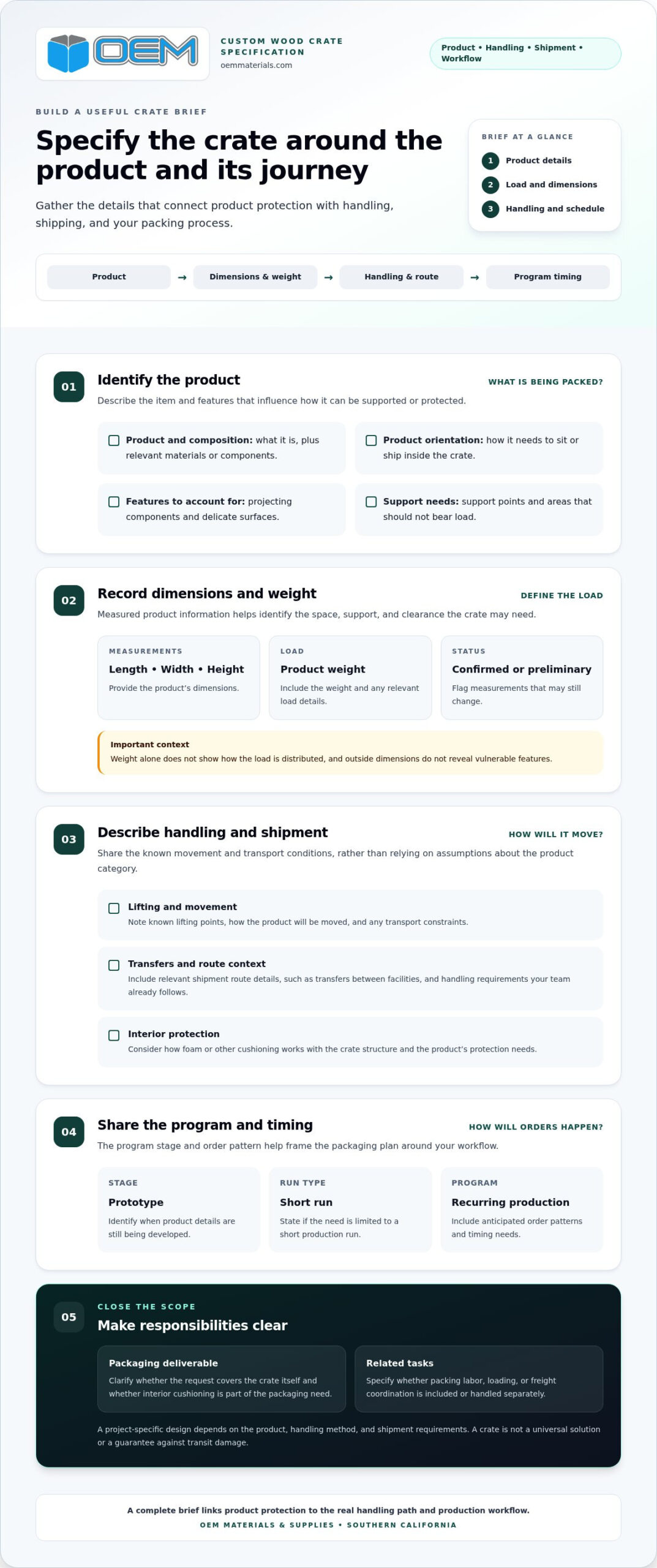
- Identify the product. Describe what it is, what materials or components it includes, and any features that affect how it can be supported or packaged.
- Record dimensions and weight. Provide the product’s length, width, height, and weight. Note the shipping orientation, protruding parts, delicate surfaces, and areas that should not bear load.
- Describe handling. Explain how the product will be moved, including known lifting points, transfers, and transport constraints. Share the shipment route context and handling requirements your team already follows.
- Share schedule needs. State whether the request is for a prototype, a short run, or recurring production. Include the anticipated order pattern and timing needs so the packaging plan can account for the program’s workflow.
Complete measurements help define the space the product occupies and where support or clearance may be needed. A weight estimate alone does not show how the load is distributed, and outside dimensions do not reveal vulnerable features. If dimensions are changing during product development, identify them as preliminary. That keeps the packaging discussion aligned with the project’s current stage.
Which product and shipment details should you collect?
Before requesting a recommendation, document the product’s orientation, support points, projecting components, and surfaces that need protection. Add the planned handling points and route context, such as transfers between facilities or known limits on how the shipment can be moved. Include whether the project is a prototype, short run, or recurring production program. Together, these details help the packaging team assess the crate in relation to the actual load and operating process.
How do interior protection and crate design work together?
The crate’s outer structure and interior protection serve related but different roles. Product contact points and potential movement inside the crate help determine whether cushioning or shaped foam packaging is appropriate. For example, a sensitive component may need support around specific surfaces rather than open space that allows it to shift. Foam is one possible part of the design, not a default requirement. Let the product’s shape, materials, and shipping conditions guide the choice.
Share drawings or photographs when they clarify features that measurements alone cannot show, and label any dimensions that are provisional. A defined product, handling path, and schedule give your team a more useful project brief. To start a project-specific review, submit your crate requirements with the product dimensions, weight, and production context.
Comparing Wood Crates with Other Packaging for Southern California Shipments
A crate, corrugated package, or pallet-based setup can each serve a different role in an industrial shipment. The right format depends on the product’s dimensions and weight, how it will be handled, the protection it needs, and how the packaging fits your operation. For manufacturers shipping within Southern California or beyond, compare those factors rather than choosing by material alone.
| Format | May suit | Protection and operational considerations |
|---|---|---|
| Wood crate | Equipment, machinery, or products with unusual dimensions that need a defined outer structure. | Custom design can account for the product’s form and handling needs. Consider interior protection and how the crate fits packing, storage, and movement processes. |
| Corrugated packaging | Products whose dimensions, weight, and handling requirements suit a box-based package. | Can form the outer container, with cushioning considered separately when the product needs support or separation from the box walls. |
| Pallet-based packaging | Shipments that need a platform for handling or grouping packaged items. | A pallet supports movement as part of a packaging setup. It does not by itself provide the enclosure or product-specific restraint that a crate or box may require. |
Use the table as a starting point, not as a performance guarantee. A format that fits one product or shipping route may not fit another. Describe the actual load, handling process, and shipment context before choosing the packaging approach.
When might a crate or a corrugated box fit better?
A wood crate is worth considering for a large or unusually shaped product when the packaging needs a custom outer structure. Corrugated packaging may suit a product that fits a box format and whose weight and handling requirements align with that approach. Neither format is automatically right based on product category. Compare measured dimensions, weight, orientation, and handling needs. OEM Materials & Supplies offers custom wood crates as part of its industrial packaging solutions.
For example, a component with a regular shape and manageable handling needs can be evaluated for corrugated packaging, while equipment with projecting features calls for a different design discussion. The recommendation depends on the product, materials, and shipping requirements, not on a broad assumption that one packaging format is always stronger or more efficient.
When should interior cushioning or a pallet enter the discussion?
Interior cushioning addresses contact and movement inside the outer package. If a product could shift or contact a crate or box during handling, consider where it needs support and whether cushioning is appropriate. Foam packaging can be part of the discussion when it suits the product’s shape and protection requirements.
A pallet is a handling platform, not a replacement for every crate requirement. It can be part of a broader setup when the shipment needs a base for movement, while the enclosure and internal protection remain separate design considerations. Buyers comparing options from a wood crating service near me should clarify how the package will be handled and what each component is expected to do. This gives the team a practical basis for evaluating the complete shipment configuration.
Preparing a Wood Crating Quote Request Near You
A detailed request connects crate design to the product, shipment, and production plan. If you’re contacting a wood crating service near me, organize the information below before submitting your request. Clear inputs help define the project scope and identify which details need further discussion.
What information helps scope a quote accurately?
Include enough detail to describe both the item and the shipment. Product drawings or photographs can clarify features that measurements alone may not capture. Note which information is preliminary so estimates and design discussions use the right assumptions.
- Product details: Describe the product and provide its length, width, height, weight, orientation, and quantity per shipment. Note projecting parts, delicate surfaces, and any areas that should not bear weight.
- Shipment context: Provide the destination and relevant route context, along with planned handling methods, known transport constraints, and schedule targets.
- Program requirements: State expected annual usage, anticipated order pattern, and whether demand is one-time or recurring. Identify the program as a prototype, short run, or production requirement.
- Supporting materials: Attach available drawings or photographs and flag product changes that could affect dimensions, packaging, or timing.
Destination context matters because a crate for one shipment path may need different planning from a crate used in another. Share the information that affects packaging selection and shipment handling, including destination-specific requirements your team knows apply. A project-specific recommendation and quote depend on the product’s dimensions, materials, and shipping requirements. Those inputs shape the proposed packaging and its scope, so avoid relying on a generic estimate for a different load.
How should buyers assess production and inventory fit?
Packaging quantities should reflect how the product moves from development into production. A prototype request may involve a single design under evaluation, while a short run or recurring program requires planning around expected order quantities and cadence. Share anticipated annual usage and how orders are likely to be released. These details frame the sourcing discussion without assuming a fixed inventory level or delivery schedule.
For ongoing programs, consider how packaging supply fits purchasing and production workflows. OEM Materials & Supplies offers vendor-managed inventory (VMI) to help coordinate packaging supply with operational needs. The right approach depends on the program’s requirements and planning details, rather than an assumed savings or availability outcome. Include known usage fluctuations or changes expected as the program develops.
With your product description, measurements, shipment context, and demand pattern assembled, you can submit a focused request for review. Request a wood crating quote with available drawings, photographs, annual usage, and schedule targets to support a project-specific discussion.
OEM Materials & Supplies Wood Crates for Southern California Manufacturers
OEM Materials & Supplies designs and supplies custom wood crates for manufacturers, with packaging design support for projects from prototypes and short runs through production programs. The focus is industrial packaging that fits the product and the operation around it. For buyers considering a wood crating service near me, that means looking at the crate alongside how products are prepared, handled, and released for shipment.
Packaging can involve more than the crate itself. Depending on the product and shipment requirements, foam packaging can provide interior support, while kitting and assembly can help prepare packaging components for use. For recurring programs, vendor-managed inventory (VMI) can also support packaging supply planning around operational needs.
How can coordinated packaging support manufacturing operations?
Looking at the packaging system as a whole connects crate design with product contact points, the packing sequence, and the materials used inside and around the package. An electronics shipment, for example, may call for attention to how components are positioned. Equipment used in automotive or aerospace manufacturing may have different support and handling considerations. These are examples of project inputs, not fixed packaging prescriptions.
OEM Materials & Supplies can coordinate custom crate design with related packaging needs. Whether foam packaging, kitting, or assembly belongs in the plan depends on the product and the operation. A coordinated approach can help clarify packing steps or material requirements, but any effect on labor or cost depends on the specific workflow, dimensions, materials, and shipment needs. Custom packaging design supports planning around those project-specific details.
What is the next step for a Southern California crate project?
Manufacturers in Orange County, Los Angeles County, the Inland Empire, and San Diego County can prepare for a focused packaging discussion by gathering the product description, dimensions, weight, destination context, handling needs, and expected annual usage. Note whether the project is at the prototype stage or part of an established production program. Drawings or photographs can help explain features that measurements alone may not convey.
These details provide a practical starting point for scoping a wood crate and related protection. If product or shipment requirements are still changing, identify which details are preliminary so the design discussion can account for them. Share the expected order pattern too, especially for recurring needs that may connect with packaging supply planning.
For a project-specific quote, send your wood crate requirements, including dimensions, weight, destination context, and annual usage. This gives OEM Materials & Supplies a clear basis for discussing packaging suited to your product and production workflow.
Put Your Crate Requirements Into Motion
A crate specification is most useful when it stays connected to the product and the process it serves. If dimensions, handling steps, or shipment destinations change, revisit the packaging assumptions before those changes reach the shipping floor. This keeps procurement, engineering, and operations working from the same project requirements instead of relying on a design based on outdated details.
That discipline also gives future packaging decisions a clearer starting point. Keep approved product information, handling notes, and order expectations together so your team can reference them as a program develops. For a new project, begin with the details you have and identify which are still subject to change. Then evaluate a wood crating service near me against the requirements that matter to your operation.
OEM Materials & Supplies works with manufacturers on packaging requirements at different project stages. To discuss your application and request a project-specific quote, start a wood crating quote request. Include product dimensions, weight, destination context, and expected annual usage to give the team a practical basis for review. A clear brief is a solid first step toward packaging that fits the work ahead.
Frequently Asked Questions
How much does a custom wood crate cost?
The cost of a custom wood crate depends on the project scope, so a reliable price requires a specific request rather than a general estimate. For a meaningful comparison between proposals, make sure each one covers the same crate quantity and packaging requirements. If the design or order quantity is still under review, identify that in the request. OEM Materials & Supplies can prepare a project-specific quote based on the defined requirements.
What information do I need to request a wood crating quote?
Along with basic product and shipment information, clarify how many units need individual crates and whether accessories or separate components ship with the main product. Share drawings or photographs if they show features that are difficult to describe. If the product is still in development, distinguish confirmed details from pending changes. That helps keep the quote discussion tied to the current design rather than assumptions about a later revision.
Can a wood crate be designed for irregularly shaped equipment?
Yes. Custom packaging design can account for equipment with an uneven profile, attached components, or features that need clearance during packing. Note which parts are fixed to the product and which are removed for shipment. This can affect how the equipment is presented for packaging and how the crate is designed around it. The final design should reflect the actual configuration being shipped.
Are wood crates reusable?
They can be, if the crate remains in suitable condition and its design fits the next shipment. Before reuse, inspect the structure for damage, loose connections, or changes made during the previous shipment. Also consider whether the next product is the same item and configuration. Base reuse on the crate’s condition and intended next use, not simply on the fact that it completed an earlier shipment.
Does a wood crate protect products from moisture?
A wood crate by itself is not automatically a moisture barrier. Exposure can range from brief contact during loading to damp storage or condensation during transit. Describe the conditions the product may encounter, especially if moisture could affect its function or finish. The appropriate packaging approach depends on that exposure and the product’s sensitivity. Do not assume the crate alone provides a sealed or moisture-controlled environment.
Do international shipments require special wood-crate compliance?
Destination-specific requirements for wood packaging can apply to international shipments. Confirm the rules that apply to the destination before shipping, and include that step in shipment planning rather than treating it as a crate-strength or design question. Requirements can vary by destination, so this answer does not establish compliance for a particular shipment.
How long does it take to make a custom wood crate?
There is no single schedule for every custom crate project. Planning depends on the design scope, the project stage, and how quickly the packaging requirements are finalized. A prototype may involve a different review path from a repeat production program. Share the date the packaging is needed and any design approval milestones so timing can be discussed in the context of the actual project.