
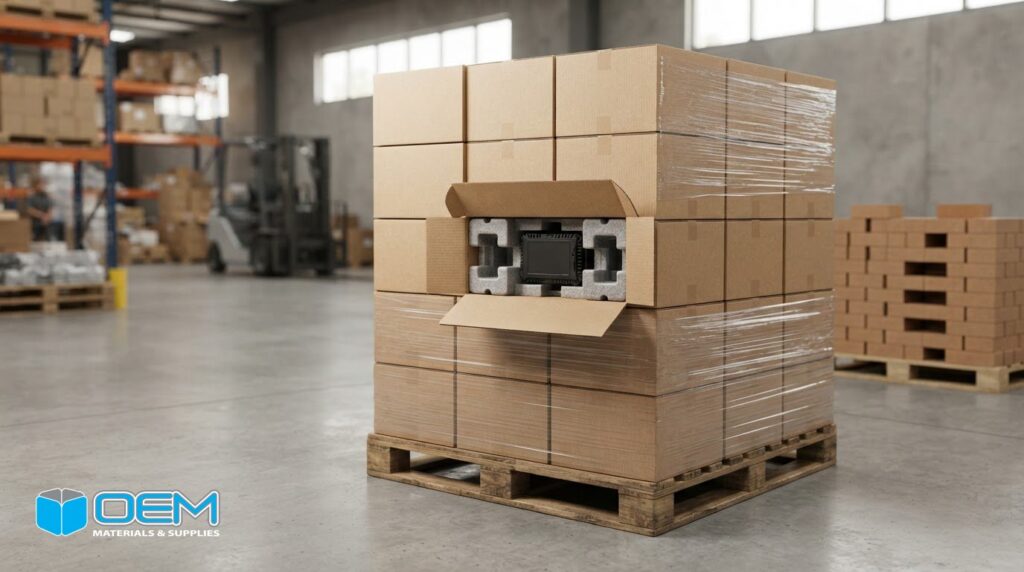
Stacking strength is a system outcome, not a board rating. A box can meet a specified board strength and still deform under the load, storage conditions, or pallet pattern it faces in service. Effective corrugated box design for stacking strength considers how the complete unit load performs, not just which material is selected.
If cartons are failing in storage or transit, it’s reasonable to look first at the corrugated board. But board strength alone doesn’t explain how product fit, box structure, stacking alignment, and humidity affect performance. Each factor can change how loads move through the carton and across the pallet.
This guide explains the main contributors to stacking performance and how to compare structural and palletization options against actual operating conditions. You’ll learn how product support and box dimensions influence compression, why pallet fit and stacking patterns matter, and what to include in a brief for design evaluation or testing.
Key Takeaways
- Assess carton compression separately from the stability of the complete pallet load.
- Use corrugated box design for stacking strength to align box dimensions, product support, and load paths with actual use conditions.
- Compare column and interlocked stacking patterns based on corner alignment, stability needs, and product support.
- Build a design brief with packed dimensions and weight, stacking orientation, storage duration, shipment requirements, and pallet layout.
- Evaluate custom box and pallet requirements together, then use prototypes to assess performance in the intended application.
What Corrugated Box Stacking Strength Means in Real Operations
Stacking strength is a carton’s ability to resist compressive loads under defined conditions. Those conditions matter. A box stored in a warehouse for an extended period faces a different load profile from one moving through a shipment with repeated handling. The same carton can perform differently depending on how it is filled, oriented, stacked, and supported.
Quotable definition: Carton compression performance describes how an individual filled box resists vertical force; unit-load performance describes how the complete palletized stack carries that force and remains stable in its operating environment.
This distinction is central to corrugated box design for stacking strength. A box compression result measures carton behavior in a controlled setup. It does not, by itself, establish that a pallet load will stay aligned or stable during storage and transit. For an overview of how box construction and test methods relate to stacking, see Corrugated box design and stacking strength.
Why a strength rating alone cannot predict field performance
A rating or test result describes performance under specified conditions, not every condition across a supply chain. Board-level indicators provide useful material information, but the finished box also reflects its dimensions, construction, closures, and packed contents. Orientation changes how forces meet the box edges, while uneven loading or unsupported space inside the carton can redirect pressure toward panels not intended to carry it. Review the assembled, filled carton and its actual support points, rather than relying on a board rating alone.
Where stacking failures affect manufacturing operations
In warehouse storage, cartons may carry a steady load for an extended period. In palletized shipments, cartons must also remain supported and aligned as a unit during movement and handling. These are related but distinct design cases, so evaluate the intended use rather than assuming one load condition applies everywhere.
When a carton deforms, the product may become exposed or harder to handle. Staff may need to inspect, repack, or reposition affected goods, interrupting routine warehouse and production workflows. For example, a box that bows where its contents do not support the panels presents a different issue from a pallet stack with cartons misaligned at their corners. Both problems call for examining how the load reaches the carton and how the complete stack is supported.
For projects in Orange County, Los Angeles, Riverside, and San Diego, packaging design can account for the packed product and operating conditions alongside the box specification. OEM Materials & Supplies supports custom packaging design, including prototype development, to translate requirements into a carton suited to its intended application. Start by assessing structure, product fit, stacking pattern, and pallet support as connected design choices.
How Box Structure, Product Fit, and Conditions Shape Stacking Strength
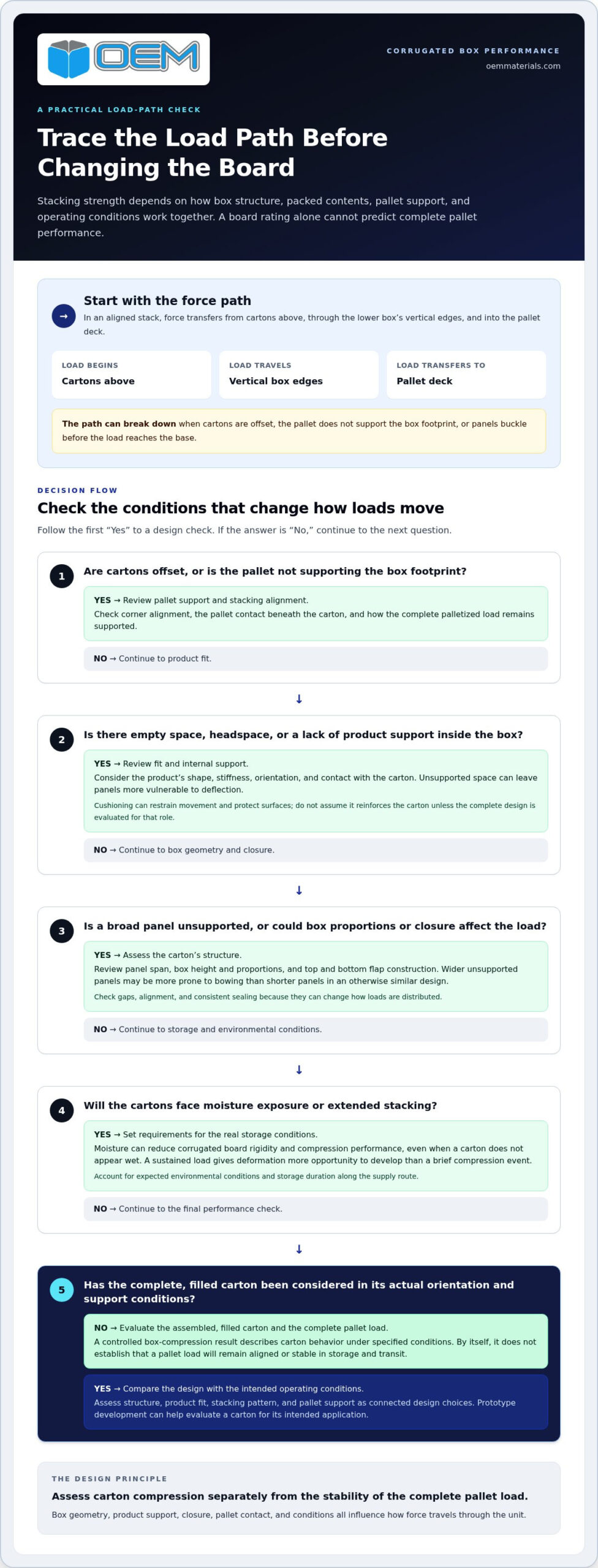
In a properly aligned stack, the load from cartons above transfers through the box below, primarily along its vertical edges, and into the pallet deck. That path can be disrupted when boxes are offset, the pallet fails to support the carton footprint, or a box’s panels buckle before the load reaches the base. The carton’s structure, packed contents, and support beneath it all influence how force travels through the unit.
Box dimensions affect that path. A wider panel has a longer unsupported span and may be more prone to bowing than a shorter panel in an otherwise similar design. Box height and proportions also affect how the carton behaves under compression. Closure construction matters because top and bottom flaps help form the load-bearing surfaces. Gaps, poor alignment, or inconsistent sealing can change how loads are distributed.
Stacking performance depends on the interaction of box geometry, closure, product support, pallet contact, and the conditions and duration of use.
How product fit changes load sharing
Contents can influence how a box carries force, but product weight alone doesn’t show whether it supports the carton. A rigid item that fits closely may limit movement, while a product surrounded by empty space can leave panels unsupported. Headspace above the product may also let the top of the box deflect before the contents engage. The result depends on the item’s shape, stiffness, orientation, and contact with the box.
Choose internal packaging for the role it needs to perform. Foam or other cushioning can restrain movement and protect vulnerable surfaces, but shouldn’t be assumed to reinforce the carton unless the complete design is intended and evaluated to do so. Where a product needs positioning or support, custom foam packaging can be designed around its shape and protection requirements. For a box design review, share product dimensions, packed weight, and how the item sits inside the carton through a packaging design request.
How storage conditions and box geometry affect compression
Moisture exposure can reduce corrugated board’s rigidity and compression performance, even when a carton doesn’t appear wet. Extended stacking matters too: a sustained load gives deformation more opportunity to develop than a brief compression event. Set design requirements based on expected storage duration and environmental conditions along the supply route, not just the moment a box is first stacked.
Assess panel span and proportions alongside board and box construction. A broad side panel with little internal support may buckle differently from a more compact carton under a comparable load. The McKee formula can estimate box compression based on board properties and box geometry, but it doesn’t capture every feature of a packed carton, pallet, or operating environment. Use it as a design aid, then evaluate the complete configuration for its intended application. This keeps corrugated box design for stacking strength tied to how the package will actually be used.
Which Box and Pallet Design Choices Best Fit Your Stacking Pattern?
Select a stacking pattern with the carton and pallet treated as one load system. Start by identifying the main requirement: direct vertical load transfer, resistance to shifting, or dependable support for the product inside each box. Then compare the pattern, carton footprint, and structural options against that requirement. A pattern that improves one aspect of the load may place new demands on box panels or product support.
Column stacking versus interlocked stacking
Column stacking places cartons directly above one another, aligning their corners so vertical loads can travel down the box edges. It can suit cartons with consistent dimensions and loads that benefit from aligned corner support. Interlocked stacking offsets cartons across layers. That arrangement may help resist lateral movement, but it can place the corners of an upper carton over weaker panel areas below. Neither pattern is universally stronger; performance depends on the box and complete load configuration.
Column stacking
Useful when corner alignment and direct vertical load transfer are priorities. Tradeoff: the load may need additional attention to lateral stability during handling.
Interlocked stacking
Useful when the unit load needs more resistance to layer movement. Tradeoff: offset cartons can transfer force onto panels rather than directly aligned corners.
Box structure and internal support
Useful when dimensions, board construction, closure, or product fit need adjustment for the application. Tradeoff: each change affects the assembled package and should be evaluated with the intended contents.
Pallet and carton footprint
Useful when the selected pallet can support the carton base across its footprint. Tradeoff: overhang or unsupported deck gaps can leave carton edges without consistent support.
Matching the carton footprint to the pallet
A flush fit helps keep the carton base supported by the pallet deck. If cartons extend beyond the pallet edge, their overhanging portions lack direct deck support and may be more vulnerable to deformation during handling. Gaps between deck boards can also leave parts of a carton base unsupported. Review pallet dimensions, deck layout, carton footprint, and carton placement together rather than treating pallet selection as a separate decision.
Unit-load stabilization is another consideration, but stretch film doesn’t replace a suitable stacking pattern or carton support. Assess its role alongside the load layout and handling requirements. OEM Materials’ stretch film options can be considered as part of the broader pallet configuration.
Use design changes selectively. If corner support is the priority, assess the pattern and carton alignment first. If panels are deflecting, review box proportions, board construction, and closure. If the product shifts or leaves unsupported space, consider fit and internal support. This project-specific approach to corrugated box design for stacking strength connects each change to the condition it is meant to address. For a custom evaluation, share product and pallet requirements through a custom packaging quote request.
How to Build and Validate a Corrugated Box Stacking Design
A useful design brief starts with operating conditions, not a preferred board grade. Document how the product is packed, stacked, stored, and shipped. Then develop a prototype and assess whether the complete package performs as intended. This sequence keeps corrugated box design for stacking strength tied to actual requirements rather than a single rating or assumed load.
Create a design brief from actual operating conditions
Record the details that define the package and its use. Include product dimensions, packed carton dimensions and weight, product fragility, internal support needs, stacking orientation, stack height, and expected storage duration. Add shipment and handling conditions, pallet footprint, pallet layout, stacking pattern, and restrictions on carton positioning. Note environmental exposure, such as moisture, if it is relevant to the storage or distribution route.
Use the brief as a shared reference for design and testing. A clear sequence helps:
- Describe the product and pack. Record the product’s dimensions, weight, orientation, fragility, and any cushioning or internal supports used.
- Define the stack. Specify carton orientation, arrangement by layer, intended stack height, and storage duration.
- Map the pallet and route. Include pallet dimensions and deck layout, carton placement, and relevant handling and shipment conditions.
- Set the evaluation objective. Identify the concern to investigate, such as carton compression, panel bowing, closure behavior, product movement, or load stability.
Use prototype testing to refine the design
Build representative samples using the intended box construction, closures, and packed contents. Evaluate them with an appropriate compression-testing approach and setup for the question being answered. ASTM D642 measures the compressive resistance of shipping containers; ISO 12048 covers compression testing of complete, filled transport packages. Choose test methods and conditions that reflect the package and use case. Neither a generic test result nor a universal pass threshold can replace project-specific requirements.
Observe how the sample responds, not just whether it reaches a target load. Note whether deformation begins at a corner, broad panel, closure, or area where the product lacks support. If a failure appears, connect it to a design variable: box proportions, construction, closure, product fit, or pallet support. Change the relevant feature and evaluate the revised sample under comparable conditions. Each prototype iteration should answer a specific design question.
OEM Materials’ custom packaging design support can help translate product and operating requirements into a prototype for evaluation. To discuss a project, share your packaging design requirements, including product and carton dimensions, packed weight, stacking orientation, storage duration, and pallet layout.
How OEM Materials Supports Custom Corrugated Box Design for Stacking
A stacking challenge rarely starts and ends with the carton. Product shape, packed weight, pallet arrangement, storage conditions, and shipping requirements all influence which box design is appropriate. OEM Materials & Supplies works with manufacturers to connect these operating details to packaging recommendations, rather than treating a carton as an isolated purchase.
For some applications, a stock box may suit the product and packing process. For others, custom dimensions or construction may better align the carton with the contents and pallet layout. OEM supports both stock and custom corrugated boxes, with project requirements guiding the recommendation. Prototypes and short runs can support early evaluation, while the design discussion can also account for high-volume production needs. No single solution fits every program.
What to bring into a packaging design conversation
Useful project details connect box choices to real use. Share the product’s dimensions and weight, the packed carton’s dimensions and weight, and how cartons are stacked on the pallet. Include annual usage estimates to help frame the production program. If cartons have shown damage or deformation, describe where it occurs and under what conditions. Storage duration, shipment route, handling practices, and environmental exposure can also inform the design discussion.
Operational constraints matter, too. Note package orientation limits, warehouse stacking practices, pallet dimensions, and handling or replenishment requirements. For example, a carton that must be packed quickly on a production line may need to fit a different workflow than one prepared in a lower-volume operation. Clear constraints help prevent a design from solving a compression concern while creating a packing or storage issue.
Connect box design with the broader supply workflow
Custom packaging design considers the relationship between the box, product, and intended use. OEM can support the process from project requirements through prototype development, with structural and fit considerations evaluated alongside the conditions the package will encounter. The goal is a clear, project-specific recommendation, not an unsupported performance promise.
For manufacturers and distributors in Orange County, Los Angeles, the Inland Empire, and San Diego County, this approach can align corrugated packaging with regional production, warehouse, and shipping needs. OEM also serves projects across the United States when packaging requirements extend beyond the region or involve broader supply needs. In either case, product fit, annual demand, and pallet configuration help shape a practical design path.
To discuss a corrugated box design for stacking strength, request a quote for your packaging project. Include product dimensions, weight, annual usage, stacking configuration, and known storage or shipment conditions so the project can be assessed against its actual requirements.
Turn Stacking Requirements Into a Design Brief
Use the next packaging review to define how the design will be judged in operation. Agree on the priority, such as keeping cartons serviceable through storage or maintaining a stable pallet during handling, and set a consistent method for reviewing results. That gives engineering, warehouse, and procurement teams a shared basis for deciding whether a proposed change is ready for broader use.
OEM Materials & Supplies can help translate project requirements into a corrugated packaging recommendation. Request a quote for a corrugated packaging project and include relevant product and operating details. A well-defined starting point helps your team move toward a design that fits its actual workflow.
Frequently Asked Questions
How do you calculate corrugated box stacking strength?
Start by estimating the vertical load assigned to the carton at the bottom of the stack, based on the filled cartons above it and the layer arrangement. This is a working load estimate, not a box rating. Uneven weight distribution and carton arrangement can change the demand. Use the estimate to define compression-test conditions for a representative package; corrugated box design for stacking strength should be verified on the finished pack.
What is the difference between stacking strength and burst strength?
Stacking strength concerns resistance to vertical compression from loads above a carton. Burst strength concerns resistance to pressure that can rupture the board. They address different stresses, so a burst result alone doesn’t establish how a box will perform under a stack. For example, a carton may resist a puncture force yet still need evaluation for the sustained compression expected in a warehouse or palletized shipment.
Can a box’s stacking strength be improved without changing its board grade?
Yes. Before changing board grade, check for inconsistent packing or handling: confirm the correct carton is used, flaps close fully, seams remain intact, and cartons aren’t overloaded or reused after damage. Standardizing these steps can help identify whether variation in pack-out contributes to the problem. If deformation continues under consistent practices, evaluate a revised box structure and test it rather than assuming a higher board grade is required.
Does printing affect corrugated box stacking strength?
Printing doesn’t automatically reduce stacking performance, but the converting process can affect board if it crushes or damages the material, particularly near scores or folds. The impact depends on the process and carton construction. To isolate the effect, compare representative samples made to the same specification, with and without the production print process. Inspect folds and panels for visible damage, then use compression testing to assess any performance difference.
How does humidity affect stacked corrugated boxes?
Humidity can reduce board stiffness and compression performance. In storage, practical controls include keeping cartons off damp floors, away from leaks, and clear of areas where dock doors expose packaging to changing conditions. Watch for softening or distortion, even if cartons aren’t visibly wet. If moisture exposure is part of normal operations, include that condition in storage procedures and in the evaluation of packaging samples.
Can corrugated boxes be stacked on their sides?
Only if the box and packed product are suitable for that position. Side storage can change how contents rest inside the package and may put pressure on panels not intended to carry the load. Define permitted orientations in warehouse work instructions and mark cartons clearly if correct positioning is critical. If side stacking is part of routine operations, evaluate a packed sample in that position before adopting it as standard practice.
How can I tell whether a box compression test reflects warehouse conditions?
Check that the test sample matches the production package, including its box style, print or converting features, closure, and internal packaging. Review the test report for sample conditioning and test setup, then compare those details with warehouse storage practices. A result from an older carton revision or a differently packed sample may not represent current use. Keep the report tied to the package specification it evaluated.