
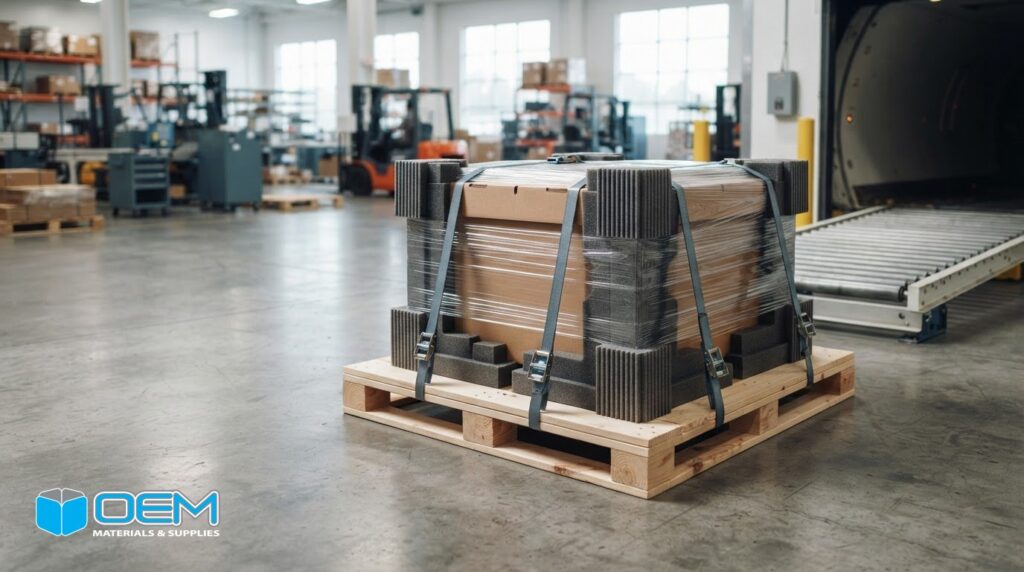
Air freight dimensions aren’t universal: allowable pallet size and height depend on the aircraft and cargo configuration. Commercial aircraft may limit shipment height to 32 inches or 65 inches, so custom pallets for air freight should be sized to the route’s aircraft requirements, not just the cargo itself.
Standard dimensions can simplify handling, but they may leave wasted space or fail to fit the available cargo area. The right pallet footprint, load height, and packaging support can help manage dimensional weight, avoid unnecessary surcharges, and protect cargo during handling.
This guide explains how aircraft limits affect pallet sizing, how actual and volumetric weight determine chargeable weight, and when a custom pallet or protective packaging makes sense. It also shows how to balance cargo fit, load stability, and material use around the shipment’s transport requirements.
Key Takeaways
- Match pallet dimensions and loaded height to the aircraft and cargo configuration to avoid fit problems.
- Compare actual weight with volumetric weight to understand what drives chargeable weight.
- Choose a pallet, skid, or crate based on the load’s support and protection requirements.
- Review pallet construction, load stability, and protective packaging to help limit surcharges and handling damage.
How can I save on the costs of my pallet shipment?
Air-freight costs depend on cargo dimensions, weight, packing, and the aircraft’s available space. Secure the load against its base, wrap it tightly with 50% overlap, and place the main shipping label on at least two sides.
Cargo Packing and Dimensional Compliance
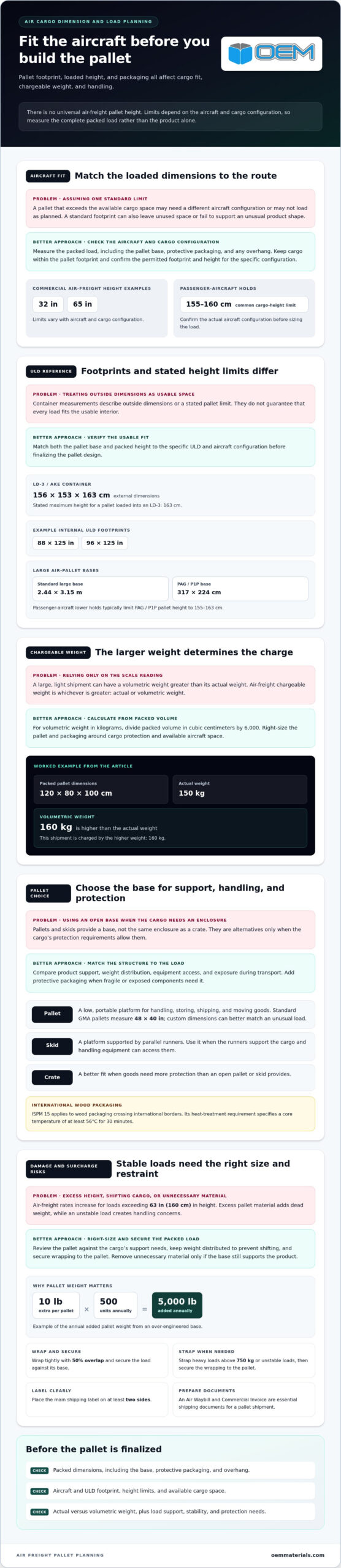
Cargo packing and dimensional compliance mean preparing a stable load that meets the airline’s size, weight, and material rules. A pallet that exceeds the available space may require a different aircraft configuration or may not load as planned. Measure the packed load, including the base, protective packaging, and any overhang, rather than the product alone.
Keep the load within the pallet footprint and distribute weight to prevent shifting. Strap heavy loads above 750 kilograms or unstable loads, then secure the wrapping to the pallet. An Air Waybill and Commercial Invoice are essential shipping documents for a pallet shipment.
Dimensions for ULDs, Aircraft, and Containers
ULD-compatible dimensions are the loaded pallet measurements that fit a Unit Load Device or aircraft cargo space. They matter because allowed height and footprint vary by aircraft and cargo configuration. Commercial air freight may limit pallet height to 32 inches or 65 inches, while passenger-aircraft holds commonly limit cargo height to 155-160 cm.
An LD-3/AKE container measures 156 cm long, 153 cm wide, and 163 cm high externally. A pallet loaded into an LD-3 container has a maximum height of 163 cm. These measurements describe the container’s outside dimensions or stated pallet limit, not a guarantee that every load will fit its usable interior.
Other ULD footprints differ. Example internal footprints for air-freight ULDs include 88×125 inches and 96×125 inches. A standard large air-pallet base measures 2.44 × 3.15 m; a PAG/P1P base measures 317 cm long and 224 cm wide. Passenger-aircraft lower holds typically limit PAG/P1P pallet height to 155-163 cm. Match the base and loaded height to the specific aircraft configuration.
Dimensional weight can outweigh the scale reading. Air-freight chargeable weight is the greater of actual or volumetric weight. To calculate volumetric weight in kilograms, divide the packed volume in cubic centimeters by 6000. For example, a 120 by 80 by 100 centimeter pallet weighing 150 kilograms has a volumetric weight of 160 kilograms, so it is charged by the higher weight.
Right-sizing can reduce unused volume or excess pallet material, but the best dimensions depend on cargo shape, protection needs, and aircraft space. A custom footprint can help when a standard pallet does not fit the available cargo area. Reviewing pallet options can help match the base to the shipment’s dimensions and handling requirements.
Pallets and skids as alternatives to wood crates
Custom pallets and skids can replace wood crates when cargo needs a stable base but not a full enclosure. Compared with a standard ULD pallet, a custom pallet adapts the base to the product; a skid uses parallel runners and may suit particular handling or storage needs. Choose based on support, protection, and transport requirements.
A pallet is a low, portable platform used to handle, store, ship, and move goods. Standard GMA pallets measure 48×40 inches, making them a familiar option for many freight loads. However, a standard footprint may leave unused space or fail to support an unusual product shape. Custom dimensions can better match the load.
Examples of non-standard wood pallet sizes include 44 x 44 inches, 24 x 24 inches, and 60 x 40 inches. These examples show how a tailored base can serve cargo that does not sit securely on a standard footprint. The design should support the product’s weight distribution and provide clearance for mechanical handling.
A skid is a platform supported by two or more parallel runners, raising it for mechanical handling. Skids and pallets differ in their construction and support, so the right choice depends on the load and handling needs. This construction can suit some storage and transport needs, but its support must match the product.
Use a skid when its runners support the cargo and handling equipment can access them. Choose a pallet when a low, portable platform is better for moving or storing the load. For example, a machine component with a defined support frame may suit a skid, while multiple boxed parts may be easier to arrange on a pallet.
A crate is a better choice when goods need more protection than an open base provides. Custom pallets and skids are alternatives only when the cargo’s protection requirements allow them. Fragile or exposed components may need added protective packaging, while a robust, self-supporting item may not need a full enclosure.
International transport also affects wood packaging choices. ISPM 15 applies to wood packaging materials crossing international borders. Its heat-treatment requirement specifies a core temperature of at least 56 degrees Celsius for 30 minutes. This is relevant to wood pallets and skids, not a reason to select a crate automatically.
Match the base to the cargo and route by comparing ULD compatibility, product support, equipment access, and protection needs. A tailored footprint can reduce unused pallet area, while a crate provides more enclosure. The right choice depends on the load’s dimensions, weight distribution, handling method, and exposure during transport.
Reducing freight surcharges and handling damage
Oversized pallets can face higher rates or fail to fit the aircraft’s cargo configuration. Air-freight rates increase for loads exceeding 63 inches (160 cm) in height. Overweight loads also create handling concerns because the pallet and cargo must move as a stable unit through loading and transfer operations.
Excess pallet material adds dead weight without protecting the product. For example, a pallet over-engineered by 10 pounds across 500 units annually adds 5,000 pounds annually. Review the base design against the cargo’s support needs. Removing unnecessary material can reduce this dead weight, but the pallet must still support the load during normal handling.
Total air-freight costs may also include fuel and security surcharges, customs documentation, and airport handling fees. These are separate from pallet construction and can vary with the shipment and route. Efficient packing helps limit avoidable bulk and material, while shipment planning helps operations teams account for the different cost components.
Inspect pallet condition before loading. A 30-second check for cracks and protruding nails can catch defects that may compromise the base or damage adjacent cargo. A cracked board can weaken support under a concentrated load. A protruding nail can snag nearby packaging or create a hazard during manual handling.
Stack cartons in columns when their design supports that arrangement. Aligning package corners vertically helps transfer load through stronger carton edges. Columnar stacking is described as reducing collapse risk by as much as 50%. Avoid placing a heavy carton on a weaker package or leaving unsupported gaps that allow upper layers to shift.
Build damage prevention into the packing review:
- Inspect the pallet deck and runners for cracks, looseness, and protruding nails.
- Keep carton corners aligned when the package design supports column stacking.
- Remove pallet material that adds weight without serving a support function.
- Review tall loads against the 63-inch rate threshold and aircraft configuration.
These practices address different sources of loss: a compromised pallet, unstable stacking, unnecessary base weight, and excess height. The right design balances cargo support with aircraft and handling requirements. Reducing material is not the goal on its own; the load must remain stable and protected throughout transport.
Skids support loads and assist with storage, handling, and transportation. Considering their role alongside the pallet’s support requirements helps teams assess whether the base serves its purpose without adding material that does not support the load.
Choosing an air-freight pallet
Choose pallet material and construction to suit the cargo, handling method, and shipment requirements. The design should support the load and its planned use.
Wood, Plastic, and Aluminum Materials
Wood, plastic, and aluminum are material options for air-freight pallets. The right choice depends on the shipment’s operating needs. Wood can be built to a specified footprint, while plastic and aluminum offer alternatives when their handling and reuse characteristics better suit the operation. Compare materials against cargo support, warehouse equipment, and transport conditions.
For international shipments, wooden packaging must comply with ISPM 15. This requirement applies to wood packaging materials crossing international borders, so include the destination and shipping route in the material decision. A wood pallet is not automatically the right choice simply because it can be customized. Evaluate compliance needs alongside the load’s support and handling requirements.
Consider how the pallet will be used after arrival. If the shipment returns through the same distribution network, repeated handling and reuse may influence material selection. For a one-way shipment, cargo support and compatibility with the planned loading process may matter more. Compare the full operating cycle before choosing a material.
Designing and Ordering a Custom Pallet
Designing and ordering a custom pallet starts with documenting the load, support needs, material, and handling requirements. An incomplete specification can result in a base that does not support the cargo as intended. Provide a clear drawing or product layout, identifying contact points and any uneven weight distribution.
Describe the pallet’s intended use, such as one-way transport or repeated circulation, and identify the loading and unloading equipment. Explain whether the shipment is a single component or a group of items. For example, a machine part with narrow support rails needs a base designed around those rails, rather than one that assumes the product rests evenly across the deck.
For wood designs crossing international borders, identify the destination so ISPM 15 compliance is part of the specification. For any material, explain how the pallet will be secured, stacked, and handled alongside the cargo. These details help the design account for more than footprint alone.
Before ordering, review the drawing against the actual product and handling process. Confirm that support locations match the load and that equipment can access the pallet as planned. A complete specification gives the manufacturer a practical basis for producing a pallet suited to the shipment.
Custom pallet pack container sizing
For a custom air-cargo pallet quote, provide the cargo’s length, width, height, and weight, along with the required pallet footprint. Include the aircraft or ULD configuration, shipment quantity, handling method, and any protective packaging that changes the packed dimensions.
Size the complete packed unit, not just its base. A 72 x 48 inch pallet and a 60 x 48 inch pallet are examples of non-standard footprints, while quarter pallets can measure 20 x 24 or 24 x 20 inches. These options illustrate how cargo dimensions can call for a footprint that differs from standard pallet formats.
Other custom sizes include 48 x 45 inches, 36 x 36 inches, 42 x 42 inches, and 40 x 40 inches. These dimensions are examples, not universal air-cargo standards. The correct footprint depends on the load’s shape, support points, and the ULD or aircraft space assigned to the shipment. Include any cargo overhang in the finished measurement.
Height needs the same attention. If 64 inches of air-freight height is available, shippers can use one 64-inch-tall Pallet Pack container or stack two separate 32-inch bins. That choice affects how cargo is grouped and accessed. Compare the loaded height with the space available for the actual aircraft configuration, including protective materials and the pallet itself.
Give the manufacturer details that affect construction and fit. A dimensioned drawing or clear product layout can show where the load contacts the base and how its weight is distributed. Identify whether the cargo ships as one item or several packages, and describe forklift or pallet-jack access. Note fragile edges, protrusions, and any need to keep components separated.
- Provide the cargo and finished-package dimensions, including protective materials.
- State the loaded weight and explain how the cargo rests on the pallet.
- Name the intended ULD or aircraft configuration and available footprint and height.
- Describe handling access, shipment quantity, and any special protection needs.
Accurate inputs help align the pallet design with cargo fit and handling requirements. Missing details can change the footprint, support layout, or loaded height after the design is prepared. For a quote, submit your pallet dimensions and shipment requirements.
Include the pallet’s own weight when checking the finished unit against the shipment’s weight limit. Ask for the proposed design’s empty weight and add it to the cargo weight when calculating the loaded weight. A change in pallet construction can affect whether the packed unit meets the stated limit, even when the cargo and footprint remain unchanged.
State clearly whether the weight provided is for the cargo alone or the complete packed unit. If the pallet will hold several packages, provide their combined weight and explain how they are arranged, along with the pallet’s empty weight. This lets the manufacturer assess the load, support layout, and handling requirements together. Confirm the finished design’s dimensions and weight before packing, especially if protective materials or the pallet design changes. Clear weight information helps prevent a design that fits the available space but fails to meet handling needs.
OEM Materials & Supplies: Corrugated Boxes
OEM Materials & Supplies can coordinate protective packaging with an air-freight pallet. Corrugated Boxes can contain and organize items, while Foam Packaging and Cushioning Materials protect products inside the package. Packaging Kits bring compatible components together for repeat shipments.
For example, use a fitted corrugated box when components need an outer enclosure, then choose cushioning to limit movement inside. Mailing Tubes & Cores suit long, narrow items that do not fit a conventional box. The right combination depends on product shape, weight, handling, and the space available in the packed shipment.
Share your packaging requirements with OEM Materials & Supplies to coordinate a pallet with protective packaging. Contact the team or visit oemmaterials.com to discuss your shipment.
Put Your Next Air Shipment on a Clear Design Path
Use the next shipment to align packaging decisions with the cargo and transport plan. A design for custom pallets for air freight should support the product and suit the planned handling process. Any savings depend on cargo dimensions, materials, and shipping requirements, so assess the complete packed unit rather than the pallet alone.
Keep design details current as products, protection needs, or routes change. Updated measurements and load information help purchasing and operations teams assess whether existing packaging still suits the shipment. They also give engineers a clear basis for coordinating the pallet with the protective materials around the product.
For help matching packaging to your shipment requirements, contact OEM Materials & Supplies with your cargo details. A well-defined starting point can make the next packaging decision more practical and straightforward.
Frequently Asked Questions
Are Air Freight Dimensions Standard?
No, air-freight dimensions are not universal. Permitted size depends on the aircraft, cargo configuration, and ULD used for the shipment. A load planned for a passenger-aircraft lower hold must fit that space, while a freighter can accommodate different dimensions. For shipments through Los Angeles, design the package for the assigned aircraft and loading configuration, not an assumed standard pallet size.
Can my load overhang the edge of the pallet?
Overhang can create fit and handling problems, so keep the load within the pallet footprint where the cargo allows. A protruding corner can interfere with adjacent freight, and exposed cargo surfaces can be damaged by impacts during movement. If the product requires an irregular footprint, specify its full packed dimensions and support points during pallet design. The finished arrangement must fit the aircraft or ULD loading space.
What are custom pallets for air freight?
Custom pallets for air freight are load bases designed around a shipment’s product dimensions, weight distribution, handling needs, and intended aircraft configuration. Unlike a standard footprint, a tailored base can support an unusual shape or help secure a product that does not sit safely on common pallets. For example, a single large component may need support beneath specific contact points rather than a general-purpose deck.
What are standard air cargo pallet dimensions and weight limits?
There isn’t one standard footprint and weight limit for every air shipment. Common reference sizes include a 48×40-inch GMA pallet, a 120 by 80 centimeter Europallet, and a PAG/P1P base measuring 317 cm long by 224 cm wide. Permitted weight depends on the pallet or ULD and aircraft configuration. Confirm both loaded dimensions and total weight for the shipment’s planned air-cargo setup.