
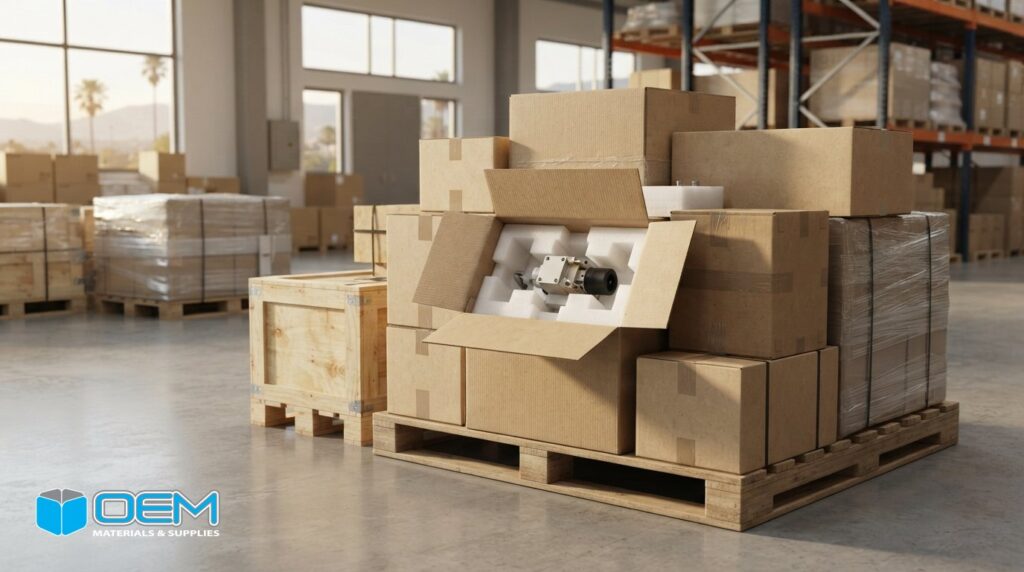
Moisture resistance isn’t automatic: heavy-duty corrugated boxes in Los Angeles can protect products from routine handling, but standard corrugated board isn’t waterproof. The right level of protection depends on board construction, moisture-resistant treatments, and the conditions packages face in storage and transit.
That distinction matters when shipments may encounter damp conditions. Double-wall construction addresses a different need: added strength for demanding loads and handling. Choose a box by balancing protection with product fit, packing efficiency, and shipping requirements.
This guide explains how moisture resistance and double walls affect box selection, how to size a box around the product, and what influences custom pricing and minimum orders. It also covers full-overlap boxes and the differences between shipping and retail packaging, so you can weigh practical tradeoffs before specifying a solution.
Key Takeaways
- Match moisture protection to storage and transit conditions; standard corrugated board isn’t waterproof.
- Compare single-, double-, and triple-wall construction against the load and handling demands, not just the label “heavy duty.”
- Use product dimensions and protective materials to guide box sizing and reduce wasted space.
- Custom order quantities and pricing depend on the box design, materials, and shipping requirements.
- Full-overlap boxes and packaging for retail or shipping serve different needs, so define how the package will be handled and presented.
Custom box pricing and minimum order quantities
Custom corrugated box pricing depends on the design, board material, dimensions, printing, and shipping requirements. A quote is based on those project details, not a general rate. A small box with simple printing has different production requirements from a large, reinforced carton for heavy shipments. Provide accurate product dimensions and expected order volume to support a useful comparison.
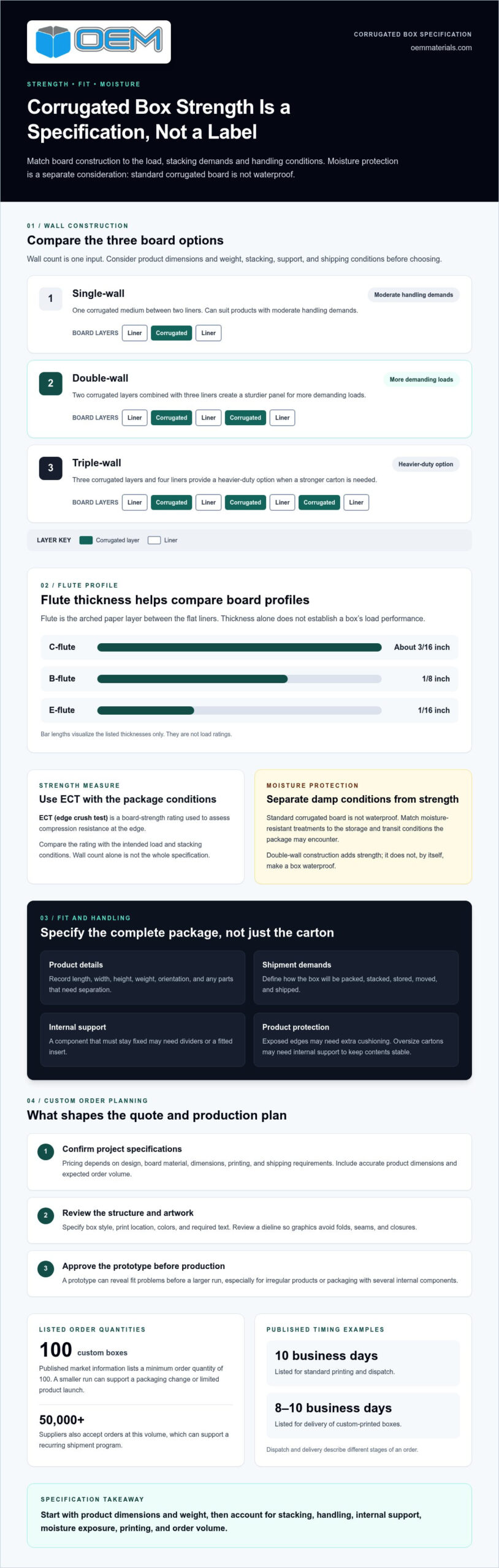
Published market information lists a minimum order quantity of 100 custom boxes, while suppliers also accept orders of 50,000 or more. Those volumes serve different purchasing needs. A smaller run can support a packaging change or limited product launch; a larger run can replenish a recurring shipment program. Before placing an order, confirm the approved dimensions, print layout, and quantity so production matches the intended use.
How quickly can corrugated box suppliers deliver in Los Angeles? Published timelines list 10 business days for standard printing and dispatch, and 8-10 business days for delivery of custom-printed boxes. Treat these as distinct listed timelines, since dispatch and delivery describe different stages of an order.
Packaging designed to customer specifications starts with the product, not a standard carton size. Record its length, width, height, weight, orientation, and any parts that need separation. Then define how the box will be packed, stacked, stored, and shipped. For example, a component that must stay fixed may need internal dividers or a fitted insert, while exposed edges may need extra cushioning.
Custom box design and printing also require production-ready artwork. Specify the box style, print location, colors, and required text, then review a dieline to ensure graphics avoid folds, seams, and closures. A practical sequence is to finalize dimensions, review the structural design, approve artwork, and evaluate a prototype before production. This helps prevent ordering packaging that fits the product but misses handling or presentation requirements.
Custom corrugated manufacturing converts the approved design into board and finished cartons. Board construction, cutting, scoring, folding, and printing all affect the final specification. A prototype can reveal fit problems before a larger run, particularly for irregular products or packaging with several internal components. For design work, review the relevant corrugated box specifications alongside the product measurements and shipment requirements.
Prepare a quote request with the product dimensions, weight, intended use, print requirements, and order quantity. Include annual usage for repeat orders, along with constraints such as stacking needs or limited warehouse space. These details help match the custom box to production volume and actual shipments, rather than choosing a design based on appearance alone.
Can I order boxes with heavy-duty double walls?
Yes. Los Angeles businesses can order double-wall and other heavy-duty corrugated boxes through local manufacturers and industrial packaging suppliers. Choose construction by product weight, stacking demands, and handling conditions, rather than relying on “heavy duty” as a complete specification.
Wall Construction and Flute Types
Flute describes the arched paper layer between the flat liners; wall construction describes how those layers are combined. C-flute board is about 3/16 inch thick, B-flute is 1/8 inch, and E-flute is 1/16 inch. Those thicknesses help compare board profiles, but they don’t alone establish a box’s load performance.
A single-wall box has one corrugated medium between two liners. A double-wall box combines two corrugated layers with three liners, creating a sturdier panel. When specifying custom corrugated boxes, consider flute profile along with box dimensions, product weight, and shipping conditions. A large carton may need a different construction from a compact box carrying the same product.
Board Strength Options
Single-wall construction can suit products with moderate handling demands; double-wall construction adds another corrugated layer for more demanding loads. Triple-wall board uses three corrugated layers and four liners, making it a heavier-duty option when a stronger carton is needed. The right choice depends on the complete package, including product support and stacking.
ECT, or edge crush test, is a board-strength rating used to assess compression resistance at the edge. Compare ECT ratings with the carton’s intended load and stacking conditions, rather than treating wall count as the only measure. A machine-packed shipment, for example, may put different demands on box edges and closures than hand-packed goods.
For oversize boxes, dimensions and handling are especially important. A long or wide carton can be harder to move and may need internal support to keep its contents stable. Specify the product’s dimensions, weight, orientation, and handling process before selecting a board grade. For businesses in Los Angeles and across Southern California, those details help match custom boxes to warehouse and transit requirements.
To buy heavy-duty corrugated boxes in Los Angeles, contact a corrugated-box manufacturer or industrial packaging supplier serving the area. Suppliers offering pickup or delivery are identified by their local fulfillment options; specify your receiving location, order quantity, and required box construction when comparing them.
Before requesting a recommendation, prepare the box dimensions, product weight, and shipment conditions. These details help narrow the choice between single-, double-, and triple-wall construction without overbuilding the package.
Packaging applications for shipping and retail
Shipping and retail cartons solve different problems. A Los Angeles County manufacturer shipping replacement components needs protection through handling and transit. A retail package also has to present the product clearly at the point of sale. Identify the package’s destination, handling steps, and presentation needs before selecting the carton style and printing.
For shipping, corrugated packaging can hold products directly or work with separate cushioning and internal supports. For example, an automotive parts shipment might use a carton with a fitted insert to keep a metal component from shifting. A direct-to-consumer order may need a compact box that closes securely and supports efficient packing. Specify product orientation and packing steps before approving the design.
Retail applications put more emphasis on appearance and access. A die-cut corrugated package can include shaped openings, display panels, or a closing style tailored to the product. For a small hardware item, a cutout can let customers see the contents without removing the item. Review the dieline for folds, openings, graphics, and assembly sequence before production.
Automotive parts vary in shape, surface finish, and handling needs. A smooth trim component, for instance, may need separation from other parts to prevent contact during shipment. A heavier replacement part may need a carton designed around its weight and support points. Map each part to a packaging method, then test the packed configuration through the actual handling process.
Corrugated packaging is recyclable in many paper recovery programs, but local acceptance depends on material condition and program rules. Keep boxes clean and dry, and remove non-paper components such as plastic bags or foam inserts before recycling. Businesses in Southern California should follow their county’s collection requirements rather than assume every facility accepts the same materials. Separating packaging at the receiving or unpacking station supports cleaner material recovery.
Product range also affects the package plan. Corrugated sheets, regular slotted cartons, die-cut inserts, and printed retail boxes serve different functions. A distribution team handling several product families can group cartons by product dimensions and packing sequence. For launches with fixed retail dates, coordinate artwork approval, production, and delivery using the supplier’s stated schedule in business days.
Before specifying a package, document the product dimensions, weight, protection needs, and final destination. Then decide whether the priority is transit protection, shelf presentation, or both. A prototype can reveal fit and assembly issues before production, such as a display panel that obstructs access or an insert that slows packing. These checks help align packaging with real warehouse and retail tasks.
Box sizing and product fit
Start with the product, not a standard carton. Measure its length, width, and height at the widest points, including handles, protrusions, or attached components. Record its weight and shipping orientation, too. For a machined part, include features that could contact the box during handling. These measurements give the packaging team a useful basis for reviewing the carton’s internal layout.
Account for protective materials and components packed alongside the product. Foam packaging, cushioning, dividers, and fitted inserts all take up interior space. A fragile instrument may need a shaped insert, while a kit with accessories may need separate compartments. Document the packed configuration before approving a size, so the design reflects how the product will actually go into the carton.
Distinguish interior dimensions from exterior dimensions in the specification. Board thickness affects the finished carton’s outside measurements, which can matter for shelving, pallet patterns, and shipping systems. Ask for a drawing that clearly labels inside and outside dimensions. This is especially useful when a carton must fit an existing tote, rack, or warehouse location.
Oversizing has a logistical impact. A box that is 20% too large can increase parcel costs on every shipment in the Inland Empire. Compare the packed product’s dimensions with the proposed carton, including protective materials and closure space. Avoid excess unused volume, while preserving room for the materials and movement control the package requires.
For products with several configurations, evaluate each packed version rather than sizing around an average. A kit containing a main component and accessories may need dividers to keep items organized. One carton can work for related products if each configuration fits securely and the packing process remains clear. Record product variants, quantities per carton, and configuration-specific components.
Printed graphics and shipping labels must fit the carton layout. Confirm panel dimensions and print placement on the dieline, then review the assembled box. For example, reserve a clear panel for shipping labels and keep key product information away from seams and closures. This helps prevent a label or important marking from landing across a fold.
Test a prototype with the actual product and packing materials. Pack it through the normal workflow, then note difficult insertion, contact points, or interference with the closure. For operations in Orange County, recording these observations can help teams follow one packaging specification across shifts and repeat shipments. Share findings with the packaging designer before approving final dimensions, especially if the product or its protective arrangement changes.
Heavy-duty and full-overlap corrugated boxes
Full-overlap boxes have flaps that extend across the entire opening when closed. This construction adds coverage over the top or bottom panel, making it useful for products that need extra surface protection. For an industrial shipment with exposed edges, overlapping flaps can cover more of the opening than standard flaps. The box style still needs to match the product, packing method, and shipping conditions.
Heavy-duty packaging is not defined by one feature alone. Board construction, box dimensions, product weight, and stacking all affect the finished package. A compact carton holding dense hardware faces different demands from a large carton carrying a lightweight assembly. Specify the product and handling conditions before choosing a full-overlap box or another heavy-duty configuration.
The listed cardboard stock thickness ranges from 12pt to 24pt. That measurement describes stock thickness, not the complete performance of a finished corrugated box. A buyer should consider the box style and overall construction alongside the stock specification. For example, a printed retail carton and a corrugated shipping box may use different materials and serve different packaging roles.
Full-overlap flaps can also affect packing operations. Because they cover more of the opening, workers may need a defined folding and closing sequence. Test the box with the actual product and packing materials, then observe the process on the warehouse floor. Note whether the carton closes cleanly, stays aligned, and fits the packing station.
Box sizes should reflect the product and distribution channel. An e-commerce order may pass through parcel handling, while a bulk order may move on a pallet through a distribution center. Review the carton’s external dimensions, label placement, and pallet arrangement together. If a full-overlap box is too large for the product or packing line, its added coverage may not solve the operational issue.
For a practical specification, document the product dimensions and weight, required board construction, flap style, printing needs, and packing method. Include a representative sample or drawing if the product has unusual geometry. Then evaluate a prototype through the normal packing sequence before approving repeat orders. This helps identify interference between flaps, inserts, and product surfaces before production.
Full-overlap construction is worth considering when increased flap coverage addresses a specific handling or protection concern. It is not automatically the best choice for every shipment. Compare the design against the product’s contact points, warehouse process, and final destination. To discuss corrugated box requirements for your application, request a corrugated packaging quote with the product dimensions, weight, and intended use.
OEM Materials & Supplies: Corrugated Boxes
OEM Materials & Supplies offers corrugated boxes for businesses evaluating packaging for shipping, storage, or product presentation. Its custom corrugated boxes are suited to specific products and handling requirements. For products needing extra interior protection, foam packaging can separate or cushion components. Packaging kits bring compatible materials together for repeat packing tasks.
For a practical recommendation, prepare the product dimensions, weight, shipment conditions, and expected usage. Include whether the box will protect a single component, hold a kit, or support a recurring fulfillment process. These details connect packaging choices to the work on your production or warehouse floor.
Contact OEM Materials & Supplies to discuss your corrugated packaging requirements, or visit oemmaterials.com.
Make Your Packaging Specification Work Harder
A box specification affects more than the carton itself. It shapes how consistently teams pack orders, protect products, and manage materials across purchasing and warehouse operations. Treat packaging as a repeatable process: document the approved design, track product changes, and review the specification when shipment conditions or packing methods change.
For businesses sourcing heavy-duty corrugated boxes in Los Angeles, the next step is to turn product and shipping requirements into a clear packaging plan. Include product dimensions, weight, intended use, and annual usage when requesting a quote. These details provide a practical starting point and help align the package with your operation.
OEM Materials & Supplies can help you move from a packaging requirement to a defined solution. Request a quote from OEM Materials & Supplies to discuss your application and next steps. A clear specification helps your team make a more informed packaging decision and build a repeatable process.
Frequently Asked Questions
Are your corrugated boxes moisture resistant?
Weather-resistant W5C and V3C boxes are available for applications where exposure to moisture is a concern. They’re different from standard corrugated boxes, so specify the environment the package will face, such as covered outdoor staging or a damp warehouse area. Also consider whether the contents need a separate protective layer. The right choice depends on how the packaging will be stored and handled.
How do I know which box size to order?
Choose a size that supports the product and packing workflow without making assembly difficult. For products with several variants, group them by packaging need and identify which can share a carton. A production team shipping the same component in different configurations, for example, may need separate packing instructions for each. Clear labeling and a documented packaging standard help staff select the correct carton consistently.
What corrugated box grades and burst strengths are available in Los Angeles?
Single-wall, double-wall, and triple-wall corrugated constructions are available, along with weather-resistant options. Burst strength and edge-crush ratings describe different measures of board performance, so specify the rating your packaging standard requires rather than treating them as interchangeable. If an engineering drawing or customer specification names a test value, include it with the box application. This helps keep purchasing and production aligned.
How much do heavy-duty corrugated boxes cost in Los Angeles?
Pricing is provided after a quote request and depends on the specific order. The box design, selected construction, printing, order quantity, and shipping requirements all affect the quoted amount. For procurement planning, use the same approved specification across quote requests and identify required print changes. This gives your team a consistent basis for comparing proposals and reviewing packaging against internal purchasing requirements.
What box sizes and custom dimensions can Los Angeles suppliers make?
Custom box dimensions can be developed for products that don’t fit a standard carton. OEM Materials & Supplies offers corrugated boxes, including custom options for industrial applications. Unusual shapes, protrusions, or required openings can affect the structural layout, so provide a drawing or product sample when available. This helps communicate the package’s geometry and intended function during design review.
What is the minimum order quantity for heavy-duty corrugated boxes in Los Angeles?
The minimum order quantity for custom boxes is 100 boxes. For purchasing plans, distinguish a new box design from repeat orders of an already approved specification. A packaging change may require a separate order review, while repeat purchasing can follow the established item description and print requirements. Keep the approved specification accessible to purchasing and receiving teams to reduce confusion between similar carton designs.
Which heavy-duty corrugated boxes are best for moving, shipping, or industrial use?
For industrial shipping, select a box based on the product’s handling demands and the package’s role in the supply chain. A replacement part shipped between manufacturing locations may need a different configuration from a kit delivered to an assembly line. For fragile or precision components, pair the carton with foam packaging or a packaging kit designed to keep parts organized. Residential moving applications fall outside this industrial packaging focus.