

The strongest packaging supply chain isn’t necessarily the one holding the most inventory. For Orange County manufacturers, developing a resilient packaging supply chain means preparing to absorb disruptions, adapt sourcing and delivery plans, and keep essential packaging available without adding unnecessary complexity.
Resilience takes more than reacting when a shipment is delayed. Clear visibility into demand and inventory, realistic forecasts, qualified supplier alternatives, and early communication help teams identify vulnerabilities and respond with less disruption. Lean operations still matter, but work best alongside practical contingency plans.
This article explains what supply chain resilience means and how to put it into practice. You’ll learn how to monitor risk, forecast packaging needs, assess supplier dependencies, and coordinate procurement, operations, and suppliers. The focus is on actionable steps for Orange County businesses managing corrugated boxes, protective packaging, and other materials essential to production and distribution.
Key Takeaways
- Track packaging demand, inventory, and supplier delivery performance together to spot potential shortages sooner.
- Build continuity plans that balance efficient inventory levels with practical backup options for critical materials.
- Use disruption scenarios, including climate events and trade changes, to identify weak points before they affect operations.
- Map suppliers beyond Tier 1 and assess whether qualified alternatives can cover required volumes.
- Share forecasts and packaging design updates early so procurement, operations, and suppliers can align plans.
1. Continuous risk monitoring and demand forecasting
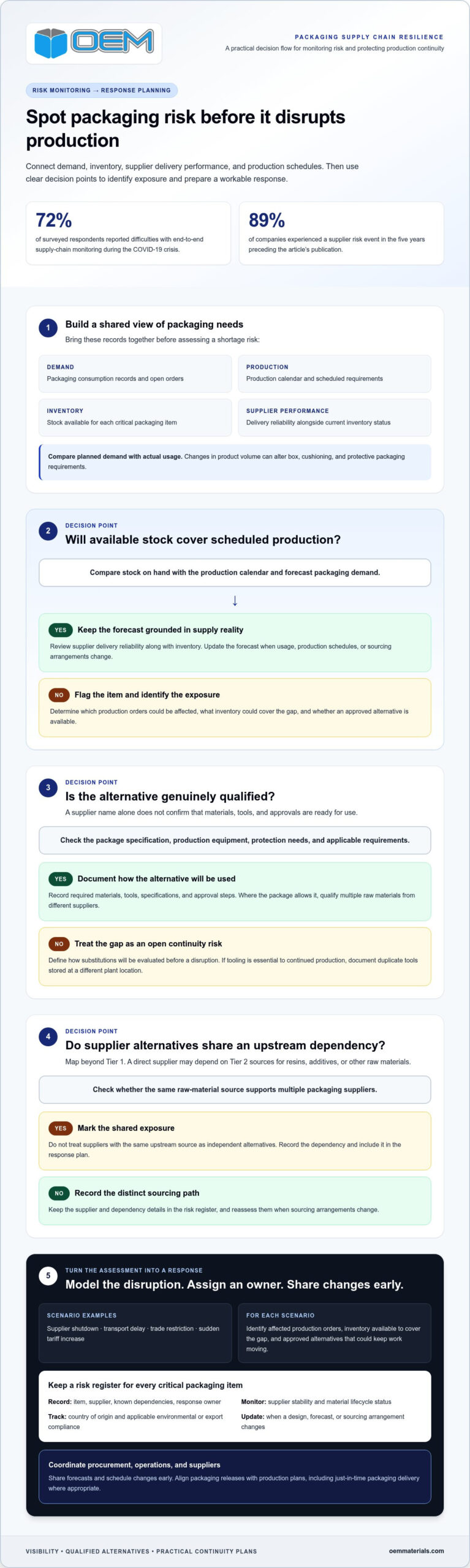
Packaging risk monitoring should connect demand forecasts with inventory, supplier performance, and production schedules. During the COVID-19 crisis, 72% of surveyed respondents reported difficulties with end-to-end supply-chain monitoring. Separately, 89% of companies experienced a supplier risk event in the five years preceding the page’s publication. These findings point to a practical need: identify dependencies early, then assign an owner to each risk and response.
Start with packaging consumption records, open orders, and the production calendar. Compare planned demand with actual usage, then flag items whose stock may not cover scheduled production. A change in product volume, for example, can quickly alter box, cushioning, or protective packaging requirements. Review supplier delivery reliability alongside inventory status so forecasts reflect both the amount needed and the likelihood of timely delivery.
Use a risk register to record each critical packaging item, its supplier, known dependencies, and a response owner. Track relevant changes, including supplier stability, material lifecycle status, country of origin, and applicable environmental or export compliance. A heat map or dependency matrix can reveal which production lines rely on the same material or supplier. Update the records when a design, forecast, or sourcing arrangement changes.
Build continuity plans around the specific package and process. For complex packaging, modified-atmosphere packs, or packages running on highly automated lines, document the required materials, tools, specifications, and approval steps. Include duplicate tools stored at a different plant location when tooling is essential to continued production. Qualify multiple raw materials from different suppliers where the package allows it, and establish how substitutions will be evaluated before disruption occurs.
Scenario planning turns those records into operating decisions. Model a supplier shutdown, transport delay, trade restriction, or sudden tariff increase. Identify which production orders would be affected, what inventory could cover the gap, and which approved alternative could keep work moving. Digital forecasting and inventory tools can support this monitoring, but their ability to guide decisions depends on accurate data and capable users. Additionally, share forecasts and schedule changes with suppliers early. Aligning packaging releases with production plans, including through just-in-time packaging delivery, can help teams coordinate replenishment without treating every item as equally critical.
2. What is supply chain resilience?
Supply chain resilience is the ability to keep essential operations moving when materials, suppliers, or transportation are disrupted. For packaging, a resin shortage can constrain supplier output, while port delays or limited carrier capacity can interrupt deliveries even when production is available. Resilience means understanding those dependencies and preparing workable responses, not simply holding more stock.
To compare sustainable packaging options for cost, durability, and recyclability, assess them against the same product dimensions, protection needs, shipping conditions, and end-of-life requirements. Lighter material may reduce packaging weight, while a more protective design may help avoid product damage. Compare the total operating effects, not just the material price.
California’s SB 54 includes an extended producer responsibility requirement. According to the California Department of Resources Recycling and Recovery (CalRecycle), “Except as provided in paragraph (2), upon approval of a plan pursuant to Section 42063, or commencing January 1, 2027, whichever is sooner, a producer shall not sell, offer for sale, import, or distribute covered materials in the state unless the producer is approved to participate in the plan of a PRO that is approved by the department for the source reduction, collection, processing, and recycling of covered material to meet the requirements of this chapter.” Federal packaging requirements depend on the material and its intended use, so document those factors during a material review before implementing a substitution.
For Orange County operations, packaging options include foam packaging, packaging kits, and cushioning materials. Select based on the item’s dimensions, fragility, packing process, and shipping route. For example, a kit can group materials used together at a packing station, while cushioning can protect an item from movement inside its outer package. Foam packaging can be considered when a product needs shaped or fitted protection.
Local logistics planning should account for receiving schedules, warehouse space, shipment frequency, and the distance between suppliers, facilities, and customers. Staging materials near the point of use can reduce internal handling, while delivery schedules aligned with production demand can limit congestion and excess stock. For Orange County businesses, map each packaging flow from receipt through storage and dispatch, then identify where a delay could interrupt operations.
Look beyond a direct packaging supplier. A Tier 1 supplier may depend on Tier 2 sources for resins, additives, or other raw materials, including overseas inputs. Map those connections and note where one raw-material source supports multiple packaging suppliers. That visibility helps distinguish genuine alternatives from suppliers sharing the same upstream exposure.
Substitutions need documented review, not an automatic swap. Check whether a proposed material fits the package design, production equipment, product-protection needs, and applicable environmental requirements. Post-consumer recycled material is already in limited supply, so confirm that the proposed design’s material needs align with sourcing capacity. A complex change may require updated specifications and production trials before routine use.
3. Climate, geopolitical, and trade-related disruption risks
A packaging supply chain can be disrupted before materials reach an Orange County facility. Extreme weather can affect roads, ports, warehouses, and production sites. Geopolitical events can change sourcing conditions, while trade actions can alter the cost or availability of imported inputs. Risks can overlap: a delayed shipment may arrive when carrier capacity is limited, leaving operations without materials scheduled for production.
During the COVID-19 crisis, more than 80% of surveyed organizations across industries reported negative impacts. In the same crisis, 68% reported products held up in ports or across borders, more than 67% reported lost sales from stockouts, and 74% reported shortages of critical raw materials due to delayed shipments. These figures show how transport constraints can become inventory problems, then affect production and customer orders.
For Orange County deliveries, port delays can push back imported packaging materials, while traffic can lengthen the final leg to a warehouse or plant. Labor shortages may constrain loading, receiving, or carrier capacity. Extreme weather can disrupt routes or facility access. Businesses can limit the operational impact by identifying packaging items needed for scheduled production and setting clear action triggers for delayed shipments or declining inventory.
Trade exposure requires specific review. Before accepting a packaging cost increase tied to tariffs, compare the material’s country of origin with the claimed trade impact. Not all overseas-sourced raw materials are affected equally. A useful scenario is to model a hypothetical 25% tariff increase on key Chinese components, then identify affected packaging, alternate sources, and the production orders at risk. This is a planning exercise, not an assumption that a tariff applies.
Climate and geopolitical scenarios should lead to defined decisions. For each critical material, record the likely disruption, its effect on production, available inventory, and the person responsible for action. Consider a storm-related route closure, a supplier shutdown, or a trade restriction. Specify when teams should adjust order timing, prioritize available stock, or move production schedules. Keep the response practical and tied to actual packaging specifications.
Communication determines how quickly teams can respond. Share forecast changes, shipment status, and design updates with suppliers before a disruption becomes a shortage. During an interruption, request clear updates on affected materials, revised ship dates, and allocation constraints. Procurement can then inform production and warehouse teams, update schedules, and coordinate customer commitments using the same information. Document decisions so the next disruption starts with a usable response plan, not conflicting messages.
4. Supplier diversification and multi-sourcing
Adding a second packaging supplier reduces risk only when it provides a genuine alternative. Map critical items to their direct suppliers, then identify shared plants, material sources, and transportation routes. Two suppliers may appear independent while relying on the same Tier 2 resin producer. If that upstream source is disrupted, both supply paths may fail together. For Orange County operations, map the supplier network far enough to expose those shared dependencies.
Prioritize coverage rather than duplicating every purchase. Review the top 10% of items by volume or operational importance, then identify which lack an adequate backup. For each critical item, record the primary source, alternate source, required specifications, and expected demand. A backup only helps if it can supply the necessary volume when needed. Assess open capacity, delivery performance, and the ability to meet production schedules before treating a supplier as qualified.
Tier 2 review adds an important layer. Ask where key raw materials originate and whether direct suppliers depend on the same mills, resin sources, additives, or converting facilities. Trace the materials that support high-volume packaging first. Record countries of origin and locations that could create concentrated exposure. If multiple Tier 1 suppliers depend on one overseas raw-material source, adding another direct supplier may not meaningfully diversify risk.
Nearshore and offshore sourcing each involve tradeoffs. A nearer source may shorten the transportation route or improve coordination, while a global source may offer different production capabilities or material access. Compare the full route, including transit mode, border crossings, shipment frequency, and reliance on a specific port. For packaging tied to daily production, a workable delivery route and available capacity may matter more than geographic distance alone.
Before adding an alternate, compare its capabilities with the approved package requirements. Check dimensions, material performance, printing or converting needs, and compatibility with packing equipment. Test the substitute through the relevant production and shipping process, then document approvals and revisions. A backup that cannot protect the product or run on the existing line is not operationally interchangeable.
Maintain a supplier scorecard covering capacity, delivery reliability, upstream dependencies, and recovery options. Review it when forecasts, package specifications, or supplier ownership changes. If two suppliers share a critical raw-material source, for example, flag their common exposure and seek an alternative source or material where feasible. This makes multi-sourcing a deliberate resilience strategy rather than a vendor-count target.
5. Supplier collaboration and trust
Packaging suppliers can respond more effectively when procurement, operations, and suppliers share timely information. Establish a regular process for communicating forecast changes, design revisions, material concerns, and delivery constraints. Notifying a supplier of a production schedule change before orders are released, for example, gives both teams time to review packaging requirements and adjust plans.
Communication is a recognized challenge: the 2026 Product Development Trends Report says 49% of companies identified poor communication across product teams and supply chain partners as a challenge. Separately, 61% of chief procurement officers view increasing supplier collaboration as a top priority. For packaging teams, these findings reinforce the value of defined contacts, clear escalation paths, and shared planning milestones.
Set expectations before a disruption occurs. Agree on what information each party will share when a shipment is delayed, a material becomes constrained, or a specification changes. A useful update identifies the affected packaging item, production orders at risk, revised shipment status, and next decision date. This structure helps warehouse and production teams act on the same facts.
Involve procurement early in product and packaging decisions. If engineering changes a product’s dimensions, procurement and the packaging supplier can assess material requirements, packing methods, and production timing together. Early review can also identify sourcing constraints before a design is finalized. Record approved specifications and revisions centrally so operations and suppliers work from the same version.
Regulatory and sustainability changes also benefit from direct supplier communication. Share relevant material requirements and ask suppliers to explain how a proposed substitution affects specifications, sourcing, and production. CDP reported that 41% of companies reporting to the organization were engaging suppliers on climate in 2023. For packaging buyers, supplier discussions can surface material alternatives and improvement opportunities that need technical review.
Trust grows through consistent follow-through. Review delivery performance, quality issues, and open corrective actions together, then assign owners and due dates. If a supplier reports a constraint, document the affected items and agree on the next update rather than relying on informal messages. A strong supplier relationship can be especially useful when a company must respond quickly to a material concern or sourcing change.
Keep collaboration practical. Share demand changes early, provide accurate specifications, and give suppliers a clear channel for raising risks. In return, request updates that help purchasing and operations make decisions, not general assurances. These routines help Orange County teams coordinate packaging supply with production needs and respond to challenges with fewer conflicting instructions.
For a packaging requirement that needs supplier input, submit your packaging specifications for a quote, including product dimensions, weight, and expected usage.
OEM Materials & Supplies: Corrugated Boxes
OEM Materials & Supplies helps Orange County businesses align corrugated boxes with their products, packing processes, and shipping needs. Turn to the team when packaging changes, product damage, or inconsistent box requirements call for a closer review of your packaging setup.
Corrugated boxes can be paired with foam packaging or cushioning materials when products need added protection inside the package. Packaging kits bring compatible materials together for repeatable packing workflows. Product dimensions, weight, and shipping conditions help guide the packaging design.
For a practical starting point, gather package specifications and describe the operational challenge, such as excess movement in transit or varied packing methods across shifts. Contact OEM Materials & Supplies to discuss your packaging needs, or visit oemmaterials.com.
Put Your Resilience Plan Into Practice
Start with one packaging item that could interrupt production if delayed. Bring procurement, operations, and warehouse teams together to trace its path from specification through receipt and use. Record each team’s first action if supply becomes constrained, then assign an owner to keep the response current. This focused exercise turns resilience from a planning concept into an operating routine.
For Orange County manufacturers, developing a resilient packaging supply chain means revisiting that routine as forecasts, materials, and production requirements change. Use each review to test whether documented assumptions still match actual operations. Update responsibilities when workflows shift, and make sure people handling purchasing, receiving, and production understand their roles. Consistent review keeps plans usable instead of leaving them untouched until a disruption forces rushed decisions.
OEM Materials & Supplies can help address packaging requirements that affect product protection and day-to-day handling. Share your packaging needs and specifications to start a practical conversation. Contact OEM Materials & Supplies about your packaging requirements, and take the next step toward a more prepared operation.
Frequently Asked Questions
What is supply chain resilience?
For a packaging operation, resilience can be measured by how well teams maintain service and restore normal workflows after an interruption. Useful measures include orders delayed by packaging shortages, time needed to resume packing, and damage or rework during recovery. Reviewing these outcomes after an incident helps operations leaders decide whether procedures, packaging specifications, or recovery responsibilities need adjustment.
What is the benefit of using a local Southern California packaging supplier?
A regional supplier can make it easier to discuss packaging in the context of a facility’s actual receiving and packing conditions. A purchasing manager, for example, can describe dock constraints, storage limits, or a packing-station issue alongside product requirements. Those operational details make for a more relevant packaging discussion than dimensions alone, especially when teams coordinate production and distribution across Southern California sites.
What packaging suppliers and manufacturers serve Orange County, California?
OEM Materials & Supplies serves manufacturers in Orange County and throughout Southern California, with packaging solutions for aerospace, automotive, medical, and electronics applications. Its offerings include mailing tubes and cores, plastic pallets, crates, edge protectors, and stretch film, alongside corrugated and protective packaging. Manufacturers can discuss solutions for specific applications, such as securing a palletized load or packaging long components for shipment.
How can Orange County businesses assess packaging supply chain risks and vulnerabilities?
Walk the packaging process from the receiving dock to the finished shipment. At each station, document the material used, the equipment or setup required, and what happens when the item is unavailable. Review damage reports, packing errors, and rework records by product or shipment type. This operational audit can reveal issues that purchasing records alone miss, such as a material that arrives but does not fit the packing workflow.
How can businesses diversify packaging suppliers and avoid single-source dependency?
Separate sourcing redundancy from true interchangeability. A second supplier is useful only if its material meets approved package requirements and works in the existing packing process. Before assigning production volume, test the alternative with representative products and document any changes to packing instructions. Procurement can also define when to shift orders, who approves the change, and how teams will prevent mixed specifications during the transition.
What steps can businesses take to build a resilient packaging supply chain in Orange County?
Choose one frequently used packaging item and run a controlled resilience pilot at the facility. Record its current specification, packing method, and recurring operational issues, then assign one person to coordinate feedback from procurement, warehouse, and production. After the pilot, document what changed and which procedure should apply during a supply interruption. This creates a usable starting point before extending the approach to other packaging items.