

Supplier quality is more than a defect count. Managing supplier quality for packaging means tracking quality, cost, delivery, and supply-chain responsiveness, then using those measures to guide inspections and corrective actions. A quality system connects those checks from supplier selection through the ongoing relationship.
That broader view matters: a packaging issue can affect incoming materials, production schedules, inventory, and finished-goods condition. Metrics show where performance is slipping, while clear specifications and regular communication give both sides a practical basis for improvement.
This article explains which supplier performance measures to track and how to interpret them. It also covers incoming inspections, quality agreements, supplier quality systems, root-cause analysis, corrective and preventive actions, and feedback loops that support consistent packaging performance.
Key Takeaways
- Use corrective and preventive actions to address root causes, assign ownership, and reduce the chance of recurring defects.
- Set incoming inspection criteria around the packaging specifications that matter to your operation, then use findings to guide supplier follow-up.
- Define expectations through a quality system that connects supplier selection, design review, and ongoing performance assessment.
- Turn customer feedback and supplier discussions into specific improvement priorities, rather than treating each complaint as an isolated issue.
- When packaging requirements call for corrugated boxes, align box specifications with product dimensions, handling, and shipping needs.
Corrective and preventive actions
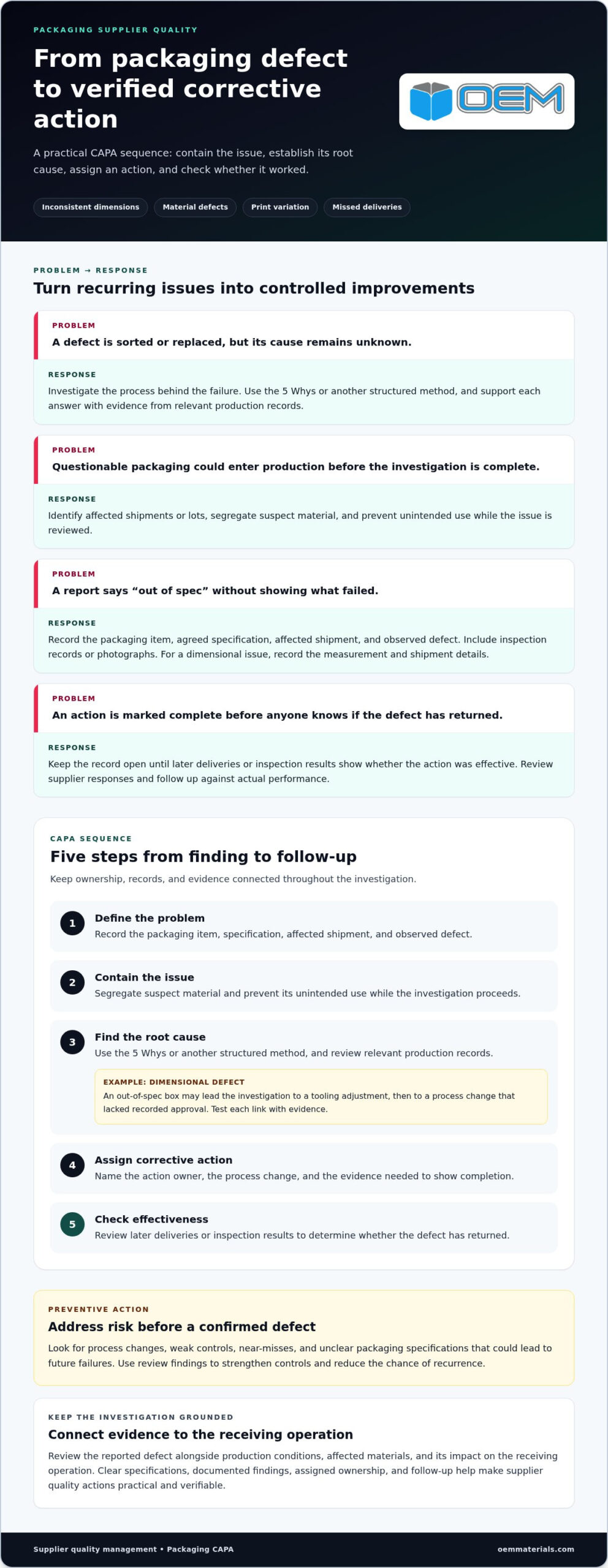
Common packaging supplier risks include inconsistent dimensions, material defects, print variation, and missed deliveries. Reduce these risks with clear specifications, incoming checks, delivery monitoring, and documented corrective actions. A recurring defect needs investigation, not just sorting or replacement, because the same cause may affect later shipments.
A corrective and preventive action process, often called CAPA, addresses an existing problem and identifies ways to prevent it from recurring. Supplier quality engineers monitor performance, assess supplier CAPA responses, and conduct audits. Their review should connect the reported defect to production conditions, affected materials, and the impact on the receiving operation.
Start with containment. Identify affected shipments or lots, separate questionable packaging, and communicate the issue with evidence such as inspection records or photographs. Then document the required specification and the observed failure. For example, if a box arrives with dimensions outside the agreed drawing, record the measurement and shipment details before deciding how to handle the material.
Root-cause analysis should test the process behind the failure, rather than stopping at a surface explanation. The 5 Whys technique repeatedly asks why to trace a problem toward its fundamental cause. A dimensional defect might lead from an out-of-spec box to a tooling adjustment, then to a process change that lacked a recorded approval. Each answer should be supported by evidence.
- Define the problem. Record the packaging item, specification, affected shipment, and observed defect.
- Contain the issue. Segregate suspect material and prevent its unintended use while the investigation proceeds.
- Find the root cause. Use the 5 Whys or another structured method, and review relevant production records.
- Assign corrective action. Name the action owner, the process change, and the evidence needed to show completion.
- Check effectiveness. Review later deliveries or inspection results to see whether the defect has returned.
Preventive action looks beyond confirmed defects. Supplier and buyer teams can identify process changes, weak controls, or recurring near-misses that could lead to future failures. A risk review may flag an unclear packaging specification before a production change causes inconsistent output.
Keep the record open until evidence shows the actions worked. If foam inserts allow a product to shift during transit, review the fit and handling conditions, then evaluate a revised foam packaging design from OEM Materials & Supplies. Managing supplier quality for packaging depends on clear ownership, documented findings, and follow-up tied to actual performance.
When analyzing the interface between the insert and product, document any needed adjustment, then verify it through later checks. This keeps the response evidence-based and prevents a quick fix from closing the investigation too soon.
A structured corrective and preventive action process supports supplier quality management. Suppliers should proactively identify and mitigate risks before they become confirmed defects, using review findings to strengthen controls and reduce the chance of recurrence.
In-process monitoring and inspections
Inspection plans connect packaging specifications to observable acceptance criteria. Receiving teams can compare each delivery with approved drawings, material descriptions, and print references. For example, checking paperboard thickness and ink color helps identify differences before packaging enters production. Supplier quality management systems can also support regular material inspections, supplier audits, and ongoing performance monitoring.
Common verification methods include visual checks, dimensional measurements, print comparisons, and performance evaluations specific to the application. Safety reviews focus on intended use, including relevant food-contact safety and labeling considerations. Choose tests according to the packaging specification and the product’s handling and shipping conditions.
Inspection starts with a defined reference. Keep the approved specification, drawing, sample, or artwork available at the receiving point. For a printed carton, an inspector can compare the delivered ink color with the approved reference and check dimensions against the drawing. Recording the results makes acceptance decisions consistent across shifts and receiving locations.
Not every delivery needs the same inspection depth. A risk-based plan can account for previous defects, supplier delivery performance, response quality, and the effect of packaging failure on production. A supplier with stable output and effective process controls may need less continuous monitoring than one with recurring nonconformances. Review the plan when specifications, processes, or observed performance change.
- Material checks: Compare incoming materials with specified characteristics, such as paperboard thickness.
- Print checks: Review ink color and printed information against the approved reference.
- Fit checks: Confirm packaging dimensions and assembly against the product and packaging design.
- Performance checks: Assess whether the package protects the product during its defined handling and shipping conditions.
- Record review: Track inspection results, supplier responses, and recurring variation over time.
In-process monitoring extends beyond receiving. A supplier audit can examine how specifications are carried through production, how changes are controlled, and how inspection results are recorded. At the buyer’s facility, operators can report issues such as cartons that do not close consistently or inserts that complicate packing. These observations help distinguish a one-time handling problem from a recurring process concern.
Use inspection findings to guide decisions, not just to sort material. Record the item, lot or shipment reference, measured result, and disposition. Then compare results across deliveries and share specific trends with the supplier. For example, recurring color variation gives both teams a clearer basis for reviewing print controls than a general complaint about appearance. This data supports focused follow-up and practical adjustments to monitoring.
Packaging quality management systems
A packaging quality system links supplier selection, design review, specifications, and ongoing oversight. It should remain active throughout the supplier relationship and the packaging product life cycle.
Applicable Packaging Quality Standards
Applicable standards and requirements are the quality-system and regulatory expectations relevant to a package’s intended use. ISO 9001 registration is one consideration when evaluating a supplier, but it does not establish that every supplied package meets your requirements.
Good manufacturing practices (GMP) and FDA requirements depend on the product and packaging application. Design review should address relevant considerations, including food-contact safety and labeling requirements. Define which expectations apply to the package, then document how the supplier’s controls support them. This helps purchasing and quality teams assess evidence of the supplier’s system alongside packaging suitability.
Supplier Qualification, Audits, and Approval
Supplier qualification is the documented assessment of whether a supplier can meet defined quality and delivery expectations. A cross-functional team can establish criteria with input from purchasing, engineering, operations, and quality.
Evaluation may include an on-site assessment, written survey, or confirmation of quality-system registration, such as ISO 9001. An audit can examine document control, production records, change management, and issue escalation. Approval should consider assessment findings and the total cost of working with the supplier, including communication, inventory, and incoming verification. Clear approval criteria help teams make consistent sourcing decisions.
Packaging Specifications and Acceptance Criteria
Packaging specifications state what the supplier must provide; acceptance criteria explain how the buyer determines whether it conforms. Both should be clear enough for the supplier, receiving staff, and production teams to apply consistently.
Identify the package, intended use, approved design revision, and required materials. Define how design changes or material substitutions must be submitted and approved before production. For example, if a supplier proposes a different cushioning material, the specification can require reviewing the proposed change against product protection and packing needs. Keep approved revisions accessible so teams work from the same requirements.
Costs of Auditing and Quality Management
Auditing and quality-management costs depend on the scope of the review and the controls needed for the supplier relationship. Factors include audit format, travel, review effort, verification needs, and supplier complexity.
An on-site assessment requires different resources than a written survey or registration review. Ongoing effort can also vary with documentation needs, inspection activity, and the supplier’s performance history. Consider these factors alongside material, communication, and inventory requirements when evaluating the total cost of working with a supplier. This broader view supports a practical decision about the appropriate level of oversight.
Customer feedback and continuous improvement
Companies maintain packaging quality by reviewing supplier delivery, response, quality, and supply-chain coordination over time. They combine inspection results with feedback from receiving, production, and customers to identify patterns that isolated complaints can obscure.
Feedback is most useful when it describes the packaging item, the observed issue, and its operational effect. For example, a production operator might report that a carton takes extra handling to close. Pairing that note with the carton specification and affected production step helps the supplier understand the issue and assess a practical change.
Use a consistent process for capturing feedback. Receiving staff can report delivery or material concerns, while production teams flag fit, assembly, or packing problems. Customer service can record reports of damaged goods and connect them to packaging type and shipment details. A shared record helps quality and purchasing teams review the same evidence.
- Quality: Review recurring material or packaging defects and their effect on operations.
- Delivery: Track missed or inconsistent deliveries against production needs.
- Response: Assess whether supplier updates and proposed actions address the reported issue.
- Coordination: Note how effectively both teams communicate changes, demand needs, and supply concerns.
Review these measures together. A low defect count may not tell the full story if late deliveries repeatedly disrupt production or supplier responses arrive too slowly for planning. A performance discussion can connect these outcomes to improvement priorities, such as clarifying a specification or coordinating forecast changes earlier.
Continuous improvement works best as joint problem-solving, not a series of short-term price demands. Buyer and supplier teams can discuss upcoming product or volume changes, understand each other’s processes, and identify waste in packaging use or communication. Assess any proposed change against product protection, handling requirements, and supply continuity.
Long-term relationships with fewer suppliers can help reduce variation in important process inputs. This approach depends on clear roles, mutual trust, and support from senior leaders on both sides. For example, purchasing may own supplier reviews while operations reports packing-line effects, giving improvement discussions clear evidence and accountable participants.
Shared digital systems can make feedback more timely by showing supply and demand needs and emerging issues. Visual signals can flag a change in demand or a packaging concern for both organizations to address. Keep records transparent: identify the issue, responsible parties, agreed follow-up, and subsequent evidence used to assess progress.
Close each review by selecting a defined improvement priority and setting a follow-up point. If carton handling remains difficult, compare operator feedback and packing observations after an agreed packaging or process change. Determine whether the change resolved the problem, created another issue, or needs further adjustment.
What quality standards apply to packaging suppliers in the United States, such as ISO 9001, GMP, and FDA requirements?
U.S. packaging requirements depend on the package’s intended use, materials, and role in the supply chain. ISO 9001 registration, good manufacturing practices (GMP), and applicable FDA requirements address different quality considerations, so buyers should define which expectations apply to each packaging project.
ISO 9001 is an example of a quality-system registration to consider during supplier selection. It provides information about a supplier’s quality-management system, but registration alone does not establish that every packaging item meets your specifications. Review the supplier’s controls alongside the actual material, design, inspection criteria, and intended application.
GMP expectations relate to controlled manufacturing practices in contexts where they apply. They are not a universal packaging certification. Define the relevant controls for the product and packaging process, then document expectations for handling, traceability, process changes, and records in the supplier’s quality agreement.
FDA requirements also depend on the product and packaging use. Design review should consider relevant packaging regulations, including food-contact safety and labeling requirements. A package intended for food-related use may need different review criteria from an outer shipping carton that does not contact the product. Document the intended use before setting supplier requirements.
For procurement and quality teams, the practical task is translating applicable expectations into verifiable criteria. Start with product use, packaging function, and the specifications that affect acceptance. Then connect each requirement to a record, review, or inspection method. For example, a printed package can have documented artwork approval and an ink-color comparison during incoming inspection.
- Identify intended use: Record whether packaging contacts the product, protects it during shipping, or carries required information.
- Set supplier expectations: Define relevant process controls, documentation, and change communication in a quality agreement.
- Verify the package: Use measurable specifications and acceptance checks, such as paperboard thickness or print comparison.
- Review changes: Reassess requirements when the package design, material, or intended application changes.
For example, a change to printed labeling can affect artwork review and incoming acceptance, while a material change may require reviewing the packaging specification. Keep the approved revision accessible to purchasing, engineering, receiving, and the supplier. This prevents teams from applying different criteria to the same package.
Build your packaging requirements around intended use, supplier controls, and measurable acceptance criteria. To discuss packaging needs and request a quote, contact the packaging team.
OEM Materials & Supplies: Corrugated Boxes
OEM Materials & Supplies provides corrugated boxes for businesses aligning packaging with product protection and handling needs. Consider corrugated boxes when existing cartons do not fit the product, complicate packing, or need clearer specifications for supplier review. Product dimensions, weight, and shipping conditions help define suitable packaging requirements.
For products needing additional cushioning, foam packaging can complement an outer box. Packaging kits can bring components together for a defined packing application. Matching these options to the product and process gives purchasing and operations teams a practical starting point for evaluating packaging performance.
Share your packaging requirements with OEM Materials & Supplies to discuss corrugated boxes or related packaging options.
Put Your Packaging Requirements Into Practice
The next step is to turn quality expectations into a working decision process. Identify where packaging performance has the greatest effect on your operation, then align purchasing, engineering, and production around the requirements that matter for upcoming orders. This keeps managing supplier quality for packaging connected to actual product needs and daily workflows, rather than treating it as a separate paperwork exercise.
Bring the packaging challenge you want to address, along with relevant product dimensions, weight, and shipping conditions. These details help frame a useful discussion about the right packaging direction for your application.
Contact OEM Materials & Supplies to discuss your packaging requirements. A clear starting point can help your team move toward more consistent packaging decisions.
Frequently Asked Questions
What are packaging supplier performance metrics?
Packaging supplier performance metrics are defined measures used to evaluate supplier results against business needs. Choose measures that help answer a decision, such as whether to continue a supplier approval, change an ordering pattern, or review a packaging design. Separate supplier-controlled outcomes from internal planning issues. For example, distinguish a supplier’s shipment timing from delays caused by the buyer’s late purchase-order release.
What is Supplier Quality?
Supplier quality describes how reliably a supplier’s materials and processes support the buyer’s intended use. For packaging, this means assessing whether the package works with both the product and packing process, not just whether it matches a document. A box that meets its drawing but does not fit the established packing-station workflow may require a joint review of the design and work instructions.
What makes supplier reporting decision-ready?
Decision-ready reporting shows the evidence behind a recommendation and identifies who needs to act. Include the data source, reporting period, relevant product or purchase order, and assumptions used to interpret the result. Separate confirmed facts from open questions. The report can then support a specific decision, such as whether engineering must approve a packaging revision before purchasing places another order.
What are best practices for managing packaging supplier quality?
Assign clear internal ownership for supplier decisions. Purchasing can coordinate commercial terms, engineering can approve design changes, and operations can evaluate packing-line usability. Maintain an approved contact and escalation path for each supplier relationship. For a packaging change affecting multiple departments, route the proposal through the responsible reviewers before production adopts it. This prevents teams from acting on conflicting instructions.
What packaging supplier quality metrics and KPIs should companies track?
Select indicators that match the decision under review, and define each calculation consistently. For example, report rejected receipts in relation to receipts inspected, rather than presenting an uncontextualized count. Pair a defect measure with its operational consequence, such as rework or a packing delay. This helps teams compare periods meaningfully and avoid mistaking a change in inspection volume for a change in supplier performance.
How can companies manage packaging supplier nonconformances, corrective actions, and quality complaints?
Use one controlled record for each complaint so receiving, production, and purchasing can track the same status. Keep supporting evidence, such as photographs, sample identification, and relevant order documents, with the record. Set a clear disposition for affected material and notify teams that may use it. If a customer complaint involves possible product damage, connect it to shipment and packaging records for investigation.
For packaging requirements that need a supplier discussion, contact OEM Materials & Supplies to start the conversation.