
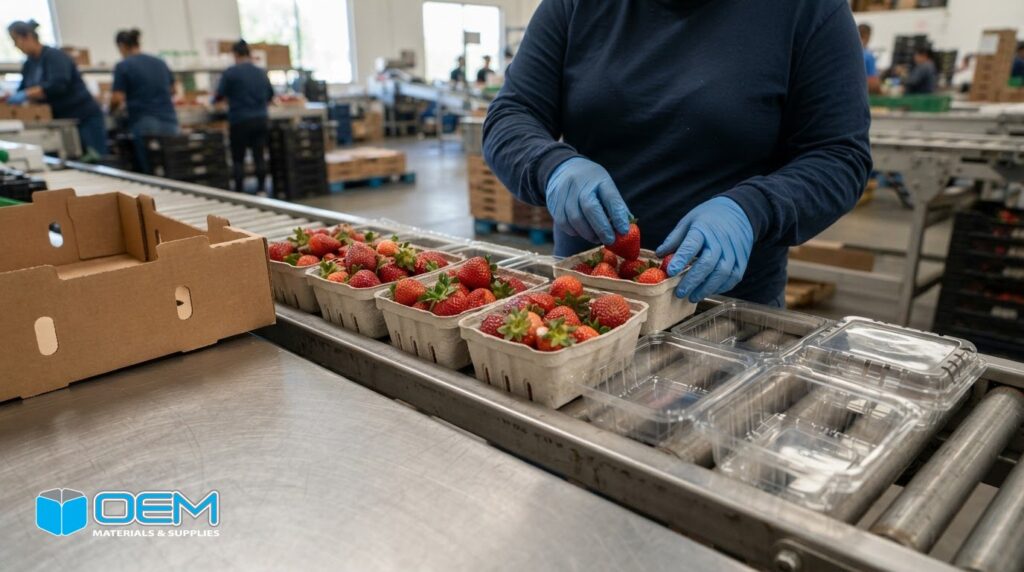
The most sustainable tray isn’t automatically the one made from a plant-based material. Sustainable alternatives to plastic trays include paper-based produce punnets and bioplastic trays, but the better fit depends on product protection, material composition, and what happens to the packaging after use. For produce businesses in Orange County, Los Angeles County, San Diego County, and Riverside, the local distribution and disposal context matters too.
For purchasing and packaging teams, choosing sustainable alternatives to plastic trays means more than swapping one material for another. Packaging must protect delicate produce through handling and distribution while meeting operational requirements and offering a realistic end-of-life route. This guide compares paper-based punnets with bioplastics, then examines molded fiber, paperboard, bamboo, compostable plastics, and reusable trays. It covers coatings, recycled content, durability, and disposal infrastructure to help teams assess options against produce needs and supply-chain realities.
Key Takeaways
- Compare paper-based punnets and bioplastics by how well they protect produce and fit your packaging operation.
- Review coatings and material composition, since they can affect recycling and composting options.
- Assess molded fiber, paperboard, bamboo, and compostable plastics against product needs and local disposal pathways.
- For reusable trays, consider the full return, cleaning, and reuse process, not just the tray material.
- Match the packaging choice to product dimensions, handling requirements, and distribution conditions.
1. Paper-based produce punnets as an alternative to plastic produce packaging
Paper-based punnets can replace clear plastic packaging for berries, cherry tomatoes, and other produce. Their fiber structure groups items for display and transport while offering an alternative to plastic. Lightweight paper formats can reduce plastic packaging, but the punnet still needs enough strength to protect delicate contents. Performance depends on its shape, fiber, and exposure to moisture.
Paper and molded-fiber packaging can also replace some plastic bags. A paper sleeve or bag may suit dry, firm produce, while soft berries generally need a supportive punnet. Reducing plastic is useful only if the package still limits bruising and product loss. Test the complete pack, including closures and labels, under the handling conditions used in stores.
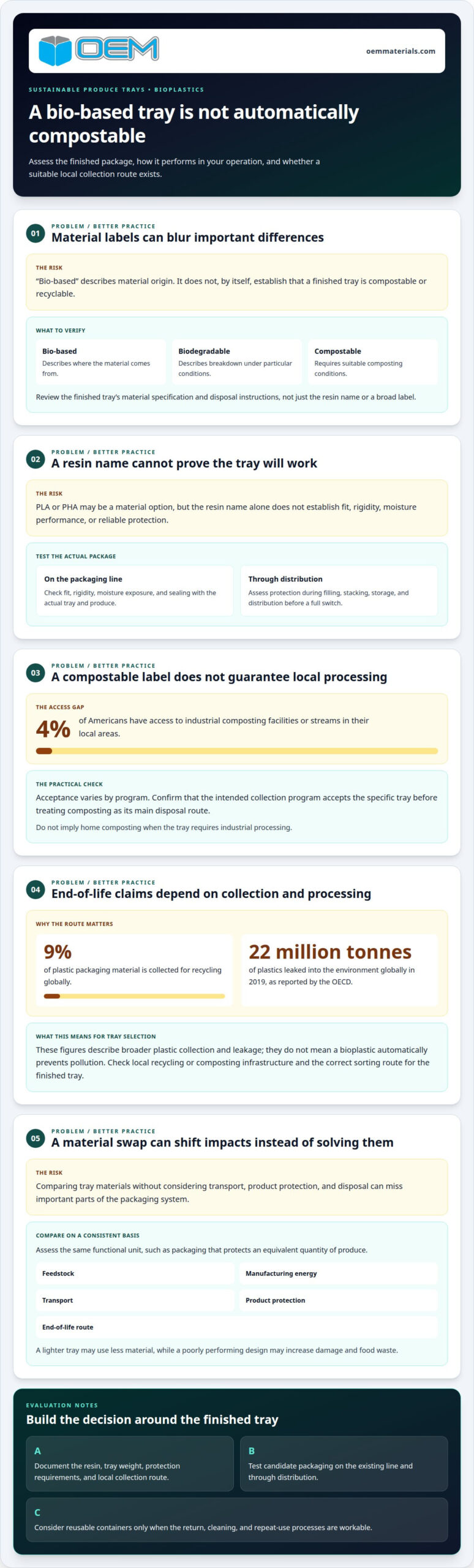
Bio-based polymers such as PLA and PHA offer another material category. A plant-based origin does not by itself mean a package is compostable or recyclable. End-of-life depends on the finished product and the collection route available to customers. Review the material specification and disposal instructions rather than relying on a “bio-based” label alone.
Paper-based takeout containers show how fiber packaging can serve different products. A paper bowl may work for dry foods, while hot, wet, oily, or acidic meals place greater demands on its barrier layer and seams. The material and coating must suit the food and time in use. A package designed for salad, for example, may not perform like one made for hot soup, just as mobile catering operations like Simply Coffee & Matcha rely on sturdy, moisture-resistant packaging when serving hot espresso and cold matcha at events.
Paper-based tape can support a fiber packaging system. Water-activated paper tape breaks down cleanly and can be composted with cardboard. Compostable tape may also work, but its material and disposal requirements should match the package. Mixing incompatible layers can complicate recovery, even when the main container is paper.
How much do sustainable food trays cost compared with plastic trays? There is no single comparison: cost depends on material, dimensions, strength, coatings, and shipping requirements. Can sustainable trays safely hold hot, wet, oily, or acidic foods? They can when their construction and barrier layer are designed for those conditions. Assess the filled package with the actual food and use conditions.
How recyclable are paper, molded-fiber, and reusable food trays in the United States? Paper and molded fiber can enter paper recovery when local programs accept them and coatings or food residue do not prevent processing. Reusable trays depend on return and reuse systems. To choose and switch, match the tray to the produce, run handling trials, review local disposal routes, then phase in the selected format alongside existing packaging.
2. Bioplastics and sustainability considerations
PLA and PHA are bio-based polymer options for trays and other containers. PLA is commonly produced from renewable plant-based feedstocks, while microorganisms produce PHA. Bio-based describes material origin, not how a package breaks down after disposal. Biodegradable describes a breakdown process under particular conditions, and compostable packaging needs suitable composting conditions. These terms are not interchangeable, so compare the finished tray’s material and disposal instructions.
Bioplastics can work as packaging, but the resin name alone does not establish suitability. A produce tray must protect its contents during filling, stacking, storage, and distribution. Test the actual tray with the produce and packaging line. A trial can reveal problems with fit, rigidity, moisture exposure, or sealing before a full switch. Sustainable packaging depends on both material choice and reliable performance.
End-of-life access is a central consideration. Only 9% of plastic packaging material is collected for recycling globally. The OECD reported that 22 million tonnes of plastics leaked into the environment globally in 2019. Those figures show why collection and processing matter, but they don’t establish that a bioplastic automatically prevents pollution. A tray’s destination depends on local recycling or composting infrastructure and correct sorting.
What U.S. regulations and labeling rules apply to compostable food trays? A label should distinguish compostable, biodegradable, and bio-based claims, and identify the disposal route the package is designed for. Avoid wording that implies home composting when the tray requires industrial processing. Clear material identification helps consumers and waste handlers sort containers correctly.
Are compostable trays accepted in U.S. commercial composting programs? Acceptance varies by program, and a compostable label alone doesn’t guarantee that a facility will process the tray. Only 4% of Americans have access to industrial composting facilities or streams in their local areas. Confirm that the intended collection program accepts the specific tray before making composting the main disposal plan.
What are the environmental impacts and life-cycle emissions of different tray materials? They depend on feedstock, manufacturing energy, transport, product protection, and end-of-life route. Compare those stages using the same functional unit, such as packaging that protects an equivalent quantity of produce. A lighter tray may use less material, while a poorly performing design may increase damage and food waste.
For a practical assessment, document the resin, tray weight, protection requirements, and local collection route. Test candidate packaging on the existing line and through distribution. Include reusable containers only when return, cleaning, and repeat-use processes are workable. This step-by-step review helps purchasing and operations teams evaluate options against actual conditions, rather than relying on a renewable-material claim alone.
3. What sustainable alternatives are available for plastic trays?
Produce operations can compare molded fiber, paperboard, bamboo, compostable plastic, and reusable formats. Each option affects the tray’s structure, handling needs, and disposal pathway. A berry punnet needs sidewall support and airflow, while a flat tray for firm produce may prioritize stacking. Start by matching tray geometry and protection requirements to the product, not by choosing solely from the material label.
Molded fiber uses formed pulp to create shaped compartments, rims, and protective corners. It can suit apples or avocados that need separation during transport. Paperboard trays offer a flatter, foldable structure that may suit produce with less need for individual cavities. Compare how each format stacks when loaded, then test for deformation during packing and distribution. Moisture exposure and produce weight can affect the result.
Bamboo-based trays offer another fiber option, but the finished tray’s coatings, binders, and manufacturing process matter as much as the feedstock. Compostable plastic trays may preserve a familiar rigid format, yet compostability depends on the material and available processing route. For either option, review the full package specification, including labels and attached film. A compostable claim does not automatically mean the whole pack shares that property.
Some packaging designs combine materials instead of eliminating plastic entirely. One comparison proposes cardboard made with 80% recycled content alongside recycled plastic film. This format may separate the structural role of board from the film’s protective role. Before adopting it, identify how users separate the layers and whether local collection accepts each component. A mixed-material design can be difficult to recover if separation is impractical.
Reusable trays are another option for controlled distribution loops. A grower supplying a nearby store can assess return routes, cleaning procedures, storage space, and tray loss alongside material choice. Reuse works operationally only when containers return in usable condition and fit existing handling equipment. Map the route from packing area to store and back, then test stacking, sanitation, and inventory control with the actual tray.
To compare packaging solutions, create a small evaluation matrix covering product protection, packing-line fit, transport efficiency, and end-of-life route. Trial each candidate with the same produce type, fill weight, and distribution conditions. Record crushing, moisture damage, rejected packs, and line interruptions. These operating results help distinguish a workable substitution from a material change that shifts costs or damage elsewhere in the supply chain.
For a mixed produce range, assess tray formats by product rather than forcing one design across every item. A firm pear and a delicate berry have different support needs. For businesses sourcing and transporting fresh agricultural commodities, such as dosanoglobal.com, tailoring packaging to specific produce types is essential to avoid transit damage. Document the selected material, coatings, closures, and disposal directions for each package to give procurement, operations, and retail teams a consistent basis for comparing alternatives and communicating disposal steps.
4. How do molded fiber, paperboard, bamboo, and compostable plastic trays compare?
The main difference is how each material becomes a tray. Molded fiber starts as a pulp mixture formed into a three-dimensional shape. Paperboard is cut and folded from sheets, while bamboo trays use bamboo-based material in a formed structure. Compostable plastic is shaped from polymer. These production differences affect tray geometry, tooling, and compatibility with established packaging equipment.
Molded fiber can form curved walls, recessed areas, and integrated compartments. That makes it a useful design direction when a package needs a contoured interior rather than a flat base. Its surface and edges have a fibrous appearance. Paperboard, by contrast, starts as a sheet, so folds and scored panels define its shape. The comparison discussed here assumes cardboard trays are made from 100% virgin paper pulp.
Paperboard’s sheet-based construction can support flat storage before assembly. The tray’s fold pattern determines how it opens and holds its shape, so operators should consider the steps required at the packing station. A design with multiple folds or tabs can require a different setup from a simple open tray. Converting and assembly details matter alongside the material itself.
Bamboo describes a feedstock, not a single tray design. A bamboo-based tray may be engineered as a molded form or incorporated into another fiber structure. When comparing specifications, procurement teams should distinguish the raw material from the finished construction. For example, “bamboo tray” alone does not explain whether the format arrives nested, flat, or ready for filling.
Compostable plastic can retain the formed, rigid shape familiar from conventional plastic trays. That may make it relevant where an operation is built around rigid tray formats. The polymer formulation and forming method still determine the package’s properties, so the material name does not define every performance characteristic. Compare the finished-tray specification rather than treating all compostable plastics as interchangeable.
Production method also affects how a tray integrates into a packaging line. A sheet-fed paperboard design may require erection before filling, while a molded or formed tray may arrive ready to load. Compare these steps with current feeding, labeling, and case-packing processes. The most useful distinction is often not simply fiber versus polymer, but how much process change each format requires.
For a meaningful material comparison, request specifications describing construction, forming method, and supplied format. Then map each tray to the line’s workflow and storage arrangement. A compact nested tray, a flat blank, and a ready-to-fill container create different receiving and staging requirements. These details let packaging teams compare materials without assuming one manufacturing approach suits every produce operation.
Finishes also deserve attention: glossy coatings on wrapping papers and packaging cards can make them harder to recycle or compost, so compare the finished package rather than its base material alone. Global bamboo sales are expected to almost double over the next 10 years, but that outlook does not replace checking the specific tray construction and finish against operational requirements and end-of-life expectations.
5. Are reusable trays more sustainable than disposable alternatives?
A life-cycle comparison needs a consistent basis. Compare packaging that protects the same quantity of produce over the same distribution function. Then assess material production, manufacturing, transport, losses, and end-of-life treatment. Looking only at one tray’s material or weight can miss impacts elsewhere in the product system.
For reusable formats, the number of successful uses changes how the initial material burden is distributed. A tray that completes repeated cycles spreads its production impact across more deliveries. A tray retired early has fewer uses over which to distribute that impact. The relevant measure is actual service life, including damaged or lost units, rather than an intended reuse target.
Disposable trays also vary by composition and recovery assumptions. The comparison discussed here assumes plastic trays contain 80% recycled plastic and a 60% consumer recycling rate for used plastic trays. These assumptions shape the modeled result. A different recycled-content share or end-of-life outcome would change the comparison, so keep assumptions visible when reviewing life-cycle results.
Transport can shift the balance between formats. A reusable tray’s production impact is distributed across its service life, but its total system also includes movement between use points. Disposable trays have their own transport and material requirements. Compare actual supply routes and packaging quantities rather than treating “reusable” or “disposable” as a complete environmental assessment.
Produce loss belongs in the analysis too. A package that fails to protect its contents can create impacts beyond the tray itself. Compare trays by the quantity of saleable produce delivered, not just by container material. For example, a design that reduces usable product at receipt may perform differently in a full life-cycle assessment than its material profile suggests.
Review a study’s boundaries before using its conclusion. Check whether it includes tray manufacture, transport, washing, reuse, recycling, and disposal. Confirm that the comparison uses equivalent tray capacity and product protection. These details help procurement teams understand what drives the result and whether the analysis reflects their packaging system.
Reusable trays can be a sound choice when the measured life cycle supports them. Disposable alternatives may compare favorably under different material and recovery assumptions. Use a transparent assessment based on actual packaging functions and documented inputs, then align the selection with business requirements. Discuss your packaging requirements with OEM Materials & Supplies.
Broader packaging evidence reinforces the need to test specific systems rather than assume reuse always wins. E-commerce plastic packaging use was expected to more than double to four-and-a-half billion pounds by 2025, and sustainable alternatives for pots and trays can cost two to three times more than conventional options. The cited research finds a reusable mailer can have greater carbon emissions than a 100% recycled poly mailer used twice, even if the reusable mailer is returned every time.
Other impacts need context: microplastics are particles smaller than 5 mm, while packaging typically accounts for less than 5-7% of an apparel product’s overall environmental and carbon footprint. The page reports that 73% of consumers are more likely to buy a product packaged sustainably. These figures concern packaging broadly, not a direct life-cycle result for produce trays; they support weighing measured environmental performance alongside cost and customer response.
OEM Materials & Supplies: Corrugated Boxes
OEM Materials & Supplies offers Corrugated Boxes for businesses coordinating product packaging and shipment. After selecting a produce tray, consider how the packed goods will be protected during outer-carton handling and distribution. Corrugated boxes provide an additional packaging layer, while Foam Packaging or Cushioning Materials can help protect products that need added cushioning. Packaging Kits can bring components together for a defined packing task.
For a practical review, document the packed product’s dimensions, weight, and shipping conditions. These details help assess how the outer packaging fits the tray and distribution process. Contact OEM Materials & Supplies to discuss your packaging needs or visit oemmaterials.com.
Put Your Packaging Decision Into Practice
A material change is most useful when it works across purchasing, packing, and distribution. Turn your evaluation into a clear packaging specification: define the produce and protection needs, document handling conditions, and identify the intended end-of-life route. Then align the tray with the outer packaging and shipping process. This helps teams move from comparing sustainable alternatives to plastic trays to implementing packaging that fits actual operations.
OEM Materials & Supplies offers Corrugated Boxes, Foam Packaging, and Packaging Kits to support packaging needs around the tray. Share product dimensions, weight, and distribution details to frame the discussion around your application. The right combination depends on how the product is packed and shipped, so include those requirements in the review.
Start a focused conversation about your packaging requirements with OEM Materials & Supplies. A well-defined next step can help your team put a practical packaging plan in motion.