

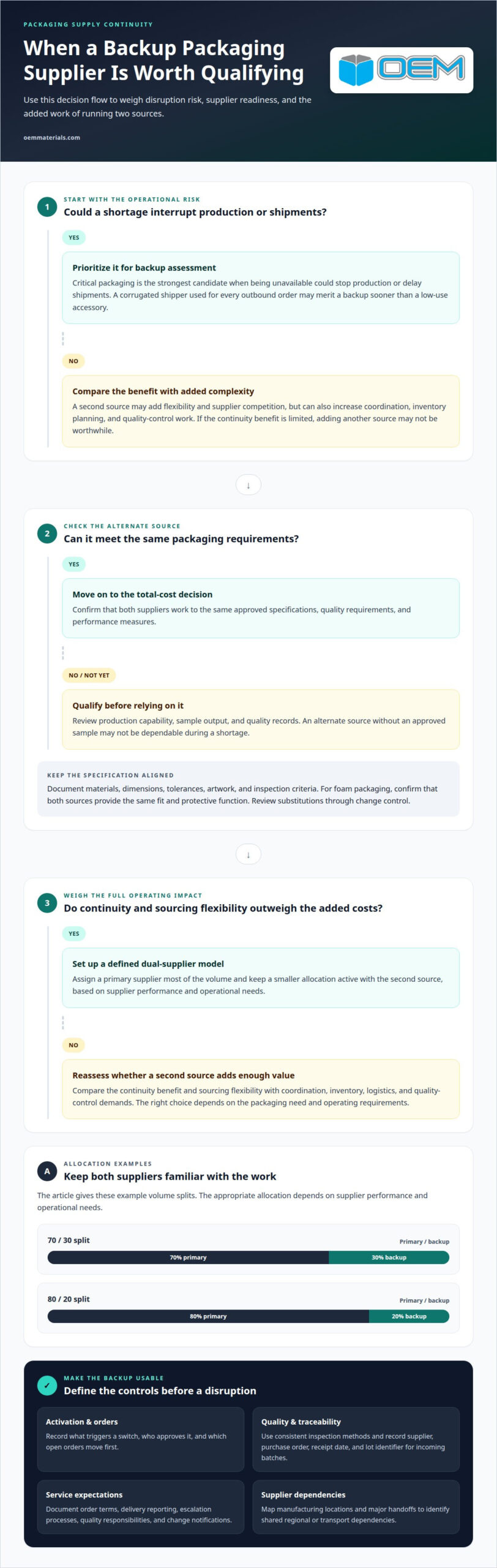
A backup packaging supplier is worth adding when a shortage of a critical item could interrupt production or shipments. Building a dual-supplier model for critical packaging means qualifying two suppliers for the same need and defining how work shifts between them. The case is strongest when the continuity benefit and added sourcing flexibility outweigh extra coordination, inventory, and quality-control costs.
Relying on one supplier can simplify purchasing and concentrate volume, but it leaves fewer options when delays, quality problems, or price changes threaten supply. A second source can add flexibility and competition, but only if its specifications, capacity, and operating costs meet your requirements.
This article explains how to identify packaging that needs a backup, compare disruption risk with total ownership costs, and maintain consistent quality across suppliers. It also covers order allocation and when a second source may add complexity without enough operational benefit.
Key Takeaways
- Prioritize backup sourcing for packaging that could interrupt production or shipments if it becomes unavailable.
- Keep specifications, quality requirements, and change-control expectations aligned across both suppliers.
- Compare total sourcing costs, including logistics, inventory, and quality-control demands, rather than focusing only on unit price.
- Set clear conditions for activating the backup and test its packaging before a disruption occurs.
- Use supplier competition to support pricing discussions while weighing any added coordination and inventory complexity.
Dual sourcing as a supply-chain risk-reduction strategy
Dual sourcing means qualifying two suppliers for the same packaging requirement. It reduces reliance on a single source if a delay, quality issue, or regional disruption threatens supply.
For critical packaging, building a dual-supplier model starts by identifying components that could stop production or shipments if unavailable. A corrugated shipper used for every outbound order, for example, may deserve a backup sooner than a low-use accessory. Buyers can assign a primary supplier most of the volume and keep a smaller allocation active with the second source. A 70/30 or 80/20 split can help maintain familiarity with both suppliers, but the right allocation depends on performance and operational needs.
Match sourcing decisions to packaging’s role. A component that directly supports a product’s presentation or handling may need tighter specification control than a general shipping carton. Define the material, dimensions, tolerances, artwork, and inspection criteria for each source. If the configuration includes foam packaging, for example, both sources should deliver the same fit and protective function. The same principle applies when sourcing specialized components like plastic tubing or bespoke extrusion profiles, where manufacturers such as Abbey Extrusions must adhere to exact dimensional tolerances and material criteria.
Backup Coordination and Qualification Costs
Backup coordination keeps two suppliers aligned on orders, specifications, quality checks, and activation conditions. Qualification includes the sampling and review needed to confirm that the alternate source meets the same requirements. These tasks take procurement and engineering time, while split orders can complicate inventory planning. A written backup plan clarifies who approves a switch and which open orders move first.
Contracts and Service-Level Agreements
Supplier contracts and service-level agreements document each source’s responsibilities, order terms, communication expectations, and performance measures. They can clarify allocation changes, escalation contacts, delivery expectations, and notice of specification changes. For example, define what triggers a shift to the backup and how the alternate order is released. Clear terms help production teams make timely decisions.
Useful agreements set out response and escalation processes, order acceptance, delivery reporting, quality responsibilities, and change notifications. They should also explain how both suppliers manage records and traceability information. Procurement can then compare performance consistently and document why it activated the alternate source.
Traceability links packaging materials to supplier records, lot identifiers, and receiving documents. Keep records consistent across both sources so a quality concern can be traced to the relevant shipment and material origin. For each incoming batch, record the supplier, purchase order, receipt date, and lot identifier. This creates a clear path to investigate defects or isolate affected inventory without assuming the two sources are interchangeable.
Regional diversification can reduce exposure when suppliers rely on the same production area or transport route. Map each supplier’s manufacturing location and major handoffs, then identify shared dependencies. A backup in another region may have a different disruption profile, but it still needs approval against the same packaging specification. The goal is two usable sources, not simply two names on a sourcing list.
Keeping specifications and quality consistent across suppliers
Qualify both sources against the same specifications, quality standards, and performance measures. In the United States, requirements depend on the packaging’s intended use and contents, so define the applicable quality, safety, and regulatory criteria before approving a supplier.
Equivalent Standards Across Suppliers
Equivalent standards mean assessing the primary supplier and backup against the same documented requirements. This gives procurement a fair basis for comparing samples and production output. Use one controlled specification covering materials, dimensions, tolerances, color standards, and current artwork files. Review any proposed substitution through change control before use. Otherwise, differences could affect fit, protection, labeling, or downstream handling.
Quality Assurance Across Suppliers
Quality assurance applies common inspection methods and performance measures to verify that each supplier’s output meets requirements. Define inspection points, defect categories, sample approval, and release responsibilities in a shared quality agreement. Tie receiving records to supplier and lot identifiers so teams can investigate problems at their source. A supplier scorecard can track delivery, quality, and corrective actions; quarterly or semiannual reviews can reveal trends before they affect production.
Requirements for Critical Packaging Suppliers
Requirements for critical packaging suppliers are the quality, safety, and regulatory criteria relevant to the package’s role and contents. Record them in the purchasing specification, then assess each supplier against the same evidence and approval process. A supplier handling packaging for a regulated product may face different requirements from one providing an outer shipping carton. Assess those use cases separately instead of applying one broad checklist to every item.
Qualification should also confirm backup readiness. Review production capability, sample output, quality records, and the supplier’s ability to follow approved specifications before assigning meaningful volume. Keep approval status and open issues visible to procurement, engineering, and operations. A backup that has not produced an approved sample may not be dependable during a shortage.
Consistent standards also make supplier competition more useful. Send both sources the same specification and quote format, then compare price alongside quality, delivery reliability, and responsiveness to engineering changes. A lower quote may not offer equivalent value if it requires extra inspection or repeated corrections. Give both suppliers clear feedback, and base allocation decisions on documented performance rather than preference.
For a packaging review, organize current drawings, acceptance criteria, and usage details before comparing samples. Teams evaluating packaging requirements and specifications can use that information to frame a consistent supplier discussion.
Is dual sourcing always more expensive than single sourcing?
No. Dual sourcing can increase coordination, logistics, and quality-control costs, while relying on one source can expose operations to costly interruptions. Compare total cost of ownership, not just purchase price, including each supplier’s logistics and quality-control costs.
A risk assessment helps procurement identify items that justify an alternative source. Review supplier continuity, quality performance, and financial stability, then map production locations and transport dependencies. Two suppliers in the same region may share exposure to a local disruption. Geographic diversification can reduce that concentration, although a source in another region may also change shipping and inventory needs.
Continuity and Operational Risk Reduction
Continuity planning defines how production or shipping will continue if a supplier cannot deliver. It reduces operational risk by giving teams an approved alternative and clear activation criteria. For example, if a confirmed delay from the primary supplier threatens an outbound schedule, operations can shift orders to the qualified backup instead of waiting without a plan. Track quality, delivery, and inventory signals so the decision reflects current conditions.
Lead-Time and Launch Risk Management
Lead-time and launch risk management aligns supplier capacity with the dates packaging must be available. It matters when a delayed component could hold up a product launch or shipping schedule. For a critical material with a long lead time, a replacement shipment from a single source can take a quarter or more. Qualify the alternative before launch, then plan how to shift volume without disrupting approved packaging workflows.
Monitoring should combine supplier performance data with a practical continuity test. Procurement can track order status, lead-time changes, quality reviews, and delivery history for each source. Set activation triggers in advance, such as an announced delay that puts a scheduled production run at risk. Then run a tabletop exercise: identify the affected packaging, decide who approves the switch, and trace how the alternate order reaches the operation.
At larger scale, manual tracking becomes difficult. Automate data collection and analysis where supplier records and ordering systems allow. A dashboard can flag late shipments, recurring defects, or deteriorating delivery performance for review. Assign a named owner to interpret alerts: a system can identify a change, but operations must decide whether it affects production or customer shipments.
Test the backup with a controlled order before an emergency, then review its output against the approved specification. Record corrective actions and update the continuity plan. Reassess supplier performance as volumes and arrangements change, so procurement can adjust allocations using current evidence rather than assumptions. Dual sourcing adds cost when the second source creates more overhead than risk reduction. Its value depends on item criticality, supplier geography, lead time, and the operational impact of a missed delivery.
Assessing packaging stockout and supply-disruption risks
Assess risk by connecting each packaging component to its effect on production, warehouse operations, and customer shipments. A 30-day stockout of packaging essential to shipments can indicate that the item merits a backup source.
Material Criticality and Production Impact
Material criticality measures how difficult it is to keep production or shipments moving without a particular packaging component. Purchase volume alone does not show the cost of its absence. Map each component to the product or shipment it supports, then identify functional substitutes and available workarounds. A box used across several product lines may have a broader impact than a low-volume item used occasionally.
Vulnerabilities in Critical Components
A vulnerability assessment identifies how a component’s supply could fail and which dependencies might affect its replacement. Review the supplier’s production region, transport route, material inputs, and any specialized tooling or artwork. A custom packaging component with no approved substitute deserves closer attention than a standard item available from multiple sources. Track supplier relationships and shared dependencies, since two vendors may rely on the same upstream material or production hub.
Create a simple risk record for each critical item: annual volume, current inventory, replenishment lead time, production impact, and substitute status. Flag items whose absence would stop packing or prevent shipments. Compare the record with actual stockout and delivery history instead of relying only on purchasing forecasts. When a component has few substitutes and repeated supply interruptions, procurement has a stronger case for qualifying an alternative.
Disruption Risks and Mitigations
Regional events, shared upstream sources, transport constraints, or inconsistent specifications can disrupt both suppliers. Mitigate these risks by mapping dependencies, qualifying the backup against the same requirements, and setting a trigger for shifting volume. For example, a missed delivery that threatens a scheduled shipping run can prompt a documented review of available inventory and alternate supply.
Risk tracking should also confirm that the backup can support the required volume, not just produce an approved sample. Compare its available capacity with demand for the affected operation, then identify which orders take priority during a switch. A backup with limited capacity may protect only selected products, so allocate it first to components whose absence would have the greatest production or shipping impact.
Review the plan after a stockout, supplier change, or material revision. Record the cause, affected orders, response time, and corrective action. If a 30-day shortage occurs, use that event to reassess inventory placement, supplier relationships, and the criticality rating. This turns disruption history into a practical sourcing decision instead of treating every packaging item as equally important.
Pricing stability and supplier competition
A secondary supplier can improve resilience and provide a credible alternative in pricing discussions, but it does not guarantee lower quotes. The value comes from comparing capable sources against the same packaging specification and assessing the full cost of supply. Procurement should weigh purchase price alongside logistics, quality-control effort, inventory needs, and available capacity. A lower unit price may not reduce total cost if extra freight, inspection, or handling offsets the difference.
Start with a like-for-like comparison. Give both suppliers the same material requirements, dimensions, tolerances, artwork, order quantities, delivery locations, and quote format. Ask each to identify assumptions that could affect the quoted scope, such as order frequency or shipment configuration. Then compare terms and cost drivers side by side. If one supplier prices a different material or assumes a different delivery pattern, the figures are not directly comparable.
Competition is useful when both suppliers meet the approved requirements and can sustain their assigned volume. A qualified secondary source gives procurement a benchmark for reviewing price changes, capacity constraints, and proposed substitutions. It also gives the primary supplier a clear performance context. Keep discussions factual: share the required specification and demand outlook, then assess responses against delivery, quality, service, and total cost. Do not shift volume solely to reward the lowest quote if quality or continuity would suffer.
Allocation affects pricing stability. Giving the backup a smaller, active share can keep it familiar with the packaging and provide recent performance data. Its share can grow if it demonstrates consistent quality, delivery, and capacity. A backup that receives no orders, by contrast, may be less prepared to respond if the primary supplier fails. Balance the readiness benefit against the additional coordination, order administration, and inventory planning involved in maintaining two sources.
Review both quotes when specifications, freight assumptions, order patterns, or material requirements change. Track supplier performance alongside price so procurement can distinguish a genuine cost advantage from a short-term quote that creates operational risk. For example, a supplier offering a lower price but unable to support the required volume may not be a practical alternative. Stable performance and sufficient capacity make a supplier more useful as a source of competitive pressure over time.
Use the comparison to identify where packaging requirements or ordering patterns may be driving avoidable cost, then align both suppliers around the same scope. To discuss packaging requirements and request a quote, share your specifications and sourcing needs.
OEM Materials & Supplies: Corrugated Boxes
OEM Materials & Supplies provides corrugated boxes for businesses assessing packaging continuity and sourcing needs. When a box is essential to outbound shipments, documented dimensions, construction requirements, and order patterns help buyers compare sources against the same specification. Corrugated boxes can also be considered alongside foam packaging, packaging kits, or mailing tubes and cores when products need different packaging formats.
Include box dimensions, product weight, shipping requirements, and usage information in your sourcing review. These details clarify what the packaging must support and keep comparisons focused on equivalent requirements.
Contact OEM Materials & Supplies to discuss corrugated boxes for your packaging needs.
Set the Next Packaging Decision in Motion
Turn your sourcing review into a focused packaging brief. Identify the item, its current specification, expected usage, shipping requirements, and the operational outcome a second source should support. This gives your team a practical basis for evaluating options and coordinating procurement, engineering, and operations around the same need.
If you’re building a dual-supplier model for critical packaging, OEM Materials & Supplies can discuss the packaging requirements behind your sourcing decision.
Contact OEM Materials & Supplies to discuss your packaging requirements and move your sourcing plan forward.
Frequently Asked Questions
When should I set up a backup packaging supplier?
Start while packaging is being designed or sourced, not after an urgent shortage. Qualification time depends on the package: a stock box or standard pouch may take a few weeks, while a custom mold or specialty substrate can require several months of sampling and approval. Allowing for this time gives engineering and procurement room to assess samples before launch pressure limits their options.
Is domestic or offshore packaging sourcing better?
Domestic sourcing often suits designs still in development because sampling and revision rounds can move faster. Offshore sourcing can suit stable, high-volume items with locked specifications, though it generally involves higher minimum order quantities and longer lead times. Compare revision frequency, shipment timing, and order size. For example, keep a frequently revised package closer to the team managing design changes, while evaluating offshore supply for an established specification.
Should a small brand bother dual sourcing at all?
A small brand can take a focused approach instead of duplicating its entire packaging catalog. It might qualify a backup for one launch-critical package while keeping low-impact, easily replaceable items with a single source. For example, brands like Beauty Made Easy focus on specialized recyclable paper packaging for their cosmetics, where ensuring primary container availability is vital to avoiding disruptions. At launch, the alternate should be identified, contacted, and capable of supporting the package. Qualification depth can reflect the package’s role and the brand’s available procurement resources.
What’s a good volume split for dual sourcing?
A 50-50 split can fit when both suppliers have similar reliability and capability, or when an even allocation is required. It isn’t automatically the best choice: equal shares can complicate inventory planning if demand varies or suppliers have different capacity. Set the allocation to match each source’s demonstrated ability and the company’s operating needs, then revisit it when order patterns or supplier performance change.
What’s the difference between dual sourcing and multi-sourcing?
Dual sourcing uses two suppliers for a packaging requirement; multi-sourcing can involve more than two. For instance, a company might qualify two suppliers for a critical package but use a broader pool across its packaging portfolio. The distinction describes the number of sources, not the allocation method. Procurement can set sourcing arrangements by component, giving an item with greater supply exposure a different source structure.
When should your business consider dual sourcing?
Reassess the sourcing decision when product volumes, package designs, or supplier arrangements change. A package that was easy to source at launch may become operationally important as sales expand or more product lines adopt it. An annual review can help procurement catch these shifts and update its approach. Revisit the arrangement after a major specification revision too, since changes can affect supplier readiness and production planning.
What is a dual-supplier model for critical packaging?
Building a dual-supplier model for critical packaging means documenting an arrangement with two suppliers for a packaging requirement. The model can distinguish routine allocation from a contingency source and identify who in procurement or operations can authorize a change. This helps teams understand whether the second supplier is intended for ongoing production or reserved for a defined supply event.
How do you identify critical packaging components and set dual-sourcing priorities?
Create a packaging dependency map linking each component to the finished products and packing operations that use it. Note shared specifications, artwork, tooling, and revision frequency. A component used across several product families may need different attention from one tied to a single package design. This map gives engineering and procurement a shared view for prioritizing sourcing work and coordinating design changes across affected products.