
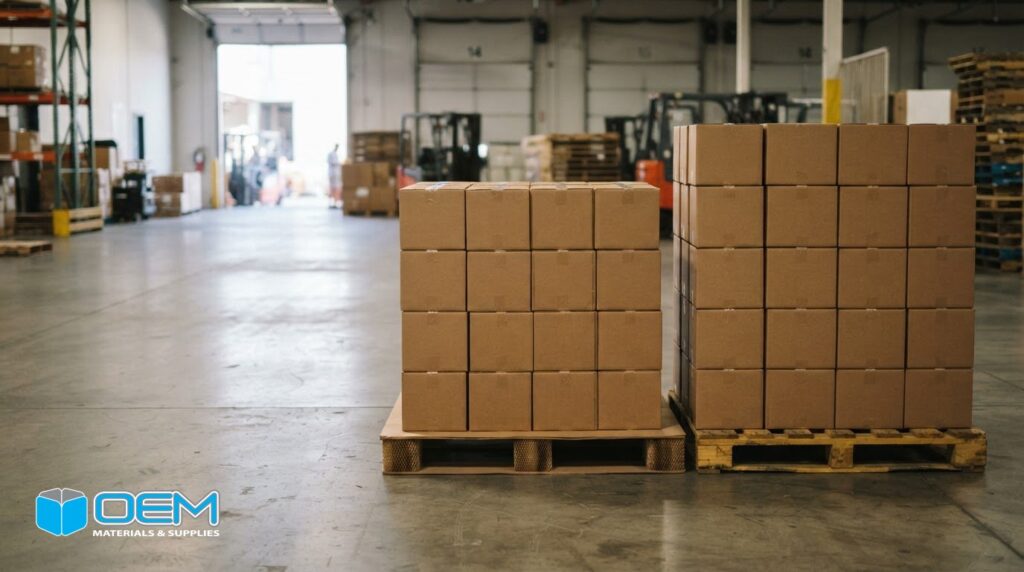
The lighter pallet isn’t automatically the better fit. In the honeycomb pallets vs wood pallets comparison, listed load capacities are 500-1500 kg for honeycomb and 1000-1500 kg for traditional wood, depending on design. The right choice depends on the load and whether the pallet must support it in static, dynamic, or racking conditions.
Both materials can support distribution, but their construction affects weight, handling, durability, and end-of-life options. Honeycomb pallets use a paper-based structure, while wood pallets are often suited to demanding, repeated handling.
This comparison shows how pallet construction affects load performance and where each option may fit. Design, moisture and impact exposure, and plans for reuse or recycling all help determine a practical choice for your operation.
Key Takeaways
- Compare pallet capacity against the load in static, dynamic, and racking conditions, including how the load is distributed.
- Account for pallet weight when planning shipments, but balance it against handling demands, impact exposure, and moisture conditions.
- Match pallet construction to the job: one-way distribution and repeat-use, high-abuse cycles can call for different designs.
- Plan for end of life alongside initial use by considering reuse cycles and how paper-based materials fit your recycling process.
- Use pallet design details, such as facings and runners, to address the demands of your handling equipment and load.
Why Are Honeycomb Paper Pallets the Future?
When shipping weight matters, honeycomb pallets vs wood pallets presents a clear distinction.
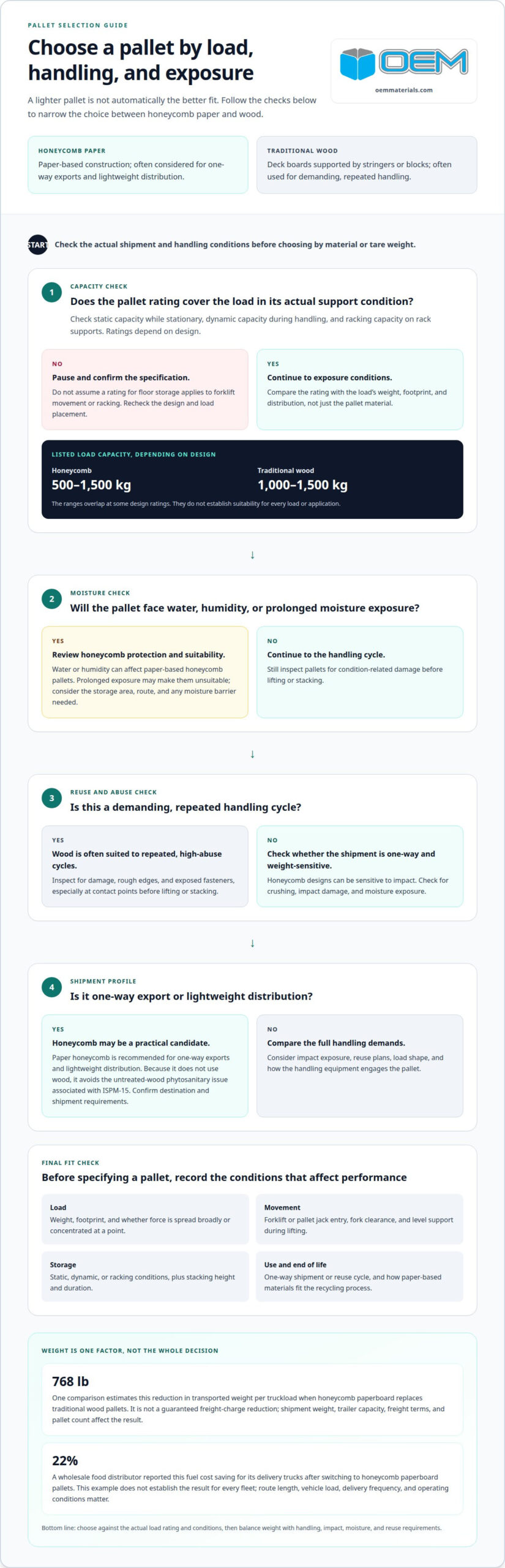
Across a truckload, lighter pallets can make a meaningful difference to transported weight. One comparison estimates a reduction of 768 pounds per truckload when honeycomb paperboard replaces traditional wood pallets. That is a freight-planning advantage, not a guaranteed reduction in freight charges. The actual effect depends on shipment weight, trailer capacity, freight terms, and how many pallets travel on each load.
Fuel use is another consideration. A wholesale food distributor reported a 22% fuel cost saving for its delivery trucks after switching to honeycomb paperboard pallets. That example shows why pallet tare weight can matter across repeated routes. It doesn’t establish the result for every fleet; route length, vehicle load, delivery frequency, and operating conditions also influence fuel use.
Honeycomb pallets are paper-based, so they avoid the untreated-wood phytosanitary issue associated with ISPM-15. Wooden export packaging may raise that issue, while honeycomb pallets don’t use wood. Exporters still need packaging suited to their destination and shipment requirements.
Wood pallets are built from lumber, typically deck boards supported by stringers or blocks and fastened together. The boards form the load surface, while the supports provide forklift openings. This familiar construction has different weight and handling characteristics from paper honeycomb designs.
Safe handling depends on the pallet’s condition and weight. Wood pallets can have rough edges or exposed fasteners, so inspect contact points before lifting or stacking. Honeycomb pallets resist splintering, but crews should still check for crushing, impact damage, and moisture exposure. Use equipment suited to the loaded pallet, and keep hands clear during forklift placement.
For Southern California operations comparing formats, pallet options can include plastic pallets alongside other packaging decisions. Compare loaded weight, handling conditions, and freight arrangements together. A lower tare weight matters most when it improves the shipment’s overall transport plan without compromising load support or safe handling.
Static, dynamic, and racking load specifications
A capacity rating is useful only when it matches how the pallet will carry its load. Compare load distribution and storage conditions before choosing a pallet.
Load Capacity and Compressive Strength
Static capacity is the load a pallet supports while stationary. Dynamic capacity applies during handling, and racking capacity applies when the pallet rests on rack supports. These ratings matter because a pallet may support a load on the floor but perform differently during forklift movement or rack storage.
Honeycomb pallets are listed at 500-1500 kilograms, depending on design; traditional wooden pallets are listed at 1000-1500 kilograms, depending on design. Honeycomb capacity can therefore overlap with wood at some design ratings, but not across every application. Compressive strength describes resistance to crushing under load. For an even, broad load, the honeycomb structure distributes force; concentrated weight can stress a smaller area. Confirm that the applicable rating covers the actual load condition and placement.
Load Stability and Handling Compatibility
Load stability is the pallet’s ability to support and position a product during lifting, movement, and storage. Shifting or unsupported loads can disrupt warehouse handling and put added stress on the pallet.
Forklifts and pallet jacks need clear entry points and adequate clearance beneath the load. Check how the equipment’s forks engage the runners or base and whether the load stays level during lifting. Wood is often used for demanding, repeated handling; honeycomb designs can be sensitive to impact. Plastic is another pallet option, but material alone does not establish capacity or compatibility.
With honeycomb pallets, concentrated point loads and impact can reduce performance even when the total load appears to be within the stated capacity. A machine foot or narrow crate runner, for example, concentrates force rather than spreading it across the deck. Use a broad, supportive load base where possible, and assess how the pallet will be lifted and set down.
Moisture can also affect load performance. Water or humidity can affect paper-based honeycomb pallets, so prolonged exposure may make them unsuitable for wet environments. Consider the storage area, route conditions, and any moisture barrier needed to protect the pallet. Inspect wood pallets for damage that could affect support, too.
For a practical comparison, record the load’s weight and footprint, then determine whether it will remain stationary, move by forklift or pallet jack, or rest on rack supports. Include stacking height and duration. These conditions influence the capacity and durability required. An evenly distributed load generally places different demands on a pallet than a compact, heavy item.
Honeycomb pallets can support 500-1500 kilograms, while traditional wooden pallets are listed at 1000-1500 kilograms, with both ranges depending on design. Compare the applicable static, dynamic, or racking rating against the actual load, not just the material.
Industrial, logistics, and construction applications
Pallet choice depends on the shipment route, handling cycle, and load shape. A one-way export shipment has different requirements from a pallet circulating repeatedly through a warehouse.
Single-Use and Reusable Applications
Single-use pallets suit shipments with no planned return cycle, while reusable pallets serve repeated transport loops. Paper honeycomb is recommended for one-way exports and lightweight distribution; wood often suits high-abuse, long-life return cycles. For example, a manufacturer shipping cartons to a customer can weigh reduced return handling against pallet durability. A closed-loop operation should plan for collection, inspection, and redeployment.
Customization for Different Uses
Customization adapts pallet dimensions and structure to the product, handling equipment, and shipping route. It matters when a standard footprint leaves products unsupported or fails to fit a conveyor or storage location. Honeycomb pallets can be tailored to business needs; a listed customizable dimension is 1200 mm x 1000 mm. Engineers can assess product footprint, support points, fork entry, and stacking requirements together.
In manufacturing, a pallet carrying packaged components must support their footprint and keep cartons stable as they move between production and shipping. A lightweight design may suit a one-way shipment, while a repeated internal loop calls for attention to impact and handling wear. Choose according to the actual route, not just the department or product category.
Logistics teams can compare pallet formats by mapping each handoff: packing line, warehouse staging, truck, and receiving dock. A pallet that works at the packing station still needs suitable fork access at the dock. Avoiding a return leg may simplify a one-way shipment; a return system requires a plan to recover pallets. Potential savings depend on product dimensions, materials, and shipping requirements.
Construction shipments need particular attention to how materials contact the deck. A long bundle or compact machine base can concentrate load differently from evenly placed cartons. Identify the support points and how forklifts will approach the load before choosing a pallet. For repeated site deliveries, durability and return logistics can matter more than the pallet’s empty weight.
Wood pallets remain useful when tough handling and repeated use are central requirements. Honeycomb can suit lighter, one-way distribution when its design matches the load and route. Plastic pallets may also suit return loops where repeated circulation is part of the operation. Compare the shipment path, product support, equipment access, and recovery plan before choosing a format.
Recyclability and end-of-life planning
Material choice affects what happens after a pallet completes its shipping cycle. Honeycomb paperboard pallets are described as 100% paper, recyclable, and biodegradable, while plastic pallets are recommended for reusable return systems.
Paper recyclability can simplify disposal after a one-way shipment, but the pallet’s condition and local recycling process matter. Keep a clean paper pallet separate from mixed packaging waste; a pallet with moisture damage or attached materials may need different handling. Set a disposal route before shipments arrive so warehouse staff know where used pallets belong.
Honeycomb paper pallets are recommended for one-way exports and lightweight distribution. For example, a shipper sending boxed components to a customer can plan for paper pallets to leave with the shipment rather than return to the origin. This can reduce return-handling steps, but the end-of-life plan still needs to match recycling options at the destination.
Biodegradability is a material property, not a complete disposal plan. Paper packaging still needs an appropriate end-of-life route; leaving it exposed in a yard does not ensure efficient recovery. In a warehouse, designate a dry collection area and separate paper pallets from plastic and wood formats. This helps prevent recyclable material from entering the wrong waste stream.
Reusable systems require a different calculation. Plastic or composite cores are recommended for return loops, where a pallet can travel back, be inspected, and re-enter circulation. The system needs a defined return path and a place to stage recovered pallets. If customers cannot return pallets reliably, the reuse plan may add handling rather than improve efficiency.
Wood pallets can serve high-abuse, long-life returnable cycles and have a listed lifespan of 3-5 years, potentially shorter in harsh conditions. End-of-life planning should account for condition: a damaged pallet may no longer be suitable for another trip, while serviceable pallets can continue in use. Include inspection and disposition steps in the same workflow as collection.
For a practical comparison, map a pallet’s full journey: shipment origin, receiving point, return route, and final disposition. A one-way paper shipment and a closed-loop plastic system have different handling requirements. Track the material, condition, and destination at each stage. This gives procurement and warehouse teams a clearer basis for assessing reuse, recycling, and disposal without treating recyclability alone as a measure of sustainability.
Honeycomb pallet designs
Honeycomb pallet performance starts with its internal structure. Bands of kraft paper are joined to form hexagonal cells, creating a core beneath the pallet’s facing layers. This design distributes load through connected cells rather than solid lumber boards. For packaging engineers, the key is matching the core, facings, and supports to the product and handling pattern.
Facings cover the honeycomb core and form the pallet’s top and bottom surfaces. Their thickness affects how the structure responds to handling and load pressure. A broad carton base spreads contact across more of the deck, while a narrow machine foot concentrates force. Reviewing the product’s support points helps identify where reinforcement may be needed.
Runners provide forklift clearance and support the deck. Their placement affects how the pallet meets forks, pallet jacks, and storage supports. For example, a load entering a warehouse by forklift and later moving by pallet jack needs suitable access from both directions. Include equipment entry and the route through the facility in the design review.
For heavy, repetitive forklift use, honeycomb designs can incorporate thicker facings, additional runners, or hybrid construction. Each option addresses a different structural demand. Thicker facings reinforce the deck; added runners provide more support; hybrid designs combine materials or structural elements. These are design choices, not automatic upgrades, so assess them against the load and handling cycle.
Honeycomb pallets are easy to handle and resist splintering. These advantages can matter at packing stations where workers position empty pallets or stage loads. However, the paper structure remains sensitive to moisture and impact. A design intended for a dry, controlled warehouse may not suit an exposed loading area with frequent wet conditions.
Wood pallets use boards and supports, while honeycomb designs rely on paper cells, facings, and runners. This difference affects repair and handling considerations. A damaged wooden board may create a rough edge or weaken support; crushed honeycomb cells can compromise the affected area. Inspect pallets before loading, and remove units with visible structural damage from service.
Use a design review to match packaging requirements to the operating environment. Start with the product footprint and contact points, then consider load distribution, fork entry, storage supports, and moisture exposure. Add reinforcement when the application involves heavy, repetitive forklift handling. Choose a structure that fits the load and route, rather than selecting by material name alone.
OEM Materials & Supplies: Corrugated Boxes
OEM Materials & Supplies provides corrugated boxes and related packaging materials to support products within your chosen pallet system. These options are useful when the pallet decision also calls for better product protection, such as cushioning for delicate components or a packaging kit that organizes multiple items for shipment.
For example, corrugated boxes can contain products on a pallet, while foam packaging or cushioning materials can protect vulnerable surfaces during transport. Mailing tubes and cores suit products that need a tubular format. The right combination depends on product dimensions, weight, and shipping requirements.
Contact OEM Materials & Supplies for help aligning packaging materials with your shipping needs, or visit oemmaterials.com.
Turn Pallet Selection Into a Packaging Plan
Make the next step practical: document product dimensions, loaded weight, handling equipment, storage conditions, and shipment route. Use these details to assess honeycomb pallets vs wood pallets alongside the packaging that protects the product. Consider the full unit load, not just the pallet.
OEM Materials & Supplies provides corrugated boxes, foam packaging, and packaging kits to contain and protect products. These options can coordinate the box, cushioning, and pallet into a shipping configuration suited to the product and its shipping requirements.
Bring your load and packaging requirements together before making a change. Contact OEM Materials & Supplies to discuss your packaging needs and identify a practical next step for your operation.
Frequently Asked Questions
How Honeycomb Pallets Address Sustainability Challenges?
Honeycomb pallets can support a sustainability strategy when their material and end-of-life route align with company goals. Define what the operation aims to improve, such as reducing packaging waste or simplifying outbound handling. Then compare pallet options using the same product, route, and packaging configuration. This offers a more useful evaluation than assuming one material is sustainable in every application.
Why Traditional Wooden Pallets Are No Longer Enough?
Wood pallets are not inadequate for every operation; they may simply be a poor fit for a particular product or shipping process. A warehouse standard based on one format can cause problems if a new product has different support needs or packaging dimensions. Review product families separately before making a broad change. A targeted adjustment can address a specific operational issue without disrupting established workflows elsewhere.
What are honeycomb paper pallets made of, and how are they constructed?
Honeycomb paper pallets are made from kraft paper formed into cells and assembled into a pallet structure. For purchasing and engineering teams, the next step is to document the finished pallet’s footprint, fork-entry orientation, and contact area with the packaged product. These details clarify how the pallet should interface with equipment and packaging. Include them in the specification so receiving and production teams work to the same design.
What are typical prices for honeycomb and wood pallets in the United States?
Price depends on the project and is provided after a quote request. Relevant cost factors include pallet dimensions, material, design requirements, order quantity, delivery, and intended reuse cycle. Compare equivalent performance requirements rather than a basic pallet with a reinforced design. This keeps the evaluation focused on formats that can serve the same shipment and operating purpose.
How do honeycomb and wood pallets compare in weight, handling, and shipping costs?
Compare pallet formats using the same shipment profile and freight quote assumptions. Record pallet count, loaded shipment weight, packaging dimensions, route, and handling requirements for each option. Review those inputs alongside carrier terms and the operation’s handling process. This helps distinguish pallet-related changes from other shipment variables, such as a different load configuration or packing arrangement, when evaluating freight results.
Are honeycomb pallets recyclable, reusable, or biodegradable compared with wood pallets?
Honeycomb paper pallets are recyclable and biodegradable, while wood pallets can be used in reuse programs. For a useful operational comparison, define how each site classifies used pallets and records their disposition. Receiving locations may handle packaging differently from shipping facilities. Documenting the intended route for each material helps sustainability teams compare outcomes consistently across locations without relying on assumptions about what happens after delivery.
What are the moisture, weather, and durability limitations of honeycomb pallets?
Honeycomb pallets are vulnerable to prolonged moisture exposure, which can affect their suitability in wet or humid conditions. Include the expected storage and transfer environment in the packaging specification, including exposure during staging and delivery. Operations teams can also set a visual acceptance standard for incoming pallets so damaged units are identified before loading. This makes handling decisions repeatable across shifts and receiving teams.
Which industries and types of shipments are best suited to honeycomb versus wood pallets?
No industry label alone determines the right pallet; shipment requirements and receiving processes matter more. An aerospace parts shipment, for example, may need packaging coordinated with the product’s shape and handling sequence, while another shipment from the same sector may have different requirements. For operations in Orange County, Los Angeles, San Diego, and Riverside, consistent specifications help teams compare needs across sites without assuming one format fits every product.