
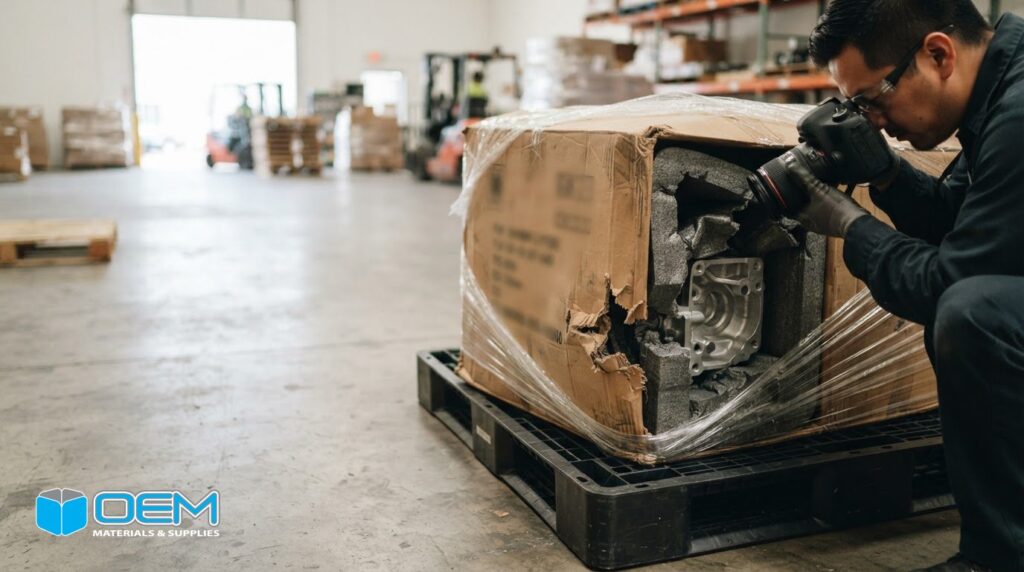
Visible damage is only the starting point. Root cause analysis for shipping damage identifies the condition that, if removed, would have prevented the loss, then tests that suspected cause against evidence from each logistics handoff. The goal is a corrective action that prevents recurrence, not just a record of what arrived damaged.
A damaged load may point to weak packaging, an unstable pallet, a handling problem, or inadequate securement. The challenge is separating the root cause from contributing factors, especially when freight passes through multiple teams and transport modes.
This article explains how to define the problem, preserve photographs and freight records, and reconstruct what happened from loading through delivery. You’ll also learn how fishbone diagrams and Five Whys organize possible causes, how to validate corrective actions, and how to trace recurring damage across routes, facilities, and logistics partners.
Key Takeaways
- Build a timestamped record of freight condition, handling events, and damage evidence so the investigation can follow the load across each handoff.
- Separate the root cause from contributing factors by defining the failure clearly and testing plausible explanations against what happened.
- Use a fishbone diagram to organize possible causes across people, equipment, materials, processes, measurement, and the shipping environment.
- Turn corrective actions into owned tasks with deadlines, then monitor the same failure mode to determine whether it recurs.
- Compare damage patterns across products, routes, facilities, and transport modes to find network-level causes that a single shipment review may miss.
How should evidence chain of custody be documented for damaged freight?
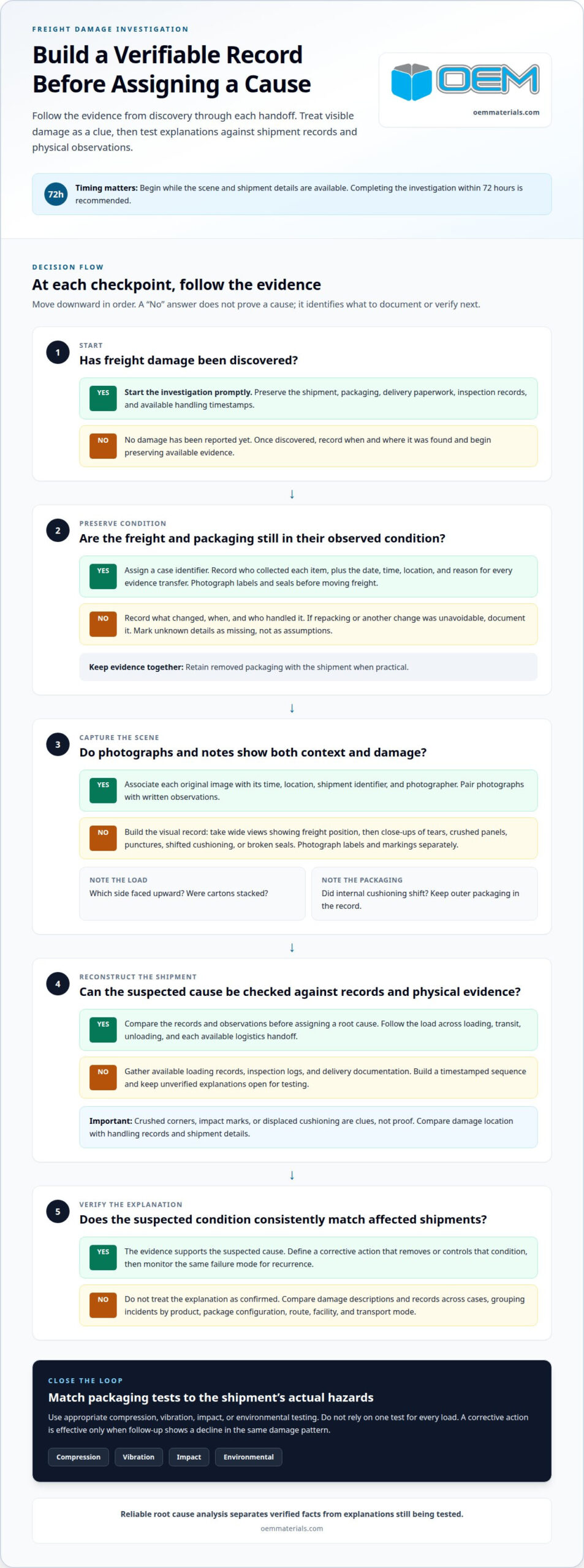
Document each handoff, observation, and evidence transfer so investigators can distinguish the damage event from later handling. Packaging tests should reflect the shipment’s actual hazards. Use appropriate compression, vibration, impact, or environmental testing rather than relying on one test for every load.
Gathering Evidence for Root Cause Verification
Evidence gathering means collecting shipment records and physical observations to test a suspected cause. It matters because a crushed corner alone cannot show whether damage began during packing, loading, transit, or unloading. In the cargo damage report, record freight identifiers, product and packaging condition, damage type, and potential causes. Build a timestamped sequence from available loading records, inspection logs, and delivery documentation. Compare those records with physical evidence before assigning a root cause.
Preserving Evidence and Chain of Custody
Evidence preservation means keeping damaged freight, packaging, and records available in their observed condition while documenting every transfer. This protects the investigation from gaps that could make a cause difficult to verify. Assign a case identifier, record who collected each item, and note the date, time, location, and reason for each transfer. Photograph labels and seals before moving freight. Keep removed packaging with the shipment when practical, and document unavoidable changes, such as repacking for safe storage.
In the United States, according to the Electronic Code of Federal Regulations, federal requirements in 49 CFR Part 396 address inspection, repair, and maintenance of commercial motor vehicles. This concerns vehicle inspections and maintenance, so it should not be treated as proof of a packaging failure.
Documenting Damage with Photographs
Photographic documentation creates a visual record of the load, packaging, and damage when discovered. It helps investigators compare visible conditions with shipment records and accounts from each handoff. Start with wide views that show the freight’s position, then take close-ups of tears, crushed panels, punctures, displaced cushioning, or broken seals. Photograph labels and package markings separately. Preserve the original image files and associate each image with its time, location, shipment identifier, and photographer.
Pair photographs with written notes. Record which side of the package faced upward, whether cartons were stacked, and whether internal cushioning shifted. A photo of a damaged product without its outer packaging may leave important evidence out.
Late Reporting and Lost Evidence
Late reporting is a delay between discovering damage and beginning the investigation. Delay can weaken the evidence record because freight may be moved, packaging discarded, or the loading area cleared. Start the investigation while the scene and shipment details remain available; completing it within 72 hours is recommended. Ask operations to preserve the shipment, packaging, delivery paperwork, inspection records, and available handling timestamps.
If evidence has already changed, document what changed, when, and who handled it. Mark unknown details as missing rather than filling gaps with assumptions. This helps separate verified facts from explanations that still need testing.
How Should Cargo Damage and Securement Failures Be Investigated?
For recurring incidents, compare claim patterns with shipment conditions, then test the most likely failure source. A corrective action is effective only if follow-up shows a decline in the same damage pattern.
Packaging failure becomes more plausible when damage aligns with crushed panels, punctures, or displaced cushioning; handling damage may leave impact marks or shifted loads. Treat these as clues, not proof, and compare them with loading records and damage location.
Calculate a damage rate by dividing damaged shipments by total shipments, then multiplying by 100. Estimate damage cost by totaling documented product loss, replacement freight, inspection, rework, and disposal expenses.
Tracing Recurring Damage and Defects
Root cause analysis for shipping damage connects repeated defects to a condition that can be removed or controlled. Replacing damaged goods alone leaves the failure in place.
Group incidents by product, package configuration, route, facility, and transport mode. For example, repeated corner crush on one lane may point to a loading pattern or handling condition rather than a product-wide defect. Compare damage descriptions and shipment records across cases. Then test whether the suspected condition consistently appears in affected shipments and is absent from undamaged ones.
Track the same failure mode after a corrective action. A reported pattern states that 57% of cargo damage incidents repeat within 90 days when no formal root cause analysis is performed. Full root cause analysis is associated with a 3.4-fold lower recurrence rate.
Using Claims to Identify Recurring Risks
Claim history is a structured record of damage types, products, routes, and shipment outcomes. Reviewing these fields helps operations detect recurring risks that isolated claim reviews can miss.
Standardize claim descriptions before comparing them. Separate crushed cartons from punctures, moisture exposure, and product movement inside packaging. Then group claims by customer, product family, origin, destination, and carrier. A concentration of one damage type on a specific route is a pattern to investigate, not automatic proof of carrier fault. Compare affected loads with shipment details and handling records to identify a plausible source.
Applying Pareto Analysis to Incidents
Pareto analysis ranks recurring failure categories by frequency or impact. It helps teams focus investigation resources on causes linked to the greatest share of incidents.
Choose a consistent review period, classify each claim, and count incidents or calculate documented impact. Sort categories from highest to lowest, then chart their cumulative contribution. If three failure modes account for most recorded cases, investigate those first rather than dividing effort evenly. Recheck the ranking after corrective actions, since a change in shipment mix can shift which problems dominate claim history.
Distinguishing Packaging and Handling Damage
Compare damage location and packaging condition with the shipment’s handling sequence. This matters because a packaging change will not correct a repeated loading or transfer failure.
Look for matching evidence across the product, inner protection, and outer packaging. A damaged product with intact outer packaging may indicate inadequate internal restraint; crushed packaging with aligned product damage may point to compression or impact. Check load orientation, stacking, and securement records for the shipment. No single mark establishes the source, so compare several incidents before assigning a cause or changing the corrective action.
Fishbone diagrams
A fishbone diagram organizes possible causes around a defined damage event. Common causes include inadequate packaging, unstable loads, handling impacts, and cargo shifting; the actual source depends on shipment evidence.
Mapping Potential Causes with Fishbone Diagrams
A fishbone diagram maps potential causes into branches leading to one clearly stated problem. This structure matters because shipping damage can involve several connected conditions, not one obvious failure.
Write a precise effect at the diagram’s head, such as “component arrived with a cracked housing.” Add branches for six categories: people, equipment, material, process, measurement, and environment. Under material, the team might list insufficient cushioning. Under process, it might note inconsistent loading instructions. These are candidates, not confirmed causes.
Use evidence from the specific shipment to decide which branches deserve investigation. For example, a displaced load may prompt a review of pallet stability, load gaps, and securement steps. Record each possibility separately so an assumption does not become the accepted cause through repetition.
Pairing Fishbone Diagrams with Why Questions
Repeated why questions examine a candidate cause beneath the fishbone’s broad categories. This pairing is useful because the diagram shows where to investigate, while each answer helps reveal the underlying condition.
For example, a branch may identify insufficient internal restraint. Ask why the product moved, then why the selected restraint allowed movement. Continue until the answer identifies a controllable process or design condition. Five Whys describes the technique, but the number of iterations is flexible. A fishbone review recommends asking why a candidate cause occurred at least three more times.
Keep each answer tied to evidence. If operators report inconsistent instructions, compare the documented packing process with actual practice. If the explanation cannot be supported, retain it as a hypothesis rather than confirming it as the cause.
Identifying Common Shipping Damage Causes
Common cause categories include people, equipment, materials, process, measurement, and environment. Reviewing all six helps teams avoid blaming one handler before examining how the shipment was prepared and moved.
Under people, consider whether roles or instructions were unclear. Equipment may include a damaged handling device; material may include packaging that does not restrain the product. Process causes can include an inconsistent loading sequence. Measurement causes may involve missing checks, while environmental conditions can affect cargo or packaging. Each example needs support from the specific shipment.
Use the diagram to distinguish a direct cause from contributing conditions. A stable pallet can still shift if a gap remains between loads. A secure outer unit can still allow product movement inside. Connect each branch to observed damage, records, or a repeatable test. Then select the strongest candidate to validate in the next stage of the investigation.
Implementing and validating corrective actions
Corrective actions must address the verified cause, not just the visible damage. Record each action, its owner, deadline, and completion evidence, then track the same failure mode after implementation.
Planning Corrective and Preventive Actions
A corrective action removes or controls a cause already linked to damage; a preventive action addresses similar risks elsewhere. Separating these purposes helps teams fix the affected process without overlooking related shipments.
For example, if a confirmed packing method allows a component to shift, revise the method and define how the change will be applied. A preventive action could extend the revised instruction to comparable products or lanes. State the expected effect in observable terms, such as reduced product movement or fewer reports of the same damage mode. Link each action to the evidence and cause it addresses.
Assigning Action Owners and Deadlines
Ownership assigns responsibility for completing and documenting an action; a deadline sets when the work is due. Both matter because an unassigned recommendation can remain in a report without changing operations.
Name the responsible person or role, specify the deliverable, and record the due date. For a loading-process change, the deliverable might be a revised work instruction and a completed briefing record. Assign separate owners if implementation and verification require different expertise. Escalate overdue tasks through the team’s normal review process, and document the reason for any revised deadline.
Verifying Corrective Actions
Verification checks whether an action was completed and whether the targeted failure recurs less often. A closed task does not, by itself, prove that shipment performance changed.
Define the failure mode and review period before implementation. Then compare subsequent shipment records with the earlier pattern, using consistent product, route, and damage categories. Check completion evidence, such as the revised instruction, alongside claim and inspection records. If the same damage continues, reopen the analysis and test whether the original cause was incomplete or another factor remains active.
Digital tools can keep corrective actions visible between review meetings. A shared task tracker can store the incident reference, cause, action, owner, due date, status, and supporting records. Use status fields for open, in progress, and completed, and attach proof such as an updated procedure or inspection result. A spreadsheet can serve the same purpose if it preserves ownership and changes over time.
Review open actions on a set team schedule and use timestamps to identify delays. Keep action records separate from incident narratives, but link them through the same case identifier. This lets operations trace each decision from the verified cause to implementation and follow-up results.
Root cause analysis across logistics networks
A logistics-network investigation follows freight across facilities, carriers, and transport modes. It can reveal failure points hidden between individual handoffs, where packaging, loading, and securement practices interact.
Build one event sequence from origin packing through final receipt. Link each record to the shipment identifier, location, timestamp, transport mode, and observed condition. Include loading instructions, transfer records, inspection notes, and delivery findings. A route map can show where freight was consolidated, reloaded, or transferred between truck, rail, and intermodal equipment. Compare the sequence with the damage location and type. The finding should explain how the observed condition developed, not simply where damage first appeared.
Interview the driver, loader, and receiving inspector separately before their accounts can influence one another. Ask each person to describe the load’s condition, securement, and handling at their own touchpoint. Compare their accounts with records and physical evidence. For example, a driver may report a stable load at departure, while the receiving inspector finds shifted cargo. That difference directs attention to intervening transfers, load gaps, or securement changes.
Small gaps can matter across a long route, particularly in rail or intermodal shipments, where repeated movement may shift cargo. Review how freight was built, wrapped, loaded, gapped, and secured on recurring lanes. Check whether heavier goods sat low, pallet loads remained stable, and voids were addressed. Stretch wrap can maintain unit integrity, but it does not reliably fill large voids or prevent major side-to-side movement on its own.
Dunnage air bags also need an application-specific review. An undersized bag may slip or underperform; an oversized bag may be difficult to position and may not contact the load as intended. Consider the void shape, cargo weight, surface, and handling exposure. Then examine placement and inflation records. A bag cannot compensate for an unstable pallet, so assess unit stability and trailer-level securement separately.
When a lane repeats the same failure, compare affected shipments with undamaged loads on that route. Look for common origins, transfer points, loading patterns, packaging configurations, and transport conditions. Apply corrective actions to the responsible process, then monitor the same failure mode across comparable shipments. Compare incident counts with shipment counts so route volume does not distort the results.
For packaging-related findings, align the corrective action with the actual product and shipping conditions. Share shipment and packaging details for a quote when a packaging change is part of the network response. Include product dimensions, weight, route conditions, and damage evidence to support a relevant recommendation.
OEM Materials & Supplies
OEM Materials & Supplies can support packaging changes identified through a cargo damage investigation. When evidence points to inadequate cushioning, product movement, or a mismatch between the package and shipping conditions, corrugated boxes, foam packaging, or packaging kits may be relevant. The right configuration depends on the product, its dimensions and weight, and how it moves through the logistics network.
Bring the damage pattern and shipment details to the packaging discussion. Product dimensions, weight, current packaging, and transport conditions help clarify what needs to change. A recurring failure may call for a different package configuration, while findings about handling or securement may require action elsewhere in the logistics process.
Contact OEM Materials & Supplies to discuss packaging needs related to your investigation.
Make the Next Packaging Change Evidence-Based
Use the investigation’s findings to guide your next packaging decision. Any change should address a demonstrated failure mode and fit the product’s dimensions, weight, and shipping conditions. This keeps the response tied to the actual shipment rather than a generic adjustment.
When packaging is part of the corrective action, OEM Materials & Supplies can help evaluate options such as corrugated boxes, foam packaging, and packaging kits. The right configuration depends on the product and how it moves through your logistics network. Clear shipment details help focus the discussion.
For a practical next step, share the product dimensions, weight, current packaging, and damage pattern with OEM Materials & Supplies. Request a packaging quote to discuss an evidence-based change. A disciplined root cause analysis for shipping damage can turn a recurring failure into a clearer packaging decision and a stronger process moving forward.
Frequently Asked Questions
How Can Investigators Move Beyond Weak Findings?
Turn broad statements into claims with a clear test and observable result. “Handling caused the damage” is too general to guide a process change. Specify the handling condition, such as a pallet position that repeatedly exposes one carton edge, then identify what record or trial could support or reject the explanation. A strong finding also states what evidence would disprove it, so teams do not mistake an early assumption for a final answer.
How Should RCA Findings Be Extended Across a Logistics Network?
Extend a finding by checking whether another site shares the same causal condition, not just the same damage label. A packaging instruction used at two warehouses may transfer directly; a different conveyor layout may require its own control. Record where the finding applies, where it does not, and who owns each local change. This prevents teams from copying a corrective action across a network without accounting for operational differences.
How Should RCA Investigators Map the End-to-End Logistics Process?
Make the process map useful by showing decision points as well as physical movement. Mark where a team selects packaging, releases a load, changes its configuration, or accepts freight after a transfer. Add the record or system entry associated with each decision. For example, a packaging revision field can distinguish shipments prepared under different configurations. This makes process changes and handoff responsibilities easier to examine.
What Evidence Should Be Preserved for Warehouse and Transportation RCA?
Preserve records showing how warehouse and transport conditions varied between shipments. Useful examples include pick locations, pallet positions within a load, loading sequence, handling-equipment assignment, and package revision. Retain the related operating instructions and records showing when they changed. These details can reveal whether damage aligns with a particular configuration or operating condition, even when claim descriptions appear similar.
When Should Supplier Packaging Design Be Included in a Logistics RCA?
Include packaging design in the investigation when there is a mismatch between product geometry, internal restraint, and the forces or movement observed in transit. Supplier input can also help when the current design’s assumptions differ from actual shipping conditions, such as a change in stacking orientation or load configuration. Share representative damaged and undamaged examples, along with product and packaging revisions, to focus design review on the observed difference.
What Is Root Cause Analysis for Shipping Damage?
Root cause analysis for shipping damage is a structured way to turn a damage incident into a supported explanation and targeted process response. Its practical value lies in connecting a specific failure condition to a decision about what to change. The analysis should leave operations with a usable record of the finding, supporting evidence, action taken, and measure used to assess the result.
How to Investigate and Document Shipping Damage Step by Step?
Keep one case file linking the claim, shipment, product version, package revision, and investigation outcome. Separate confirmed observations from working theories, and record why each theory was retained or ruled out. Before closing the case, make sure the assigned action changes the relevant work instruction or control, where appropriate. This creates a useful reference for a later incident involving the same product or process.
What Data and Evidence Are Needed for a Shipping Damage Root Cause Analysis?
Include comparison data that helps distinguish a one-off event from a process pattern. Product family, production lot, package revision, order type, pallet position, and shipment route can help define meaningful groups. Keep records in a form that preserves these relationships, rather than storing photographs or claim notes without shipment context. Investigators can then compare similar shipments and avoid conclusions based on cases with materially different conditions.