
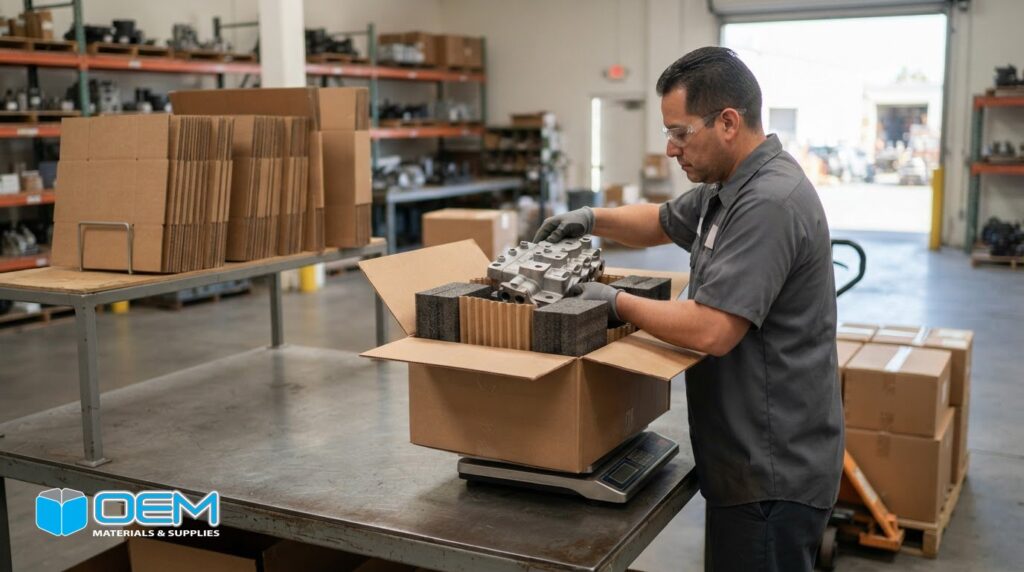
A packaging supply chain resilience plan turns disruption from an emergency into a managed operating risk. Supply chain resilience means being able to respond to disruptions and recover while limiting effects on operations and customer commitments. Packaging belongs in that plan because shortages, material substitutions, or inadequate product protection can affect fulfillment as well as production.
A packaging supply chain resilience plan takes more than keeping extra inventory or reacting when a shipment is delayed. It gives you a clear view of vulnerable materials, supplier dependencies, regional exposure, and the packaging needed to protect products in transit. A practical plan balances operational flexibility with efficiency, so backup options support continuity without adding unnecessary complexity.
This article explains how scenario planning can prepare your team for changing demand, supplier instability, and pricing pressure. It covers supplier diversification, regional and cross-border risks, and packaging decisions that can protect goods and keep distribution moving. The goal is a structured approach your purchasing, operations, and warehouse teams can use to identify risks and plan workable responses.
Key Takeaways
- Map how packaging materials move through sourcing, production, storage, and distribution to identify where a disruption could affect operations.
- Use immediate, near-term, and long-term scenarios to prepare responses to demand shifts, supplier instability, and inventory pressure.
- Build supplier redundancy by assessing raw-material dependencies, backup capacity, and options for substituting packaging materials.
- Account for regional sourcing exposure and destination-specific requirements when planning domestic and cross-border shipments.
- Review packaging choices for their role in product protection, handling efficiency, and continuity when preferred materials are unavailable.
1. What is Supply Chain Resilience, and How Can It Help You?
Supply chain resilience is the ability to respond to disruptions and recover while limiting operational and customer impacts. Packaging logistics links material sourcing, product protection, warehouse handling, transport, and delivery. A shortage of one box size, for example, can interrupt packing even when finished goods and labor are available. A packaging supply chain resilience plan maps these dependencies so teams can spot weak points and act proactively.
To assess packaging supply chain risks and vulnerabilities, map each material from supplier through production, storage, and shipment. Identify single-source items, long replenishment dependencies, demand changes, and packaging failures that could delay orders. For example, compare a fragile component’s damage history and protective packaging requirements with the capacity available at each packing location. This assessment brings supplier capability, inventory exposure, and logistics constraints into one view.
Assess supplier capability alongside cost and logistics, rather than treating them as separate purchasing decisions. Document which materials each supplier can provide, the volumes required, and the routes those materials follow. A backup source is useful only if its material suits the product and packing process. For a component shipped from Southern California, consider how box dimensions, cushioning needs, and transport routes affect handling, storage, and delivery.
Visibility tools make dependencies easier to track. Shared inventory and order records can show material availability and purchasing activity. Digital packaging features, such as QR codes or RFID, can connect package-level information with shipment workflows. Choose tools that capture the data teams need, such as item identity, location, or movement status. Clear records help procurement and warehouse teams spot emerging shortages and coordinate responses across their networks.
Packaging design affects both product protection and logistics efficiency. Review product dimensions, cushioning, package size, and pallet arrangement together, since a change in one can affect storage and transport. For e-commerce orders, packaging must protect goods through parcel handling; for reverse logistics, it should also support returns and inspection. A defined foam packaging design can help protect delicate items, while packaging kits can standardize components used at different packing stations.
Packaging can account for 10-40% of total logistics cost, depending on industry. Resilience strategies can require added inventory, alternate materials, or package redesign, while reducing disruption exposure and damage-related handling. Assess costs against product dimensions, materials, shipping requirements, warehouse space, and labor. Packaging changes should also be tested against actual handling and transport conditions, so protection and operational fit guide the decision rather than material cost alone.
2. Scenario planning and risk-management frameworks
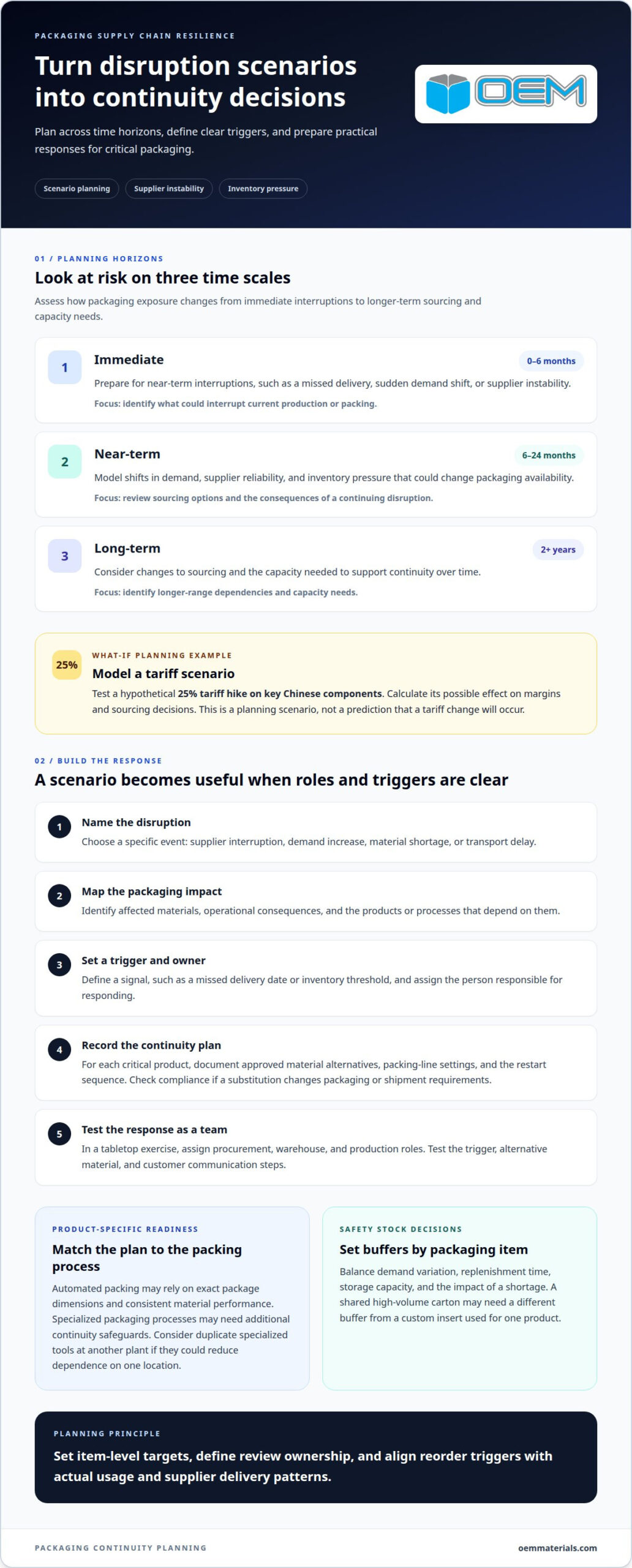
Scenario planning turns uncertainty into specific decisions for supply chain management, production, and procurement. Start with a disruption, such as a supplier interruption, demand increase, material shortage, or transport delay. For each scenario, identify the affected packaging, likely operational consequences, and the person responsible for the response. Define trigger points, such as a missed delivery date or inventory threshold, so teams can act before production runs short.
Assess exposure across immediate, near-term, and long-term horizons: 0-6 months, 6-24 months, and 2+ years. Near-term scenarios might include a sudden demand shift or supplier instability; longer horizons can address sourcing changes and capacity needs. Model a 25% tariff hike on key Chinese components as a what-if exercise, then calculate its possible effect on margins and sourcing decisions. This is a planning scenario, not an assumption that a tariff change will occur.
Product-specific continuity plans should reflect how packaging interacts with the product and production process. An automated packing line may depend on exact package dimensions and consistent material performance, while modified-atmosphere packaging requires additional continuity safeguards. Record approved material alternatives, line settings, and the restart sequence for each critical product. If specialized packaging tools support production, consider whether duplicate tools at another plant could reduce dependence on one location.
Safety stock decisions should balance demand variation, replenishment time, storage capacity, and the impact of a shortage. Set stock targets by packaging item instead of applying one blanket buffer to every material. A high-volume carton used across several product lines may need a different buffer from a custom insert used for one product. Define who reviews stock levels and when, then align reorder triggers with actual usage and supplier delivery patterns.
Bottleneck planning focuses on materials that can stop work, not just items with the highest spend. Trace how a shortage of one insert, label, or box could affect production schedules, finished-goods storage, and customer orders. In a tabletop exercise, assign procurement, warehouse, and production roles, then test the trigger, alternative material, and customer communication steps. Include compliance checks if a substitution changes packaging or shipment requirements. Record gaps, assign owners and deadlines, then repeat the exercise after a major process or sourcing change.
Assign owners and revisit responsibilities as conditions change. Nearly two-thirds of companies were delayed in responding to supplier risk events because they lacked a comprehensive risk-management framework. Resilience planning balances flexibility and efficiency as global businesses extend their supply sources and networks. Supply chains should be able to adapt operations quickly and efficiently to manage disruptions and anticipate them, reducing their impact.
Organizations can assess supply chain exposure by identifying vulnerable categories, supplier concentration, and products that need long-term sourcing strategies. Procurement leaders can focus on the categories most likely to be affected if market conditions shift.
3. Supplier diversification and operational resilience
Supplier diversification reduces dependence on one source, but adding vendors alone does not create resilience. Map each critical packaging material to its suppliers, production locations, and upstream raw-material dependencies. Two Tier 1 suppliers may share the same Tier 2 source, leaving the same vulnerability beneath separate purchase orders. For example, trace the inputs behind a protective insert before treating another supplier as independent coverage.
Multi-sourcing works best when alternative suppliers can provide materials that meet product and process requirements. Document approved material options, dimensional needs, performance criteria, and any production adjustments required. Qualify alternatives before a shortage forces an urgent substitution. A packaging continuity plan should also consider qualifying multiple raw materials from different suppliers, with substitutions reviewed for regulatory implications before adoption.
Capacity matters as much as the number of suppliers. Establish the required backup volume and service expectations, then determine whether an alternative source can meet them during an interruption. Compare normal demand with the volume needed to maintain essential production, and document allocation priorities if capacity is constrained. A backup supplier with limited open capacity may not cover a sudden increase in orders or a prolonged outage.
Material flexibility can strengthen sourcing options, but alternatives must work in the actual packaging design. Assess whether different cushioning, box construction, or packaging kits can protect the same product and fit existing packing operations. More material options can reduce dependence on a single specification, but uncontrolled variation can complicate purchasing and warehouse handling. Keep approved substitutions clear in product and procurement records.
Operational resilience also depends on collaboration and visibility. Deloitte reports that 61% of chief procurement officers view increasing supplier collaboration as a top priority. Share demand forecasts and expected changes with suppliers so capacity and material constraints surface earlier. Track delivery performance, order status, and recurring quality issues using consistent records. For each critical item, assign an owner to review sourcing exposure and update the continuity response when supplier capabilities or production needs change.
Finally, test the sourcing plan against a realistic interruption, such as a primary supplier outage, raw-material constraint, or demand surge. Confirm who activates the alternative source, which approved material can replace the preferred option, and how procurement communicates the change to production and warehouse teams. Record and resolve gaps before the next disruption. This makes diversification an operating process, not just a supplier list.
4. U.S. manufacturing and cross-border supply risks
U.S. manufacturers face packaging exposure from changing trade conditions, regional events, and global material networks. A facility in Southern California might depend on paperboard sourced from another region, imported components, or transport routes affected by disruption. Map each critical material’s origin, route, and production dependency. This helps distinguish a local interruption from a wider sourcing constraint and plan alternative supply paths.
Climate and geopolitical scenarios should reflect the locations and routes in your actual supply network. For example, a Southern California operation can model how a wildfire-related closure or regional transport interruption affects inbound packaging and outbound shipments. A separate scenario can test geopolitical instability affecting an overseas raw-material source. For each case, identify the affected material, likely bottleneck, and operational response, then note which decisions protect manufacturing continuity.
Review trade exposure separately. Before accepting a packaging cost increase, verify relevant tariffs and countries of origin. A U.S.-based supplier may still source resins, additives, or other inputs overseas, so the supplier’s location alone does not show the full dependency. Record the country of origin and upstream sourcing information for critical materials. This helps procurement assess changing trade conditions without assuming domestic purchasing removes global exposure.
Paperboard sourcing also deserves attention when a package depends on a single mill, grade, or supply route. European paperboard capacity is around 14 million tonnes. Five new paperboard mills are expected globally in the next five years, and four of those five are located in the Far East and the Americas. These figures describe global capacity context, not a guarantee that a specific U.S. buyer can access substitute material. Map approved grades and alternate sources before a supply interruption.
Packaging regulations and sustainability requirements affect U.S. resilience planning because they can shape material choices, package design, and shipment readiness. Account for requirements that apply to the goods and destination, especially for international shipments, where noncompliant packages may be held at customs. Sustainability planning can also include waste reduction, sourcing transparency, customer expectations, recycled materials, and relevant state EPR laws.
Build these checks into routine purchasing decisions. When a packaging quote changes, compare its origin, applicable tariffs, material specification, and transport route before revising the supply plan. When a substitute is proposed, assess how it fits product protection, manufacturing efficiency, and shipment expectations. For teams in Orange County, Los Angeles, San Diego, and Riverside, documenting these decision points supports consistent responses as global conditions change.
5. Packaging’s role in supply chain resilience
Packaging is an operational control, not simply a container added after production. It protects goods during manufacturing, storage, handling, and transport, when impact or compression can cause damage. A fragile electronic assembly, for example, needs packaging matched to its shape and handling route. If protection fails, replacement work and delayed delivery can affect production schedules and customer commitments.
Start by matching package design to the product and distribution environment. Review product dimensions, weight, fragility, handling steps, and transport conditions, then assess how the package performs at each stage. Advanced protective packaging can reduce transit damage by 30-60%. That range shows the potential value of protection, but the right design depends on the item and its shipping conditions.
Package geometry also affects warehouse and transport efficiency. Lightweight, space-optimized packaging improves pallet utilization by 15-25%, helping teams use available pallet space more effectively. For a mixed shipment, consistent package footprints can simplify stacking and handling. Design decisions should account for product protection as well as storage space, pallet patterns, and the equipment used to move loads.
Packaging innovation can support faster, more consistent operations when the design fits the process. Automation-ready packaging reduces handling time by 20-35%. Teams should assess how package dimensions, closures, and presentation interact with their equipment. A package that protects a product but jams a packing line can create a different bottleneck. Test design changes in the relevant workflow before adopting them across production.
Visibility technologies can add shipment information to packaging workflows. RFID- and IoT-enabled packaging can improve tracking accuracy to 95-99%. QR codes can also connect a package to digital information through scanning. These tools are useful when teams need to associate a package with movement or product data. Select technologies based on the operational question they need to answer, rather than adding features without a defined purpose.
Environmental goals belong in the same design review as protection and efficiency. Reducing excess material can support waste objectives, but a lighter package must still protect goods through the actual distribution route. Compare material use, damage exposure, and pallet fit together. The measure of success is a package that performs for the product, process, and environment without creating avoidable handling steps. To evaluate a packaging design for your product, request a packaging quote with its dimensions, weight, and shipping requirements.
OEM Materials & Supplies
OEM Materials & Supplies can support packaging continuity with corrugated boxes, foam packaging, packaging kits, and mailing tubes and cores. These options can help address needs such as protecting products in transit, standardizing packing components, or selecting suitable formats for different shipments.
Turn to OEM Materials & Supplies when packaging availability or product protection needs a closer review. Sharing product dimensions, weight, shipping conditions, and expected usage helps define the application and guide a practical packaging discussion. The right choice depends on how the product is packed, handled, stored, and transported.
Contact OEM Materials & Supplies to discuss your packaging requirements.
Put Your Resilience Plan Into Practice
A plan is useful when it guides decisions before a disruption reaches the production floor. Start with one critical product or shipment, and document the packaging requirements and operational constraints that affect continuity. This focused review turns a packaging supply chain resilience plan into a practical process your team can refine over time.
For a productive discussion, share the product dimensions, weight, shipping conditions, and expected usage. These details connect packaging requirements to how goods are handled and transported, rather than treating every product the same way.
Use the resulting decisions to inform future packaging reviews and continuity exercises. Small, documented steps give teams a clearer basis for responding as conditions change. Contact OEM Materials & Supplies to discuss your packaging requirements and identify a practical next step for your operation.
Frequently Asked Questions
What is Supply Chain Resilience, and How Can It Help You?
Supply chain resilience helps a business maintain priority customer commitments when normal packaging operations are interrupted. Connect order priorities with packaging decisions: identify which shipments need the standard configuration and which can use an approved alternative. This gives customer service and operations a consistent basis for communicating shipment changes, rather than requiring separate decisions for each affected order.
What are common packaging supply chain disruption risks?
Packaging specifications and records can create less visible risks beyond delayed supply. A drawing revision that does not reach the packing floor can leave operators using an outdated package. Inaccurate inventory records can also make stock appear available when it is already allocated. Review specification changes, material descriptions, and inventory transactions together to catch process mismatches before they affect an order.
How to diversify packaging suppliers and sourcing locations
Compare actual manufacturing locations, not just supplier headquarters or billing addresses. Find out how orders are produced and routed, then assess whether separate sources depend on the same facility or freight corridor. For an operation in Southern California, a source routed through the same constrained distribution point may offer less geographic separation than it appears. Record the production site and usual shipping path for each approved source.
How much safety stock should companies keep for packaging materials?
Set stock by estimating the packaging needed during replenishment, then adding a buffer based on shortage consequences and variation in usage or delivery. Keep common materials separate from dedicated, product-specific components in the policy. Compare actual inventory issues with recorded balances, since inaccurate counts can undermine even a carefully set buffer. Adjust targets when production schedules or order patterns change.
How to qualify backup packaging suppliers and alternate materials
Run a controlled trial before approving a backup. Use a representative product and normal packing instructions, then record fit, closure performance, operator handling, and how the packed item performs through its intended shipping process. Compare the results with the currently approved package and document any differences. Keep the accepted specification and revision in purchasing and production records so repeat orders use the tested configuration.
How to build a packaging supply chain continuity and recovery plan
Give the continuity plan a clear activation owner, a record of decisions, and a defined handoff from disruption response to normal purchasing. During recovery, track temporary substitutions, outstanding orders, and packaging configurations still in use. After service stabilizes, reconcile those records and capture process changes needed for the next event. This closes the loop between immediate response and a controlled return to routine operations.