
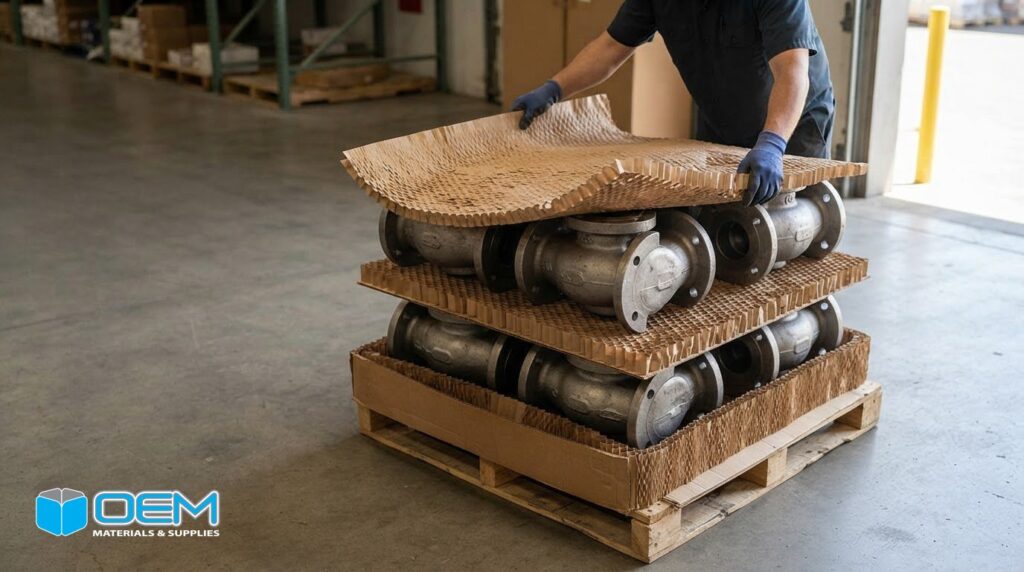
Equipment protection depends on more than cushioning. Paper-based honeycomb dunnage in Riverside can serve as a pallet top, load spacer, or protective sheet, helping separate and support items during industrial and automotive shipments.
A paper honeycomb sheet is a panel with a cellular paper core between facing layers. Its structure offers a practical way to protect equipment and parts, but the right format depends on the load, packing method, and conditions during transit.
This guide explains how honeycomb sheets work and where they fit in e-commerce, industrial, and automotive packaging. Learn how format and cushioning needs affect selection, what influences cost, and how sheets, pads, and other dunnage formats suit different shipments. The key is matching the material to the job, including recognizing when paper honeycomb works and when shipment conditions call for another protective approach.
Key Takeaways
- Honeycomb sheets can function as pallet tops, load spacers, liners, and protective packaging. Match the format to the shipment and the support the load needs.
- Compare total packaging and transportation needs, not just material cost. Product dimensions, material choice, and shipping requirements affect the result.
- For e-commerce shipments, choose cushioning based on the product’s fragility, fit, and movement risk inside the package.
- Panel thickness, facing strength, and cell size help determine how honeycomb dunnage performs with industrial and automotive equipment.
- Paper honeycomb is not moisture-proof in its standard form, so shipment exposure to water should factor into material selection.
What is a Paper Honeycomb Sheet?
A paper honeycomb sheet is a panel built around a cellular paper core with outer facing layers. Its open-cell structure creates a lightweight board used in packaging and construction. A packaging engineer might place a panel between metal housings, while a builder might use honeycomb board as a door core or partition component. Paper-based honeycomb dunnage in Riverside can support, separate, or shield goods during handling.
Its role depends on how the load meets the panel. A flat sheet can separate stacked parts, while a liner can protect an interior surface from abrasion. In automotive packaging, shaped separators can prevent adjacent trim or components from rubbing. Door cores and partition walls use the same basic panel structure for a different purpose: adding internal form without a solid sheet of material.
Honeycomb board is generally used as a supporting or separating panel, while cushioning materials may be better suited to conforming around irregular parts. Foam can surround an irregular part, plastic can resist moisture, and wood can provide structural support. Paper honeycomb can serve as a separating or supporting layer when its properties suit the shipment. Choose based on contact points, handling, and transit exposure.
Riverside buyers can source custom-cut or made-to-order honeycomb formats through suppliers serving industrial packaging needs. A useful specification identifies the part outline, support areas, and how the sheet will sit inside a carton, crate, or pallet load. For repeat shipments, document the approved dimensions and orientation so production teams can place each panel consistently.
For large-scale packaging, procurement teams should assess repeatability as well as supply volume. Define the format around the product and packing method, then align the specification across work instructions and replenishment plans. For example, a layer separator used on an automotive line should fit the stack pattern and let operators load parts in the intended orientation.
Paper honeycomb dunnage can be recyclable, but acceptance in Riverside depends on local collection rules and material condition. Confirm the municipality’s current guidance for paper packaging in the relevant collection stream. Keep the material separate from incompatible waste to support its intended recycling route after unpacking.
Before selecting a panel for shipping, identify product dimensions, weight, contact points, and handling conditions. Position the sheet to separate surfaces or support the load, then ensure it stays aligned as the package moves. Use paper honeycomb when a panel format addresses the risk; choose another cushioning method when the product needs close-fitting support.
Regulation (EU) 2025/40 generally applies from 12 August 2026, according to the European Union. Its relevance depends on whether packaging is placed on the European market, so Riverside businesses shipping to that market should account for the regulation in their packaging planning.
Cost efficiency and transportation savings
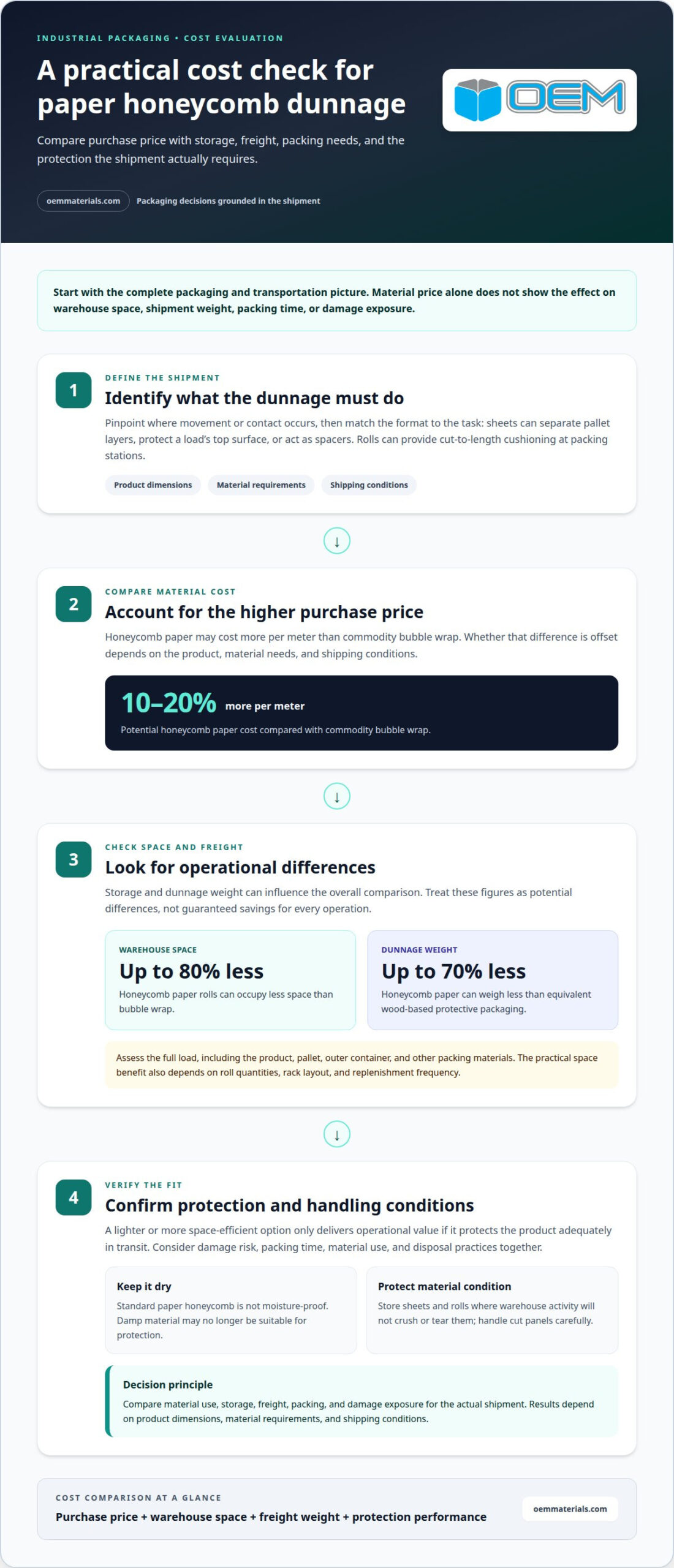
Packaging cost includes more than the price per unit. For Riverside operations, compare material use, warehouse space, shipment weight, packing time, and damage exposure. Honeycomb paper may cost 10-20% more per meter than commodity bubble wrap. That difference can be offset in some applications by storage or freight considerations, but the result depends on product dimensions, material requirements, and shipping conditions.
Storage is one measurable factor. Honeycomb paper rolls can occupy up to 80% less warehouse space than bubble wrap. A facility switching from bulky rolls could use that reclaimed space for other packaging materials or inventory. The practical benefit depends on roll quantities, rack layout, and how frequently the line replenishes packing stations.
Freight weight also affects the comparison. Honeycomb paper weighs up to 70% less than equivalent wood-based protective packaging. That can reduce the dunnage weight traveling with a pallet, particularly when shipments use substantial wood protection. The complete load still includes the product, pallet, outer container, and other packing materials, so assess the shipment as a whole.
Paper’s raw-material cost is higher than plastic alternatives, and that difference can affect transportation costs. A lighter format may reduce dunnage weight, while higher material costs can increase purchase expense. Track both factors along the shipment’s actual route. For example, compare the packaging for a recurring automotive parts load, including material use and the freight impact of its protective supports.
Honeycomb dunnage suits a range of transit applications. Sheets can separate pallet layers, protect a load’s top surface, or act as spacers between components. Rolls can provide cut-to-length cushioning at packing stations. Select the format by identifying where movement or contact occurs, then assess whether the material can perform that specific protective function.
Environmental impact involves tradeoffs. Paper packaging can reduce plastic use, but paper mills consume energy, contributing to the material’s carbon footprint. Compare packaging methods based on shipment damage risk, material use, and disposal practices. A lower-weight option delivers operational value only if it protects the product adequately in transit.
Storage and handling matter. Keep paper honeycomb dry because standard sheets are not moisture-proof; damp material may no longer be suitable for protection. Store sheets and rolls where warehouse activity will not crush or tear them, and handle cut panels carefully to keep their edges usable. These are practical material-care measures, not a separate shipping certification.
For a useful cost comparison, record the current dunnage format, amount used per shipment, storage needs, and transport conditions. Then compare an equivalent honeycomb application without assuming that material price alone determines total cost. Share product dimensions, load details, and shipping requirements through a packaging quote request to discuss the right protective format.
Cushioning and shock absorption for e-commerce
In e-commerce, cushioning limits product movement and helps manage impact inside a shipping carton. Paper honeycomb can provide protective cushioning in a lightweight format.
Cushioning for E-Commerce Shipments
Honeycomb paper cushioning uses an expandable cellular structure to surround or separate products. During transit, the cells deform under force, helping reduce direct contact between the item and its carton. For an e-commerce team, the right choice depends on product shape, fragility, and movement risk. A compact item needs a different protective arrangement than a long component or a multipiece order.
For fragile products weighing under 5 lbs, wrap or pad cushioning is recommended. A packing line can place a paper pad around the item, then fill remaining space to limit shifting. The carton still needs a suitable fit. Oversized voids can let products gain momentum before an impact, while tight packing can transfer force directly to delicate surfaces.
Strength-to-Weight Performance
Strength-to-weight performance describes how much support a material provides relative to its mass. Paper honeycomb’s cellular geometry creates a lightweight sheet that can support separation and cushioning tasks. This matters in e-commerce logistics, where a package must protect the product without unnecessary dunnage. For example, a honeycomb pad can divide products in a carton without using a solid block of material.
The useful format depends on the item and packing method, not weight alone. A flat sheet can protect broad surfaces, while a wrap or formed pad can follow a product’s outline. For electronics, consider whether the component has exposed edges or delicate finishes. Paper cushioning can help prevent contact, but the pack design must also keep the product from shifting.
Impact and Shock Absorption
Impact absorption is the material’s ability to take in energy during a sudden force rather than pass it directly to the product. Honeycomb packaging can absorb up to 80% of impact energy during transit. This can help protect packaged goods from handling shocks, but performance depends on the material format and how it is positioned around the item.
Place cushioning at likely contact points, such as carton corners or the space beneath a product. For a boxed metal part, pads can separate its surface from the carton and limit movement. Select cushioning based on the product’s weight, geometry, and sensitivity. A single sheet may suit separation, while multiple contact points may call for pads or wrap.
Global shipping adds handling stages, so the package may experience impacts at different points in the logistics chain. Test the packed configuration with the actual product and carton before adopting it for repeated fulfillment. Review product movement, contact marks, and cushioning placement after a shipment trial. These observations help refine the protective layout and determine whether cushioning materials suit the application.
Honeycomb liners, pallets, layer pads, and void fills
Honeycomb panels and rolls serve different roles in palletized shipments. The format determines how the material supports, separates, or fills a load.
Honeycomb Dunnage Formats
A liner protects a container surface, while a layer pad separates stacked products. A pallet top creates a broad support surface, and smaller cut pieces can fill gaps around cargo. For example, a layer pad between stacked automotive components helps keep their surfaces apart during handling.
Honeycomb board with a 30-60 mm core can replace wooden pallet decks and crate liners in many applications. Pads can also sit between a load and its pallet, distributing contact across a wider area. Pairing a honeycomb sheet with a plastic pallet is one way to build a paper-based protective layer into a pallet unit.
Void fill has a different job. It occupies unused space to restrict product movement inside a box or shipping container. Sheets can be cut to suit a gap, while rolls provide flexible material for wrapping or separating smaller items. Paper honeycomb sheets are 100% recyclable, making end-of-use handling relevant to packaging plans.
Available Sizes and Thicknesses
Honeycomb board panels are available in core thicknesses from 10 to 60 mm, including 10, 15, 20, 30, 40, 50, and 60 mm. Panel cell sizes range from 8 to 25 mm, depending on load requirements. These dimensions help buyers match the board structure to the support or separation task.
Roll formats offer another option for flexible packing operations. Honeycomb paper rolls typically use 70-90 GSM paper, with cell sizes of 6-10 mm. Available widths range from 300 mm to 500 mm, and lengths range from 50 m to 250 m. A narrower roll may suit individual packing stations, while wider material can cover larger surfaces.
To select a format, identify the load’s footprint, contact points, and required dunnage role. A pallet top needs dimensions that cover the supported area; a layer pad must match the product stack. For a void, measure the open space and choose cut sheets or roll material. Comparing core thickness, cell size, and format helps establish a practical specification.
Environmental impact depends on the complete packaging method, not one component alone. In suitable applications, a paper honeycomb layer can replace a wooden deck or liner; other shipments may need a different support structure. Match the format to the load first, then plan how to separate the paper material for recycling after transit.
Protective dunnage for industrial and automotive equipment
Industrial and automotive loads need dunnage matched to contact points, weight, and handling. A honeycomb panel can separate metal parts, support palletized equipment, or line a crate. For Riverside operations, the key is how the panel transfers force across the load during transit.
For heavy industrial items above 50 kg, board core thickness and facing specifications should be selected for the load and handling conditions. A 20 mm or thicker core and 120+ GSM facings may suit some applications, but the appropriate configuration depends on factors such as the part’s geometry, contact points, and shipping requirements. Machinery bases and cast components may need a broad support surface, while finished automotive parts may need separation between exposed faces. Choose the configuration around the part’s geometry, not simply its overall dimensions.
For machinery or automotive parts, a 20-40 mm core may be suitable depending on the product and packaging design. The thicker structure can provide a more substantial barrier between the product and pallet, crate, or neighboring components. For palletized shipments and heavy equipment, boards with 30-60 mm cores may replace wooden dunnage in suitable applications. The change affects how the load is supported, so assess the full packaging design.
Start by mapping the load’s contact points. A transmission housing, for example, may concentrate pressure around its base and mounting ears. Place dunnage beneath those areas and between parts that could rub. Cutting panels to fit the footprint helps limit unsupported edges, while layer pads can separate stacked components without changing their orientation.
Humidity is a practical concern for paper-based protection. Standard honeycomb board is not moisture-proof, and water can weaken paper or cause tearing. For shipments exposed to condensation or wet handling, account for the route, storage conditions, and protective outer packaging. Sustainable packaging must still protect the part in transit, especially when corrosion-sensitive metals are involved.
Kraft paper is commonly used in honeycomb production, but facing strength and core thickness determine how the finished panel performs. Keep dunnage aligned beneath the load, avoid crushed edges, and secure the palletized unit so parts cannot shift. A packaging trial with the actual automotive component can reveal movement, pressure marks, or gaps that need adjustment.
Paper honeycomb can support a sustainable packaging plan by replacing some wood-based dunnage while keeping material choice tied to load requirements. Though consumers may never see the internal support, damage to a finished part can affect delivery and production schedules downstream. Select a panel based on part weight, shape, handling, and humidity exposure.
For a load-specific packaging recommendation, share the equipment dimensions, weight, contact points, and transit conditions in a dunnage quote request.
OEM Materials & Supplies
OEM Materials & Supplies helps businesses plan protective packaging around product dimensions, handling needs, and shipping conditions. When paper honeycomb dunnage is part of the load design, the surrounding carton and cushioning also affect how well equipment stays protected.
For example, corrugated boxes can contain the shipment, while foam packaging can cushion parts that need closer support. Packaging kits bring compatible materials together for repeat packing workflows, and mailing tubes and cores suit products that need a tube format. The right combination depends on the item and its transit requirements.
Share your product dimensions, weight, and shipping requirements with OEM Materials & Supplies to discuss packaging options for your application.
Put Your Dunnage Plan Into Practice
The next step is to turn the shipment’s handling conditions into a packaging specification your team can use consistently. For paper-based honeycomb dunnage in Riverside, start with the product’s dimensions, weight, contact points, and moisture exposure during storage and transit. Include the pallet or carton arrangement and recurring packing challenges, such as surface contact or load movement.
These details help frame a practical discussion about the protective materials around the product, not just the dunnage sheet in isolation. OEM Materials & Supplies can help assess how packaging components fit together for your shipment. A clear specification also gives purchasing and operations teams a useful basis for evaluating needs across repeat orders.
Contact OEM Materials & Supplies to discuss your packaging requirements. Share the product dimensions, weight, and shipping conditions to start a focused conversation about your equipment protection needs.
Frequently Asked Questions
What is paper-based honeycomb dunnage and what is it used for?
Paper-based honeycomb dunnage is a paper panel or cushioning format with a cellular structure. Shippers use it to separate products, support pallet loads, line containers, or fill spaces that allow cargo to shift. For example, a layer pad can keep finished components from touching in a stacked shipment. Select the format based on the product’s contact points, handling, and transit exposure.
Where can I buy paper honeycomb dunnage in Riverside, California?
Riverside-area manufacturers can contact OEM Materials & Supplies about industrial packaging requirements. The company serves businesses in Riverside and supplies related protective packaging, including corrugated boxes, foam packaging, and packaging kits. Share the part’s dimensions, weight, shipment configuration, and protection needs to discuss how the surrounding package can support it. This keeps the conversation focused on the complete shipment, not dunnage in isolation.
Which Riverside-area packaging suppliers sell honeycomb paper dunnage?
OEM Materials & Supplies is an industrial packaging supplier serving manufacturers in the Riverside area. Its offerings include corrugated boxes, foam packaging, packaging kits, mailing tubes and cores, and cushioning materials. For a shipment using honeycomb dunnage, consider how the outer container and other protective components work with the internal supports. Share the application details to discuss an approach suited to the product and shipping conditions.
How much does paper honeycomb dunnage cost per sheet, roll, or pallet?
Pricing depends on the order and packaging requirements, so a single per-sheet, per-roll, or per-pallet figure will not apply to every project. Relevant factors include format, dimensions, thickness, facing material, order quantity, and shipping needs. A sheet sized for a specific pallet load differs from roll material used at packing stations. For a useful quote, provide the required format, product dimensions, expected usage, and destination.
What load capacity and cushioning performance does paper honeycomb dunnage offer?
Performance varies with the core and facing. Honeycomb board flat-crush resistance is listed at 15-50 kg/cm², while honeycomb packaging can absorb up to 80% of impact energy during transit. These figures describe different performance measures, not a guaranteed rating for every finished package. For heavy equipment, evaluate the panel’s intended support area, load placement, and surrounding package design before selecting a specification.