
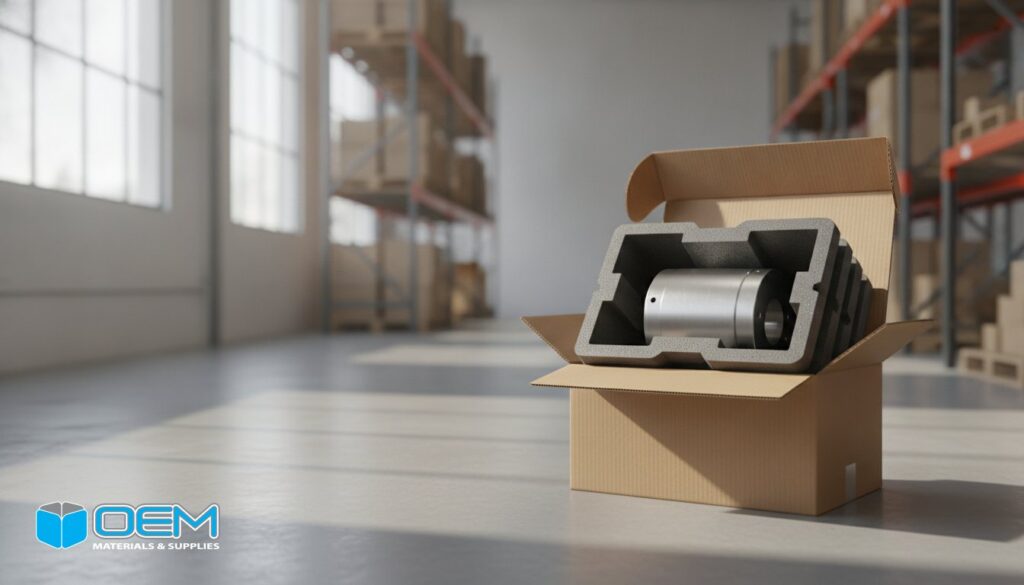
Your packaging is not just a container; it’s a precision-engineered component that dictates the profitability of your entire logistics chain. High damage rates and slow packing lines are more than just daily frustrations for operations managers in Southern California. It’s a direct drain on your bottom line. When evaluating die cut box inserts orange county manufacturers, you need a partner that understands the technical balance between material durability and assembly speed.
We understand that shifting inventory in transit and excessive labor costs can compromise your operational efficiency. This guide will teach you how to select and engineer precision die-cut inserts to eliminate product damage and streamline your Southern California supply chain. You’ll learn about material selection under the latest SB 54 recyclability mandates, design strategies for faster assembly, and how vendor-managed inventory can reduce your warehouse footprint. By focusing on engineered solutions rather than commodity components, you can achieve zero-damage shipping and more predictable lead times.
Key Takeaways
- Identify how to engineer die cut box inserts orange county manufacturers produce to eliminate internal product movement and surface abrasion during transit.
- Compare the structural rigidity of corrugated inserts against the cushioning properties of foam to find the optimal material for your product weight and fragility.
- Evaluate the financial impact of pre-assembled kitting and assembly services on reducing local warehouse labor costs and floor space requirements.
- Discover how rapid prototyping and technical packaging design help meet the rigorous shipping standards of the Southern California aerospace and medical device sectors.
- Determine key criteria for selecting an industrial packaging partner capable of scaling from initial design and validation to full scale production.
Defining Die-Cut Box Inserts for Industrial Packaging
Industrial packaging requires more than just a sturdy outer shell. For manufacturers shipping high-value components, the internal architecture of the package is what prevents costly returns. Die-cut box inserts are precision-engineered internal components designed to secure products within a shipping container. While a standard box provides a general barrier, these inserts function as a tailored structural system that eliminates internal product movement and prevents surface abrasion. Sourcing the right die cut box inserts orange county suppliers provide is the first step toward a more efficient warehouse and a more reliable supply chain.
Die-cutting allows for complex geometries that standard slotted containers simply cannot achieve. By utilizing specialized tooling, manufacturers can create folds, tucks, and cavities that mirror the specific shape of a product. This distinction between the primary packaging (the outer box) and the protective insert system is critical. The insert serves as the primary defense against G-force impacts and vibration, while the outer box provides the stacking strength and branding surface.
The Mechanics of Die-Cutting for Protection
The process of Die cutting utilizes custom steel-rule dies to stamp out complex shapes with high repeatability and tight tolerances. This level of precision is necessary for high-volume production where every millimeter of clearance matters. By creating a physical lock around the product, these inserts remove the reliance on inconsistent loose-fill materials like packing peanuts or air pillows. A die-cut insert is a structural stabilizer designed to fit the exact contours of a specific part. This exactness ensures that even sensitive electronics or aerospace components remain stationary during the vibrations of long-haul transit.
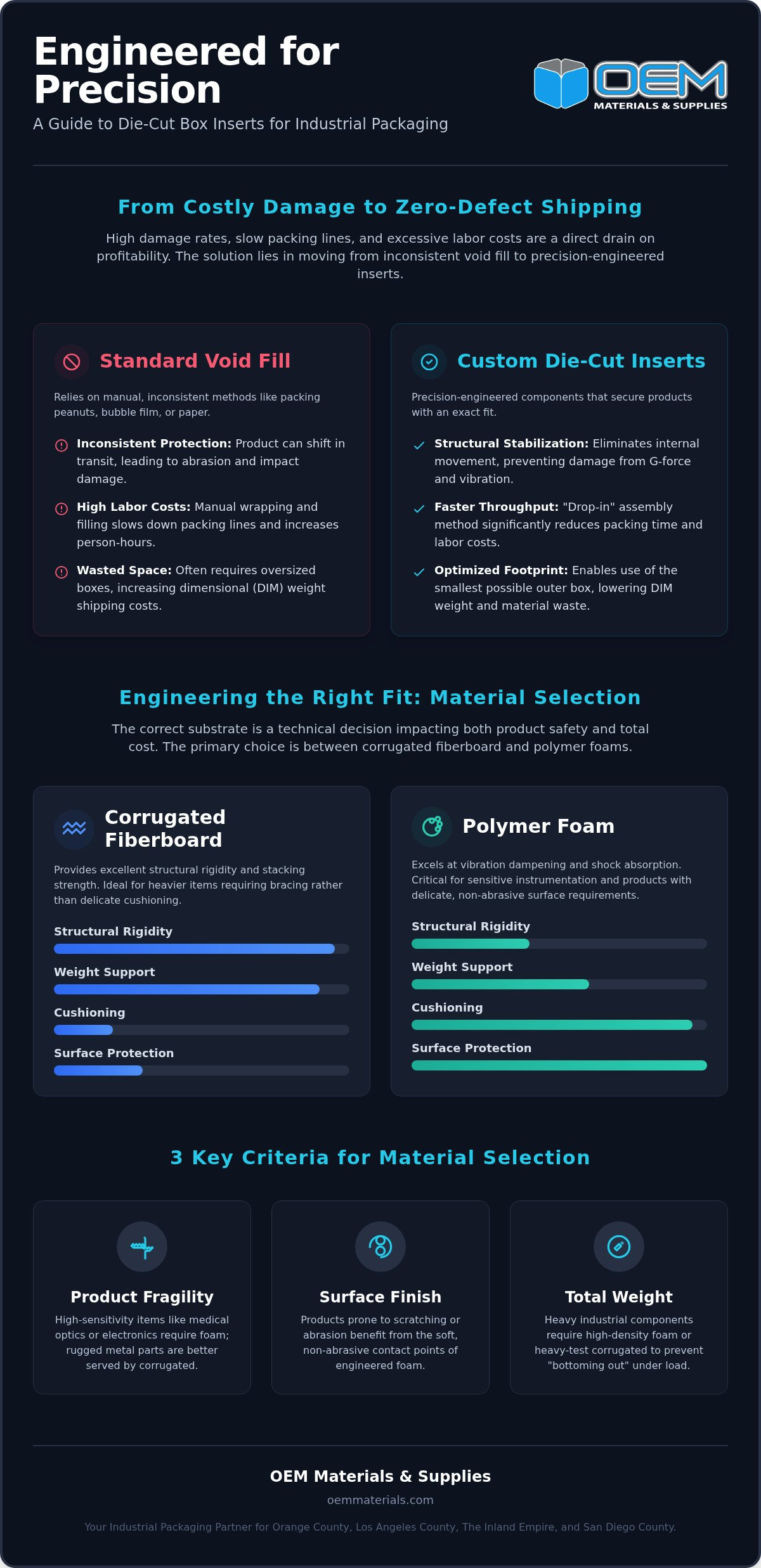
Custom Inserts vs. Standard Void Fill
Relying on manual void fill often leads to unpredictable labor costs and inconsistent protection levels. When a worker has to wrap every individual part in bubble film, packing times skyrocket. In contrast, using custom corrugated boxes with integrated foam packaging allows for a drop-in assembly method. This transition from manual wrapping to engineered die cut box inserts orange county facilities utilize results in significantly faster throughput on the packing line.
Beyond speed, custom inserts optimize the dimensional (DIM) weight of your shipments. Standard void fill often requires larger outer boxes to accommodate excessive padding; however, precision custom packaging design allows for the smallest possible footprint while maintaining superior protection. For high-value industrial sectors, this approach also improves the unboxing experience, presenting the product as a professional, securely housed component rather than an item buried in waste material. This reduction in material waste also assists in meeting local sustainability goals and reducing the total cost of disposal for the end user.
Engineering the Right Fit: Corrugated vs. Foam Inserts
Selecting the correct substrate is a technical decision that impacts both product safety and shipping costs. When procurement teams evaluate die cut box inserts orange county suppliers offer, the primary choice is between corrugated fiberboard and various polymer foams. Corrugated provides excellent structural rigidity and stacking strength, making it ideal for heavier items that require bracing rather than delicate cushioning. Foam, on the other hand, excels at vibration dampening and shock absorption, which is critical for sensitive instrumentation. Surface sensitivity also plays a role; while corrugated is effective for many products, highly polished surfaces may require the non-abrasive properties of an engineered foam.
Material selection usually follows three primary criteria:
- Product Fragility: High-sensitivity items like medical optics require foam, while rugged metal parts are often better served by corrugated.
- Surface Finish: Products prone to scratching benefit from the soft contact points of polyurethane foam.
- Total Weight: Heavy industrial components require the high-density support of polyethylene or heavy-test corrugated to prevent bottoming out.
Environmental impact is no longer a secondary concern. According to the EPA’s Containers and Packaging Data, corrugated materials have a high recovery rate, making them a preferred choice for companies focused on circularity and waste reduction. While foam is often necessary for technical protection, corrugated inserts offer a cost-effective and highly recyclable alternative for high-volume, low-fragility goods. Balancing these environmental goals with the physical requirements of the product is essential for a sustainable supply chain.
Corrugated Die-Cut Inserts for Structural Support
Corrugated inserts utilize different flute sizes to provide specific levels of vertical stacking strength and puncture resistance. For heavy-duty industrial kitting, these inserts stabilize multiple components within a single master case, preventing part-on-part contact. These systems work best when integrated with custom corrugated boxes that act as the outer structural shell. This combination ensures that the load is distributed evenly across the packaging walls, reducing the risk of box failure during palletized transport.
Engineered Foam Inserts for Sensitive Electronics
For high-value electronics and medical devices, foam provides the necessary deceleration during impact. Polyethylene (PE) foam is a closed-cell material used for heavier, more rugged items, while Polyurethane (PU) is an open-cell foam better suited for lightweight, delicate components. Orange County electronics manufacturers frequently require anti-static (ESD) foam to protect circuit boards from static discharge during handling. You can review specific technical material specifications for foam packaging to match the right density and cell structure to your product’s fragility rating. If you aren’t sure which material meets your drop-test requirements, you can request a technical consultation to review your product’s fragility.
Industry Specific Applications in Orange County
Orange County serves as a critical nexus for advanced manufacturing, particularly within the aerospace, medical, and electronics sectors. Each of these industries operates under rigorous compliance standards that dictate how products must be secured during transit. For purchasing managers, selecting die cut box inserts orange county manufacturers produce requires an understanding of these specialized niches. According to the Industrial Packaging Alliance of North America, maintaining industry-specific standards is essential for mitigating risk in the global supply chain. Whether shipping from a facility in Anaheim or a distribution center in the Inland Empire, the packaging must be engineered to withstand the specific stressors of the regional and international logistics networks.
High-value automotive components and complex electronics assemblies also benefit from this level of engineering. For electronics, anti-static properties are often integrated into the die-cut design to protect against electrostatic discharge. In automotive logistics, where parts are frequently moved between regional distribution centers, durable corrugated or foam inserts ensure that heavy or oddly shaped components remain secure, reducing the high cost of damaged returns.
Aerospace and Defense Packaging Standards
The Southern California aerospace corridor demands packaging with extremely tight tolerances. Precision-machined components often feature delicate surface finishes or specialized coatings that can be compromised by even minor shifting. Die-cut inserts provide the necessary immobilization to prevent part-on-part contact during long-distance transit. For complex defense projects, multi-part inserts allow for organized kitting, ensuring that all assembly-ready components arrive together and in the correct sequence. This level of organization reduces assembly errors and speeds up production timelines for prime contractors.
Medical Device and Life Science Requirements
In Irvine and Costa Mesa, medical device manufacturers face unique challenges regarding sterile barrier integrity. Inserts must be designed to hold devices in a fixed orientation to prevent the product from puncturing its sterile pouch or tray. Material selection is equally vital; inserts used in these environments must often be cleanroom-compatible and low-particulate. By utilizing professional kitting and assembly services, life science companies can receive pre-loaded packaging systems that minimize the labor required in high-cost laboratory environments. This approach ensures that orientation is maintained from the point of manufacture to the final surgical suite.
Optimizing the Supply Chain with Kitting and Assembly
Packaging efficiency is often measured by throughput on the assembly line. For many operations, the manual labor required to assemble complex internal components creates a significant bottleneck. Receiving pre-assembled box and insert kits directly impacts your operational speed. Instead of warehouse staff spending time folding and nesting corrugated components, they can focus on product fulfillment. Outsourcing the kitting of these systems to a partner providing die cut box inserts orange county allows your team to maintain higher line speeds without increasing headcount.
Integrating these components into a Vendor Managed Inventory program further streamlines the process. By allowing a supplier to monitor and replenish stock levels, you eliminate the risk of inventory stockouts that halt production. This partnership transforms packaging from a simple purchase order into a strategic component of your lean manufacturing initiative. When your supplier understands your production cadence, they can ensure that assembled kits are staged and ready for your busiest shifts.
Reducing Total Cost of Ownership through Design
True cost savings come from analyzing the entire lifecycle of a package. While a generic insert might seem cheaper initially, the financial impact of product damage and return shipments quickly erodes those margins. Engineered inserts are designed to lower the total cube size of your shipments, which directly reduces freight costs by optimizing dimensional weight. Professional packaging design services help identify hidden costs in the packing process by evaluating assembly motions and material redundancy. This technical approach ensures that every fold and cavity serves a functional purpose in protecting the product while minimizing waste.
Just-In-Time Delivery for SoCal Manufacturers
Warehouse space in Southern California remains a premium asset. Many facilities in Orange County and the Inland Empire operate with limited floor space, making the storage of bulky packaging materials impractical. Leveraging JIT packaging allows you to receive inventory only when it is needed for the production cycle. Coordinating the production of die cut box inserts orange county with your manufacturing schedule prevents bottlenecks and keeps your loading docks clear. This local distribution model ensures that high-volume packaging components are available without occupying valuable square footage. If you’re looking to optimize your assembly line efficiency, you can request a quote for a customized kitting and VMI program.
Selecting an Industrial Packaging Partner in Orange County
Choosing a vendor for industrial packaging requires looking beyond basic unit pricing. To truly optimize your supply chain, you need a partner capable of providing both technical design and high-volume production. A supplier that functions as a consultant rather than a commodity reseller will analyze your specific failure points and engineer solutions that reduce your total cost of ownership. When sourcing die cut box inserts orange county facilities rely on, technical expertise in material engineering is the difference between a secure shipment and a costly insurance claim.
Local proximity within Southern California provides significant advantages for quality control and lead times. Working with a manufacturer in the Orange County or Inland Empire area allows for faster site visits, immediate design iterations, and a more responsive feedback loop. This geographic advantage is particularly critical when navigating tight production schedules or managing sudden shifts in inventory requirements. Rapid prototyping serves as the cornerstone of this partnership, allowing you to validate fitment and protection levels before committing to full-scale production tooling.
The Value of an Integrated Packaging Supplier
Sourcing your outer containers and internal inserts from separate vendors often leads to compatibility issues and administrative friction. An integrated supplier eliminates these risks by engineering the entire system simultaneously. This approach ensures that your cushioning materials and inserts are perfectly calibrated to the interior dimensions of your master cases. For a broader perspective on selecting a manufacturing partner, you can consult our guide for corrugated packaging box manufacturers to understand the standards required for industrial OEMs. Accessing a full suite of edge protection and cushioning from a single source simplifies your procurement process and ensures consistent material quality across your entire packaging SKU list.
Getting Started with Custom Die-Cut Prototypes
The transition from a product sample to a CAD-designed packaging insert is a methodical process. It begins with a technical assessment of your product’s dimensions, weight, and fragility. To facilitate an accurate recommendation and quote, you should be prepared to provide specific data points, including your annual usage and preferred shipping methods. This information allows engineers to select the most cost-effective materials that meet your protection requirements without over-engineering the solution. Local manufacturers looking to eliminate product damage and reduce assembly labor can request a design consultation to begin the prototyping phase. By providing a physical sample or a 3D model, you can move quickly from the design stage to a functional prototype for drop testing and validation.
Advancing Your Industrial Packaging Strategy
Precision-engineered inserts are essential for maintaining the integrity of high-value components throughout the Southern California supply chain. By selecting the optimal balance between structural corrugated support and cushioning foam, you can virtually eliminate transit damage while reducing total freight costs. Integrating these components into a kitting or VMI program further streamlines warehouse operations by cutting down on-site assembly labor and reducing your overall storage footprint. This technical approach ensures that your packaging functions as a strategic asset rather than a simple overhead expense.
Sourcing die cut box inserts orange county manufacturers provide ensures your packaging meets the rigorous standards of the local aerospace and medical device sectors. Local manufacturing and specialized expertise in technical packaging design provide the reliability required for precision manufacturing and distribution across the Inland Empire and Los Angeles. To optimize your logistics chain and eliminate shifting in transit, contact OEM Materials & Supplies for a custom die-cut insert quote and prototype. We recommend providing your product dimensions, weight, and annual usage to help our engineers develop the most efficient solution for your application. We look forward to partnering with you to achieve a zero-damage shipping environment.
Frequently Asked Questions
What is the primary benefit of using die-cut box inserts over standard void fill?
The primary benefit is precision stabilization that eliminates internal product movement and reduces packing labor. Unlike standard void fill, which relies on manual worker consistency, die-cut inserts provide an engineered, repeatable fit for every package. This ensures that high-value components remain stationary during transit, preventing surface abrasion and impact damage. Additionally, drop-in inserts significantly increase throughput on the assembly line by removing the need for manual wrapping.
Can die-cut inserts be designed for both low-volume prototypes and high-volume production?
Die-cut inserts are scalable for both initial design validation and full-scale manufacturing runs. Professional suppliers utilize rapid prototyping to create physical samples for fitment testing before committing to permanent tooling. Once the design is validated, the same specifications are used for high-volume production. This process ensures that Southern California manufacturers can maintain consistency from the first prototype through thousands of units in a production cycle.
Which material is better for heavy industrial parts: corrugated or foam?
Corrugated is generally better for heavy industrial parts that require high structural rigidity and vertical stacking strength. It provides a durable bracing system that prevents heavy items from shifting within the master case. However, for heavy parts with sensitive finishes or critical calibration, a high-density polyethylene foam may be necessary. The choice depends on whether the primary goal is structural stabilization or delicate vibration dampening during long-haul transport.
Do custom die-cut inserts require expensive tooling charges for every order?
Tooling charges are typically a one-time investment for the initial production of the steel-rule die. Once the custom die is fabricated, it’s stored for your future orders, which eliminates recurring setup fees for the same design. For short-run prototypes or initial design phases, digital cutting methods can sometimes be used to bypass traditional tooling costs entirely. This makes custom engineering more accessible for specialized aerospace or medical device projects.
How do custom inserts help reduce dimensional weight (DIM weight) shipping charges?
Custom inserts reduce DIM weight charges by allowing for the smallest possible outer box dimensions. By engineering the internal packaging to fit the product exactly, you eliminate the need for oversized master cases filled with excessive void fill. This reduction in total package volume directly lowers the dimensional weight calculated by carriers. For high-volume shippers in Los Angeles and San Diego, this optimization can lead to substantial freight savings over time.
Are there eco-friendly or recyclable options for die-cut packaging inserts?
Recyclable options are readily available, particularly with corrugated materials that feature high post-consumer recycled content. Selecting die cut box inserts orange county manufacturers produce often involves choosing materials that comply with California’s SB 54 recycling mandates. While some technical foams require specialized recycling streams, corrugated inserts are easily processed through standard industrial recycling programs. This helps manufacturers meet sustainability goals while maintaining the necessary levels of product protection.
How does a local Orange County supplier improve the packaging design process?
A local supplier facilitates faster design iterations through onsite consultations and rapid prototype delivery. Sourcing die cut box inserts orange county facilities produce means you can exchange physical product samples and CAD data without the delays of long-distance shipping. This proximity is vital for Southern California manufacturers in the aerospace and medical sectors who require precise fitment and immediate quality control feedback during the critical design phase.
Can inserts be designed to hold multiple different components in a single kit?
Inserts are frequently designed for complex kitting applications where multiple components must be secured in a single container. Engineers create multi-cavity designs that hold the primary device, power cables, and accessories in separate, organized sections. This prevents part-on-part damage and ensures that all assembly-ready components arrive together. Organized kitting also improves the end-user unboxing experience and reduces the time required for onsite assembly at the final destination.