
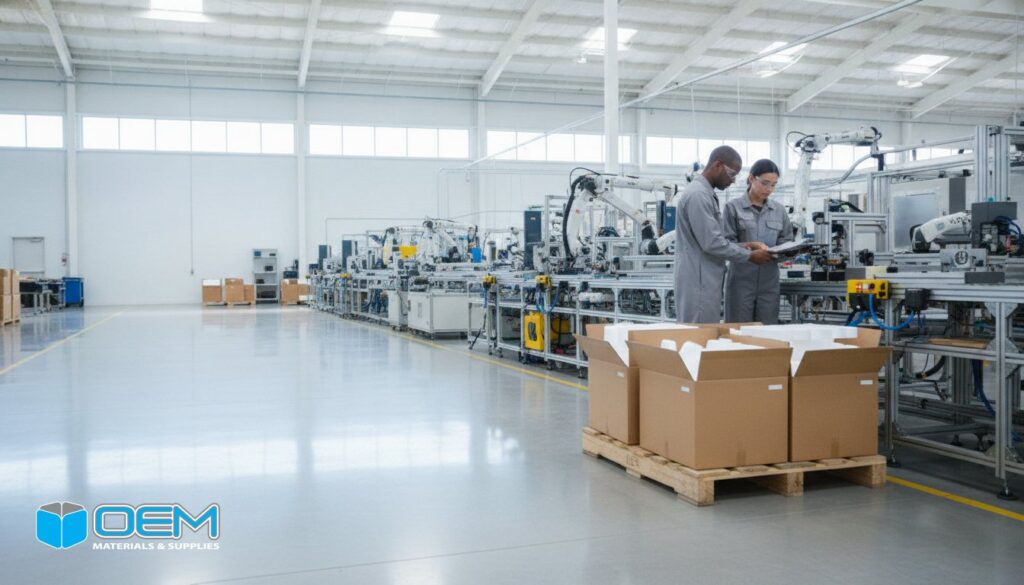
How much of your high-value manufacturing floor is currently being used as a storage closet for empty corrugated boxes? For many Southern California manufacturers, the answer is far too much. You likely already know that every square foot dedicated to storing bulky packaging materials is a square foot that isn’t generating revenue through production. When you combine that wasted space with the high labor costs of manual tracking and the constant threat of stockouts, the traditional procurement model starts to look like a significant liability.
By utilizing professional packaging inventory management services, you can reclaim your warehouse and stabilize your supply chain. This article explains how a strategic vendor-managed inventory program reduces your total cost of ownership and ensures just-in-time delivery for everything from custom foam inserts to heavy-duty crates. We will look at how local warehousing and streamlined procurement through a single SoCal partner can optimize your operations in Los Angeles, Orange County, or San Diego.
Key Takeaways
- Reclaim high-value Southern California manufacturing floor space by outsourcing the storage of bulky corrugated and foam materials.
- Reduce manual procurement labor and eliminate the risk of production shutdowns with professional packaging inventory management services.
- Streamline complex supply chains by combining custom corrugated designs and engineered cushioning into a single vendor-managed program.
- Utilize local warehousing and just-in-time delivery to lower your total cost of ownership without sacrificing supply chain control.
- Establish accurate safety stock levels through a comprehensive audit of your production data and warehouse capacity.
The Impact of Inefficient Packaging Inventory on Industrial Operations
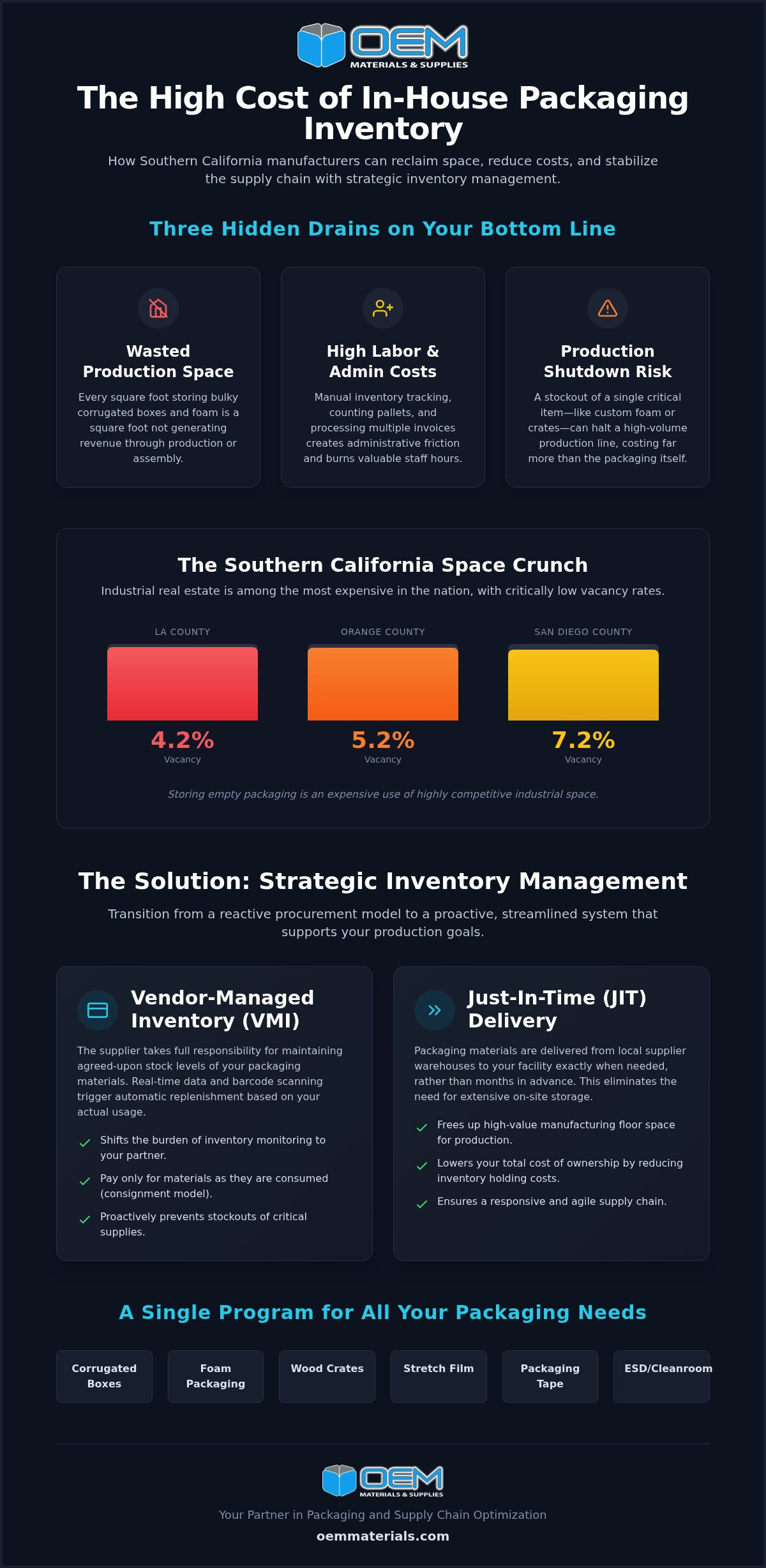
Industrial operations often treat packaging as an afterthought, yet it represents a significant portion of total logistical costs. When your team relies on manual tracking, they aren’t just counting boxes; they’re burning time that should be spent on production. Relying on fragmented procurement cycles leads to inconsistent stock levels and high administrative friction. If you manage five different vendors for stretch film, tape, and custom inserts, your accounting team is processing five different invoices for every production run. This inefficiency creates a hidden drain on your bottom line.
Warehouse Space Optimization in Southern California
Industrial real estate in Southern California is among the most expensive in the nation. According to Q2 2026 data, warehouse vacancy rates remain tight, with Los Angeles County at 4.2% and Orange County at 5.2%. San Diego County is also competitive at 7.2%. In this environment, every square foot must be productive. Storing air in the form of empty, bulky corrugated boxes is an expensive mistake.
By moving bulk inventory to a supplier facility through packaging inventory management services, you can reclaim that footprint. This space can then be repurposed for new manufacturing equipment or additional assembly lines, directly increasing your plant’s throughput. Professional inventory management ensures you only have the materials you need for the current week’s production on your floor, rather than months of overstock.
Reducing Labor Overhead and Administrative Friction
The true cost of maintaining a supply chain includes the labor required to manage it. Manual purchase orders and constant invoice reconciliation create a bottleneck in the procurement department. This administrative friction often leads to panic ordering when a stockout is discovered too late. Using professional packaging inventory management services allows for a streamlined flow of materials without the overhead of on-site bulk storage.
A stockout on a critical shipping material like foam packaging or custom crates can halt a high-volume production line. The cost of an idle line in the aerospace or medical device sector far outweighs the cost of the packaging itself. Transitioning to vendor-managed inventory (VMI) eliminates these risks. Automated replenishment cycles, triggered by your actual production data, ensure that materials arrive exactly when needed. This approach frees your procurement team to focus on strategic sourcing rather than chasing down late deliveries or counting pallets in the warehouse.
Core Components of Professional Packaging Inventory Management
Professional packaging inventory management services rely on two primary logistical frameworks: VMI and JIT. While these terms are often used interchangeably in general logistics, they serve distinct functions in the industrial packaging sector. Understanding these mechanics allows operations managers to choose the right model for their specific production volume and facility constraints. Effective management isn’t just about storage; it’s about creating a responsive loop between your production line and your supplier’s warehouse.
Vendor Managed Inventory (VMI) Models
In a VMI arrangement, the supplier takes responsibility for maintaining agreed upon stock levels of packaging materials at the manufacturer’s site. This often involves a consignment model where the manufacturer only pays for the material once it’s pulled from the shelf for use. This setup stabilizes supply chain costs and shifts the burden of inventory monitoring to the partner. It’s a highly effective way to manage high volume items like corrugated boxes and foam packaging without tying up capital in upfront purchases.
Modern VMI programs utilize barcode scanning and real time data to track consumption patterns. This visibility is essential for optimizing packaging management workflows, ensuring that replenishment orders are triggered automatically based on actual usage rather than guesswork. For industries like aerospace or medical devices, where even a minor delay is unacceptable, this proactive approach prevents stockouts of critical shipping supplies.
Just-In-Time (JIT) Packaging Delivery
Manufacturers with limited floor space in high rent Southern California hubs often prefer JIT packaging services. Unlike VMI, which keeps stock on site, JIT relies on frequent, smaller deliveries that align exactly with production schedules. If your facility in Orange County or San Diego is launching a production run of automotive components on Wednesday, your custom crates and edge protectors arrive on Tuesday afternoon. This eliminates the need for long term storage of bulky materials.
The primary benefit of JIT is improved cash flow. Since capital isn’t tied up in months of safety stock, you can allocate those funds toward R&D or new equipment. This model requires a partner with local warehousing in Southern California to ensure rapid response times. If you’re unsure which model fits your current production volume, you can speak with a specialist to analyze your usage data. These packaging inventory management services provide the technical foundation for a leaner, more resilient supply chain that adapts to fluctuating market demands.
Integrating Custom Packaging Solutions into Management Programs
Managing inventory for standard items is straightforward, but custom corrugated boxes and die-cut designs introduce significant lead-time variability. Professional packaging inventory management services must account for the unique manufacturing cycles of engineered components. When you rely on multiple vendors, you risk having the outer container ready while the engineered foam inserts are still in production. A single-source partner synchronizes these timelines to ensure all components arrive as a complete unit, preventing bottlenecked assembly lines.
Synchronized Management of Custom Components
High-value products in the aerospace or medical sectors often require multi-material protection. This might include custom-sized wood crates, plastic pallets, and complex protective cushioning. If these parts are managed in isolation, they occupy excessive floor space and complicate the procurement process. Our management programs treat these as a unified bill of materials. This synchronization ensures that foam inserts and corrugated outers are available simultaneously for the packing line, reducing the risk of product damage during transit. For more on selecting a partner that meets these rigorous quality standards, see our guide on corrugated packaging box manufacturers.
Kitting and Assembly as an Extension of Inventory
Many Southern California manufacturers in Orange County and Los Angeles County are moving toward pre-assembled packaging kits. Instead of picking and assembling five different components on the production floor, workers receive a single, ready-to-use kit. This approach reduces the footprint of packaging materials at the workstation and significantly lowers labor costs. It’s a functional remedy for facilities with limited square footage that need to maintain high throughput.
Integrating kitting into your packaging inventory management services allows for better control over small but critical items. Managing labels, ribbons, and printing supplies within the kitting workflow ensures that no production run is delayed by a missing secondary component. By outsourcing the assembly of these kits, you free up your internal team for higher-value manufacturing tasks. This strategy effectively turns your packaging supplier into a logistical extension of your own operation, providing stability and precision in a competitive market.
Selecting a Packaging Inventory Management Partner
Transitioning from manual ordering to professional packaging inventory management services requires a partner with specific regional and technical capabilities. A national vendor might offer a deep catalog, but they often lack the logistical agility required for high-volume Southern California manufacturing hubs. You need a partner who functions as a technical consultant rather than a mere order taker. The selection process should focus on how well a supplier can integrate with your specific production flow and quality standards.
Local Proximity and Distribution Capabilities
Choosing a wholesale industrial packaging supplier situated near Los Angeles, Orange County, or San Diego is a strategic necessity. Proximity directly dictates the success of JIT and VMI models. Long-haul freight from out-of-state vendors introduces lead time variability and high shipping costs that erode the benefits of managed inventory. If your supplier is four states away, a sudden production shift could leave you waiting days for critical materials.
Verify that your partner maintains their own delivery fleet. Relying on third-party LTL carriers for critical replenishment often leads to missed windows and production delays. A local partner with dedicated trucks provides the reliability needed for rapid response when schedules shift. This local presence is especially vital for bulky items like custom crates and plastic pallets, where shipping costs can quickly become prohibitive if not managed through a local distribution network.
Technology and Data Integration
Transparency is the foundation of a successful program. Your partner must provide clear, data-driven reporting that tracks actual usage against safety stock levels. These insights help identify opportunities for operational efficiency by revealing over-ordered items or identifying where custom kitting could reduce labor. If you don’t have visibility into your own consumption patterns, you can’t optimize your warehouse floor space effectively.
Check for compatibility with your existing procurement systems. The goal is to reduce administrative friction, so the reporting should integrate cleanly with your operations. Accurate metrics on inventory turnover and replenishment triggers ensure you never face a stockout during a seasonal production spike. Successful packaging inventory management services rely on this data to adjust safety stock levels dynamically based on real-time production trends.
Accuracy in inventory reporting is non-negotiable. If a VMI count is off by even a small percentage, it can trigger an emergency order or a production halt. Ask potential partners about their cycle counting frequency and how they handle discrepancies. Flexibility is equally important. Your program must scale effortlessly to handle sudden production spikes. A partner that only offers rigid, fixed-volume contracts will eventually become a bottleneck. If you are ready to evaluate your current usage and storage requirements, contact our team for a consultation to see how a local partnership can stabilize your supply chain.
Implementation Roadmap for Industrial Inventory Programs
Transitioning to professional packaging inventory management services requires a structured approach to ensure zero disruption to current manufacturing lines. It isn’t a simple hand-off; it’s a technical integration. Success depends on an accurate initial assessment of your current operational state. By establishing a clear baseline, you can measure the specific improvements in warehouse efficiency and labor allocation as the program matures.
The Inventory Audit and Baseline Phase
The first step is a comprehensive audit of all packaging materials currently on your floor. This involves identifying high-turnover items like standard shipping boxes and separating them from slow-moving, specialized stock. You must map the physical flow of these materials from the receiving dock to the final shipping station. Understanding this path reveals where material handling labor is being wasted or where congestion occurs.
Establishing a baseline for your total cost of ownership is the critical final piece of the audit. The baseline for total cost of ownership is the sum of material costs, the carrying cost of dedicated floor space, and the total labor hours required for procurement and material handling. Once these variables are quantified, you have a benchmark to evaluate the ROI of a managed program. This phase ensures that the transition is rooted in production data rather than estimates.
Scaling and Optimizing the Program
Once the baseline is set, we define safety stock levels and automated replenishment triggers. These triggers ensure that a new delivery of stretch film or custom foam arrives before the current supply hits a critical low. Clear communication protocols and monthly reporting frequency keep the program aligned with your production shifts. This automation replaces the guesswork of manual ordering with precision logistics.
Optimization is an ongoing process. Regular business reviews allow you to adjust inventory levels for new product launches or the scaling of medical device production. As trust in the system grows, many manufacturers expand the program to include secondary supplies like packaging tape and edge protectors. This holistic approach ensures that every component of your shipping workflow is optimized for speed and cost efficiency. Continuous data analysis identifies further opportunities to reduce waste and improve the throughput of your Southern California facility.
Optimizing Your Industrial Supply Chain for Long-Term Growth
Transitioning from manual procurement to automated packaging inventory management services is a strategic investment in your facility’s throughput. By reclaiming floor space in expensive Southern California markets like Los Angeles and Orange County, you convert storage areas into revenue-generating production lines. A successful program doesn’t just prevent stockouts; it eliminates the administrative friction of managing multiple vendors and disparate material types. If you are scaling medical device production or streamlining aerospace logistics, a local partner with a full-service industrial packaging fleet provides the stability your operation requires.
Ready to identify hidden costs in your current workflow? Contact OEM Materials & Supplies for a Packaging Inventory Audit to see how our VMI and custom design services can optimize your warehouse in San Diego, Riverside, or the Inland Empire. Please provide us with your product dimensions, weight, and annual usage data to receive a precise recommendation. We look forward to helping you build a leaner, more resilient supply chain.
Frequently Asked Questions
What is the difference between VMI and JIT in packaging?
VMI involves the supplier taking responsibility for maintaining agreed stock levels at your facility, often through a consignment model. JIT focuses on frequent, smaller deliveries that arrive exactly when your production line requires them. While VMI provides the security of on-site materials, JIT is designed to maximize your available floor space. Both models aim to eliminate stockouts while reducing the time your team spends on manual inventory tracking.
How much warehouse space can I save with inventory management services?
Reclaiming warehouse space is a primary benefit of managed programs. By moving bulky items like corrugated boxes and plastic pallets to our local SoCal facility, you can repurpose that square footage for revenue-generating assembly lines. Some manufacturers report that moving to a JIT model allows them to reclaim a significant portion of their storage area. This optimization is vital in high-rent areas like Los Angeles and Orange County where industrial floor space is limited.
Does managed inventory increase the unit price of my packaging?
Implementing packaging inventory management services typically results in a lower total cost of ownership. While unit prices remain competitive, the true savings come from reduced administrative labor and the elimination of emergency freight charges. Specific cost savings always depend on variables like your product dimensions, materials, and shipping requirements. Consolidating your procurement with a single partner often provides better price stability for custom foam and specialized shipping supplies.
How does a supplier track my inventory usage levels?
Usage tracking is handled through a combination of on-site cycle counts and digital reporting tools. Our team performs regular physical audits of your stock levels in facilities across Riverside and San Diego to ensure data accuracy. This consumption data is integrated into our replenishment system, which automatically triggers new orders based on your actual production speed. This transparency allows your procurement team to focus on strategic tasks instead of manual counting.
Can custom foam inserts and wood crates be included in a VMI program?
Custom components like engineered foam inserts and wood crates are perfectly suited for managed inventory programs. Because these items are bulky and have specific manufacturing lead times, keeping them in a synchronized replenishment cycle prevents production bottlenecks. We manage the inventory of these complex parts alongside your standard boxes, ensuring that every component of your packaging kit is ready for the assembly line exactly when your production schedule demands it.
What industries benefit most from packaging inventory services?
High-tech sectors such as aerospace, medical devices, and electronics benefit most from packaging inventory management services due to their rigorous quality requirements. These industries often deal with delicate components that require custom cushioning and precise shipping schedules. By utilizing these services, manufacturers ensure they have a consistent supply of specialized materials like ESD packaging without the burden of managing multiple vendors or facing costly production shutdowns due to stockouts.
Is there a minimum annual usage requirement for these services?
There is no universal minimum, as we evaluate each program based on the complexity of your packaging and your specific logistical needs. We look for opportunities where our local warehousing and delivery fleet can provide the most value, such as high-volume production runs or complex kitting requirements. Sharing your annual usage and product dimensions allows us to conduct a thorough audit and determine if a managed program will provide the necessary ROI.
How do you handle sudden spikes in my production volume?
We handle production spikes by maintaining strategic safety stock levels at our local Southern California warehouses. Our proximity to manufacturing hubs in Orange County and Los Angeles allows our fleet to provide rapid, same-day or next-day replenishment when your volume increases unexpectedly. We monitor usage data in real time to identify these trends early, allowing us to scale our production and delivery schedules to support your growth without interruption.