
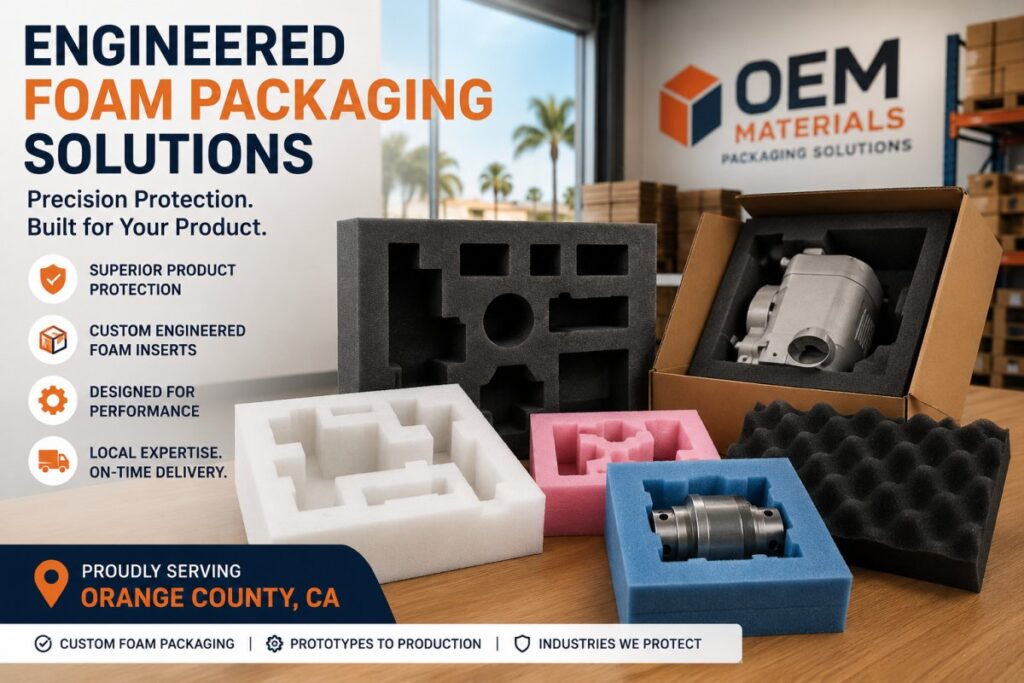
If you treat protective packaging as an afterthought, you are essentially gambling with your most valuable inventory. For manufacturers in Southern California, a single shipment of damaged medical devices or aerospace components can erase months of profit and jeopardize critical contracts. High damage rates and inconsistent lead times from national suppliers shouldn’t be the standard for your supply chain. You need protection that matches the precision of your engineering.
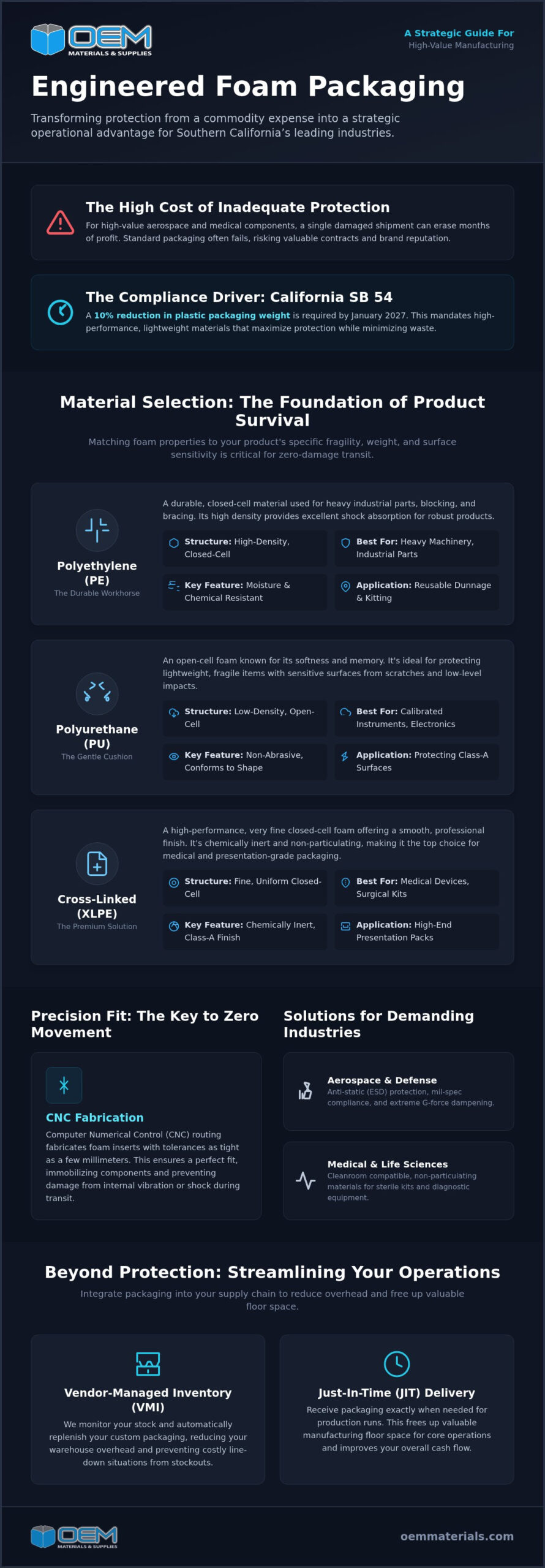
This guide explains how to select the right materials and design processes for engineered foam packaging solutions orange county to ensure your products arrive intact every time. With California’s SB 54 now requiring a 10% reduction in plastic packaging weight by January 2027, choosing high-performance materials that offer maximum protection with minimal waste is more critical than ever. We will examine how matching foam density to product fragility, utilizing CNC routing for precision fit, and leveraging local kitting services can eliminate shipping damage while reducing your assembly line labor costs. By the end of this article, you will know how to turn your packaging from a commodity expense into a strategic operational advantage.
Key Takeaways
- Learn how to differentiate between polyethylene, polyurethane, and cross-linked foams to match material density with specific product fragility.
- Discover how precision fabrication methods like CNC routing ensure the tight tolerances required for high-value aerospace and medical device components.
- Identify the essential criteria for choosing a partner for engineered foam packaging solutions orange county to maintain reliable lead times and local technical support.
- Explore how Vendor Managed Inventory (VMI) and Just-In-Time (JIT) delivery programs reduce warehouse overhead and free up valuable manufacturing floor space.
- Understand how kitted assemblies and multi-material solutions can significantly lower labor costs and streamline your internal packaging processes.
The Role of Engineered Foam Packaging in Orange County Industrial Sectors
Engineered foam is not a commodity; it is a precision component designed for high-performance vibration and shock dampening. Unlike standard packing materials, engineered foams are manufactured with specific densities and cell structures to absorb kinetic energy before it reaches the product. This technical distinction is vital for manufacturers in Southern California who produce high-value, fragile equipment that cannot survive the rigors of standard shipping cycles without specialized protection.
Standard solutions like bubble wrap or loose fill often fail because they lack the structural integrity to prevent product migration. For precision instruments, even a few millimeters of movement can result in calibration errors or catastrophic surface damage. Effective package cushioning materials must provide consistent deceleration. Engineered foam achieves this by distributing pressure across the product’s surface area, ensuring that impact forces do not concentrate on delicate components or thin-walled housings.
The manufacturing landscape in Orange County, particularly in hubs like Irvine, Anaheim, and Santa Ana, is defined by high-tech clusters in the aerospace, defense, and medical sectors. These industries require engineered foam packaging solutions orange county that can be prototyped and iterated quickly. A local partner is essential for rapid prototyping. Physical design reviews and immediate fit-testing allow engineers to refine packaging geometry in real time, reducing the risk of design flaws that lead to product damage.
Aerospace and Defense Applications
Aerospace components face extreme conditions, including high-frequency vibrations and significant G-force impacts during transit. We provide custom foam inserts that meet rigorous military and aerospace standards for durability and chemical resistance. For sensitive avionics, anti-static foam is a requirement to prevent electrostatic discharge from damaging circuit boards. These precision-cut inserts hold specialized hardware securely, preventing any internal movement within the foam packaging assembly.
Medical Device and Life Sciences
The medical sector requires specialized cushioning for fragile diagnostic equipment and surgical kits. These products often consist of multiple components that must remain organized and protected. We design custom inserts for multi-component medical assemblies that facilitate quick inventory checks and easy access for clinicians. For sterile environments, we offer cleanroom-compatible foam options that do not shed particles or outgas. Utilizing custom packaging design ensures that every piece of a medical kit is secured against shock while maintaining the professional presentation required for the healthcare market.
Selecting the Right Material: Polyethylene vs. Polyurethane vs. Cross-linked Foam
Selecting the right material is a technical decision that determines the survival of your product. When sourcing engineered foam packaging solutions orange county, we evaluate material performance based on the G-force rating of your item and the anticipated drop height during transit. Selecting an incorrect density can lead to bottoming out, where the foam compresses fully and transfers the impact energy directly to the product. Conversely, foam that is too stiff won’t compress enough, causing a sharp deceleration that can shatter sensitive components.
The distinction between closed-cell and open-cell structures is fundamental. Closed-cell foams, like polyethylene, provide high structural integrity and buoyancy. Open-cell foams, such as polyurethane, offer superior breathability and a softer initial strike. Research into Advanced polymer applications shows that the chemical composition and cell geometry of these materials dictate their energy absorption capabilities. Balancing these technical traits is the only way to ensure zero-damage shipping cycles.
Polyethylene (PE) Foam Properties
PE foam is a durable, closed-cell material used for heavy industrial parts and machinery. It resists moisture and chemicals, making it ideal for long-term storage or international export. We offer both natural and anti-static PE options, ensuring that sensitive electronics are protected from both physical shock and electrostatic discharge. If you are unsure which density fits your weight requirements, you can request a technical review from our design team.
Polyurethane (PU) Foam Properties
PU foam is a soft, open-cell material designed for light and highly fragile items. It is frequently used for delicate glass components or smaller electronics that require gentle cushioning. While PU offers excellent initial protection, it does have limitations regarding moisture absorption and heavy loads. It is generally not suitable for heavy machinery that might permanently deform the foam over time.
Cross-linked Polyethylene (XLPE)
XLPE is the premium choice for high-end medical or consumer devices. It features a smooth, non-abrasive surface that prevents scratching on sensitive finishes. Its superior chemical resistance and high aesthetics make it the standard for critical protection where presentation and performance are equally weighted. It is particularly effective for multi-use kits where the foam must maintain its shape over hundreds of cycles.
Material recovery is another critical factor. High-quality engineered foam should handle multiple impacts during a single shipping cycle without losing its protective properties. While XLPE or high-density PE might have a higher initial material cost, they often allow for smaller box sizes and lower shipping rates. Balancing these performance metrics with your budget ensures a cost-effective solution that eliminates the hidden expense of damaged goods.
Fabrication Methods for Custom Foam Inserts
Fabrication is the process where material selection meets engineering precision. The method chosen directly affects your lead times, initial investment, and the final fit of the product. For many firms seeking engineered foam packaging solutions orange county, the decision often comes down to the balance between upfront tooling costs and per-unit pricing. Precision tolerances are not negotiable; an insert that is too loose allows for damaging vibration, while one that is too tight can cause stress on the product or slow down the packing line.
The fabrication process must also account for how the foam will be integrated with other components. A high-performance foam insert is only effective if it fits perfectly within its outer container, such as custom corrugated boxes or plastic shipping cases. Effective custom packaging design ensures that these multi-material assemblies work in unison to provide a comprehensive protective barrier.
CNC Routing and Water Jet Cutting
Digital fabrication methods like CNC routing and water jet cutting are ideal for low to medium volumes and rapid prototyping. These processes are driven by CAD files, which means there are no physical tooling costs. This makes them highly cost-effective for custom designs that may require iterations. Water jet cutting uses a high-pressure stream of water to slice through thick foam packaging with zero heat distortion, while CNC routing allows for complex 3D shapes and varying pocket depths. This precision is critical for aerospace components with irregular geometries that require a perfectly contoured fit.
Die-Cutting Processes
When your production scales to high volumes, die-cutting becomes the most efficient fabrication method. This process utilizes a custom-made steel rule die to punch out shapes with extreme speed and repeatability. While there is an initial investment required for the tooling, the per-unit cost drops significantly as volume increases. Die-cutting is the standard for large-scale manufacturing programs where consistency is paramount. It allows for the rapid production of thousands of identical inserts, ensuring that every shipment meets the same rigorous protection standards. For high-volume engineered foam packaging solutions orange county, die-cutting offers the best balance of speed and long-term cost efficiency.
Choosing between these methods requires an understanding of your total project lifecycle. A project might start with CNC-routed prototypes to verify the design and then transition to die-cutting once the product design is finalized and volume increases. This phased approach minimizes initial risk while optimizing for long-term production costs.
Criteria for Evaluating an Engineered Foam Supplier in Southern California
Choosing a partner for engineered foam packaging solutions orange county requires more than a simple price comparison. In high-tech manufacturing hubs like Irvine, Anaheim, and Santa Ana, the speed of your supply chain is often dictated by the proximity of your vendors. A supplier must offer more than just material; they must provide technical expertise that integrates directly with your production goals. Reliability in this sector is measured by the supplier’s ability to provide in-house engineering support and maintain strict quality control standards for every custom insert.
Transparency in material sourcing is also paramount. With California’s SB 54 regulations mandating specific plastic reduction targets, your supplier should be knowledgeable about material weight and recyclability. You need a partner that understands the nuances of local regulations and can provide documentation for material densities and performance ratings. This level of detail ensures that your packaging remains compliant while providing the necessary protection for your high-value assets.
Logistical Advantages of Local Sourcing
Local sourcing offers a distinct financial advantage by reducing freight costs on “shipping air.” Because foam is bulky but lightweight, shipping it over long distances is notoriously expensive; you pay for the volume of the truck rather than the weight of the cargo. By partnering with a Southern California supplier, you eliminate these excessive freight charges. Furthermore, local proximity allows for face-to-face design consultations. When dealing with complex product geometries, being able to review a physical prototype with an engineer in person can save weeks of back-and-forth communication and lead to faster revisions.
Value-Added Services: Kitting and Assembly
Efficiency on your assembly line is just as important as the protection of the product itself. We provide value-added kitting services that allow you to receive ready-to-use packaging assemblies. Instead of sourcing components from multiple vendors, you can streamline your procurement by combining foam inserts with custom corrugated boxes for a complete, integrated solution. This approach reduces the labor required by your team to prep shipments and ensures all cushioning materials are perfectly matched to their outer containers. Using a single source for multi-material kits simplifies your inventory management and reduces the risk of stockouts on critical packing components.
If your current supplier is struggling to meet your lead times or isn’t providing the engineering support your products require, it’s time for a professional review. You can contact us for a packaging consultation to see how a local partnership can optimize your Southern California operations.
Optimizing Your Supply Chain with OEM Materials & Supplies
Industrial real estate in Orange County is among the most expensive in the nation. Dedicating large portions of your facility to storing bulky engineered foam packaging solutions orange county is an inefficient use of capital. To maximize your operational footprint, you need a supply chain strategy that prioritizes speed and space optimization. We don’t just deliver foam; we provide logistical frameworks that ensure your packaging is available precisely when it’s needed without cluttering your production floor.
As manufacturers reclaim valuable floor space through these logistical efficiencies, many choose to modernize their facilities with advanced automation. For companies seeking to enhance their production lines, RWC Inc. offers custom robotic manufacturing systems and automated simulation services that maximize throughput in high-tech environments.
By shifting from a traditional vendor relationship to a solutions partnership, manufacturers can see significant reductions in total landed costs. Engineering support allows us to right-size your packaging, which reduces the outer dimensions of your corrugated boxes. This is a critical factor in lowering dimensional weight (DIM weight) charges from carriers. While the material cost of high-performance foam might be higher than generic alternatives, the savings in reduced shipping fees and eliminated damage claims often result in a lower total cost per unit shipped.
Vendor Managed Inventory (VMI) for Packaging
Stockouts of critical packaging components can halt an entire production line. Our Packaging VMI services eliminate this risk by allowing us to monitor and replenish your foam stock levels automatically. This system reduces administrative overhead and procurement friction, as your team no longer needs to track inventory or issue repetitive purchase orders. Combined with JIT packaging delivery, VMI ensures that you maintain only the inventory you need for the immediate production cycle, freeing up valuable square footage for manufacturing equipment.
Custom Design and Engineering Support
Effective protection starts with data-driven design. We utilize 3D modeling and drop testing data to ensure that every insert provides the specific deceleration required for your product’s fragility. Requesting a custom packaging design review is the first step in identifying inefficiencies in your current setup. Our engineers focus on material efficiency, ensuring that we provide maximum protection using the least amount of material possible. This approach is not only cost-effective but also helps your firm stay ahead of California’s SB 54 regulations, which mandate a 10% reduction in plastic packaging weight by January 1, 2027.
Sustainability is becoming a core requirement for industrial buyers. We offer recyclable polyethylene (PE) foams and designs that prioritize material reduction without sacrificing structural integrity. By using high-density foams that can be reused in closed-loop shipping cycles, you can further reduce your environmental impact while maintaining the rigorous protection standards required for aerospace and medical components.
Secure Your Supply Chain with Precision Engineering
Protecting high-value industrial products requires more than just filling a box with foam. It demands a technical understanding of material density, fabrication tolerances, and the specific rigors of the Southern California logistics network. By selecting the correct polymer and utilizing digital fabrication methods like CNC routing, you can eliminate shipping damage and reduce the total cost of your packaging operations. For manufacturers in the Irvine and Anaheim hubs, local support is the most effective way to ensure rapid prototyping and reliable lead times.
OEM Materials & Supplies offers specialized expertise in meeting the stringent standards of the aerospace and medical device sectors. Our engineered foam packaging solutions orange county are backed by comprehensive VMI and JIT programs designed to maximize your floor space and reduce procurement friction. To receive a tailored recommendation for your specific application, please provide your product dimensions, weight, and annual usage requirements. We look forward to helping you optimize your protective packaging for maximum efficiency and zero-damage results.
Request a Custom Foam Packaging Quote and start your technical review today.
Frequently Asked Questions
What is the difference between polyethylene and polyurethane foam for packaging?
Polyethylene (PE) is a closed-cell foam that offers high structural strength and moisture resistance, making it ideal for heavy industrial parts and machinery. Polyurethane (PU) is an open-cell, softer material designed to cushion lighter, highly fragile items like delicate electronics or glass components. While PE provides superior durability for multiple impacts and long-term storage, PU is often preferred for gentle deceleration and surface protection of sensitive instruments.
How much does it cost to have custom foam inserts designed?
The cost associated with designing custom foam inserts depends on the complexity of the product geometry and the number of prototyping iterations required for your specific application. We focus on providing engineering support that reduces total landed costs by right-sizing the packaging to lower shipping dimensions and DIM weight charges. While design complexity influences the initial setup, a well-engineered solution typically pays for itself by eliminating product damage and reducing material waste.
Can engineered foam be recycled in Orange County?
Many engineered foam packaging solutions orange county utilize polyethylene (PE), which is a thermoplastic that can be recycled in specific industrial streams. However, the recyclability of any foam depends on the local processing facilities and the absence of contaminants like adhesives or films. With California’s SB 54 regulations now in effect, our team prioritizes material-efficient designs and recyclable polymers to help manufacturers meet state-mandated plastic reduction targets.
What is the typical lead time for custom CNC-routed foam inserts?
Lead times for CNC-routed foam inserts are generally shorter than die-cut options because they do not require the fabrication of physical steel rule dies. The actual turnaround depends on the current stock of specific foam densities and the complexity of the CAD design files. Because digital fabrication is software-driven, we can move from a design review to a physical prototype quickly, supporting the rapid production schedules common in the aerospace and medical sectors.
Do I need a custom die for my foam packaging project?
You typically only require a custom steel rule die when your project moves into high-volume production where speed and per-unit cost are the primary concerns. For low to medium volumes or designs that may require future revisions, CNC routing is more cost-effective because it eliminates upfront tooling expenses. We evaluate your projected annual usage and design stability to recommend the most efficient fabrication method for your budget.
What industries in Southern California use engineered foam most often?
Aerospace, defense, and medical device manufacturers are the most frequent users of engineered foam in the Southern California region. These industries require high-performance materials that meet rigorous military standards or cleanroom requirements for sterile diagnostic equipment. Electronics and automotive component manufacturers also utilize custom foam inserts to safeguard sensitive hardware from vibration and shock during transit between local manufacturing hubs like Irvine and Anaheim.
How do I determine the right foam density for my product weight?
Determining the correct foam density requires calculating the static load, which is the weight of your product divided by the surface area in contact with the foam. You must also account for the product’s fragility rating, or G-factor, to ensure the material provides adequate deceleration during an impact. Our engineering team uses these data points to select a foam density that prevents the product from bottoming out without being so stiff that it transfers shock to the component.