
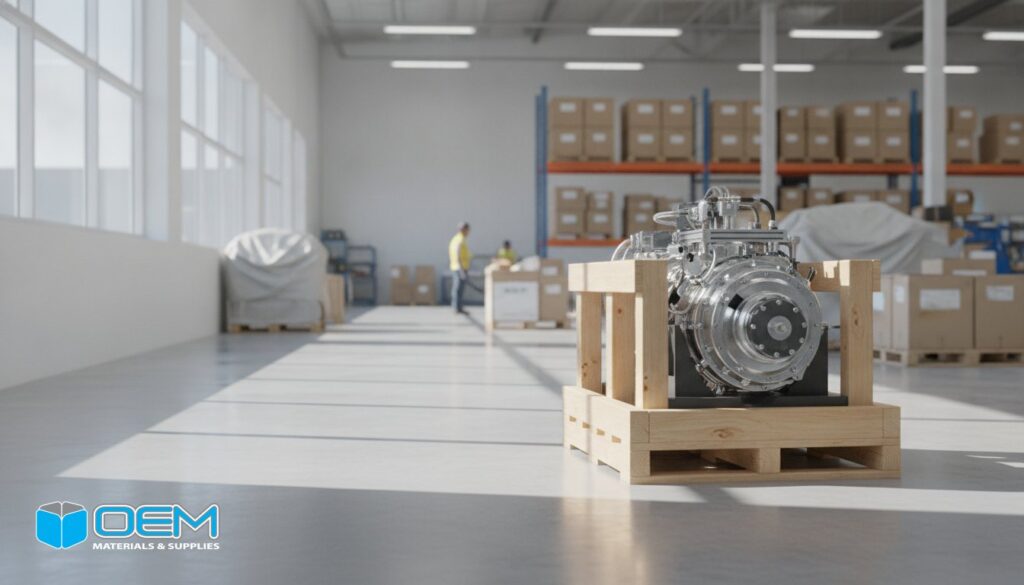
A standard 48×40 pallet is often the most expensive component in your warehouse when it doesn’t actually fit your product. For industrial manufacturers in Southern California, relying on “one size fits all” solutions frequently leads to costly product damage and inefficient use of trailer space. Procuring custom pallets Los Angeles businesses can rely on requires moving beyond commodity thinking and treating the pallet as a precision-engineered part of your shipping system.
You likely already know that manual adjustments to oversized loads or repairing goods damaged by pallet failure are drains on your bottom line. This guide will show you how to optimize your supply chain with custom-engineered pallets designed for the specific load requirements of Southern California industrial sectors. We will examine how tailoring pallet dimensions and materials can reduce shipping damage, maximize your warehouse footprint, and ensure your international shipments meet the latest ISPM 15 hyphen enforcement standards at the Ports of Los Angeles and Long Beach.
Key Takeaways
- Identify why standard 48×40 pallets often fail to protect specialized industrial loads and how custom dimensions prevent transit damage.
- Evaluate engineering specifications like static and dynamic load capacities to ensure your pallet choice matches cargo weight and fragility requirements.
- Compare the cost benefits of wood prototypes against the long-term durability and hygiene standards of plastic pallets for medical or electronics sectors.
- Maintain international shipping compliance by following ISPM-15 heat treatment standards to avoid costly rejections at Southern California ports.
- Learn how sourcing custom pallets Los Angeles suppliers provide via VMI programs can reduce warehouse labor and eliminate inventory shortages.
Limitations of Standard Pallets for Los Angeles Industrial Loads
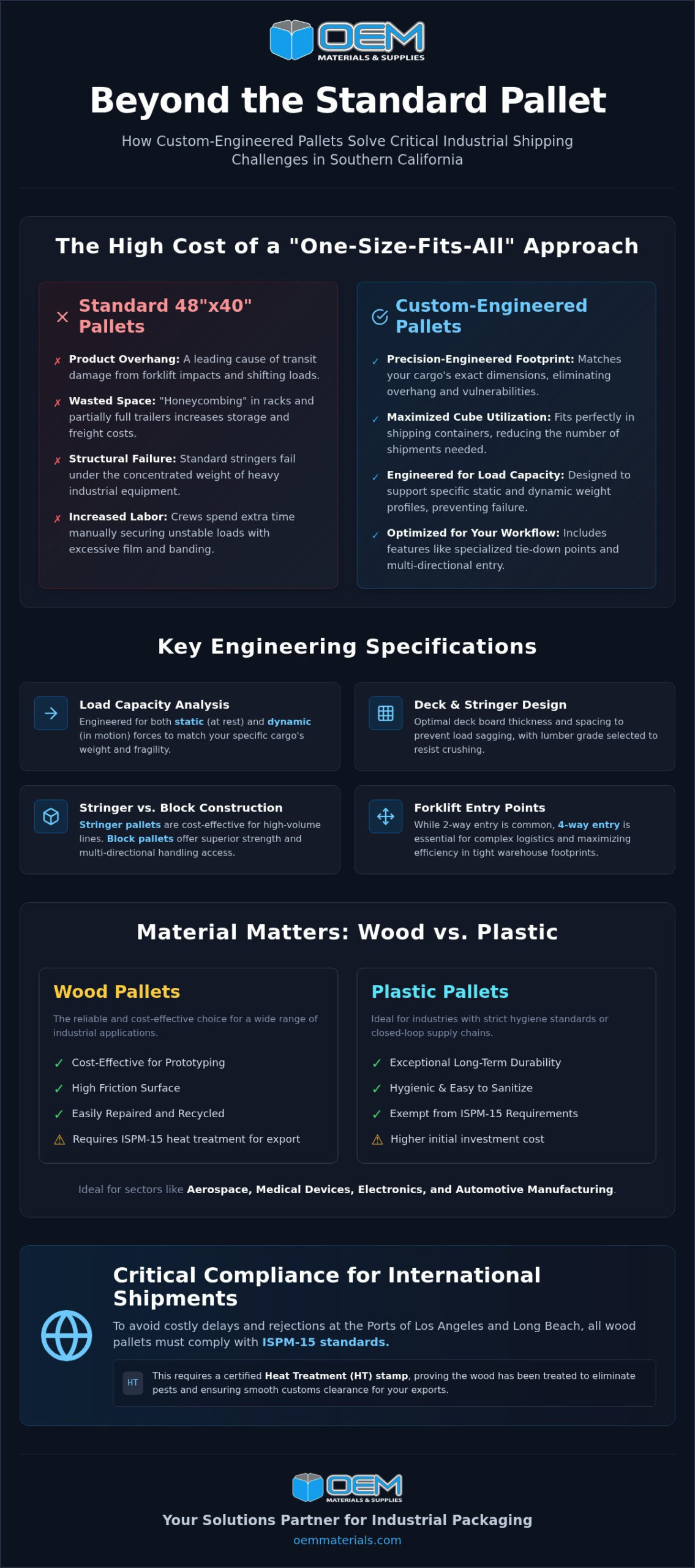
The standard GMA 48×40 pallet is the backbone of the retail supply chain, but it’s often a liability for the specialized industrial sectors in Southern California. Aerospace components, automotive assemblies, and heavy machinery rarely conform to these dimensions. When you force an irregular load onto a standard platform, you create immediate risks. If the product is too small, you’re paying to ship air and wasting warehouse footprint. If it’s too large, you face the danger of pallet overhang.
Overhang is a leading cause of product damage in crowded Los Angeles warehouses. A protruding edge is an easy target for a passing forklift or a neighboring rack. Even a minor impact can compromise the structural integrity of the entire load. Sourcing custom pallets Los Angeles manufacturers rely on allows for a precision-engineered footprint that matches your specific cargo, eliminating the vulnerabilities of mismatched dimensions.
Identifying Product Damage Risks
Standard pallet stringers aren’t always designed to handle the concentrated weight of heavy industrial equipment. Structural failure often occurs when weight isn’t distributed evenly across the deck boards. Many industrial loads also require specialized tie-down points or recessed pockets that standard pallets simply don’t have. Without these features, sensitive electronics or medical devices can shift during transit across the region’s highways.
To mitigate these risks, logistics professionals integrate custom foam packaging directly with the pallet base. This combination provides both structural support and vibration dampening. A deep understanding of pallet design and materials is necessary to ensure the deck can withstand the static and dynamic forces encountered during shipping. Custom pallets Los Angeles businesses use are engineered to support these specific load profiles, ensuring the product stays secure from the assembly line to the final destination.
Operational Inefficiencies in the Warehouse
Using standard pallets for irregular loads creates “honeycombing” in your storage racks, where empty spaces between mismatched pallets waste valuable vertical and horizontal capacity. This inefficiency drives up your total cost of ownership. You’ll also see a spike in labor costs as warehouse crews spend extra time manually securing unstable loads with excessive banding or stretch film.
For high-value machinery, the most effective remedy is often a hybrid approach. Integrating custom-sized pallets with custom crates provides a rigid outer shell and a secure, bolted base. This setup allows for safe stacking and more predictable freight planning. By designing the pallet to fit the exact dimensions of a standard shipping container, you can maximize your trailer’s cube utilization and reduce the number of shipments required to move your inventory.
Engineering Specifications for Custom Pallet Design
Engineering custom pallets Los Angeles operations need involves more than just selecting wood or plastic. It’s about matching the pallet’s structural properties to the specific forces it will encounter. We determine optimal deck board thickness and spacing based on the footprint of your product. If the spacing is too wide, the load might sag; if it’s too narrow, you’re adding unnecessary weight and material cost. Selecting the right lumber grade or plastic density is equally important. Fragile cargo requires a more rigid deck to prevent flexing, while heavier industrial components might need dense hardwoods to resist crushing.
Entry points also dictate warehouse efficiency. Two-way entry pallets are often sufficient for simple storage, but four-way entry is essential for complex logistics where forklifts and pallet jacks need access from any side. This flexibility is particularly valuable in the tight footprints of many Southern California distribution centers. If you’re designing a new shipping system, you can consult with our design team to ensure your specifications are accurate for your specific load and warehouse configuration.
Stringer vs Block Pallet Design
Stringer pallets are a reliable, cost-effective choice for many high-volume manufacturing lines. They utilize parallel boards to support the deck, providing a sturdy foundation for most industrial loads. However, for complex supply chains that require multi-directional handling, block pallets are often superior. These use individual blocks instead of long stringers, enabling four-way entry for all handling equipment. If your cargo is highly sensitive to surface irregularities, we often utilize plywood or oriented strand board (OSB) decks. These materials provide a smooth, flat surface that eliminates the gaps and ridges found on standard deck boards.
Calculating Load Requirements
Load capacities aren’t interchangeable. A static load rating tells you how much weight a pallet can hold while sitting still on a flat floor. It’s usually the highest rating. The dynamic load capacity is more practical; it accounts for the pallet being lifted and moved by a forklift. This rating is typically much lower than the static limit because it accounts for the stresses of motion and sudden stops.
The most critical metric for many managers is the racking load. This is the weight a pallet can safely support when it’s suspended in an open-beam rack. If your pallet isn’t engineered for this specific stress, the deck boards can bow or break, leading to safety hazards. Precise engineering ensures your pallets don’t fail under pressure, protecting both your personnel and your inventory.
Comparing Wood and Plastic Pallets for Southern California Distribution
Choosing between wood and plastic is a fundamental decision that impacts your total cost of ownership. Wood remains the industry standard for custom pallets Los Angeles manufacturers require during the prototyping phase. It offers the highest level of customization and the lowest initial cost for short-run production. When an aerospace firm in the South Bay needs a unique platform for a new component, wood allows for rapid adjustments and immediate delivery without the lead times required for custom plastic molds.
Environmental factors in Los Angeles also play a role in material selection. While wood is susceptible to moisture and requires strict pest control, plastic pallets are naturally resistant to both. This makes plastic an ideal choice for medical and cleanroom environments where hygiene is non-negotiable. For a detailed breakdown of material densities and load ratings, you should consult the Industrial Guide to Heavy Duty Plastic Pallets before finalizing your procurement strategy.
Benefits of Custom Wood Pallets
Custom wood pallets are highly adaptable for local distribution loops across Orange County and the Inland Empire. Their ease of repair is a major advantage; a damaged deck board can be replaced quickly to extend the pallet’s service life. They’re also the most cost-effective option for one-way international shipments. Since wood is fully recyclable, it aligns with the sustainability goals of many businesses looking to minimize their environmental footprint in Southern California.
Advantages of Plastic Pallets in Specialized Sectors
In the electronics and medical device sectors, the precision of plastic is often worth the higher initial investment. Plastic pallets offer uniform dimensions and weight, which are critical for automated sorting and retrieval systems (ASRS). They don’t produce wood dust or splinters, protecting sensitive components from contamination. In a closed-loop supply chain where you control the return of the asset, the durability of plastic provides a superior long-term ROI compared to wood, which may only last a fraction of the cycles.
Compliance and Export Standards for Custom Pallets
International shipping through the Ports of Los Angeles and Long Beach requires strict adherence to wood packaging regulations. For any business utilizing custom pallets Los Angeles suppliers provide for export, ISPM-15 compliance is a non-negotiable requirement. These standards are designed to prevent the global spread of invasive timber pests. Non-compliant shipments face immediate quarantine, fines, or destruction at the exporter’s expense, which can derail sensitive aerospace or medical supply chains.
As of 2026, enforcement has become even more stringent regarding the physical marking on wood packaging. U.S. Customs and Border Protection now requires a specific hyphenated format for the ISPM-15 stamp. The country code and facility code must be separated by a hyphen to be considered valid. Verifying that your wholesale industrial packaging supplier uses the updated 2026 marking format is essential to avoid rejections at the border.
The ISPM-15 Heat Treatment Process
Heat treatment (HT) is the most common method for achieving compliance, accounting for over 95% of treated wood packaging globally. The process involves heating the core of the wood to a minimum temperature of 56 degrees Celsius (132.8 degrees Fahrenheit) for at least 30 continuous minutes. This thermal process eliminates larvae and insects without the use of chemicals, making it safe for sensitive electronics and pharmaceutical environments.
Once treated, the wood receives the IPPC mark. This permanent stamp serves as a passport for your pallets, allowing them to move through 186 member countries. In the aerospace sector, where documentation is as critical as the hardware itself, maintaining records of heat treatment certifications is a standard operational requirement. If you are preparing an international shipment and need verified compliant platforms, you can request a quote for ISPM-15 certified pallets to ensure your cargo moves without friction.
Alternative Materials for Export
You can simplify your export logistics by selecting materials that are naturally exempt from ISPM-15 regulations. Plastic pallets contain no raw wood, meaning they don’t require heat treatment or specialized stamps. This makes them an excellent choice for high-frequency international loops where speed is a priority. Engineered wood products, such as those made with high-heat and pressure processes, are also typically exempt. These materials offer a lighter weight alternative to solid wood, helping to minimize dimensional weight surcharges while ensuring your cargo clears customs without delay.
Optimizing Supply Chain Efficiency with Custom Pallet Programs
Efficiency in the Southern California supply chain depends on moving away from reactive purchasing. Manufacturers in Los Angeles and Orange County often face labor spikes caused by manual pallet preparation and load stabilization. A structured program for custom pallets Los Angeles operations use transforms these platforms into strategic assets. Kitting and assembly services provide pallets pre-fitted with specialized components, which significantly reduces the labor hours required on your production line. Just-in-time (JIT) delivery schedules further support lean manufacturing by providing the exact number of units needed for specific production runs.
Vendor-Managed Inventory for Pallets
Stockouts of custom components can halt an entire assembly line. Implementing packaging VMI ensures specific pallet designs are always available without requiring you to dedicate massive amounts of floor space to overstock. This proactive approach uses historical usage data to optimize order cycles, ensuring lean inventory levels and reducing the capital tied up in unused materials. It also reduces administrative overhead by consolidating reporting and invoicing into a single, manageable stream. This stability allows your procurement team to focus on engineering tasks rather than constant stock checks.
Integrated Packaging Solutions
A pallet is the structural foundation of a complete protective system. Designing pallets and corrugated boxes as a single unit ensures the box footprint aligns perfectly with the deck boards. This alignment prevents box corners from collapsing, which is a common failure point when using mismatched standard pallets. Perfect alignment also improves cube utilization in trailers, allowing you to fit more product into every shipment across the Inland Empire.
Integrating your pallet design with edge and corner protectors stabilizes the load, allowing for more efficient stretch film application. Consulting with an expert for custom packaging design helps identify these cost-saving opportunities. It is important to note that specific financial results and performance improvements depend on variables such as your product dimensions, material selection, and shipping requirements. These integrated solutions ensure high-value aerospace or medical components remain secure during transit to San Diego County, ultimately lowering your total cost of ownership.
Optimize Your Southern California Shipping Operations
Transitioning from standard platforms to engineered shipping solutions is a critical move toward long-term supply chain stability. By prioritizing load-specific engineering and adhering to the latest ISPM-15 hyphen enforcement standards, you protect your inventory from transit damage and avoid costly port delays. Integrating the custom pallets Los Angeles manufacturers rely on into a structured VMI or JIT program eliminates warehouse congestion and ensures your production lines remain operational. These strategies shift your packaging from a commodity expense to a functional advantage.
OEM Materials & Supplies has supported the specialized requirements of the aerospace, medical, and electronics sectors since inception. We provide local Southern California support with a nationwide reach, offering the technical expertise required to manage complex industrial logistics. Our team handles everything from rapid wood prototyping to high-volume plastic pallet production with precision.
To receive an accurate recommendation for your application, contact OEM Materials & Supplies for a consultation. Please be prepared to provide your product dimensions, estimated load weight, and annual usage requirements so our engineers can design the most efficient solution for your facility.
Frequently Asked Questions
Is a standard 48×40 pallet always the best choice for shipping?
No. While the 48×40 GMA pallet is a retail standard, it’s often inefficient for specialized industrial loads. If your product dimensions don’t align with these measurements, you face risks like pallet overhang or wasted trailer space. Custom sized platforms ensure that weight is distributed across the stringers correctly. This prevents structural failure, which is especially important for aerospace or automotive components manufactured in Los Angeles that don’t fit standard dimensions.
What is ISPM-15 compliance for Los Angeles exporters?
ISPM-15 is an international standard requiring wood packaging to be heat treated to eliminate pests. For exporters using the Ports of Los Angeles or Long Beach, all wood pallets must reach a core temperature of 56 degrees Celsius for 30 minutes. As of 2026, customs officials strictly enforce the hyphenated IPPC mark. Non-compliant pallets can lead to shipment rejection, quarantine, or destruction at the exporter’s expense.
How do custom pallets reduce shipping damage for heavy machinery?
Custom pallets are engineered to handle specific static and dynamic load requirements. By matching the pallet footprint to the machine base, you eliminate overhang and the risk of forklift strikes in crowded San Diego or Riverside warehouses. We design these platforms with reinforced deck boards and specific tie down points. This ensures heavy loads remain stationary during transit, preventing the shifting that typically causes structural damage to high value equipment.
Can I combine custom pallets with foam inserts for sensitive electronics?
Yes, integrating custom pallets with engineered foam inserts is a standard practice for protecting sensitive electronics. This combination provides both structural support and vibration dampening. For manufacturers in Orange County, we often design these as single units where the foam is fitted to the pallet deck. This ensures the cargo is isolated from road shock and remains secure within the outer corrugated box or wood crate during the entire shipping cycle.
What is the typical lead time for custom pallet prototypes in Southern California?
Lead times vary based on material availability and design complexity, but local Southern California manufacturers often benefit from rapid turnaround for wood prototypes. Because wood is highly adaptable, we can produce initial samples quickly to verify fit and function before moving to high volume production. This speed is essential for R&D teams in the aerospace and medical sectors who need to test packaging designs against tight project deadlines.
How does vendor-managed inventory work for industrial pallet supplies?
Vendor-managed inventory (VMI) allows us to monitor your usage levels and replenish custom pallets Los Angeles businesses need before a stockout occurs. We take responsibility for maintaining agreed upon inventory levels at your facility or our regional warehouse. This proactive approach reduces your administrative overhead and eliminates the need for emergency orders. It also frees up valuable floor space in your warehouse by supporting a lean, just-in-time delivery model.
What are the main differences between stringer and block pallets?
The primary difference lies in their entry points and structural support. Stringer pallets use parallel boards to support the deck and typically offer two-way or partial four-way entry. Block pallets use individual blocks, providing true four-way entry for forklifts and pallet jacks. While stringer pallets are often more cost-effective for high-volume runs, block pallets offer superior durability and flexibility for complex logistics and automated sorting systems used across Southern California.
Are plastic pallets worth the extra cost for cleanroom environments?
Plastic pallets are often the superior choice for medical and pharmaceutical cleanrooms because they’re non-porous and easy to sanitize. Unlike wood, they don’t produce dust, splinters, or harbor pests, which are critical factors for maintaining sterile environments in the San Diego biotech sector. While the initial investment is higher, their durability in closed-loop systems often results in a lower total cost of ownership over many reuse cycles compared to wood.