
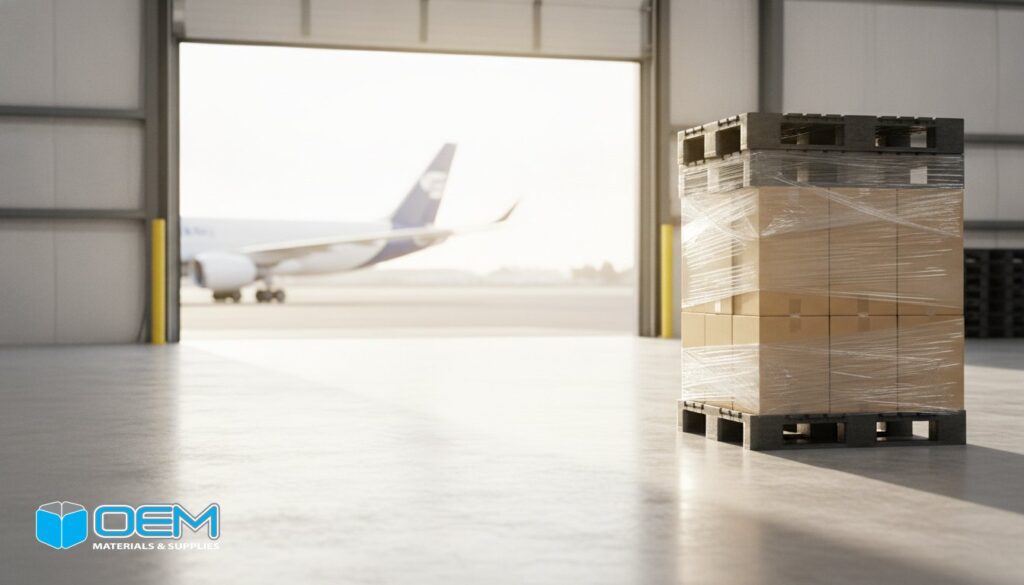
A recent industry report from the European Pallet Association confirms that plastic pallets can be up to 30% lighter than their wooden counterparts. For companies managing high-volume global distribution, this weight difference represents a direct opportunity to lower tare weights and reduce air freight expenses. You understand that every pound and every minute counts when moving critical components across borders. Dealing with customs delays due to ISPM-15 non-compliance or finding products damaged by moisture and splinters in a shipping container is a costly drain on your resources.
This guide demonstrates how plastic pallets for international shipping streamline your logistical compliance and protect your inventory. By choosing plastic, you eliminate the need for heat treatment and fumigation, ensuring your shipments move through customs without the risk of wood-borne pest inspections. We will explore the technical benefits of different pallet designs, their compatibility with automated systems, and how they provide a more reliable foundation for your global supply chain. You’ll learn to standardize your packaging while achieving a lower total cost of ownership for your international operations.
Key Takeaways
- Learn why plastic pallets are naturally exempt from ISPM-15 regulations, allowing you to bypass heat treatment requirements and avoid costly customs delays.
- Discover how the high weight-to-strength ratio of plastic pallets for international shipping reduces tare weight to help lower your total air freight expenses.
- Understand the durability benefits of non-porous materials that resist moisture, chemicals, and splinters to protect your high-value inventory during long-haul transit.
- Identify the critical differences between US and metric dimensions to ensure your pallet loads remain compatible with global warehouse standards and automated systems.
- Explore how Southern California exporters can leverage local sourcing and vendor-managed inventory to maintain a steady supply of pallets near major shipping hubs.
International Shipping Regulations and ISPM-15 Compliance
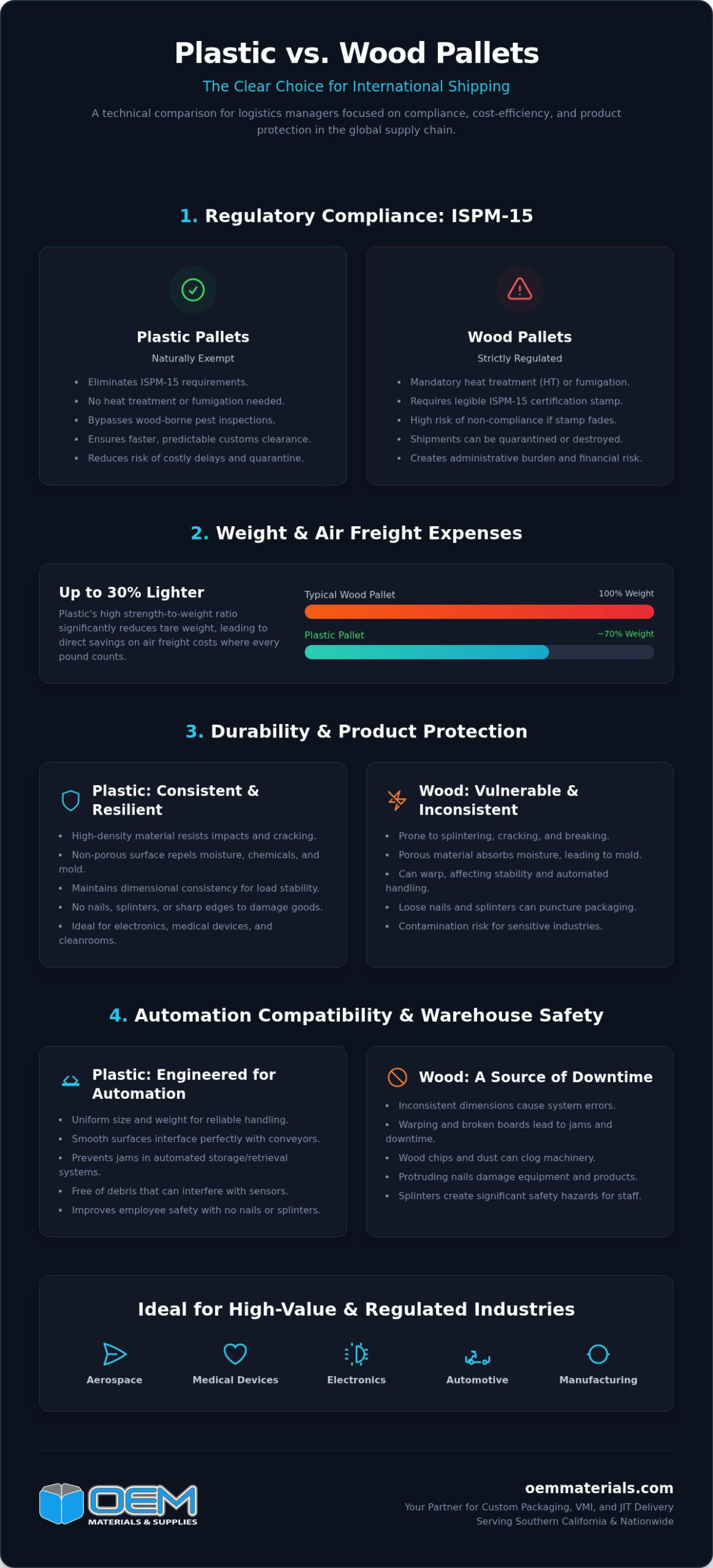
ISPM-15 is the international standard for regulated wood packaging. Established by the International Plant Protection Convention (IPPC), these rules dictate how solid wood packaging material thicker than 6mm must be treated to prevent the spread of invasive pests. For exporters, this means every wooden pallet must undergo heat treatment or fumigation and bear a visible certification mark. Using plastic pallets for international shipping eliminates these regulatory requirements because plastic is a non-organic material that cannot harbor wood-borne insects.
The risk of using wood in global trade is substantial. If a customs official in a foreign port finds a missing stamp or suspects a pest infestation, they can hold the entire shipment in quarantine. These delays lead to storage fees and missed delivery windows. In extreme cases, the cargo must be offloaded and the non-compliant wood destroyed at the exporter’s expense. Moving to plastic mitigates these financial risks by ensuring your packaging is naturally compliant with ISPM 15 regulations across all major trading partners.
The Problem with Heat-Treated Wood
Heat-treated (HT) wood pallets are the standard alternative to plastic, but they come with operational limitations. The HT stamp must remain legible throughout the entire journey. If a pallet is repaired with untreated wood or if the stamp fades due to moisture, it loses its certification. Additionally, wood is porous and prone to mold growth in humid shipping containers. For high-precision sectors like medical devices or electronics, mold contamination is as damaging as a physical impact. Managing the paperwork and verifying the HT status of every pallet in a warehouse creates an unnecessary administrative burden for logistics teams.
Regulatory Advantages of Plastic
Choosing plastic pallets for international shipping provides a level of consistency that wood cannot match. Customs agents recognize plastic as a low-risk material, which facilitates faster processing at checkpoints. You don’t need to track heat-treatment logs or maintain specialized phytosanitary documentation for your packaging. This standardized approach is particularly valuable for companies in San Diego and Orange County that ship to multiple international destinations with varying local rules. By using a material that is universally exempt from wood-specific mandates, you simplify your export protocols and ensure your supply chain remains fluid regardless of the destination’s specific environmental laws.
Performance Advantages of Plastic Pallets in Global Logistics
Plastic pallets offer a superior weight-to-strength ratio that directly impacts the efficiency of your supply chain. While traditional wood pallets are prone to splintering, cracking, or losing structural integrity under heavy loads, high-density polyethylene (HDPE) or polypropylene (PP) pallets maintain their shape. This dimensional consistency is a requirement for modern warehouses utilizing automated sorting and retrieval systems. In these environments, even a slight warp in a wood board can cause a system jam, leading to downtime and manual intervention. Plastic pallets for international shipping provide a standardized platform that interfaces reliably with conveyors and robotic arms.
Safety is another critical factor. The absence of nails, splinters, and broken boards protects your warehouse staff from injury and prevents damage to your transport equipment. Plastic is non-porous. It doesn’t absorb moisture, harbor bacteria, or react to most industrial chemicals. This makes it an ideal choice for sectors with strict hygiene requirements, such as pharmaceuticals and food exports. Following the ISPM 15 guidelines ensures your material choice meets global safety standards while maintaining a clean environment for your cargo.
Material Durability and Product Protection
The rigidity of plastic pallets prevents load shifting during the intense vibrations and movements of ocean transit. When your products are secured on a stable, non-flexing base, the risk of secondary packaging failure is significantly reduced. For companies shipping sensitive electronics or medical devices, this stability is essential. You can enhance this protection by integrating your pallet loads with custom foam packaging. This combination creates a high-precision shipping solution that isolates delicate components from both impact and environmental contaminants. If you need a specialized configuration for your next export, you can request a quote for a tailored packaging system.
Weight Savings and Freight Efficiency
Weight reduction is one of the most immediate benefits of switching from hardwood to plastic. Research from the European Pallet Association indicates that plastic pallets can be up to 30% lighter than wood alternatives. In the context of air freight, where costs are calculated by the pound, this reduction in tare weight translates into substantial savings. For manufacturers in San Diego County or the Inland Empire, these savings extend to ground transportation as well. Lighter loads allow for better fuel efficiency and can often enable higher product density per truckload within legal weight limits. These efficiencies help offset the initial purchase price by lowering the ongoing operational costs of your global distribution network.
Analyzing Total Cost of Ownership for Export Pallets
Evaluating the value of plastic pallets for international shipping requires looking past the initial purchase price. While a wood pallet might appear cheaper on a line-item quote, the total cost of ownership (TCO) reveals a different reality. You must account for the elimination of heat-treatment fees, the reduction in product damage claims caused by failed boards, and the significant labor efficiency gains from handling lighter, uniform equipment. A 15-pound weight reduction per pallet results in a total savings of 300 pounds for a standard 20-pallet air shipment, directly lowering the billable weight on the carrier invoice. Because plastic is exempt from ISPM 15 regulations, you also remove the financial risk of container rejection at the port.
Freight and Fuel Surcharges
Carriers increasingly pass fuel costs to exporters through variable surcharges. Lighter packaging materials help you manage these fluctuating expenses by reducing the gross weight of your shipments. When shipping through the Port of Los Angeles or the Port of Long Beach, maximizing container volume without exceeding weight limits is a constant challenge. Heavy hardwood pallets consume a larger portion of your weight allowance, often forcing you to ship fewer products per container. For aerospace components manufactured in Southern California, switching to plastic pallets ensures that the weight budget is reserved for the high-value cargo itself rather than the packaging. This optimization is particularly effective for high-frequency air freight where every ounce impacts the bottom line.
Warehouse and Labor Optimization
Operational savings extend into the warehouse environment. Consistent dimensions and weight allow your staff to handle pallets more predictably, reducing the physical strain associated with heavy, moisture-laden wood. Lighter loads also lead to less wear and tear on forklifts and pallet jacks, extending the life of your material handling equipment. In high-volume facilities across Los Angeles County, warehouse space is at a premium. Utilizing a Vendor-Managed Inventory program for your pallets reduces storage overhead by ensuring you only house the inventory you need for immediate production. This service prevents stockouts and eliminates the hidden costs of managing large, idle pallet piles in your facility. By streamlining both the physical handling and the administrative tracking of your shipping platforms, you achieve a more lean and cost-effective export operation.
Key Specifications for Selecting International Shipping Pallets
Selecting the correct platform requires a precise understanding of the infrastructure at your destination. While the 48×40 inch pallet is the standard for North American distribution, many international markets utilize the 1200×1000 mm metric standard. Using a non-standard footprint can lead to wasted space in ocean containers or incompatibility with foreign racking systems. You must also evaluate load capacities based on how the cargo moves. Static capacity refers to the weight a pallet supports when stationary on a level floor, while dynamic capacity dictates the limit for plastic pallets for international shipping when they are in motion on a forklift. For heavy machinery or dense industrial components, these ratings are non-negotiable safety requirements.
Material choice also impacts performance and cost. Virgin High-Density Polyethylene (HDPE) offers superior impact resistance and performs well in cold storage environments. Recycled plastic blends provide a cost-effective alternative for one-way export applications where the pallet will not be returned. You should also consider deck designs. Ventilated decks allow for better airflow and easier cleaning, which is essential for temperature-sensitive goods. Solid top designs prevent small parts or liquids from dripping onto cargo stored below, providing an extra layer of protection for high-value shipments leaving Orange County or San Diego ports.
Nestable vs. Stackable Configurations
Nestable pallets provide a significant advantage for warehouse optimization. Because the legs of these pallets fit inside one another, they can reduce empty storage space requirements by up to 70% compared to traditional stackable models. This feature is particularly valuable for facilities in Los Angeles where square footage is expensive. However, nestable designs are typically intended for floor stacking or floor-to-floor transit. If your global distribution involves high-density warehouse racking, stackable pallets with a full-perimeter base or runners are necessary to ensure the load remains stable and unsupported on the rack beams.
Safety and Handling Features
Versatility in handling is mandatory for global logistics. Four-way entry designs allow forklifts and pallet jacks to access the load from any side, which is critical when navigating tight containers or diverse international warehouse layouts. To prevent load shifting, look for pallets with anti-slip surfaces or perimeter lips that keep corrugated boxes in place. These features work in tandem with secondary packaging materials to secure the unit. Proper load containment is achieved through the correct stretch film for pallet wrapping, ensuring that the entire shipment remains unitized during the vibrations of ocean or air transit. If you are unsure which specifications best suit your product weight and dimensions, contact us for a technical consultation to find the right industrial solution.
Industrial Packaging Solutions for Southern California Exporters
For manufacturers in Orange County and San Diego, logistics efficiency is directly tied to the proximity of the Port of Los Angeles and Port of Long Beach. Sourcing plastic pallets for international shipping from a local partner ensures that your supply chain remains responsive to the rapid shifts in maritime schedules and container availability. We don’t just provide a pallet base. We focus on how that base integrates with other critical components like corrugated boxes and stretch film to create a unified, damage-resistant load. This holistic approach is essential for high-volume distribution hubs in Riverside and the Inland Empire, where Just-in-Time (JIT) delivery options prevent warehouse congestion and keep assembly lines moving without the need for massive on-site pallet stockpiles.
Custom Packaging Design and Kitting
When launching new products in the medical or aerospace sectors, a standard pallet is often insufficient for high-stakes transit. You require a configuration that accounts for the specific center of gravity and the extreme fragility of your components. Our team provides technical prototyping services that combine pallets with engineered foam packaging to isolate products from vibration and shock during multi-modal transport. We also offer kitting and assembly services, delivering pre-configured packaging sets directly to your facility. This streamlines your internal processes by reducing the labor required on your production floor, allowing your team to focus on manufacturing rather than sourcing individual packaging elements from multiple vendors.
Partnering with a Local SoCal Supplier
Choosing a local supplier provides a level of accountability and technical support that national commodity resellers cannot match. When an urgent export requirement arises in San Diego County, you need a partner capable of rapid response and accurate stock availability. We understand the rigorous quality standards of the aerospace and medical device industries, where documentation and consistency are as important as the materials themselves. By aligning your pallet strategy with our value-added services like vendor-managed inventory, you gain a competitive edge in global distribution through increased reliability. Contact OEM Materials & Supplies today for a consultation on your specific export requirements. Please include your product dimensions, weight, and annual usage to help our engineers provide a tailored recommendation for your supply chain.
Optimizing Your Global Logistics Strategy
Adopting plastic pallets for international shipping is a strategic decision that addresses the most persistent challenges in modern export logistics. By utilizing a platform that is naturally exempt from ISPM-15 regulations, you eliminate the risk of costly customs delays and quarantine fees. The significant reduction in tare weight compared to hardwood alternatives provides direct savings on air freight and fuel surcharges, while the non-porous material ensures your high-value inventory remains protected from moisture and contaminants throughout the entire transit process.
OEM Materials & Supplies serves as a dependable partner for aerospace and medical OEMs across Southern California. With local inventory in Orange County and San Diego, we offer the technical expertise and rapid response times required to maintain a lean, efficient supply chain. Our engineers are ready to help you integrate these pallets with custom foam and corrugated solutions for a complete, high-precision packaging system. Request a Quote for Export-Grade Plastic Pallets today. Please provide your specific product dimensions and annual usage to receive an accurate recommendation for your operation. We look forward to strengthening your global distribution network.
Frequently Asked Questions
Do plastic pallets need to be heat treated for international shipping?
Plastic pallets do not require heat treatment or fumigation because they are naturally exempt from ISPM-15 regulations. These standards specifically target solid wood packaging materials to prevent the spread of invasive pests. Since plastic is a non-organic material, it doesn’t harbor wood-borne insects. This exemption allows your shipments to move through international customs checkpoints without the need for specialized phytosanitary documentation or heat-treatment stamps.
What is the weight capacity of a standard export plastic pallet?
Weight capacity depends on the specific pallet design and whether the load is static or dynamic. High-performance plastic pallets can support static loads of several thousand pounds when stored on a flat floor. However, dynamic capacity is typically lower and refers to the weight the pallet supports while in motion on a forklift. Engineers at our Orange County facility can help you determine the correct specifications based on your specific machinery or product weight.
How do plastic pallets save money on air freight costs?
Plastic pallets for international shipping save money by significantly reducing the tare weight of your cargo. Because high-density plastic can be up to 30% lighter than hardwood, you pay less in billable weight for every shipment. These savings are especially impactful for aerospace and medical manufacturers in San Diego who utilize frequent air transport. Lowering the weight of each pallet by 15 to 20 pounds directly offsets carrier fuel surcharges.
Are plastic pallets recyclable after their service life?
Yes, most industrial plastic pallets are manufactured from High-Density Polyethylene (HDPE) or Polypropylene (PP), which are both highly recyclable materials. Once a pallet reaches the end of its functional lifespan, it can be ground down and processed into new plastic products. This recyclability supports a circular economy and helps Southern California manufacturers meet corporate sustainability goals while maintaining a durable and reliable shipping platform for their global distribution needs.
What are the most common sizes for international shipping pallets?
The two most prevalent sizes are the standard 48×40 inch pallet used in North America and the 1200×1000 mm metric pallet used in many international markets. Choosing the correct size is vital for maximizing container volume and ensuring compatibility with foreign warehouse racking systems. We provide both US and metric dimensions to help exporters in Los Angeles County standardize their packaging for seamless integration into global supply chains and automated sorting systems.
Can plastic pallets be used in cleanroom or medical environments?
Plastic pallets are the preferred choice for medical and cleanroom environments due to their non-porous surfaces. Unlike wood, plastic does not absorb moisture, harbor bacteria, or produce dust and splinters. They are easy to clean and sanitize, making them ideal for shipping sterile medical devices or sensitive electronic components. Our local inventory in Riverside includes options specifically designed to meet the rigorous hygiene requirements of the healthcare and pharmaceutical sectors.
What happens if my wood pallet does not have the ISPM-15 stamp?
If a wooden pallet lacks the required ISPM-15 certification mark, customs officials may hold the entire shipment in quarantine. This leads to significant delays, storage fees, and potential fines. In many cases, the cargo must be offloaded and the non-compliant wood destroyed at the exporter’s expense. Using plastic pallets for international shipping eliminates this risk entirely, as they are universally accepted as low-risk materials that don’t require phytosanitary markings.
How do nestable plastic pallets save warehouse space?
Nestable pallets feature a hollow leg design that allows them to fit inside one another when empty. This configuration can reduce the warehouse footprint required for empty pallet storage by up to 70% compared to stackable models. For facilities in Los Angeles where floor space is limited, this efficiency is a major benefit. Nesting also improves transport efficiency for empty returns, allowing for more pallets to be loaded onto a single truck or container.