
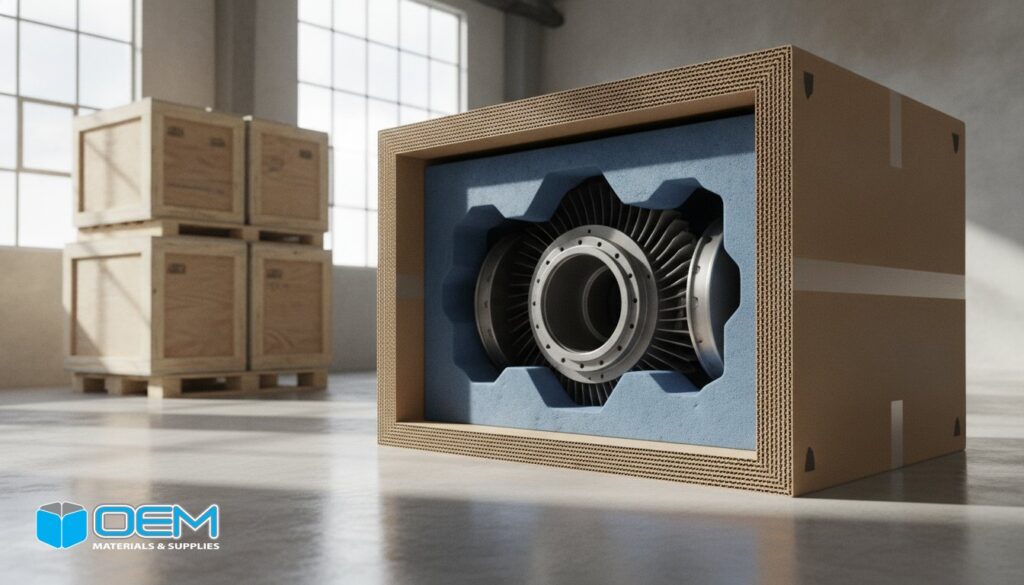
What if you could reduce your outbound shipping weight by approximately 30% without compromising the safety of your most critical industrial components? For many manufacturers across Los Angeles and Orange County, wood crates are the long-standing default for heavy-duty protection. You likely rely on them because they offer undeniable structural integrity, yet you’re also forced to manage high freight costs, excessive assembly labor, and the significant warehouse footprint these bulky materials require. It’s a common frustration to see shipping budgets consumed by the weight of the packaging rather than the product itself, which is why engineering-grade triple-wall shipping boxes are becoming the preferred alternative for local logistics managers.
This article explains how triple-wall corrugated provides a high-strength, lightweight solution that meets rigorous industrial standards while streamlining your logistics. You’ll learn how these engineered materials provide the durability needed for heavy-haul transit while significantly lowering your total cost of ownership. We will examine the technical specifications of ASTM D5168-22 compliant materials, compare specific Edge Crush Test (ECT) ratings to traditional crating, and show how Southern California businesses are optimizing their supply chains with custom-sized, heavy-duty designs. By the end, you’ll understand why switching from wood to triple-wall corrugated is a strategic move for modern manufacturing and distribution operations.
Key Takeaways
- Understand the seven-layer structural engineering that allows corrugated material to support heavy industrial components.
- Learn how Edge Crush Test (ECT) ratings determine stacking strength to maximize warehouse vertical space.
- Discover how triple-wall shipping boxes reduce total freight costs by significantly lowering tare weight compared to wood crates.
- Identify specific industrial applications in Southern California, including aerospace and automotive components, that benefit from high-strength protection.
- Explore how custom sizing and vendor-managed inventory (VMI) programs eliminate stockouts and reduce dimensional weight charges.
Understanding Triple-Wall Corrugated: Engineering Strength for Heavy Loads
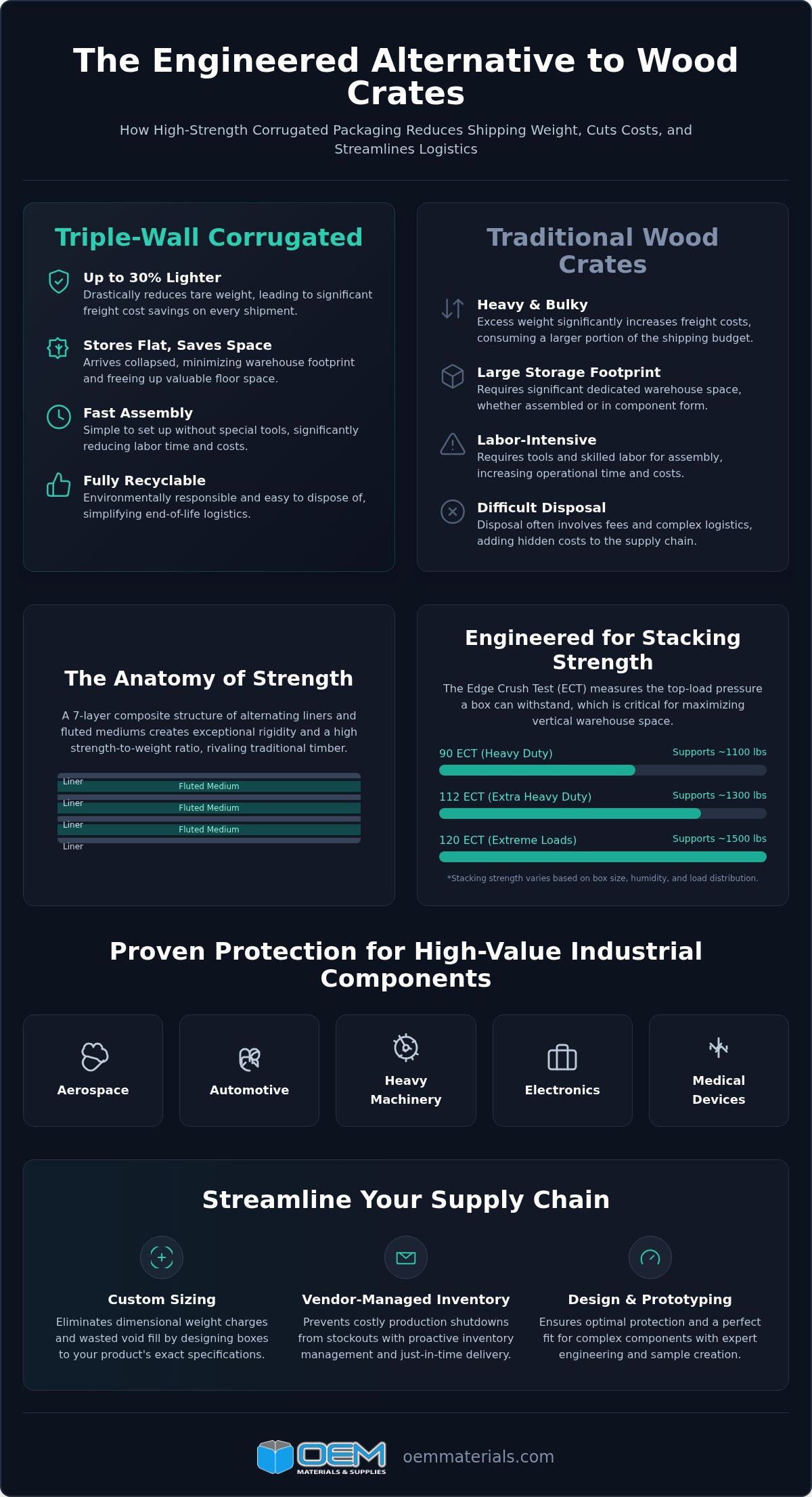
Triple-wall corrugated is a heavy-duty packaging material engineered for high-stress industrial environments. It’s a seven-layer composite consisting of four flat liners and three fluted mediums. This specific architecture allows triple-wall shipping boxes to provide a strength-to-weight ratio that rivals traditional timber. While standard boxes might fail under the pressure of heavy machinery or dense metal components, triple-wall is the preferred choice for shipments frequently exceeding 250 pounds. It provides a level of rigidity that ensures the container maintains its shape even when stacked multiple units high in a busy Southern California warehouse. This durability is essential for local manufacturers who need to protect high-value assets during ground or air transit.
The Anatomy of a Triple-Wall Box
The structural integrity of Corrugated fiberboard in a triple-wall configuration comes from its alternating flute layers. These flutes act as vertical columns that resist crushing forces. Manufacturers often combine different flute profiles, such as A, B, C, or K flutes, to balance cushioning with vertical stacking strength. For example, a combination of C-A-B flutes provides a thick, rigid wall that absorbs impact while supporting thousands of pounds of top-load pressure. The adhesive quality is equally critical; industrial-grade resins ensure the layers don’t delaminate during long-haul transit or in high-humidity environments. High-performance liners further enhance the box by creating a barrier against punctures and moisture ingress. This is especially vital for custom corrugated boxes designed for long-distance export or intermodal shipping.
Weight Capacity and Load Limits
Triple-wall containers are capable of handling significant weight, often engineered to protect products weighing 450 pounds or more. The specific load limit depends heavily on the box design and the nature of the contents. A standard Regular Slotted Container (RSC) is efficient for many applications, but a Half Slotted Container (HSC) with a separate cover often provides better stacking strength for exceptionally dense loads. Proper weight distribution is essential to prevent bottom-panel failure. For unique industrial components, custom packaging design helps determine the optimal box style for the specific weight and dimensions of the product. This engineering approach is what allows operations in Orange County and Los Angeles to transition away from heavy wood packaging. Triple-wall is an industrial-grade material capable of replacing traditional timber packaging.
Performance Metrics: Burst Strength and Edge Crush Test (ECT) Ratings
Selecting the right triple-wall shipping boxes requires more than just looking at dimensions. You must evaluate the specific engineering metrics that define how a box performs under pressure. The Edge Crush Test (ECT) is the primary industry standard for measuring stacking strength. It determines the amount of force a sample of corrugated board can withstand on its edge before collapsing. In a high-density warehouse in Los Angeles or Orange County, where pallet loads are often stacked three or four high, ECT is the most critical factor in preventing box failure. A 90 ECT rating is frequently the baseline for industrial loads, while a 112 or 120 ECT rating provides the necessary structural safety margin for exceptionally heavy components.
While stacking strength is vital, puncture resistance is equally important for heavy machinery with sharp edges or protruding bolts. This is measured by the Mullen Test, which determines the pressure required to burst the face of the corrugated board. For example, a 90 ECT triple-wall box typically corresponds to an 1100 lbs./sq. in. burst strength rating. Environmental factors in Southern California also play a role in performance. Humidity in coastal areas like Long Beach or Irvine can soften paper fibers, which may reduce a box’s effective ECT by a measurable percentage. Using high-performance liners or moisture-resistant coatings helps maintain integrity when shipping through varying climates.
ECT vs. Mullen Test: Which Matters More?
Industrial OEMs must prioritize these metrics based on their specific logistics chain. If your products are palletized and secured with stretch film, ECT is your primary concern because the boxes must support vertical weight. However, if your items have irregular shapes that exert localized pressure against the box walls, Mullen ratings become the priority to prevent punctures. Adhering to federal standards for fiberboard packaging ensures that your containers meet the necessary puncture and water resistance requirements for sensitive industrial applications. Balancing these two metrics is the key to minimizing product damage during long-haul transit.
Standard Ratings for Industrial Shipping
In the aerospace and automotive sectors, 90 ECT and 112 ECT are the standard benchmarks for triple-wall construction. These ratings offer the structural reliability needed for engine blocks, avionics, and heavy suspension assemblies. You can find more detail in our guide on Strength Ratings for Corrugated Shipping Containers. If you’re designing a new packaging program for a heavy component, you can request a technical consultation to review your specific load profiles and shipping requirements.
Triple-Wall vs. Wood Crates: Evaluating Cost and Operational Efficiency
Many industrial operations in Southern California default to wood crates because of their perceived durability. However, engineering-grade triple-wall shipping boxes provide a functional remedy that balances high-level protection with operational speed. Industry research suggests that switching from timber to triple-wall corrugated can result in weight savings of around 30%, which directly lowers freight costs for LTL and air shipments. It is necessary to clarify that actual cost reductions depend on specific variables, including product dimensions, material selection, and unique shipping requirements. When moving high volumes of industrial parts out of Los Angeles or Orange County, these incremental savings in tare weight represent a substantial reduction in total logistics spend.
Labor efficiency is another area where corrugated outperforms traditional timber. Building a custom wood crate requires specialized tools and safety equipment. In contrast, assembling a heavy-duty corrugated container involves simple folding and high-performance packaging tape. This reduction in assembly time allows your warehouse team to process more shipments per shift. Additionally, storing packaging materials is more efficient with corrugated. Triple-wall containers arrive and store flat, occupying a fraction of the warehouse space required for pre-built or knocked-down wood crates. This optimization is particularly valuable in the Inland Empire and San Diego, where industrial floor space carries a premium price.
Total Cost of Ownership Analysis
A true ROI analysis must look beyond the initial unit price of the box. You have to consider the full lifecycle, including assembly, shipping, and disposal. Because corrugated materials are fabricated under strict standards like ASTM D5168, they offer predictable performance that minimizes product damage claims. For the end receiver, corrugated is significantly easier to manage. In the United States, the recycling rate for corrugated paper is approximately 91.4%, making it one of the most sustainable and easily disposable materials in the supply chain. This eliminates the dunnage management fees and disposal headaches often associated with heat-treated lumber and wood scrap.
When Wood is Still Necessary
Corrugated is a robust material, but it has defined limits. For extremely oversized equipment or top-heavy machinery that requires a rigid base for bolting, traditional timber remains the industry standard. In many cases, a hybrid solution provides the best of both worlds. Using triple-wall containers mounted on wood pallets allows for easy forklift handling while keeping the overall tare weight lower than a full six-sided crate. If your application involves heavy-duty machinery that exceeds the load-bearing capacity of fiberboard, you can review our Industrial Guide to Crates to determine the best structural support for your specific project.
Industrial Applications: Protecting High-Value Components in Southern California
Southern California’s manufacturing landscape requires packaging that can withstand the rigors of heavy industrial transport. While previous sections detailed the engineering specs of these materials, their real-world value is best seen in high-stakes sectors like aerospace and automotive production. In Orange County, aerospace firms utilize triple-wall board to move sensitive avionics and engine components. These items require extreme stacking strength and puncture resistance to ensure they arrive at the assembly line without a scratch. Similarly, automotive suppliers in the region rely on these containers for transporting heavy transmissions and suspension assemblies that would otherwise require expensive, heavy timber crates.
The medical device industry also utilizes these high-strength solutions. Large-scale diagnostic equipment requires absolute stability during domestic transit to prevent calibration issues. For high-value electronics, combining triple-wall shipping boxes with engineered foam inserts provides the necessary shock protection to mitigate G-force impacts during forklift handling and transit. This combination of a rigid outer shell and a dampening inner layer is the industry standard for protecting sensitive hardware from the vibration and impact common in LTL shipping environments.
Regional Logistics in San Diego and Los Angeles
Regional logistics in San Diego and Los Angeles present unique challenges for operations managers. Packaging must be optimized for short-haul drayage from the ports as well as long-haul cross-country shipping. Major Southern California distribution hubs have strict requirements for pallet integrity and load stability. Sourcing from a local supplier reduces lead times for urgent manufacturing runs, ensuring that production lines don’t stall due to packaging shortages. This proximity allows for just-in-time delivery, which is essential for facilities with limited warehouse space in dense industrial zones.
Customization for Specific Industrial Parts
Standard box sizes often leave gaps that allow heavy parts to move, which is a leading cause of transit damage. Customization is the functional remedy. Die-cut triple-wall solutions are engineered to match unique product geometries, providing a snug fit that standard RSC boxes cannot achieve. Integrating internal dunnage, such as specialized cushioning materials, prevents internal movement that leads to surface abrasion. Custom design prevents product damage by eliminating shifting inside the box. If you need a specialized solution for a complex industrial component, request a quote for a custom prototype tailored to your specific dimensions and weight requirements.
Custom Triple-Wall Solutions and Vendor-Managed Inventory
Standardized boxes often create a logistical inefficiency known as dimensional weight inflation. When a container is larger than necessary, carriers charge based on the volume rather than the actual weight of the cargo. Custom-sized triple-wall shipping boxes solve this problem by matching the outer dimensions to the product’s specific footprint. This precision reduces freight expenses and minimizes the requirement for excessive internal dunnage. For companies shipping heavy industrial components, these incremental savings accumulate into significant cost reductions across high-volume programs.
Beyond the physical container, the reliability of a supply chain depends on consistent inventory management. A Vendor-Managed Inventory (VMI) program ensures zero stockouts of critical shipping supplies by shifting the burden of monitoring stock levels to the supplier. This service is particularly beneficial for manufacturers in Riverside and the Inland Empire who operate with limited floor space. Instead of dedicating valuable square footage to bulky packaging inventory, you can utilize Just-In-Time (JIT) delivery. This approach keeps production lines moving while maintaining a lean warehouse footprint.
Prototyping is a critical step before transitioning to high-volume production. It allows engineers to test custom box designs against real-world transit stresses and stacking requirements. By verifying the structural integrity and fit during the design phase, you eliminate the risk of costly product damage once the shipment enters the distribution network. This engineering-first approach ensures that the final packaging solution is both cost-effective and functionally sound.
Streamlining the Procurement Process
VMI programs lower administrative costs for purchasing managers by automating the reordering process and reducing the number of individual transactions. This allows for the consolidation of triple-wall shipping boxes with other essential supplies like stretch film, high-performance tape, and edge protectors. When requesting quotes, providing specific data such as annual usage, product weight, and dimensions allows for more accurate recommendations. This data-driven procurement strategy helps in securing better volume-based pricing and optimized delivery schedules.
Partnering with a Southern California Supplier
Working with an industrial partner that understands the local manufacturing landscape provides a distinct advantage in responsiveness. A Southern California supplier can offer rapid prototyping services for new product launches in Los Angeles, allowing you to move from design to finalized packaging in a fraction of the time required by out-of-state vendors. This proximity also facilitates more frequent site visits and technical support. Contacting a specialist for a comprehensive packaging audit can reveal hidden inefficiencies in your current process, ranging from material waste to labor-intensive assembly methods.
Optimizing Your Heavy-Duty Logistics Strategy
Industrial manufacturers across Southern California are recognizing that traditional timber packaging is no longer the only viable option for heavy-haul protection. Engineering-grade triple-wall shipping boxes provide the necessary structural integrity for sensitive aerospace and medical components while significantly reducing tare weight and freight expenses. By moving away from bulky wood crates, your operation can lower labor costs and reclaim valuable floor space in Los Angeles or Orange County facilities. The transition to high-performance corrugated is a functional remedy for rising shipping costs and warehouse inefficiencies.
OEM Materials & Supplies acts as a dedicated partner for SoCal manufacturers, offering custom design and rapid prototyping to meet specific industrial requirements. Our logistics support, including VMI and JIT programs, ensures your supply chain remains lean and responsive to production demands. We invite you to provide your product dimensions, weight, and annual usage for a technical assessment of your packaging needs. Contact OEM Materials & Supplies for a Triple-Wall Packaging Quote to begin optimizing your outbound logistics. We look forward to helping you build a more efficient and reliable shipping operation. Beyond facility management, if you are looking to enhance your property’s exterior, you can explore 4K Aluminum lattice patio cover options for a high-quality outdoor upgrade.
Frequently Asked Questions
What is the maximum weight capacity of a triple-wall shipping box?
Triple-wall shipping boxes can typically handle loads exceeding 450 pounds when engineered correctly. The specific capacity depends on the box style, such as a regular slotted container versus a half-slotted container with a cover. For dense industrial parts like engine blocks or heavy transmissions, the stacking strength is often more critical than the internal weight capacity alone. Custom designs can be reinforced to meet even higher weight requirements for specialized manufacturing applications.
Can triple-wall corrugated boxes replace wood crates for international shipping?
Yes, triple-wall containers are an excellent alternative to wood for international freight because they aren’t subject to ISPM 15 heat-treatment regulations. Solid wood packaging requires specific certifications to prevent pest migration, but corrugated board is exempt from these requirements. This simplifies the export process for Southern California manufacturers shipping to global markets. Additionally, the reduced tare weight of corrugated compared to timber can lead to significant savings on international air and ocean freight charges.
How do ECT ratings for triple-wall compare to double-wall boxes?
Triple-wall corrugated offers significantly higher Edge Crush Test (ECT) ratings than double-wall alternatives. While heavy-duty double-wall boxes usually peak at 51 ECT, triple-wall boards start at 67 ECT and can exceed 112 ECT. This jump in performance allows for much higher vertical stacking in warehouse environments. The extra layer of fluting provides the structural rigidity necessary to prevent box compression when palletizing heavy industrial components for long-haul transit.
Are triple-wall boxes water-resistant for outdoor storage?
Securing heavy-duty triple-wall boxes requires industrial-grade closure methods. Standard packaging tape may not provide enough shear strength for loads exceeding 200 pounds. We recommend using reinforced water-activated tape or heavy-duty pressure-sensitive tape in a wide format. For maximum security during LTL shipping, many operations also apply polyester or steel strapping. These materials ensure the bottom flaps remain secure under the immense pressure of heavy industrial components and high-stacking forces.
Can triple-wall boxes be reused for multiple shipments?
Triple-wall boxes can be reused for multiple shipments if the fluting remains structurally sound and the corners are not crushed. Reusability is most common in closed-loop logistics programs where the containers are returned to the point of origin. However, for one-way outbound shipping, the primary value lies in its high recyclability. After the box has served its purpose, it can be easily broken down and processed through standard recycling channels, which is more efficient than disposing of wood scrap.
What industries benefit most from switching to triple-wall corrugated?
The aerospace, automotive, and medical device sectors benefit most from transitioning to triple-wall corrugated. These industries frequently ship heavy, high-value components that require the protection of a crate without the associated weight. In Los Angeles and San Diego, manufacturers of avionics, transmissions, and large-scale diagnostic equipment use these boxes to streamline their packing processes. The material’s high puncture resistance and stacking strength make it ideal for protecting irregular, dense parts that would damage standard double-wall packaging.
How does the cost of triple-wall compare to standard double-wall corrugated?
The unit price of triple-wall corrugated is higher than standard double-wall because of the additional material and specialized manufacturing process. However, the total cost of ownership is often lower when shipping heavy items. Triple-wall prevents product damage that standard boxes cannot withstand, and it offers significant freight savings when used as a lightweight alternative to wood crates. When you factor in reduced labor for assembly and lower shipping weights, the investment in triple-wall often pays for itself.