
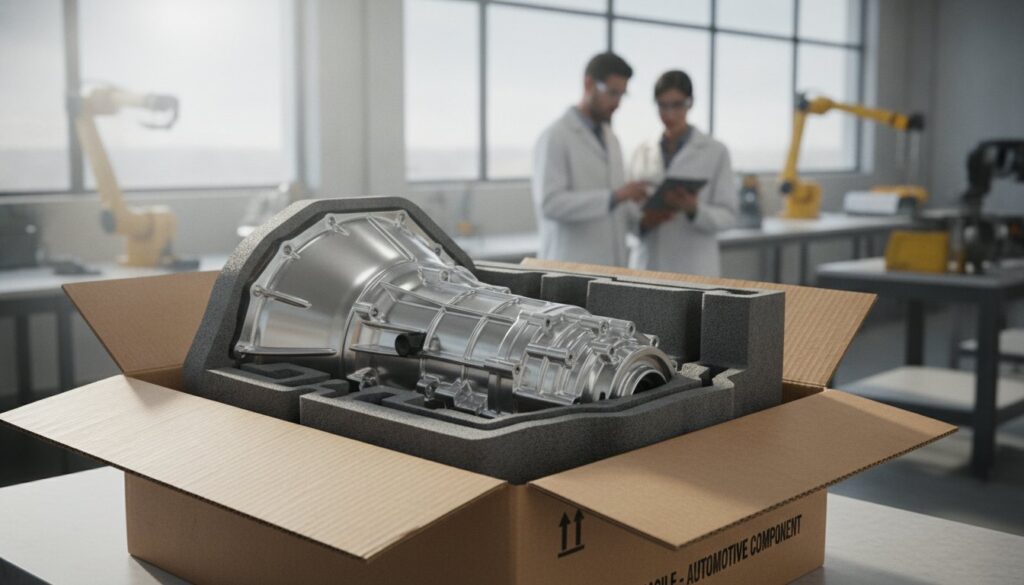
Paying for a shipping container is the least expensive part of your logistics process, but the cost of a single damaged engine component can derail an entire production schedule. Tier 1 and OEM suppliers in Southern California understand that transit damage and warehouse congestion are more than just operational nuisances. They are direct threats to profitability. Securing reliable automotive parts packaging san diego requires a shift from buying commodities to implementing engineered systems designed for technical precision and durability.
You need a strategy that balances protection with operational efficiency. This article demonstrates how custom corrugated solutions and specialized foam packaging reduce shipping damage while lowering your total cost of ownership. We will examine how professional kitting services reduce labor costs and how managed inventory programs provide just in time delivery to free up valuable floor space in your San Diego or Riverside facility. By focusing on precision design and localized support, you can replace bulky, inefficient materials with a streamlined supply chain that prioritizes both safety and speed.
Key Takeaways
- Heavy-duty materials like triplewall corrugated and custom foam inserts protect high-value components from transit damage and vibration.
- Optimizing your automotive parts packaging san diego through pre-assembled kitting reduces labor costs and speeds up assembly line production.
- Vendor-Managed Inventory (VMI) and Just-in-Time delivery programs minimize warehouse storage requirements while ensuring critical supplies are always available.
- Focusing on engineering support rather than individual unit price helps manufacturers reduce the total cost of ownership across the entire supply chain.
- Local prototyping and testing capabilities are essential for meeting the rigorous standards of Tier 1 and OEM automotive suppliers.
Understanding Automotive Parts Packaging Requirements in San Diego
Industrial automotive packaging is an engineered system designed to protect high-value components throughout the rigorous logistics cycle. It’s not merely a container; it’s a calculated barrier against the physical and environmental stresses of the supply chain. Unlike retail packaging, these systems account for the extreme weight of drivetrain components and the delicate tolerances of electronic sensors. In the San Diego region, this infrastructure is critical. The local manufacturing landscape is a sophisticated mix of aerospace-adjacent production and high-volume cross-border operations. Manufacturers here require custom packaging design that can withstand the unique challenges of regional transport and international shipping.
Maintaining Tier 1 supplier status depends on consistent quality. If a component arrives at an assembly plant with even minor surface abrasions, the entire shipment can be rejected. Standard retail boxes lack the vertical stacking strength and puncture resistance needed for heavy industrial use. Industrial solutions utilize multi-wall corrugated boxes and precision-cut foam to ensure that parts remain stationary and protected, regardless of how many times they’re handled during transit. Using the right automotive parts packaging san diego ensures that your components meet the strict quality benchmarks required by major OEMs.
The Impact of Transit Vibration and Shock
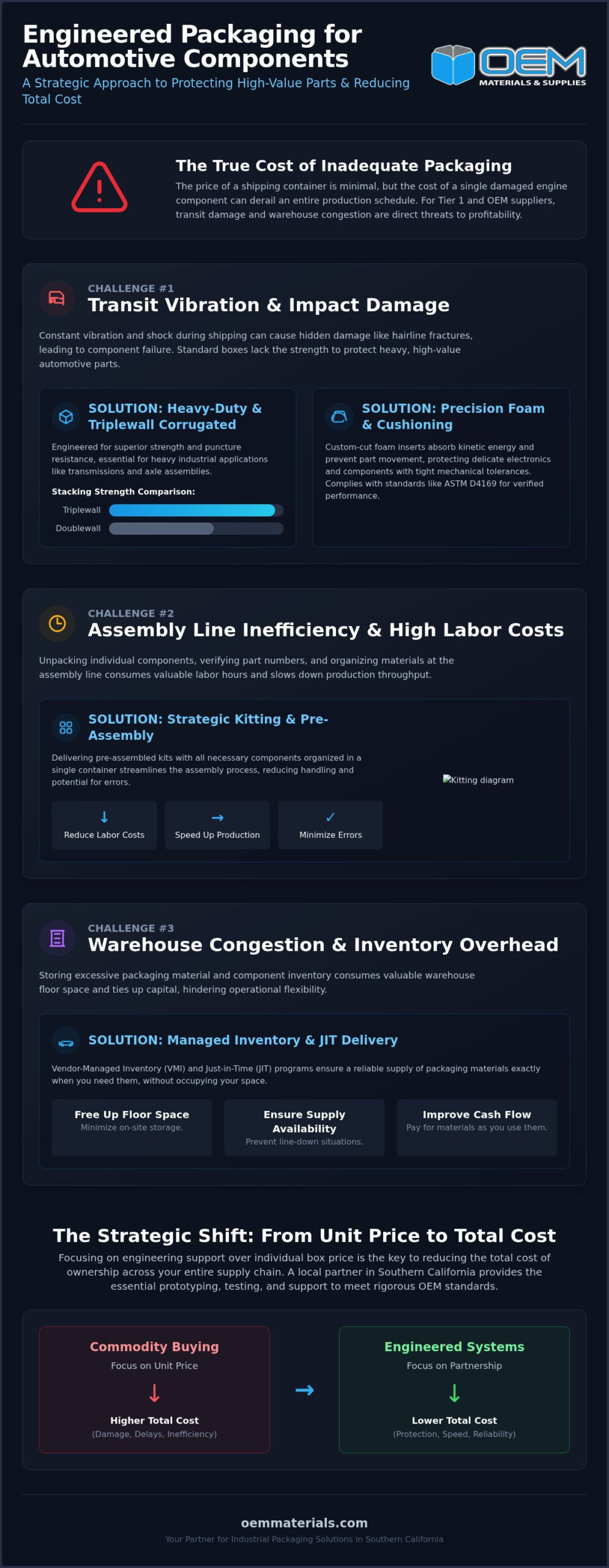
Precision automotive parts often have mechanical tolerances measured in microns. Constant vibration during long-distance shipping can lead to hidden damage, such as hairline fractures or the loosening of calibrated components. This damage often goes unnoticed until the part fails during assembly or, worse, in the field. To mitigate this risk, engineers use specialized cushioning materials to absorb kinetic energy. The ASTM D4169 standard provides a consistent framework for evaluating the ability of shipping units to withstand the rigors of the distribution environment through simulated vibration and impact testing.
Compliance and Identification for Global Logistics
Effective packaging must facilitate seamless movement through customs and assembly lines. This requires integrated identification systems, including high-contrast barcodes and durable labels that won’t peel under humid or oily conditions. For San Diego manufacturers exporting components, meeting international standards for wood packaging and chemical resistance is mandatory. Proper labeling doesn’t just help with tracking; it prevents costly installation errors by ensuring that technicians at the assembly plant can quickly verify part numbers and orientation before the component reaches the line. Investing in high-quality edge protectors and secure strapping also ensures that palletized loads remain intact during the frequent loading and unloading common in global automotive logistics.
Material Engineering for High-Value Automotive Components
Protecting heavy engine blocks and complex drivetrain components requires a departure from standard packaging methods. In the industrial sector, material engineering focuses on the physical properties of the container and the internal cushioning to create a unified defense against logistics hazards. Effective automotive parts packaging san diego relies on the synergy between structural integrity and impact absorption. By selecting materials based on weight distribution and fragility ratings, manufacturers can significantly reduce the risk of mechanical failure during shipping. This technical approach ensures that every component, from a cast-iron cylinder head to a delicate electronic control unit, arrives in factory condition.
Heavy-Duty Corrugated and Triplewall Solutions
Standard doublewall corrugated boxes often fail when subjected to the concentrated weight of automotive hardware. Triplewall corrugated provides a superior alternative, offering three layers of fluting that deliver exceptional stacking strength and puncture resistance. While doublewall is suitable for lighter aftermarket parts, triplewall is the industry standard for heavy industrial applications like transmissions and axle assemblies. Utilizing heavy-duty corrugated boxes allows for high-density pallet stacking without the risk of box compression. Custom sizing is a critical factor here; by engineering the box to the exact dimensions of the part, you eliminate the need for excessive void fill. This reduction in material waste not only lowers your environmental impact but also ensures the part remains centered and secure throughout the journey.
Engineered Foam and Cushioning
Internal protection must be as precisely engineered as the outer container. Selecting the correct foam density depends on the specific weight and fragility of the automotive part. Polyurethane (PU) foam is often used for lighter, highly sensitive electronic sensors due to its soft, open-cell structure. In contrast, Polyethylene (PE) foam is a rigid, closed-cell material better suited for heavy mechanical parts that would otherwise bottom out in softer cushioning. Closed-cell foam structures provide a non-porous surface that prevents the absorption of oils, lubricants, and other automotive chemicals during long-haul transit. Integrating custom foam packaging into your design ensures that every contour of the part is supported, distributing the load evenly and preventing surface abrasions. If you are unsure which material density fits your specific requirements, you can request a packaging review to evaluate your current system.
Material selection also plays a vital role in managing total operational costs. While heavy-duty materials provide better protection, they must be balanced against dimensional weight (DIM) charges from carriers. Engineered systems aim to maximize protection while minimizing the overall footprint of the package. By replacing oversized, generic containers with right-sized, die-cut solutions, San Diego manufacturers can reduce shipping weights and storage requirements. This focus on precision engineering transforms packaging from a simple expense into a strategic asset that protects the bottom line as much as the product itself.
Strategic Kitting and Assembly for San Diego Manufacturers
Efficiency on the manufacturing floor is often won or lost at the packing station. While high-quality materials protect the product, the way those materials are presented to your team determines your labor costs. Strategic kitting involves consolidating all necessary packaging components, such as custom inserts, edge protectors, and fasteners, into a single, pre-assembled unit. For those managing automotive parts packaging san diego, this approach transforms a chaotic packing area into a streamlined, repeatable process. By reducing the number of touches required to secure a part, you directly lower the labor friction that often slows down high-volume production runs.
Packing errors represent a significant hidden cost in the automotive supply chain. A missing bracket or an incorrect hardware count can halt an entire assembly line at the destination. Custom-designed kits use precision layouts to ensure every part has a dedicated space. This visual management system allows packers to verify at a glance that a shipment is complete. When every component is organized within a single container, the risk of shipping incomplete assemblies drops. While the exact savings vary based on your specific production volume and part complexity, many industrial facilities find that kitting significantly improves their throughput and accuracy.
Reducing Labor Friction with Pre-Assembled Kits
On-site box assembly is a time-consuming task that pulls workers away from higher-value activities. Pre-assembled kits arrive at your facility ready for immediate use, eliminating the need for staff to fold corrugated flaps or manually place foam inserts. This is especially critical for high-volume automotive runs where every second saved per unit adds up to hours of recovered labor over a week. To maintain structural integrity in these high-density kits, we often integrate heavy-duty edge protectors. These components prevent the outer container from collapsing under the weight of multiple heavy parts, ensuring the kit remains functional from the warehouse to the assembly line.
Design for Assembly Line Integration
Sophisticated packaging does more than just hold a part; it serves as a temporary workstation organizer. By color-coding foam layers or using clear labeling for specific sub-assemblies, you provide workers with a roadmap for installation. This level of organization is a hallmark of experienced Corrugated Packaging Box Manufacturers: A Guide for Industrial OEMs. Consider a brake assembly line as a practical example. A custom kit can hold the rotor, calipers, and pads in the exact order they are needed for assembly. This eliminates the time spent searching through multiple boxes and reduces the footprint of packaging materials on the production floor. By integrating these kits directly into your workflow, you create a cleaner, safer, and more efficient manufacturing environment.
Inventory Management and Logistics for SoCal Supply Chains
In Southern California, warehouse space is at a premium. Storing bulky items like triplewall corrugated boxes or large foam inserts can quickly consume floor space intended for manufacturing. Transitioning to a leaner logistics model allows Tier 1 and OEM suppliers to optimize their facility layout. By utilizing localized automotive parts packaging san diego, companies can shift from holding months of inventory to a more responsive system. This proximity to manufacturing hubs in San Diego and Riverside enables a rapid response to sudden production spikes without the need for massive on-site storage.
Implementing VMI in Automotive Facilities
Managing the procurement of shipping supplies often creates a heavy administrative burden. Packaging VMI programs solve this by moving the responsibility of inventory tracking to the supplier. We monitor your usage patterns and automate replenishment cycles, ensuring that you never face a stockout of critical items. This model reduces administrative overhead through consolidated billing and real-time tracking. It effectively turns packaging from a fixed overhead cost into a variable expense, improving cash flow and allowing for more accurate project budgeting.
Just-in-Time Delivery for San Diego and Riverside
Efficiency depends on timing. JIT packaging services coordinate deliveries directly with your production schedule. Instead of receiving a massive shipment that sits in the way for weeks, you receive exactly what is needed for the current production run. This strategy is particularly effective for cross-border operations and high-volume automotive lines where space is a critical constraint. Proper palletization is also vital in this cycle; understanding how to optimize stretch film for pallet wrapping ensures that JIT deliveries remain secure during the short but frequent transit legs common in SoCal logistics.
A localized supply chain provides the flexibility required to handle the volatile demands of the automotive industry. When production requirements change overnight, having a partner within the region ensures that your packaging adapts just as quickly. If your current storage costs are impacting your margins, you can request a quote for a managed inventory review to identify potential savings in your supply chain.
Selecting a San Diego Industrial Packaging Partner
Choosing a supplier for your automotive supply chain requires looking beyond the price per unit. While a low individual box price might seem attractive during procurement, it often masks the higher costs of transit damage and packing inefficiencies. A true partnership is built on technical expertise and the ability to solve complex logistical problems. When evaluating providers for automotive parts packaging san diego, prioritize those who offer comprehensive engineering support and a deep understanding of Tier 1 and OEM requirements. This shift from a commodity mindset to a solutions-based approach ensures that your packaging protects your bottom line as effectively as it protects your products.
The ability to scale is equally vital. Your partner must be equipped to handle the entire product lifecycle, from initial die-cut foam prototypes to high-volume production runs. In the fast-moving automotive sector, a dedicated account manager serves as a critical link between your engineering team and the production floor. This single point of contact ensures that specifications are met consistently and that any shifts in production volume are handled without disrupting your supply chain. Reliability in this sector is not just about the quality of the corrugated board; it’s about the responsiveness of the service behind it.
The Value of Engineering Support
Effective packaging design begins with data, not a catalog. Moving away from off-the-shelf containers toward custom packaging design allows for a more precise application of materials. By analyzing specific data points like part weight, fragility, and surface finish requirements, engineers can determine the exact density of foam or the specific wall strength of corrugated needed for the task. This data-driven selection process eliminates the guesswork that leads to over-packaging or, more dangerously, under-protection. The result is a streamlined system that minimizes material waste while maximizing transit safety.
Local Expertise and Support
Proximity offers a distinct competitive advantage in Southern California. Working with a partner located near San Diego and Riverside manufacturing centers allows for rapid site visits and real-time packaging reviews. When a production spike occurs or a new part enters the assembly line, a local partner can provide immediate engineering feedback and faster prototyping turnarounds. This regional presence reduces lead times and simplifies the logistics of managed inventory programs. OEM Materials & Supplies combines this local agility with high-level technical capability, providing the stability and precision required by the world’s most demanding automotive manufacturers.
To optimize your current supply chain, contact OEM Materials & Supplies for a comprehensive packaging review. Our team can evaluate your existing designs to identify opportunities for cost reduction and damage prevention. When requesting a quote, please provide specific data points such as product dimensions, weight, fragility, and expected annual usage. This information allows us to develop a tailored recommendation that meets your technical requirements and operational goals. Whether you need custom engineered foam, heavy-duty corrugated, or a full vendor-managed inventory program, we are ready to serve as your dependable industrial partner.
Optimizing Your Automotive Supply Chain
Managing a high-volume automotive supply chain requires more than standard shipping supplies. It demands an integrated approach that combines material science with logistical precision. Prioritizing engineered protection and strategic kitting reduces transit damage and labor costs on the assembly floor. Implementing a localized program for automotive parts packaging san diego ensures your facility remains lean and responsive to production spikes. It’s a strategic shift that protects your bottom line as effectively as it protects your components.
OEM Materials & Supplies provides the industrial engineering support and specialized compliance expertise necessary for Tier 1 and OEM success. Our Southern California distribution network facilitates reliable JIT delivery to keep your operations moving without the burden of excessive on-site inventory. We focus on durability and accuracy to meet the rigorous standards of the automotive and aerospace sectors. This localized support allows for rapid prototyping and site reviews that national vendors simply cannot match.
Contact OEM Materials & Supplies today for a comprehensive packaging review or custom quote. Please provide your product dimensions, weight, and annual usage so our team can develop a tailored recommendation for your specific application. We look forward to helping you streamline your logistics and improve your operational efficiency.
Frequently Asked Questions
What are the best packaging materials for heavy automotive parts in San Diego?
Triplewall corrugated and heavy-duty wood crates are the industry standard for heavy components like transmissions or engine blocks. These materials provide the necessary puncture resistance and vertical stacking strength to handle high-density loads. For manufacturers seeking automotive parts packaging san diego, selecting materials with high burst strength ratings ensures that heavy metal parts don’t compromise the container integrity during transit or high-density pallet stacking.
How can custom foam inserts reduce shipping damage for sensitive electronics?
Custom foam inserts reduce shipping damage by isolating sensitive electronics from vibration and impact shock. High-density polyethylene foam is often used to provide rigid support for heavier sensors, while softer polyurethane foam absorbs the kinetic energy of high-frequency vibrations. By creating a precise, die-cut fit, the foam prevents the component from shifting inside the box, which is the primary cause of mechanical failure in complex electronic control units.
What is the typical lead time for custom automotive packaging prototypes?
Lead times for custom prototypes depend on the complexity of the design and the specific materials required for the project. Local Southern California facilities allow for faster turnaround on die-cut foam and corrugated samples than national suppliers. This proximity helps San Diego manufacturers move from the design phase to production-ready packaging more quickly; however, specific timelines are determined after a technical review of the part requirements and material availability.
Do you offer VMI programs for manufacturers in Southern California?
We offer comprehensive Vendor-Managed Inventory (VMI) programs for manufacturers throughout Southern California, including San Diego, Riverside, and Orange County. These programs automate the replenishment of your critical shipping supplies, such as custom corrugated boxes and stretch film. By monitoring your usage patterns, we ensure you have the necessary materials on hand without overstocking your warehouse floor or risking production delays due to stockouts.
Can you provide export-compliant packaging for cross-border automotive logistics?
Yes, we provide export-compliant packaging solutions designed for cross-border automotive logistics and international shipping. This includes ISPM-15 heat-treated wood crates and pallets that meet international phytosanitary regulations. Our engineering team understands the rigorous requirements of global supply chains, ensuring your shipments pass through customs without delays caused by non-compliant materials or improper identification labeling.
How does kitting improve assembly line efficiency in automotive manufacturing?
Kitting improves efficiency by consolidating all necessary packaging and assembly components into a single, organized unit. This reduces the number of steps a worker must take to pack a part, which lowers labor costs and minimizes packing errors. Pre-assembled kits arrive at the line ready for immediate use, allowing your team to focus on production rather than wasting time searching for individual foam inserts or edge protectors.
Are your corrugated boxes rated for heavy metal and mechanical components?
Our triplewall corrugated boxes are specifically engineered to support the weight and sharp edges of heavy metal and mechanical components. These boxes feature three layers of fluting to provide superior puncture resistance and stacking strength. They are a reliable alternative to wood crates for many industrial applications, offering high protection levels while significantly reducing the overall shipping weight and dimensional weight charges of the pallet.
What data is needed to get an accurate quote for custom industrial packaging?
To provide an accurate quote for automotive parts packaging san diego, we require specific technical data points. Please be prepared to provide the outer dimensions of the part, its total weight, and any fragility concerns. Additionally, knowing your expected annual usage and shipping methods allows our engineers to recommend the most cost-effective material and design for your specific supply chain requirements.