

Selecting the wrong container for high-value industrial components is a liability that many supply chains carry unknowingly. While standard corrugated might suffice for lightweight goods, heavy duty shipping boxes are engineered structural systems designed to withstand the rigors of stacked transit and multi-stage handling. Many purchasing professionals in sectors like aerospace and medical device manufacturing struggle with consistent transit damage because they rely on generic specifications rather than application-specific engineering.
You likely understand the frustration of seeing a precision-machined part arrive at a client site with surface abrasions or structural compromises due to box failure. It’s a costly disruption that affects both your reputation and your bottom line. This guide provides the technical roadmap you need to master corrugated specifications and material selection. We will examine how to align ECT ratings with your specific load requirements, reduce dimensional weight charges, and leverage local Southern California inventory programs to streamline your supply chain.
Key Takeaways
- Identify the mechanical differences between retail packaging and industrial heavy duty shipping boxes to ensure structural integrity during transit.
- Understand how specific fluting profiles and board grades act as a structural system to protect high-value aerospace and medical components.
- Evaluate the cost-saving potential of custom-engineered containers in reducing dimensional weight charges and secondary material waste.
- Learn to integrate secondary stabilization tools like stretch film and edge protectors to maintain load stability for heavy industrial shipments.
- Streamline your local supply chain in Orange County and Los Angeles through vendor-managed inventory (VMI) to improve warehouse efficiency.
What Defines an Industrial Heavy Duty Shipping Box?
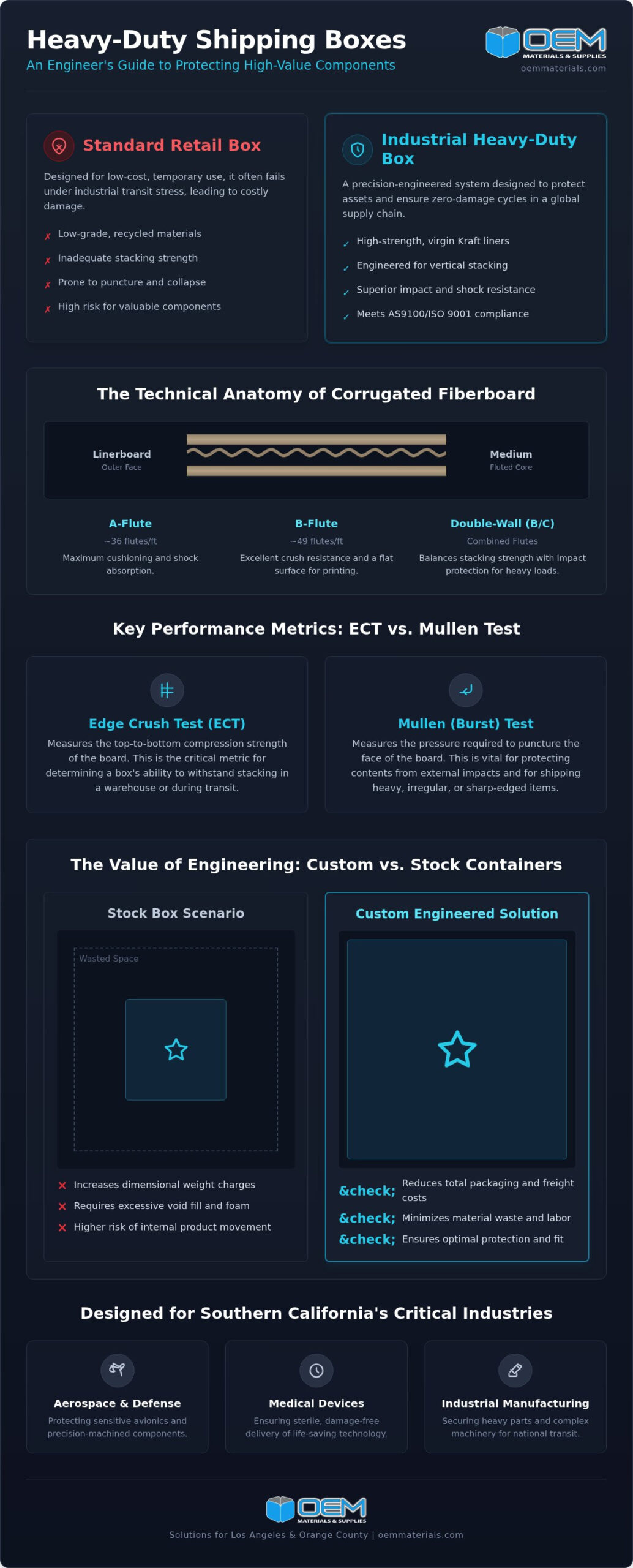
An industrial heavy duty shipping box is a precision-engineered structural system designed to protect high-value assets. Unlike standard retail moving boxes, which prioritize low-cost material and temporary use, industrial heavy duty shipping boxes are specified based on their mechanical performance under stress. For manufacturers in Orange County and Los Angeles, these containers serve as a primary defense against the harsh realities of the global supply chain. They ensure that sensitive aerospace components or medical devices remain within strict tolerance levels throughout the shipping cycle.
These containers are not merely commodity items; they are essential components of a quality management strategy. High-performance heavy duty shipping boxes play a critical role in maintaining ISO 9001 or AS9100 compliance. By providing documented protection levels, they help manufacturers meet rigorous industry standards that require evidence of product preservation during transit and storage. This level of reliability is non-negotiable when transporting high-precision machinery or life-saving medical technology.
The Functional Requirements of Industrial Packaging
Industrial applications demand specific performance metrics that standard packaging cannot meet. To ensure a zero-damage cycle, packaging must excel in three primary areas:
- Vertical Stacking Strength: Boxes must support significant weight in high-density warehouse environments. This allows for safe double-stacking, which optimizes floor space and reduces storage costs.
- Impact Resistance: Heavy-duty board grades are designed to absorb the vibrations and sudden shocks inherent in LTL (Less-Than-Truckload) freight and international transit.
- Mechanical Handling: The structural design must withstand the aggressive movements of forklifts, pallet jacks, and automated conveyor systems without tearing or collapsing.
Economic Consequences of Substandard Box Selection
Selecting a box based solely on the lowest per-unit price is a frequent procurement error that leads to inflated long-term expenses. The hidden costs of product damage, return logistics, and administrative overhead for claims often far outweigh any initial material savings. Poor packaging design also increases labor costs because warehouse personnel must spend more time applying secondary materials, such as extra stretch film or tape, to compensate for structural deficiencies.
Industrial-grade materials reduce the total cost of ownership by eliminating the financial waste associated with transit failures and streamlining the assembly process. While actual savings depend on specific product requirements and shipping methods, shifting toward engineered solutions consistently improves operational efficiency and protects the manufacturer’s reputation for reliability. For a comprehensive look at how modern material engineering and inventory management can further reduce your total cost of ownership, our industrial packaging guide for manufacturers provides an authoritative roadmap aligned with current supply chain demands.
The Technical Anatomy of Heavy Duty Corrugated Fiberboard
Industrial heavy duty shipping boxes are complex laminate structures rather than simple paper containers. They consist of linerboard, the flat outer faces, and the medium, the wavy interior fluting. These layers are bonded with high-strength starch-based adhesives to create a rigid, load-bearing panel. The performance of these corrugated boxes depends heavily on fiber quality. Virgin Kraft liners offer superior tensile strength compared to high-recycled content alternatives. This makes them the preferred choice for high-stress manufacturing environments in the aerospace and automotive sectors.
Fluting profiles determine the mechanical properties of the finished container. A-flute provides maximum cushioning with approximately 33 to 39 flutes per linear foot. B-flute offers excellent crush resistance and a flatter surface for clear labeling. Most heavy-duty applications utilize double-wall or triple-wall constructions. These combine different flute sizes, such as a B and C flute combination, to balance stacking strength with impact protection. This layering creates a structural safety factor that standard single-wall boxes cannot match.
Strength Testing Standards: ECT vs. Mullen
Engineers evaluate material performance using two primary metrics. The Edge Crush Test (ECT) measures the top-to-bottom compression strength of the board edge. It’s the critical metric for warehouse stacking and pallet stability. The Mullen Test, or Burst Test, measures the pressure required to puncture the face of the board. This is vital when shipping heavy, irregular, or sharp-edged industrial components that exert internal pressure on the box walls.
| Priority Metric | Application Scenario | Primary Benefit |
|---|---|---|
| ECT (Edge Crush Test) | High-density pallet stacking | Prevents box collapse under vertical weight |
| Mullen (Burst Test) | Heavy, loose, or sharp contents | Resists internal punctures and rough handling |
Material Performance in Industrial Environments
Standard liners can lose structural integrity in high-humidity or extreme temperature conditions. For medical device and aerospace shipments, we often specify high-performance liners or specialized coatings. These treatments prevent abrasion on sensitive surfaces and provide a moisture barrier. If your current packaging fails during long-distance transit, you can request a technical packaging review to identify the optimal board grade for your specific application.
Using triple-wall corrugated is often necessary for high-capacity loads exceeding 100 pounds. This construction provides the structural rigidity of wood crates with significantly less weight. Selecting the right board grade for heavy duty shipping boxes requires balancing these technical variables against your logistics budget to ensure your products arrive without compromise.
Custom Engineered vs. Standard Stock Shipping Containers
While standard stock containers offer immediate availability, they often force industrial manufacturers into a compromise that drives up total logistics costs. Stock boxes are designed for a broad range of generic goods; they rarely account for the specific center of gravity or fragility of precision equipment. Relying on oversized stock heavy duty shipping boxes creates a reliance on excessive void fill, which increases material costs and assembly time. Custom engineering shifts the focus from simple containment to optimized protection, ensuring the container works in harmony with the product’s geometry.
Precision-fit containers are a primary tool for reducing dimensional weight (DIM) shipping charges. Freight carriers calculate costs based on the volume a package occupies rather than just its actual weight. If you ship a small, dense component in a standard large box, you’re paying to ship air. By engineering heavy duty shipping boxes to the exact footprint of your product, you eliminate unnecessary volume and lower your per-unit shipping expense. These savings often offset the initial design costs, especially for high-volume manufacturers in Orange County and Los Angeles who manage frequent LTL shipments.
The design process often incorporates custom foam packaging to provide internal stabilization and shock absorption. This integrated approach allows for rapid prototyping, where engineers can test the interaction between the outer corrugated shell and the internal cushioning. This iterative cycle ensures that the final packaging system is validated for performance before it hits the production floor, reducing the risk of transit failure during the first live shipment.
Sector-Specific Sourcing Requirements
Different industries require specialized material properties to meet operational standards. In the aerospace sector, containers must offer exceptional stacking strength to protect high-value, machined components from crushing. Medical device manufacturers require cleanroom-compatible materials and sterile packaging kits that prevent contamination during transit. Automotive suppliers often prioritize durable, reusable designs that can survive multiple cycles in a high-volume part distribution network. Each of these applications demands a level of material performance that off-the-shelf options cannot provide.
Advanced Design Features for OEMs
Custom design allows for the inclusion of functional features that improve ergonomics and safety. Die-cut packaging can be engineered for complex shapes or multi-component kitting, ensuring that all parts arrive together in a logical, organized layout. Integrated handles and access panels can be added to larger containers to assist warehouse personnel with manual handling, reducing the risk of workplace injuries. Manufacturers looking to optimize their workflow should explore custom packaging design services to create a system that addresses both protection and operational efficiency. The result is a more streamlined supply chain where packaging is a functional asset rather than a logistical hurdle.
Optimizing Load Stabilization and Protection Supplies
A box is only as strong as the system supporting it. Even the highest grade heavy duty shipping boxes can fail if the load shifts during transit. Proper stabilization ensures the structural integrity of the corrugated board remains intact by preventing lateral movement and vibration. When shipping heavy industrial components, the synergy between the outer container and secondary materials is what determines the success of the shipping cycle.
High-performance stretch film is the primary tool for unitizing heavy loads. It provides the containment force necessary to keep multi-box shipments from shifting on the pallet. This prevents lateral pressure from crushing box corners, which is a common cause of stack failure. To further reinforce the container, we recommend using edge and corner protectors. These rigid components distribute the tension from strapping and film, preventing the straps from cutting into the corrugated liners. This is especially vital for double and triple-wall containers where the weight of the contents is significant.
Internal cushioning strategies must be calculated based on the product’s fragility and weight distribution. For high-fragility industrial goods, this often involves a combination of foam inserts and corrugated dividers to isolate the item from the box walls. By engineering these internal supports to match the structural capacity of your heavy duty shipping boxes, you create a comprehensive protective system that survives rough handling by LTL carriers.
Palletization Best Practices for Heavy Loads
Stacking patterns significantly influence the effective Edge Crush Test (ECT) rating of your packaging. Column stacking, where boxes are aligned vertically, preserves the maximum compression strength of the corrugated flutes. Interlocking patterns might seem more stable, but they can reduce stacking strength by up to 30 percent due to corner misalignment. For oversized machinery that exceeds corrugated weight limits, integrating custom crates and wood packaging provides the necessary base support. You can find more detail on this in our industrial guide to optimizing stretch film for pallet wrapping.
Improving Packing Line Throughput
Manufacturers can increase efficiency by utilizing kitting and assembly services. This reduces the labor required on the production floor by delivering pre-assembled packaging components ready for immediate use. For specialized items like textiles or industrial rolls, using specialized mailing tubes ensures protection without the bulk of a rectangular box. Implementing JIT packaging supply deliveries improves warehouse efficiency by reducing the footprint of on-site inventory. If you need to optimize your stabilization strategy, request a quote for a comprehensive packaging audit today.
Strategic Sourcing for Southern California Manufacturers
Sourcing heavy duty shipping boxes should be treated as a strategic procurement decision rather than a simple commodity transaction. For manufacturers in Orange County and Los Angeles, the proximity of a technical packaging partner provides a distinct competitive advantage. Moving from a transactional relationship to a solution-based partnership allows your engineering and purchasing teams to focus on core production while the supplier manages the complexities of protective design and material availability.
Reclaiming warehouse floor space is a primary objective for high-volume industrial facilities. By implementing Just-In-Time (JIT) delivery, you can reduce the footprint of bulky packaging stock and reallocate that space to manufacturing or assembly lines. This localized approach eliminates the lead time volatility associated with national vendors who lack a physical presence in Southern California. Local deliveries ensure that your heavy duty shipping boxes arrive exactly when needed, reducing the risk of production bottlenecks caused by packaging shortages.
Eliminating stockouts requires a proactive approach to inventory control. Utilizing Vendor Managed Inventory (VMI) shifts the responsibility of monitoring stock levels to the supplier. This system uses real-time data to trigger replenishments, ensuring that critical packaging components are always on hand. For aerospace and medical device manufacturers, this level of reliability is essential for meeting strict shipping deadlines and maintaining customer trust.
Lowering Total Logistics and Procurement Costs
Consolidating your packaging spend with a full-service industrial supplier reduces administrative overhead and simplifies the procurement cycle. Instead of managing multiple vendors for boxes, foam, and film, a single point of contact can oversee the entire protective system. Professional packaging audits are a valuable tool in this process. These reviews identify areas where material over-specification or inefficient box sizes are inflating costs. While total savings depend on specific product requirements and shipping methods, an audit often reveals significant opportunities to streamline the supply chain. Our service focus extends across San Diego, Riverside, and the Inland Empire to support regional manufacturing hubs. Manufacturers operating within the Inland Empire logistics corridor can explore how industrial packaging suppliers in Riverside are applying custom corrugated engineering and managed inventory programs to achieve a lower total cost of ownership.
Compliance and Sustainability in Industrial Sourcing
Global distribution requires strict adherence to international shipping regulations. If your logistics involve wood components, ensure you are using ISPM-15 compliant materials to avoid customs delays and fines. Beyond compliance, industrial corrugated materials are highly recyclable within large-scale waste streams, supporting corporate sustainability initiatives without sacrificing structural performance. For more information on selecting the right production partner, refer to our guide for corrugated packaging box manufacturers. Aligning with a supplier that understands these technical and logistical requirements is the final step in building a resilient industrial supply chain.
Advancing Your Industrial Logistics Strategy
Mastering the technical specifications of your packaging transforms a logistical expense into a structural asset. By moving beyond generic containers and embracing engineered heavy duty shipping boxes, you protect your bottom line from the hidden costs of transit damage and dimensional weight penalties. Successful manufacturers in the aerospace and medical sectors recognize that reliability starts with the outer shell and extends through every layer of internal cushioning and stabilization.
OEM Materials & Supplies serves as a technical partner for Southern California OEMs, providing specialized engineering support and local VMI logistics. We help you reclaim warehouse space and eliminate stockouts through precision-managed JIT delivery programs tailored for high-value components. To start optimizing your packaging process, contact us for a technical packaging review and quote. Providing data points such as product dimensions, weight, fragility, and annual usage will allow our team to develop an accurate, high-performance recommendation. We look forward to helping you build a more efficient and resilient supply chain.
Frequently Asked Questions
What is the difference between ECT and Mullen strength ratings for shipping boxes?
ECT measures the top-to-bottom compression strength of a box, which is the primary factor for stacking stability in a warehouse. Mullen testing measures the burst strength or puncture resistance of the box walls. Use ECT ratings when your priority is pallet stacking height, and choose Mullen ratings when shipping heavy, irregular items that may shift and poke through the sides during transit.
When should an OEM choose double-wall corrugated over single-wall?
Double-wall construction is necessary for products that exceed the weight capacity of single-wall board, typically starting around 65 pounds. It provides two layers of fluting that offer significantly higher stacking strength and better shock absorption for long-distance LTL freight. If your industrial components are sensitive to vibration or are being shipped internationally, double-wall provides the required structural safety factor.
How do custom shipping boxes help reduce dimensional weight (DIM) charges?
Custom-sized heavy duty shipping boxes eliminate the excess air and wasted volume found in standard stock containers. Freight carriers calculate costs based on the box dimensions if the volumetric weight is higher than the actual weight. By engineering a container to the exact footprint of your product, you lower the billable volume and reduce per-unit shipping costs.
What fluting profile is best for heavy industrial components?
A combination of B and C fluting in a double-wall configuration is the standard for heavy industrial loads. The C-flute provides the vertical stacking strength needed for warehouse efficiency, while the B-flute offers a flatter surface for labeling and superior puncture resistance. For extremely heavy machinery, triple-wall fluting provides a lightweight alternative to traditional wood crating.
Can custom heavy duty boxes be recycled in standard industrial programs?
Yes, custom corrugated containers are fully recyclable in standard industrial cardboard recycling streams. Even high-performance Kraft liners are made from natural fibers that can be reprocessed alongside standard shipping materials. This allows manufacturers to meet sustainability requirements without compromising the structural integrity of their protective packaging systems.
What are the benefits of a vendor-managed inventory (VMI) program for packaging?
VMI programs eliminate stockouts by shifting the responsibility of inventory monitoring and replenishment to your packaging partner. This system improves your cash flow by reducing the capital tied up in on-site inventory. It also reclaims significant warehouse floor space since you only store the heavy duty shipping boxes and supplies needed for immediate production cycles. For organizations looking to further optimize their facility by moving archives or overflow inventory off-site, 100storage.com provides professional door-to-door storage solutions.
How do edge protectors prevent heavy duty box failure during transit?
Edge protectors distribute the tension of strapping and stretch film across the corners of the box to prevent the material from buckling. Without these protectors, high-tension straps can cut into the corrugated liners and collapse the internal fluting. By reinforcing the vertical corners, they maintain the box’s structural integrity even when subjected to the high containment forces required for heavy pallet loads.
Are there specific packaging requirements for aerospace and medical devices?
Aerospace components often require high-strength board grades and custom foam inserts to protect precision tolerances from vibration. Medical devices frequently require cleanroom-compatible materials and sterile packaging kits to prevent contamination. Both industries typically require documented compliance with quality management standards, such as ISO 13485 or AS9100, to ensure product preservation throughout the supply chain. For a detailed breakdown of how precision-engineered industrial packaging standards apply to these sectors in 2026, our comprehensive manufacturer’s guide covers current best practices and material specifications.