
Is the lowest price per unit actually costing your operation more in the long run? Many procurement professionals focus on the invoice price of corrugated boxes or stretch film while overlooking the hidden expenses of warehouse footprint and assembly labor. Finding truly cost-effective packaging for manufacturers requires a shift from commodity buying to strategic sourcing. It’s about balancing material durability with operational throughput to ensure that a cheaper box doesn’t lead to expensive transit damage or slowed production lines.
You understand that every square foot of your warehouse in regions like Orange County or Los Angeles is valuable real estate that shouldn’t be consumed by bulky packaging inventory. This article provides a framework for optimizing your industrial packaging spend by integrating material selection, design efficiency, and supply chain logistics. We will cover how custom design reduces waste, why kitting services can lower your labor costs, and how just-in-time delivery models stabilize your cash flow without risking stockouts. By the end of this guide, you will have the technical insights needed to lower your total cost of ownership while maintaining the high standards required for your manufacturing environment.
Key Takeaways
- Understand why the lowest per-unit price often masks a higher total cost of ownership (TCO) due to product damage and inefficient handling.
- Identify high-performance materials and corrugated grades that provide cost-effective packaging for manufacturers without compromising structural integrity.
- Discover design strategies like self-locking bottoms and component reduction that streamline assembly lines and lower manual labor requirements.
- Learn how Vendor Managed Inventory (VMI) and Just-In-Time (JIT) delivery models can free up valuable warehouse space and improve operational cash flow.
- Explore the importance of rapid prototyping to validate packaging designs before transitioning from short-run samples to high-volume production.
Analyzing the Total Cost of Packaging in Manufacturing
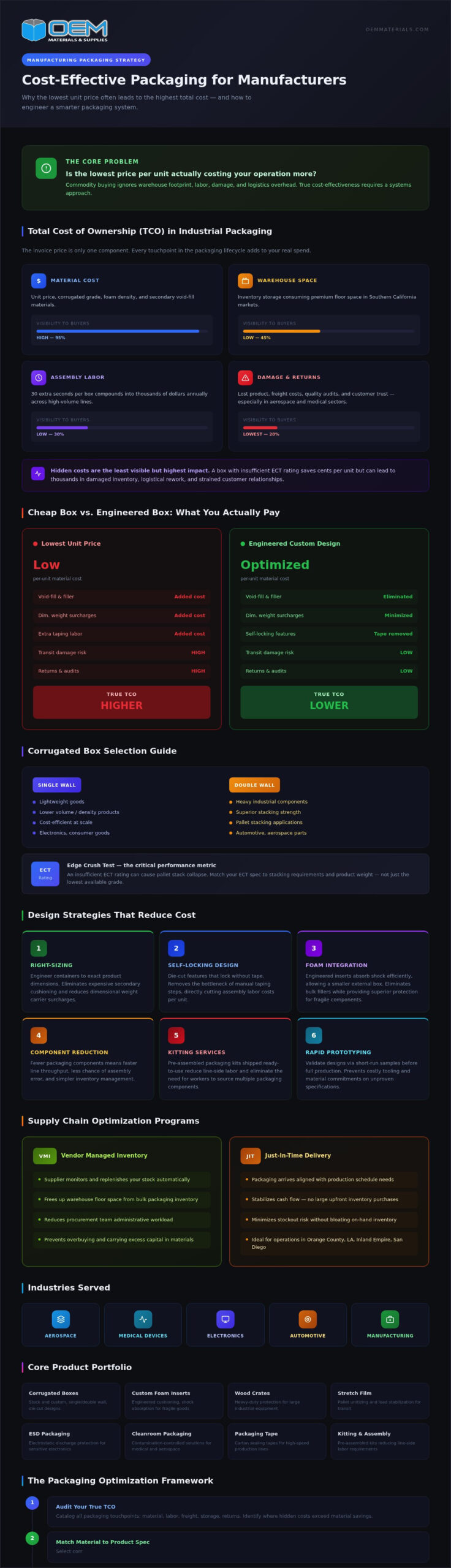
Procurement professionals often focus on the unit price of a corrugated box, but this number represents only a fraction of the true financial impact. Total Cost of Ownership (TCO) in industrial packaging accounts for every touchpoint in the lifecycle, including procurement, storage, labor, and the cost of failure. Opting for the lowest-priced material frequently results in higher long-term expenses. For instance, a box with an insufficient Edge Crush Test (ECT) rating might save cents upfront but could collapse under the weight of a pallet stack. This leads to thousands of dollars in damaged inventory, logistical rework, and strained customer relationships. Precision in material selection is a prerequisite for achieving truly cost-effective packaging for manufacturers.
Hidden Costs in Industrial Logistics
Operational inefficiencies often hide in plain sight. Consider the labor hours spent on complex manual assembly. If your staff spends an extra 30 seconds taping every box because the design is flimsy or poorly engineered, those labor costs quickly exceed any material savings. Additionally, warehouse space in Southern California, from the Inland Empire to San Diego County, is a premium asset. Storing excessive packaging inventory takes up floor space that should be used for production. Oversized containers also trigger dimensional weight surcharges from carriers, meaning you are effectively paying to ship empty space.
Balancing Protection and Material Spend
Finding the right balance between over-packaging and under-packaging is essential for protecting manufacturing margins. Over-packaging inflates material costs and shipping weights, while under-packaging risks product returns. Utilizing engineered foam packaging allows for a more compact footprint. These inserts absorb shock more efficiently than bulkier alternatives, often allowing for a smaller external corrugated box. Custom design eliminates the need for excessive filler materials, ensuring you only pay for the protection your specific product requires.
When a product is returned due to shipping damage, the manufacturer loses more than just the material cost. You lose the labor invested in the original build, the freight cost of the return, and the reputation for reliability. In sectors like medical devices or aerospace, these failures can also trigger complex quality audits and documentation requirements that further drain administrative resources. Investing in the right design upfront prevents these cascading costs. Cost-effective packaging for manufacturers isn’t about buying the cheapest components; it’s about engineering a system that minimizes total operational friction and maximizes product safety during transit.
Selecting Materials for Maximum Protection and Efficiency
Material selection is a technical decision that impacts both the physical safety of your product and the long-term health of your logistics budget. Many operations default to standard sizes to simplify procurement, but this often leads to “air shipping” and excessive use of void-fill. Achieving cost-effective packaging for manufacturers requires a deeper look at material performance ratings rather than just unit price. By matching the specific burst strength or cushioning density to the product’s weight and fragility, you can reduce material waste without increasing the risk of transit damage.
Optimizing Corrugated Box Specifications
The choice between single wall and double wall corrugated depends on your stacking requirements and the density of your product. Single wall boxes are efficient for lightweight goods, but heavy industrial components or automotive parts typically require the superior stacking strength of double wall materials. Right-sizing your corrugated boxes is one of the most effective ways to lower costs. When a container is engineered to the exact dimensions of the product, you eliminate the need for expensive secondary cushioning and reduce dimensional weight charges from carriers. Custom die-cut designs can also integrate self-locking features that remove the need for excessive packaging tape.
Protective Inserts and Cushioning Strategies
For high-value electronics and medical devices, the external box is only the first line of defense. Engineered foam packaging provides the specific shock absorption needed to protect sensitive calibration or fragile components. Polyethylene (PE) foam is a durable, closed-cell option ideal for heavy parts that require firm support. Conversely, polyurethane (PU) foam is softer and better suited for lightweight, highly delicate items. Using custom-molded or die-cut foam inserts allows you to achieve maximum protection with minimal material volume. This precision ensures that your manufacturing margins aren’t eroded by the high cost of replacement units or expedited return shipping.
Modern sustainable materials have also evolved to meet industrial standards. You can now utilize high-recycled-content corrugated and recyclable foam alternatives that do not compromise on structural integrity or burst strength. These options help meet corporate sustainability goals while maintaining the durability required for rigorous supply chains. If you are looking to optimize your current material specs, you can request a technical consultation to review your product dimensions and shipping requirements. Finding the right balance between material weight and protection is the most reliable path toward cost-effective packaging for manufacturers.
Design Strategies to Reduce Labor and Shipping Overhead
Engineering the physical structure of your packaging is just as critical as selecting the material itself. While high-quality corrugated provides the foundation, the design dictates how much time your team spends on the assembly line. Implementing cost-effective packaging for manufacturers often involves moving away from standard Regular Slotted Containers (RSC) toward custom die-cut designs that prioritize speed. Features such as self-locking bottoms and pre-glued joints allow operators to snap a box into shape in seconds, eliminating the need for bottom-taping or heavy-duty stapling. This reduction in manual touchpoints directly lowers your cost per unit by increasing throughput.
Simplifying the assembly process also means reducing the total number of components. A custom-engineered design can often replace multiple pieces of loose void-fill or separate inserts with a single, integrated corrugated or foam structure. This consolidation reduces the complexity of your bill of materials and minimizes the risk of assembly errors that lead to product damage. Additionally, standardizing box dimensions across different product lines creates a building block effect for your logistics team. This allows for more efficient pallet interlocking and maximizes the vertical space in shipping containers, ensuring you aren’t paying to transport empty air.
Streamlining Assembly with Custom Kits
For manufacturers in specialized sectors like aerospace or medical devices, managing dozens of separate packaging SKUs is an administrative burden. Packaging kits solve this by delivering all necessary components, including boxes, custom foam, and edge protectors, under a single part number. This approach reduces the number of vendors you manage and improves inventory accuracy on the warehouse floor. Pre-assembled kits arrive ready for the production line, preventing bottlenecks and ensuring that your staff always has the exact materials needed for the day’s output.
Optimizing for Freight and Palletization
Freight costs are a major component of the total packaging spend, especially when shipping from high-traffic hubs in the Inland Empire or Orange County. Precision sizing is the most effective way to reduce dimensional weight (DIM weight) charges. By eliminating even a half-inch of unnecessary space, you can often fit more units per pallet and more pallets per truckload. Once the load is optimized, using high-performance stretch film is vital. The right film provides the necessary load-containment force to prevent shifting during transit, which is a leading cause of damage in high-density shipments. This strategic approach to design ensures that your cost-effective packaging for manufacturers remains reliable from the assembly line to the final destination.
Optimizing the Supply Chain with VMI and JIT Programs
Procurement efficiency relies on more than just the physical product. Strategic inventory management is a cornerstone of cost-effective packaging for manufacturers. By shifting the focus from unit price to supply chain flow, operations can eliminate significant hidden costs related to administrative overhead and inventory carry. Implementing modern logistics programs ensures that your packaging supply is as lean and responsive as your production line. It’s about moving from a reactive buying model to a proactive, data-driven partnership.
Vendor Managed Inventory (VMI) shifts the responsibility of stock monitoring from your internal team to your packaging partner. Instead of manual counts and frequent purchase orders, the supplier monitors usage levels and replenishes stock automatically. This removes the administrative burden from purchasing managers and virtually eliminates the risk of stockouts. When your supplier manages the replenishment cycle, you don’t face the high costs of emergency shipping or production downtime caused by missing materials. This automated approach creates a more predictable and reliable supply chain for high-volume industrial environments.
Vendor Managed Inventory (VMI) Benefits
The primary advantage of a packaging VMI service is the stabilization of your material flow. By maintaining a buffer of stock, we ensure you never face a production halt due to a missing component. This program also improves cash flow by allowing you to pay for packaging only as it is consumed. Freeing up capital that would otherwise be tied up in stagnant inventory allows for reinvestment in core manufacturing capabilities. In the competitive Southern California market, these marginal gains in liquidity provide a significant operational advantage.
Just-In-Time Delivery in Southern California
For manufacturers operating in Orange County, Los Angeles County, and San Diego County, warehouse floor space is a premium asset. Storing months of bulky corrugated boxes or foam inserts is an inefficient use of high-rent real estate. Our JIT packaging services provide frequent, scheduled deliveries that match your production schedule. This reduces the footprint required for packaging storage and minimizes the risk of inventory obsolescence. Corrugated materials can degrade over time if exposed to warehouse dust or humidity; JIT ensures you’re always using fresh, high-strength materials. Smaller, more frequent deliveries also allow you to pivot quickly if product designs or shipping requirements change.
Integrating these logistics strategies is essential for maintaining cost-effective packaging for manufacturers at scale. If you’re ready to reclaim your warehouse space and streamline your procurement process, contact our logistics team for a VMI assessment. We can review your annual usage and delivery requirements to build a customized replenishment program that meets your specific operational needs.
Implementing a Cost-Effective Strategy with OEM Materials
Executing a successful packaging strategy requires a shift from transactional purchasing to technical partnership. High-volume manufacturing environments don’t have room for trial and error on the production line. Achieving cost-effective packaging for manufacturers is a process of continuous refinement, starting with a rigorous assessment of your current material usage and logistical flow. By collaborating with a partner that understands the specific demands of industrial OEMs, you can move beyond generic solutions toward engineered systems that protect your margins as effectively as they protect your products.
The transition to a more efficient packaging model often begins with a comprehensive site audit. This allows our team to observe your packing stations in real-time, identifying bottlenecks in assembly or areas where material is being wasted. For manufacturers in specialized sectors like aerospace or medical devices, this collaboration ensures that every component meets strict regulatory requirements and industry standards. Whether you are shipping sensitive electronics from the Inland Empire or medical components from Orange County, the goal is to align your packaging specifications with the actual rigors of your distribution cycle.
Custom Design and Prototyping
Rapid prototyping is the most effective way to validate a new design before committing to a large-scale production run. Utilizing custom packaging design allows you to test the performance of different corrugated grades and foam densities under simulated transit conditions. This phase is critical for solving complex protection challenges without over-engineering the solution. Once a prototype is approved, we provide the infrastructure to scale seamlessly from short-run samples to high-volume production programs, ensuring consistent quality and structural integrity throughout the lifecycle of the product.
Next Steps for Procurement Professionals
Moving toward a more efficient packaging model requires actionable data. To facilitate an accurate recommendation and quote, we suggest gathering the following information for your primary product lines:
- Exact product dimensions (length, width, and height)
- Total unit weight and fragility requirements
- Estimated annual usage and typical order quantities
- Current shipping methods and destination profiles
For a more technical look at material selection, you can reference our guide on corrugated packaging box manufacturers to understand how different fluting and liner weights impact performance. If your facility is located in Los Angeles County, San Diego County, or the surrounding Southern California areas, we can schedule a site visit to perform a direct packaging audit. To begin the process and receive a technical consultation for cost-effective packaging for manufacturers, contact our engineering team with your specific project requirements today.
Optimizing Your Industrial Packaging Strategy
Transitioning to a high-efficiency packaging model requires looking beyond the invoice price of a corrugated box. By focusing on the total cost of ownership, your operation can eliminate the hidden expenses of transit damage, excessive labor, and underutilized warehouse space. Strategic material selection and custom engineering ensure that your packaging protects your margins as much as your products. Precision design is not an extra expense; it’s a fundamental tool for long-term operational stability.
As specialists in the rigorous requirements of the aerospace, medical, and electronics sectors, OEM Materials provides the technical expertise needed to implement cost-effective packaging for manufacturers across Southern California. Our VMI and JIT programs keep supply chains lean and responsive for facilities in Orange County, Los Angeles, and San Diego. We focus on the logistical details so your team can focus on production. Every recommendation we make is based on your specific product dimensions, weight, and annual usage to ensure maximum efficiency.
Ready to identify saving opportunities in your current packaging lifecycle? Contact OEM Materials & Supplies for a custom packaging quote and design consultation. We look forward to helping you build a more reliable and efficient distribution network.
Frequently Asked Questions
What is the most cost-effective packaging material for heavy industrial parts?
Double wall or triple wall corrugated board is the most cost-effective choice for heavy industrial parts due to its high strength to weight ratio. While wood crates offer superior protection for extremely dense loads, engineered corrugated provides a lighter alternative that reduces freight expenses. Matching the Edge Crush Test rating to your specific pallet stacking requirements ensures you don’t overpay for material while maintaining the structural integrity needed for heavy duty distribution.
How can custom packaging design actually save money compared to stock boxes?
Custom packaging design saves money by eliminating the need for excessive void fill and reducing the time spent on manual assembly. Stock boxes often require secondary cushioning like bubble wrap or packing peanuts to fill empty space, which increases material costs and shipping volume. An engineered solution right sizes the container to your product, leading to more cost-effective packaging for manufacturers by lowering both material spend and dimensional weight surcharges.
What are the benefits of Vendor Managed Inventory for a manufacturing facility?
Vendor Managed Inventory (VMI) stabilizes your supply chain by shifting the responsibility of stock replenishment to your packaging partner. This program frees up valuable warehouse floor space in Southern California facilities, allowing you to use that square footage for production instead of bulky box storage. By automating the reordering process, you eliminate administrative overhead and avoid the high costs associated with emergency production halts or expedited shipping fees.
How does right-sizing packaging impact shipping costs and DIM weight?
Right-sizing directly reduces shipping costs by minimizing the external dimensions of your package, which lowers its Dimensional (DIM) weight. Carriers charge based on whichever is greater: the actual weight or the volume of the box. By eliminating even a few inches of unnecessary space, you can fit more units on a pallet and avoid paying to ship air. This precision sizing is a core component of maintaining cost-effective packaging for manufacturers at scale.
Can kitting and assembly services really reduce my internal labor costs?
Kitting and assembly services significantly reduce internal labor costs by delivering production ready packaging components to your line. Instead of your staff spending hours folding boxes and inserting foam, they receive pre-assembled kits that are ready for immediate use. This consolidation reduces the number of touchpoints in your facility, lowers the risk of assembly errors, and allows your skilled labor to focus on core manufacturing tasks rather than secondary packaging.
What information do I need to provide for an accurate custom packaging quote?
To receive an accurate custom packaging quote, you should provide the exact dimensions, weight, and fragility of your product. Additionally, include your estimated annual usage and details about your shipping environment, such as whether the product is palletized or sent via small parcel. Providing a prototype or CAD file of your part allows our engineers to design a more precise solution that balances protection requirements with material efficiency.
How does engineered foam compare to standard bubble wrap for electronics?
Engineered foam inserts provide more consistent shock absorption and vibration dampening for sensitive electronics than standard bubble wrap. While bubble wrap is often perceived as a low cost option, it requires multiple layers to achieve the same protection level, which increases the total box size and shipping cost. Custom cut foam ensures that delicate components are held securely in place, preventing the internal shifting that often leads to transit damage in high value electronic shipments.
Are there sustainable packaging options that are also cost-effective?
Sustainable packaging is increasingly cost-effective when you utilize high recycled content corrugated and recyclable foam alternatives. These materials often match the performance of virgin materials while helping your operation meet corporate environmental goals. By optimizing your design to use less material overall, you simultaneously reduce your environmental footprint and your total packaging spend. Many manufacturers find that a more efficient, sustainable design actually lowers their per unit cost by reducing waste.