
A single failure in your medical supply packaging can lead to more than just a damaged product; it can compromise patient safety and trigger costly regulatory audits. Maintaining integrity throughout the supply chain is a constant challenge for operations managers and engineers throughout Southern California. You understand that meeting strict industry standards while managing rising shipping costs requires a precise balance of materials and engineering. High-stakes logistics in the healthcare sector leave no room for trial and error.
This guide provides the technical insights you need to select the right medical supply packaging to ensure compliance, safety, and operational efficiency in your facility. Manufacturers shipping sensitive diagnostic equipment from Orange County or distributing high-volume disposables across the Inland Empire require packaging that performs under pressure. We will examine various material options, including custom foam inserts and specialized corrugated solutions. You will also find a framework for evaluating suppliers based on reliability, technical capability, and their ability to support your specific manufacturing requirements.
Key Takeaways
- Differentiate between sterile and non-sterile requirements to maintain strict product integrity throughout the distribution cycle.
- Learn how to select medical supply packaging that balances regulatory compliance with material durability and shipping efficiency.
- Audit your current packaging workflows to identify specific areas where custom foam or corrugated designs can reduce product damage and waste.
- Evaluate potential suppliers based on their technical expertise and ability to provide value added services like vendor managed inventory.
- Streamline your supply chain by aligning packaging specifications with the unique weight and dimensions of your medical devices to control costs.
Understanding Medical Supply Packaging: Types and Applications
Effective medical supply packaging serves as the primary line of defense between a sensitive device and a chaotic shipping environment. In facilities across Los Angeles and Orange County, operations managers prioritize packaging that balances rigid safety requirements with logistical efficiency. Reliability is non-negotiable. If a package fails to protect against moisture, light, or physical impact, the result is a total loss of product and potential risk to the end user. High-performance packaging must be durable enough to survive the rigors of the supply chain while remaining easy for healthcare professionals to open and use.
Compliance drives every design decision in this sector. Manufacturers must adhere to specific pharmaceutical packaging standards and medical device regulations to ensure every unit remains uncontaminated until the moment of use. Materials like medical-grade films, specialized foam packaging, and high-strength corrugated boxes are selected based on their ability to withstand sterilization processes and long-term storage. Choosing the wrong material can lead to chemical leaching or barrier failure, making material science a critical component of your packaging strategy.
Sterile vs. Non-Sterile Medical Packaging
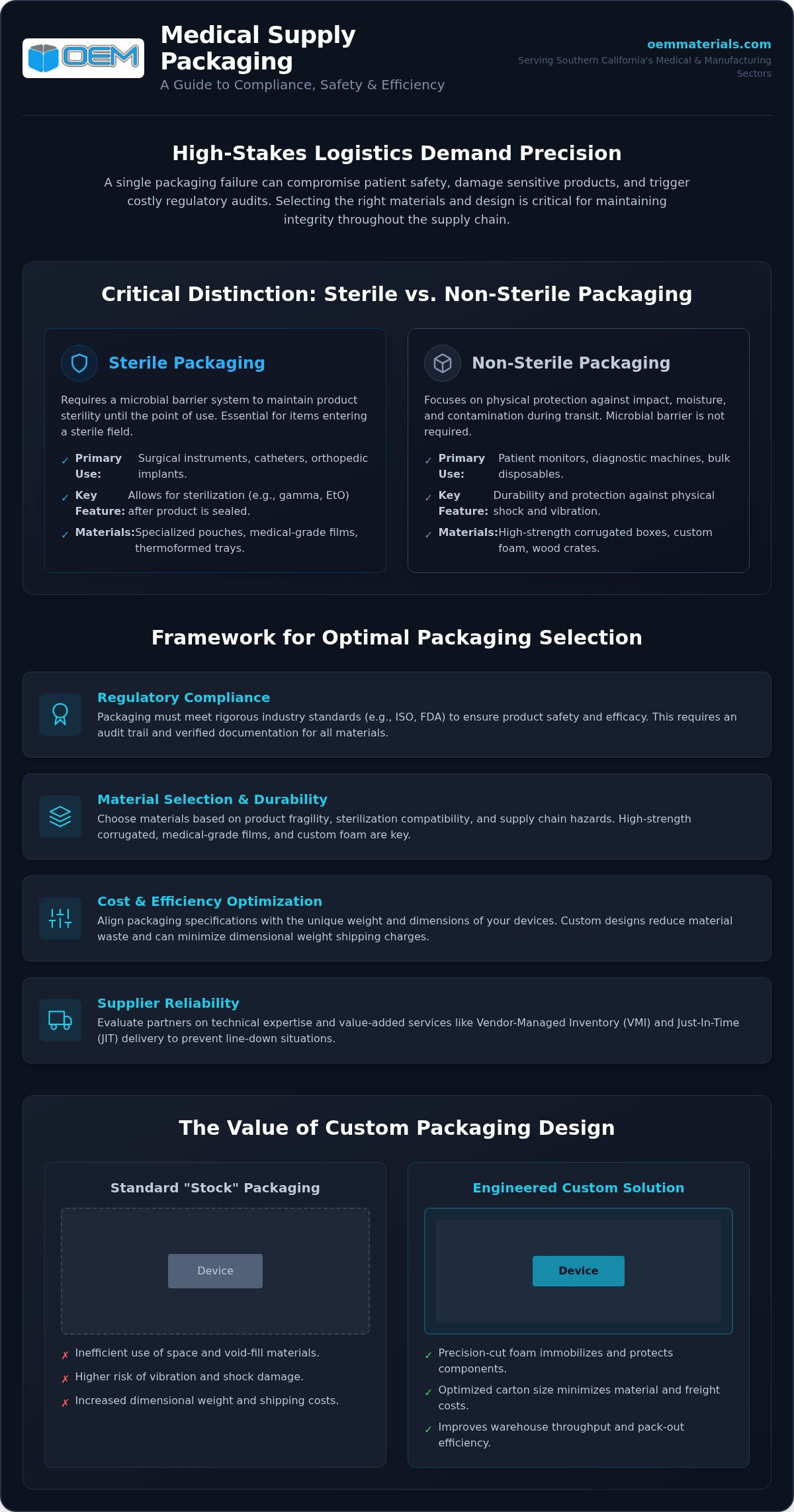
The distinction between sterile and non-sterile applications dictates the entire manufacturing workflow. Sterile packaging requires a microbial barrier system to maintain the sterility of items like surgical instruments, catheters, and orthopedic implants. These often utilize specialized pouches or thermoformed trays that allow for sterilization after the product is sealed. Non-sterile packaging is utilized for items that don’t require a sterile field, such as patient monitoring equipment, bulk disposables, or diagnostic machines. While the microbial requirements differ, both types must provide significant physical protection during transit through regional distribution hubs.
Custom Packaging Solutions for Medical Applications
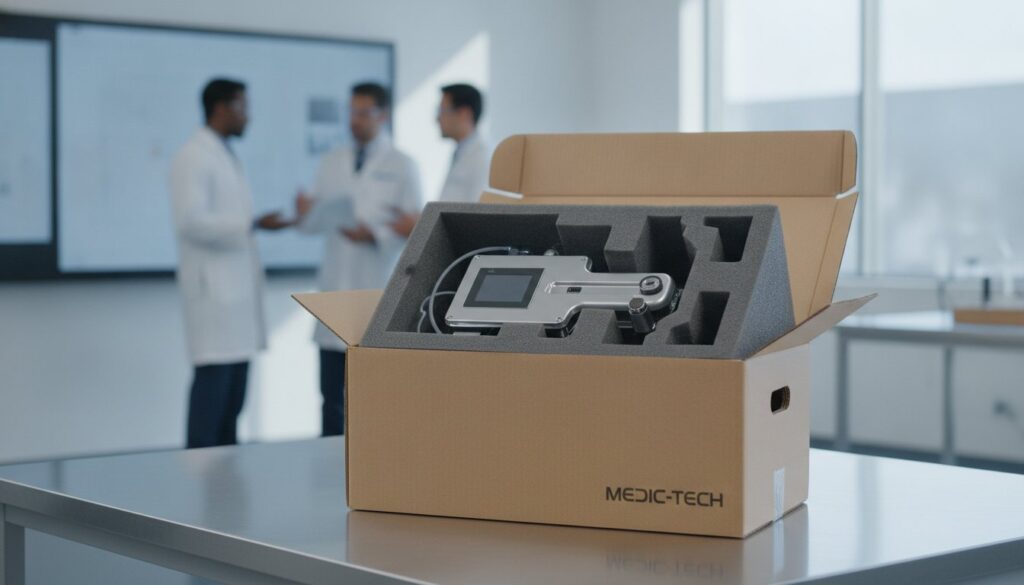
Standard containers often fall short when dealing with high-value medical electronics or irregularly shaped diagnostic kits. Investing in custom packaging design eliminates the inefficiency that leads to excessive material use and increased shipping costs. For example, a specialized diagnostic tool might require a precision-cut foam insert to prevent vibration damage, paired with a custom-sized outer carton to minimize dimensional weight charges. This tailored approach ensures that your medical supply packaging is optimized for both protection and profit margins.
OEM Materials & Supplies works as a technical partner for Southern California manufacturers to develop these targeted solutions. We focus on creating kits that simplify the assembly process for your warehouse team while ensuring every component is secured. By integrating custom foam and corrugated materials, we help facilities in the Inland Empire and San Diego County reduce product damage and improve throughput. Our team understands that a well-designed package is a tool for operational success. To see how this approach works in practice, explore our custom medical device packaging kits case study in operational efficiency for a detailed look at how Southern California manufacturers are consolidating components and reducing overhead.
Key Considerations When Selecting Medical Supply Packaging
Selecting the right medical supply packaging requires more than a simple comparison of material specs. You must evaluate how the packaging interacts with your specific product and the entire logistical cycle. For a purchasing manager in Los Angeles County or Orange County, the stakes are high. A failure in the field doesn’t just result in a return; it can lead to regulatory scrutiny and compromised patient outcomes. You need a solution that addresses the unique fragility, shelf-life requirements, and weight distribution of your devices.
Reliability in your supply chain is equally critical. Working with a partner that offers vendor-managed inventory (VMI) ensures you never face a line-down situation due to a shortage of custom crates or foam inserts. Proximity matters. A local Southern California supplier can provide faster turnaround times for prototypes and emergency restocks, which is vital for facilities maintaining lean operations.
Regulatory Compliance in Medical Packaging
Compliance is the foundation of the medical sector. Your packaging must meet rigorous standards to ensure the product remains safe and effective from the cleanroom to the operating room. This involves more than just selecting durable materials; it requires a complete audit trail and verified documentation. You must ensure that every component, from the corrugated outer box to the internal cushioning, aligns with the necessary certifications for your specific device class. Maintaining these records is essential for passing quality audits and meeting FDA requirements. To systematically verify your processes against ISO 11607 and FDA mandates, review our medical packaging compliance checklist for manufacturers to confirm every component in your system meets the required standards.
Cost Analysis: Beyond the Initial Price
The sticker price of a box is only a fraction of the total cost of ownership. To find true packaging cost savings, you must analyze the “landed cost” of your supplies. This includes labor for assembly, storage space in your warehouse, and shipping fees. For example, using oversized boxes leads to high dimensional weight charges. Switching to custom-engineered medical supply packaging can reduce material waste and optimize pallet patterns, significantly lowering your per-unit shipping expense.
Inefficient packing processes also drive up labor costs. If your team spends too much time wrapping individual components in bubble film, a custom-designed kit with pre-cut foam might be a more economical choice. If you are looking to optimize your current spend, you can speak with our team for a detailed assessment based on your annual usage and product dimensions. We focus on identifying these hidden inefficiencies to improve your bottom line.
How to Optimize Medical Supply Packaging for Your Needs
Optimization is a methodical process that transforms your packaging from a necessary expense into a strategic advantage. For facilities in Los Angeles County and the Inland Empire, efficiency often hinges on how quickly a team can secure a product for shipment without sacrificing safety. Achieving this requires a deep look at your current workflows and material choices. You aren’t just looking for a cheaper box; you’re looking for a better system that reduces labor and prevents product loss.
The goal of optimization is to align your medical supply packaging with the specific rigors of your distribution network. Whether you are shipping high-sensitivity electronics or bulk disposables, the right material choice reduces the risk of failure. By moving away from “one size fits all” solutions, you can eliminate excess weight and volume that inflate your freight costs.
Assessing Current Packaging Effectiveness
Start by auditing your damage rates and shipping data. If products are arriving at clinics with crushed corners or internal shifting, your current cushioning is inadequate. Speak with your warehouse team in San Diego or Orange County to identify which kits take the longest to pack. High labor hours often indicate that your packaging is too complex or requires too much manual taping and wrapping. Tracking these metrics provides the data needed to justify a shift toward more engineered solutions.
Implementing Custom Solutions for Optimal Protection
Standard packaging often leaves gaps that lead to movement during transit. Transitioning to custom foam packaging ensures a precision fit for every component of a medical device. This is particularly effective for complex kits where multiple parts must stay separated and protected from impact. Custom designs allow you to use smaller outer corrugated boxes, which directly lowers your dimensional weight charges and storage requirements in the warehouse.
Many Southern California manufacturers find success by integrating custom packaging design early in the product development phase. This proactive approach allows you to build a protective environment that matches the exact fragility of the device. Medical OEMs managing multiple components and SKUs can further streamline operations by adopting custom medical device packaging kits that consolidate individual parts into a single engineered solution, reducing packing time and simplifying procurement. If you are ready to eliminate shipping damage and reduce assembly time, you can request a quote for a custom packaging prototype tailored to your specific product dimensions and weight. We focus on creating functional remedies for your most difficult logistical challenges.
Conclusion: Partnering for Successful Medical Packaging Solutions
Your choice of medical supply packaging is a direct reflection of your commitment to product quality and patient safety. For manufacturers in the Inland Empire and across Southern California, the right packaging system reduces the risk of liability and operational downtime. It functions as a technical component of the medical device itself. You need a partner that provides stability and expertise rather than just a transaction. Reliability is the cornerstone of a successful healthcare supply chain.
OEM Materials & Supplies acts as a seasoned industry partner for facilities managing complex logistical requirements. We focus on durability, accuracy, and operational efficiency to solve real-world problems like inventory shortages and product damage. Our team provides functional remedies that allow your operations to scale without increasing your overhead. We understand the precision required to meet rigorous industry standards in a competitive market.
Building Long-Term Partnerships
Effective packaging isn’t static. As your product lines evolve and shipping regulations change, your packaging strategy must adapt. Ongoing collaboration with a knowledgeable supplier allows for continuous optimization of your materials and workflows. We encourage regular feedback loops to ensure that your custom foam inserts and corrugated solutions continue to meet the demands of your distribution network. Utilizing services like just-in-time (JIT) delivery and vendor-managed inventory (VMI) creates a seamless link between your production schedule and your packaging supply.
Requesting a Quote for Your Medical Packaging Needs
Moving toward a more efficient packaging model starts with accurate data. When you are ready to evaluate new medical supply packaging solutions, preparing a detailed set of requirements ensures a precise recommendation. We recommend having your specific product dimensions, the weight of the items, and your estimated annual usage ready for review. This information allows us to engineer a solution that maximizes protection while minimizing material waste and shipping costs. Results depend on these specific variables, and we use them to provide a grounded, business-to-business assessment.
Our team is ready to provide the technical context and industrial expertise required to support your operations in Orange County, Los Angeles, and beyond. We prioritize speed and precision in every quote and prototype we develop. To begin optimizing your supply chain, contact OEM Materials & Supplies for a professional consultation and quote. We are here to build a reliable foundation for your medical packaging needs.
Strengthen Your Medical Supply Chain Performance
Securing your high-value devices requires a transition from standard off-the-shelf containers to engineered systems that prioritize both protection and compliance. You’ve seen how the right medical supply packaging reduces product damage and lowers total landed costs by optimizing dimensional weight. Whether you’re operating out of Los Angeles County or San Diego, local expertise in regulatory requirements and material science is essential for maintaining operational integrity. Precision in your packaging choices isn’t just a logistical necessity; it’s a competitive advantage that ensures patient safety and brand reliability.
OEM Materials & Supplies delivers custom packaging solutions for a variety of medical applications. We focus on expertise in regulatory compliance and efficiency improvements to help you eliminate waste in your warehouse. Our team provides the technical support needed to design prototypes and manage inventory through VMI programs. If you’re ready to improve your packing speed and reduce shipping expenses, we can help you build a more resilient operation. Request a quote for your medical supply packaging needs today! We look forward to helping you solve your most complex distribution challenges.
Frequently Asked Questions
What types of medical supply packaging are available?
Medical supply packaging is generally divided into primary sterile barriers and secondary protective layers. Common options include microbial barrier pouches, thermoformed trays, and specialized films for sterile fields. For secondary protection, manufacturers rely on heavy duty corrugated boxes, custom foam packaging, and cushioning materials. These components work together to maintain sterility while providing the structural integrity needed to survive the physical rigors of the distribution cycle.
How do I ensure my medical packaging meets regulatory standards?
Ensuring compliance starts with selecting materials that are validated for your specific sterilization method, such as gamma radiation or ethylene oxide. You must verify that your supplier provides materials with traceable certifications and performance data. Maintaining a complete audit trail for every component, from the outer carton to the internal foam, is essential for meeting FDA and ISO 11607 standards during quality audits. Our medical packaging compliance checklist provides a structured framework to help you verify each requirement is addressed before your next audit.
What are the benefits of custom medical packaging solutions?
Custom solutions eliminate the gaps found in standard containers, which prevents product shifting and damage during transit. By engineering a precision fit with custom foam inserts, you can often use smaller outer boxes to reduce dimensional weight shipping charges. This approach also simplifies the assembly process for your warehouse staff in facilities throughout Southern California, leading to faster throughput and lower labor costs for each unit shipped.
How can I reduce packaging costs without sacrificing quality?
You can lower costs by right sizing your packaging to eliminate excess material and minimize freight expenses. Implementing value added services like vendor managed inventory (VMI) helps reduce the amount of warehouse space dedicated to packaging storage in your facility. Switching to specialized kits or pre assembled components can also reduce the labor time required for packing, which lowers the total landed cost of your supplies.
What should I consider when choosing a medical packaging supplier?
Look for a supplier that offers technical engineering support and a wide range of industrial materials, including custom foam and corrugated solutions. Reliability is critical, so choose a partner with a strong presence in Southern California areas like Orange County and Los Angeles to ensure fast turnaround times. A knowledgeable supplier should act as a consultant, helping you navigate material selection and logistical challenges rather than just providing a catalog of items.
How does OEM Materials & Supplies support medical packaging needs?
OEM Materials & Supplies supports the healthcare sector by designing high performance medical supply packaging that balances safety with operational efficiency. We provide a full suite of products, including custom crates, foam inserts, and stretch film, along with services like JIT delivery and VMI. Our team works closely with engineers and purchasing managers to develop prototypes that meet specific protection requirements and strict regulatory standards.