
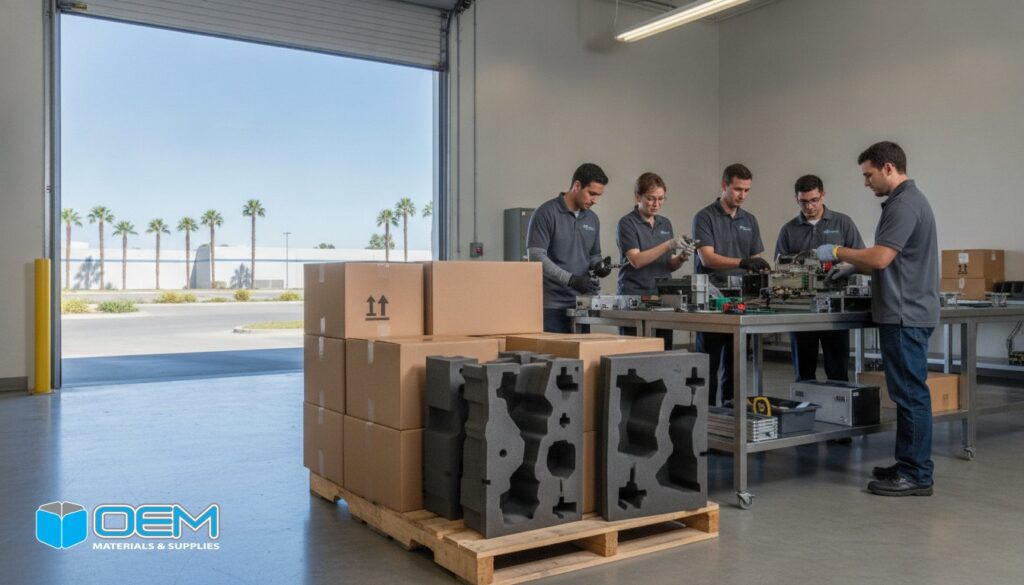
Every square foot of your warehouse currently occupied by stacks of corrugated boxes and foam inserts is space that isn’t generating production revenue. For manufacturers in Southern California, where industrial real estate rates in Los Angeles and Orange County average around $1.50 per square foot, the cost of doing it yourself extends far beyond the price of materials. You likely already feel the pressure of rising labor costs and the steep capital requirements of automated machinery.
Deciding between in-house packaging vs outsourcing is a strategic calculation of your total cost of ownership rather than a simple line-item comparison. This guide evaluates the operational impact of both models to help you identify the most efficient path for your facility. We will examine how shifting to a partner for kitting and assembly can reduce your overhead, improve throughput without increasing headcount, and ensure your high-value industrial components remain protected throughout the supply chain. By analyzing the logistical realities of the Inland Empire and San Diego County, we provide a practical framework for optimizing your packaging workflow and reclaiming valuable floor space for your core manufacturing operations.
Key Takeaways
- Calculate your total cost of ownership by accounting for hidden expenses such as machinery maintenance, utility overhead, and the opportunity cost of warehouse floor space.
- Evaluate in-house packaging vs outsourcing to determine which model provides the necessary operational agility to scale production without the risks of temporary labor hires.
- Leverage a partner’s specialized engineering expertise and testing equipment to ensure compliance with strict aerospace, medical, or automotive specifications.
- Utilize Vendor-Managed Inventory (VMI) and kitting services to streamline your assembly process and reduce the number of individual SKUs managed at your facility.
- Analyze the specific logistical advantages of local Southern California partnerships for faster just-in-time delivery and reduced shipping lead times.
Defining the Models: In-House Packaging vs. Outsourcing
Every industrial facility eventually reaches a tipping point where the packing line begins to compete with the production line for critical resources. The choice between in-house packaging vs outsourcing isn’t merely a logistical preference. It’s a structural business decision that dictates how you allocate your facility footprint and your capital equipment budget. For manufacturers handling high-value components, this decision determines whether you’re managing a complex packaging warehouse or focusing strictly on core engineering and production.
Industrial manufacturing introduces unique variables that standard retail fulfillment doesn’t face. You’re often dealing with bulky items like heavy-duty wood crates or sensitive electronics that require precision-cut engineered foam. Managing these materials requires specialized knowledge and significant physical space. Whether you keep these processes under your roof or move them to a partner changes your operational risk profile and your ability to scale.
The Scope of In-House Operations
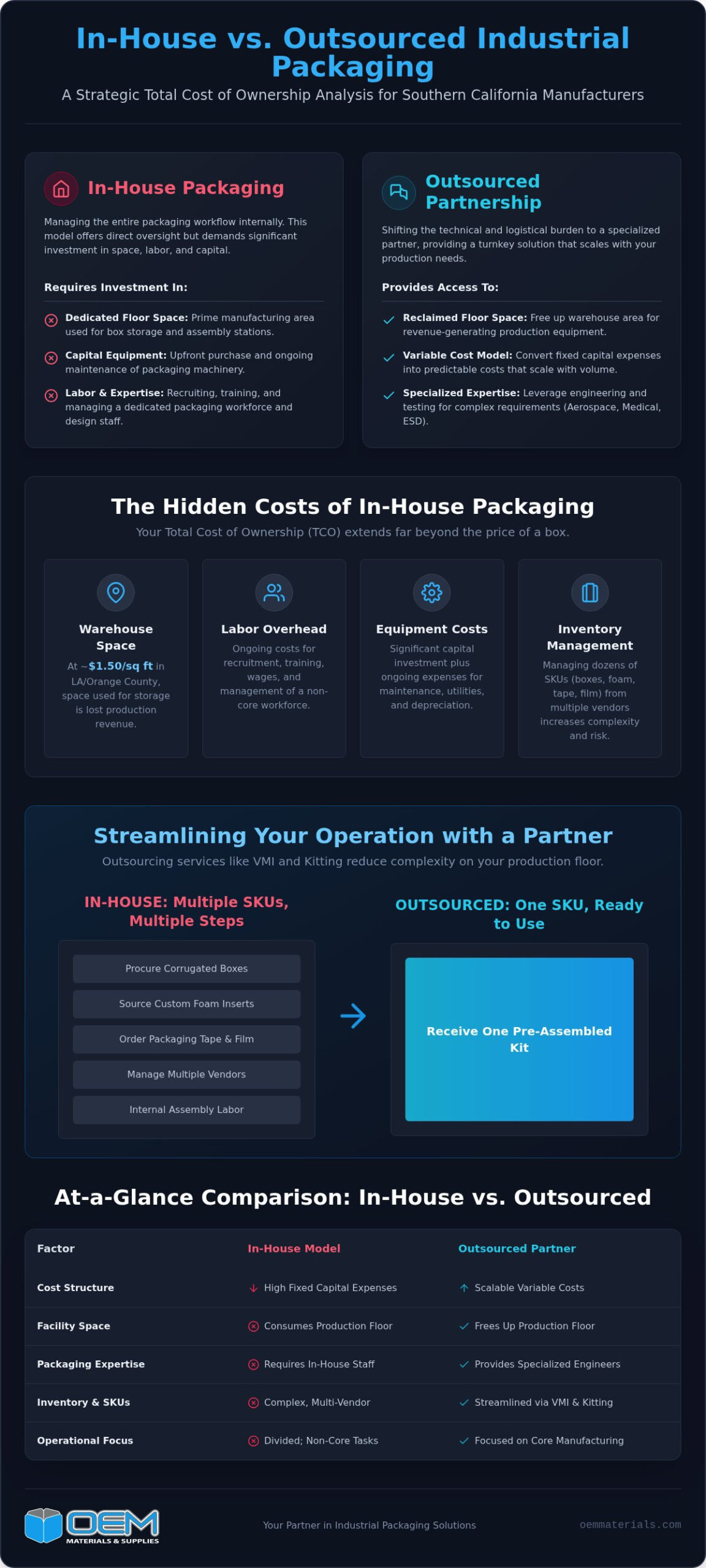
Managing your packaging in-house means your team owns the entire workflow from material procurement to final assembly. This model offers direct oversight but demands dedicated floor space for corrugated box storage and assembly stations. In Southern California, where warehouse vacancy rates are low and lease rates are high, using prime manufacturing space for packaging inventory can be a costly trade-off. It’s not just about the space; it’s about the people. You’re responsible for managing a workforce specifically for packing and logistics, which includes recruitment, training, and managing rising labor costs. Maintaining an internal department also requires you to keep technical expertise on staff for packaging design and testing to ensure your high-value components aren’t damaged during transit.
The Scope of Outsourced Packaging Services
Outsourced packaging shifts the technical and logistical burden to a specialized partner. This approach, often integrated into a broader strategy of Third-party logistics (3PL), provides a turnkey solution. A partner handles everything from initial custom packaging design to the procurement of disparate materials like stretch film, edge protectors, and specialized cushioning.
This model focuses on specialized services like kitting and assembly to streamline your production line. Instead of your team spending hours assembling complex kits, the partner delivers a single SKU that’s ready for the final product. This reduces your internal procurement workload and eliminates the need to manage dozens of different vendors for boxes, foam, and tape. Reclaiming warehouse space for revenue-generating production equipment becomes possible when you move these functions off-site while gaining access to advanced design and testing capabilities that are often too expensive to maintain internally.
Capital Investment and the Total Cost of Ownership
Evaluating the financial impact of in-house packaging vs outsourcing requires looking past the unit price of a single box. You must analyze the total cost of ownership (TCO) to understand the true burden on your bottom line. Total Cost of Ownership in the context of industrial packaging is the sum of material, labor, storage, and damage costs. While outsourcing can significantly reduce these overheads, the exact level of cost savings depends on specific variables like product dimensions, material choices, and shipping requirements. By shifting to an outsourced model, you convert these complex, fixed capital expenses into predictable variable costs that scale directly with your production volume.
Operational efficiency often suffers when manufacturers treat packaging as a secondary concern. The hidden costs of internal production include utility overhead, machinery depreciation, and the constant need for operator training. In high-rent regions like Los Angeles County and Orange County, where industrial lease rates average between $1.37 and $1.52 per square foot, the opportunity cost of warehouse space is a critical factor. Using 5,000 square feet to store packaging materials instead of revenue-generating production equipment can cost your business tens of thousands of dollars in lost manufacturing capacity every month.
Fixed Costs of Internal Production
Maintaining an internal packaging department demands significant upfront and ongoing investment. These fixed costs remain even when your production slows down. Key financial burdens include:
- Capital Equipment: High initial expenditure for box makers, engineered foam cutters, or automated stretch wrappers that require regular maintenance.
- Inventory Management: The physical and financial cost of maintaining a large stock of corrugated boxes and cushioning materials.
- Compliance and Safety: Ongoing costs for equipment safety inspections, operator certifications, and OSHA compliance related to packaging machinery.
Variable Costs and Scalability with a Partner
Outsourcing allows you to pay only for what you use. This model provides budget certainty and protects you from equipment underutilization during market fluctuations. A specialized partner offers:
- Predictable Budgeting: Pay-per-unit or pay-per-kit pricing structures make it easier to project costs for large production runs.
- Technology Access: You benefit from the latest packaging technology without the risk of equipment obsolescence or the need for internal troubleshooting.
- Bulk Procurement: Partners leverage high-volume purchasing to secure wholesale pricing on supplies like stretch film, edge protectors, and packaging tape.
If you’re looking to transition from fixed overhead to a more agile model, you can request a custom cost analysis based on your facility’s specific logistical requirements.
Quality Control and Engineering Specifications
Industrial sectors like aerospace and medical devices demand a level of precision that goes far beyond standard shipping practices. When evaluating in-house packaging vs outsourcing, you must consider whether your internal team can strictly adhere to complex engineering drawings and material specifications. Specialized components often require rigorous validation through drop tests and vibration analysis. While an in-house team understands your product, they often lack the specialized testing equipment or the technical background in material science required to guarantee protection under extreme shipping conditions.
Consistent quality is fundamentally easier to maintain when you partner with an organization that specializes exclusively in protective packaging. These partners treat packaging as an engineered product rather than an afterthought; they ensure every box and insert meets the exact tolerances defined in your technical documentation. This specialized focus eliminates the variability often found in internal packing lines where packaging is secondary to the manufacturing process.
Meeting Rigorous Industry Standards
Compliance is a non-negotiable requirement for manufacturers in Southern California hubs like Orange County and San Diego. Ensuring your packaging meets specific cleanliness or sterilization standards requires controlled environments and documented processes. Professional package suppliers provide the necessary material certifications and traceability that auditors require for aerospace and medical applications.
Rapid prototyping plays a vital role in this validation process. By producing a physical prototype before moving to high-volume production, you can verify the fit and function of the packaging against your engineering drawings. This proactive approach prevents costly mid-production adjustments and ensures that your final shipping solution is fully compliant with industry-specific regulations. It’s a level of technical assurance that’s difficult to sustain with an internal team focused on production quotas.
Reducing Product Damage through Expertise
Selecting the wrong material density can lead to catastrophic failure for sensitive electronics or precision instruments. Professional packaging engineers use material science to determine the ideal specifications for engineered foam inserts, balancing shock absorption with structural support. This level of expertise is difficult to replicate with a general warehouse staff that handles multiple disparate tasks.
For heavy machinery and oversized components, the structural integrity of custom crates and pallets is paramount. A partner who understands the load-bearing requirements of different wood species and fastener patterns can prevent structural collapses during transit. When you outsource, you aren’t just buying materials; you’re investing in the professional assembly and engineering expertise that significantly reduces product damage rates. This specialized focus ensures your high-value assets arrive at their destination in the exact condition they left your facility.
Operational Agility in the Southern California Supply Chain
Manufacturers operating in Los Angeles and Orange County face unique economic pressures that dictate their logistical strategies. With industrial real estate rates averaging $1.52 per square foot in these regions, every inch of floor space must be optimized for production. The debate between in-house packaging vs outsourcing often centers on how quickly a facility can adapt to market shifts. Maintaining an internal packing line creates a rigid operational structure that’s difficult to scale when order volumes spike or supply chains face local disruptions.
Outsourcing provides the agility to handle rapid scaling during seasonal peaks without the risk of hiring and training temporary staff. This flexibility is vital in the tight Southern California labor market, where the average hourly rate for a warehouse worker is approximately $18.05. By leveraging a partner’s infrastructure, you can increase your output instantly without committing to long-term facility expansions or additional equipment leases. Local Southern California proximity allows for immediate technical support and same-day delivery of custom industrial orders, drastically reducing lead times compared to out-of-state vendors.
Managing Labor Shortages and Training
Packaging labor is notoriously high-turnover, creating a constant cycle of recruitment and training for internal departments. This administrative burden distracts your management team from high-value manufacturing tasks. When you outsource, you shift this responsibility to professional partners who utilize specialized kitting teams. These teams focus exclusively on assembly and packing, achieving a level of efficiency and speed that general warehouse staff simply can’t match. This transition allows your core team to stay focused on engineering and production, where their expertise generates the most value for your facility—a strategy similar to how modern agencies utilize white label seo services canada to scale their capabilities efficiently.
You can significantly improve your facility’s throughput by reclaiming warehouse space currently used for storing pallets and bulky corrugated inventory. Just-in-Time (JIT) delivery programs ensure you receive the exact amount of packaging required for a specific production run, eliminating the need for on-site stockpiling. Receiving pre-assembled kits that are ready for the final product streamlines your production line and reduces the number of touches required to get a product out the door. This lean approach is especially beneficial for manufacturers in the Inland Empire and San Diego County who need to maintain high velocity in their shipping departments.
If your current packing process is creating a bottleneck in your facility, it’s time to evaluate a more flexible approach. You can request a quote to see how a localized kitting and JIT program can optimize your Southern California operations.
The Hybrid Advantage: Vendor-Managed Inventory and Kitting
The choice between in-house packaging vs outsourcing often presents a false binary. You don’t have to choose between complete internal control and total external reliance. A hybrid model utilizing packaging VMI provides the visibility of an in-house operation with the lean efficiency of a third-party partner. This approach minimizes stockouts and overstock situations through professional inventory monitoring; it allows your procurement team to focus on high-value components rather than secondary supplies.
By integrating a partner into your supply chain, you gain the ability to scale without the overhead of additional management. This model is particularly effective for manufacturers in Orange County and Los Angeles who need to maximize every square foot of their facility. You maintain the materials you need on-site, but the responsibility for replenishment and inventory accuracy shifts to the expert supplier.
How VMI Streamlines Industrial Operations
VMI streamlines industrial operations by removing the friction from the replenishment cycle. Instead of your warehouse manager spending hours auditing stock, the supplier monitors levels and replenishes packaging automatically. This reduces the hidden administrative costs associated with constant purchase orders for mailing tubes, stretch film, or custom tape. You avoid the bullwhip effect in your supply chain. You only pay for what you use, which significantly improves your monthly cash flow and reduces the risk of dead inventory sitting on your shelves.
Kitting and Assembly as a Competitive Edge
Kitting and assembly provide a distinct competitive edge by reducing the number of touchpoints in your packing process. Professional packaging kits are designed for specific production runs; they arrive at your facility as a single SKU ready for immediate use. This eliminates the need for your staff to pull multiple disparate items from different warehouse locations.
Consider the impact on labor efficiency. A manufacturer in San Diego County recently reduced labor costs by switching to pre-assembled kits featuring custom-cut foam inserts already seated within corrugated boxes. Their team no longer spends time folding boxes or fitting foam; they simply place the product in the kit and seal it. This shift improves throughput without increasing headcount. OEM Materials & Supplies acts as a strategic extension of your team. We provide the technical expertise to design these kits and the logistical infrastructure to manage your inventory. By adopting a hybrid model, you reclaim your warehouse space while ensuring your high-value industrial components always have the protection they require.
Strategic Steps to Optimize Your Packaging Workflow
The strategic shift from internal logistics to a specialized partnership allows you to align your packaging operations with your facility’s long-term growth. When weighing in-house packaging vs outsourcing, the goal is to eliminate bottlenecks that hinder production velocity. By leveraging advanced engineering and professional kitting, you ensure that high-value components receive consistent protection while your team focuses on core manufacturing tasks. This transition moves your operation toward a leaner, more responsive model that can adapt to changing market demands without the burden of fixed capital expenditure.
Transitioning to vendor-managed inventory and pre-assembled packaging kits provides the operational agility necessary to maintain a competitive edge. It’s a method of reclaiming valuable floor space and reducing the administrative complexity of managing multiple material vendors. This approach ensures your facility remains optimized for its primary purpose: producing high-quality industrial goods for your clients.
Contact OEM Materials & Supplies for a Custom Packaging Consultation to begin optimizing your logistics. To provide the most accurate recommendations for custom corrugated boxes, engineered foam, or wood crates, please include your product dimensions, weight, and annual usage when requesting a quote. We look forward to helping you build a more efficient supply chain.
Frequently Asked Questions
Is it cheaper to package in-house or outsource for small manufacturing runs?
Outsourcing is often more cost-effective for small manufacturing runs because it avoids the high setup costs and capital expenditure required for internal lines. When evaluating in-house packaging vs outsourcing for low volumes, the internal labor costs and material waste often outweigh the per-unit price of a partner. Specialized suppliers leverage bulk material purchasing and existing machinery to deliver professional results without requiring you to dedicate valuable warehouse space to specialized assembly stations.
What are the main risks of outsourcing industrial packaging?
The main risks involve a perceived loss of control over the immediate workflow and potential delays if the supplier lacks local proximity. Manufacturers may worry about a partner’s ability to adapt quickly to engineering revisions. You can minimize these risks by selecting a local Southern California partner with deep expertise in industrial sectors. Clear communication protocols and documented quality management systems ensure the final output consistently meets your technical requirements and production schedules.
How much warehouse space can I save by using a VMI program?
A VMI program allows you to reclaim significant warehouse space by shifting the burden of inventory storage to your supplier. Instead of stockpiling bulky pallets of corrugated boxes or foam inserts, you receive frequent, smaller deliveries based on actual usage. This strategy is particularly effective for manufacturers in Los Angeles and Orange County who need to convert storage areas into revenue-generating production zones without risking stockouts of critical packaging supplies.
Can an outsourced partner handle custom engineering specifications for aerospace parts?
Specialized partners are equipped to handle the most rigorous engineering specifications for the aerospace industry. They utilize precision CAD design and rapid prototyping to ensure every component fits perfectly within its protective housing. These suppliers also manage the complex documentation required for material traceability and compliance. By delegating this to an expert, you ensure that high-value parts are protected by packaging that meets the same engineering tolerances as the products themselves.
How does kitting improve the efficiency of an assembly line?
Kitting increases efficiency by consolidating multiple packaging elements into a single, ready-to-use SKU at the assembly station. This eliminates the time warehouse staff spends searching for boxes, cushioning, and tape. By reducing the number of individual steps in the packing process, kitting allows for faster throughput and minimizes the risk of assembly errors. It transforms a complex logistical task into a simple, repeatable action that keeps the production line moving at peak velocity.
What industries benefit most from outsourcing their packaging logistics?
Manufacturers in the aerospace, medical, electronics, and automotive sectors see the greatest benefits from outsourcing. These industries deal with sensitive, high-value components that require specialized protection and strict regulatory compliance. Outsourcing allows these companies to access advanced material science and custom engineering without the overhead of an internal packaging department. It is an ideal solution for businesses that need to scale production quickly while maintaining the highest standards of product protection during transit, much like how Silicon Valley Direct helps brands optimize their mailing and fulfillment operations.
Providing detailed data is essential for an accurate technical recommendation and cost analysis. You should include the dimensions, weight, and fragility of your product, along with your estimated annual usage. Sharing engineering drawings and specific material requirements, such as ESD protection or cleanroom-compatible foam, helps the supplier design a solution that meets your exact needs. This data allows for a precise evaluation of the total cost of ownership compared to internal packing methods.
How do I maintain quality control when using an external packaging supplier?
You maintain quality control by treating your packaging supplier as an extension of your own engineering team. Establishing clear performance metrics and requiring first-article prototypes for validation ensures the final product meets your standards. Regular reviews of material certifications and consistent feedback loops regarding shipping performance allow you to monitor quality without managing daily operations. A professional partner will have their own robust quality management systems in place to guarantee consistency across every production run.