
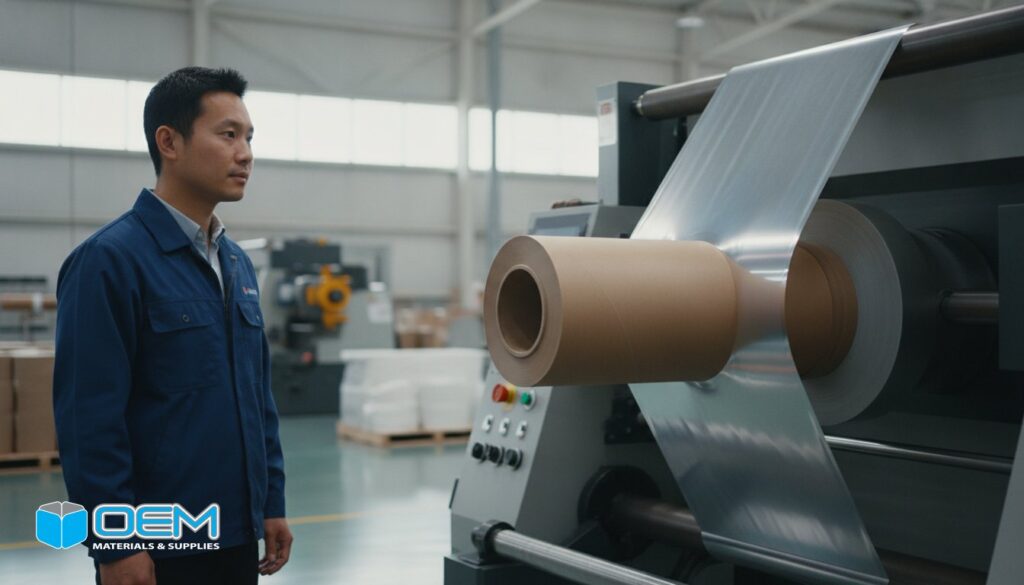
A single core collapse during high-speed winding can scrap thousands of dollars in high-value film, foil, or textile materials in seconds. For operations managers across Southern California, this isn’t just a hypothetical risk; it’s a costly reality when using substandard cores that fail under industrial tension. You understand that the structural integrity of your packaging is the only thing standing between a successful production run and a warehouse full of unsalvageable waste. Relying on generic specifications often leads to over-engineered costs or, more frequently, catastrophic material failure.
We’ll show you how to select and implement industrial-grade thick-wall paper tubes to prevent core collapse and protect high-value materials during manufacturing and transit. By focusing on technical requirements like crush strength and precision wall thickness, you can ensure your winding processes remain stable and your shipments arrive intact. This article provides a clear roadmap for identifying the correct specifications for your application, navigating the impact of California’s SB 54 regulations, and establishing a reliable SoCal supply chain that eliminates the long lead times associated with national distributors.
Key Takeaways
- Differentiate between lightweight mailing tubes and industrial-grade thick-wall paper tubes engineered for high-density structural integrity.
- Evaluate the engineering metrics of radial crush strength and beam strength to prevent core collapse during manufacturing and transit.
- Apply a technical framework to select custom dimensions and end-caps that match the weight and tension requirements of your specific material.
- Reduce supply chain friction by leveraging local Southern California distribution and vendor-managed inventory to ensure consistent availability for high-volume orders.
Understanding Thick-Wall Paper Tubes in Industrial Environments
Thick-wall paper tubes aren’t merely larger versions of the cardboard cylinders found in retail shipping centers. These are high-density, spiral-wound components engineered specifically for structural integrity and high-tension manufacturing. Most industrial applications require a substrate that can withstand significant radial pressure without deformation. The primary material, Paperboard, is selected based on its fiber density and thickness to ensure the final product meets rigorous industrial benchmarks.
The Anatomy of a Spiral-Wound Tube
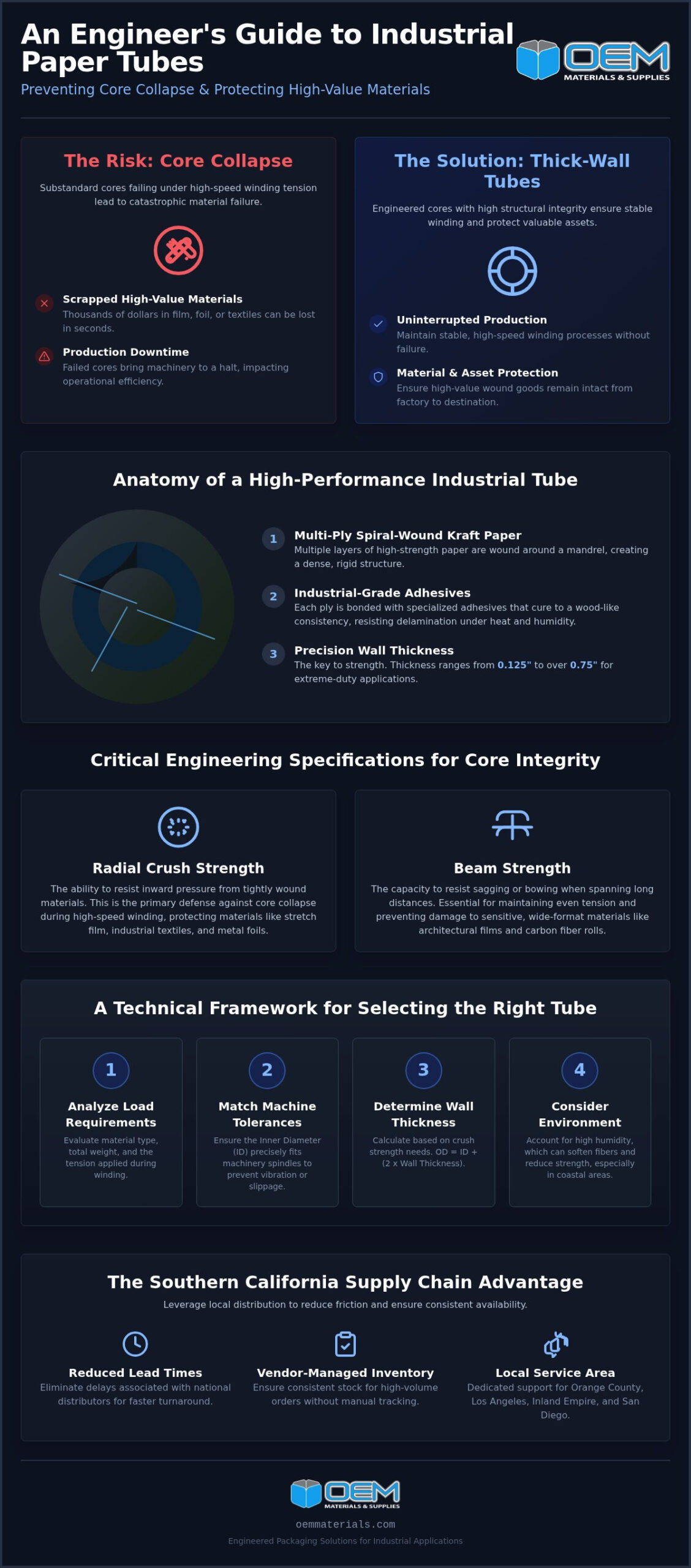
The manufacturing process involves winding multiple plies of high-strength kraft paper around a fixed mandrel. Each layer is bonded using industrial-grade adhesives that cure to a rigid, wood-like consistency. The total ply count directly dictates the wall thickness, which can range from 0.125 inches to over 0.75 inches for extreme-duty applications. Choosing the right adhesive is critical; it must resist delamination even when the tube is subjected to the high heat or humidity often found in manufacturing plants or long-haul shipping containers.
Industrial vs. Consumer Grade Standards
Standard consumer tubes are designed for low-weight protection and manual handling. In contrast, industrial thick-wall paper tubes must maintain precision tolerances to interface with automated winding machinery. Even a slight deviation in the inner diameter can cause machine vibration or core slippage, leading to uneven tension and ruined product. While we offer a variety of Mailing Tubes & Cores for general use, industrial-grade versions are built to survive the crushing forces of heavy-duty winding equipment.
Wall thickness serves as the primary determinant of radial crush resistance. This metric is vital for protecting high-value materials like aerospace textiles, medical-grade films, and specialized foils. These materials are often wound under immense tension, exerting a constant inward force on the core. If the tube wall is too thin, the core will collapse inward, rendering the material impossible to unwind and resulting in total product loss. By selecting a tube with the appropriate wall thickness, engineers ensure the core remains a stable foundation throughout the manufacturing and distribution cycle.
Engineering Specifications: Wall Thickness and Crush Resistance
Crush resistance is the maximum pressure a paper tube can withstand before its circular profile deforms or collapses under load. For industrial applications, this metric is the difference between stable inventory and the total loss of high-value wound materials. Radial crush strength specifically refers to the tube’s ability to resist the inward pressure exerted by materials like stretch film, industrial textiles, or metal foils during high-speed winding. If the core fails, the material becomes unusable because it cannot be properly unwound by downstream machinery.
Beam strength is equally critical for long-format shipments. When thick-wall paper tubes span several feet, they must resist sagging under the weight of the material they support. A tube that bows in the middle creates uneven tension and can damage sensitive architectural films or carbon fiber rolls. Engineers must also account for the environment; paper is hygroscopic and absorbs moisture from the air. In coastal Southern California areas like Long Beach or San Diego, high humidity can soften the paper fibers and significantly reduce the core’s effective crush strength if the specifications aren’t adjusted for these conditions.
Determining the Required Wall Thickness
Selecting the correct thickness involves analyzing the material weight, winding speed, and the internal diameter (ID) required to fit your machinery spindles. Standard industrial wall thicknesses typically range from 0.125 to 0.500 inches, though heavy-duty applications often require even greater dimensions. To calculate the necessary outer diameter (OD), you must add twice the wall thickness to the ID. Precision matters here; a core that is even slightly undersized won’t seat correctly on the mandrel, leading to operational delays. If you’re unsure of the exact specifications needed for your equipment, you can request a technical consultation to determine the optimal dimensions for your specific load.
Material Grades and Performance
The choice between recycled kraft paper and high-strength virgin fibers involves a trade-off between cost and performance. Recycled materials are sustainable and sufficient for many standard loads, but they generally have shorter fibers and lower overall rigidity. Virgin fibers provide superior structural performance and higher crush ratings for the same wall thickness. For manufacturing plants in the Inland Empire or Orange County, material selection should balance the need for durability with the total weight of the shipping unit. Heavier tubes increase freight costs, so the goal is to find the minimum wall thickness that still provides a safety margin against collapse without over-engineering the package.
Strategic Applications Across Manufacturing and Logistics
Heavy-duty paper cores serve as the backbone for diverse industrial processes throughout Southern California. In the textile and flexible film industries, thick-wall paper tubes provide the necessary rigidity to support thousands of yards of material without structural compromise. These sectors require cores that can handle the specific inward pressure of elastic materials, which tend to “cinch” after winding. Without sufficient wall thickness, the resulting core compression makes it impossible for downstream converters to mount the roll on their equipment.
Beyond material winding, these tubes function as high-performance structural components. In construction, large-diameter versions are utilized as single-use concrete forms for cylindrical pillars. In the metals industry, they act as protective spacers for rolled aluminum and steel. These metal rolls are susceptible to edge damage during transit; a well-fitted paper core ensures the weight is distributed evenly across the pallet, preventing the metal from shifting and denting. For aerospace manufacturers in Los Angeles and Orange County, the combination of lightweight design and extreme crush resistance is non-negotiable for shipping precision-engineered components.
High-Speed Winding and Core Stability
High-tension winding equipment exerts immense force on the center of a roll. If the core lacks sufficient density, it can undergo “ovalization,” where the circular profile becomes an ellipse. This distortion causes significant vibration at high speeds, which can damage machine bearings and lead to uneven material thickness. Using tubes with reinforced walls ensures smooth material payoff during automated production. This level of precision often requires custom packaging design to match the specific torque and tension settings of your machinery.
Protective Sleeving for Sensitive Components
While often used as a core, thick-wall paper tubes also serve as an external protective sleeve. For long, cylindrical items like drive shafts or medical-grade piping, a tube offers superior puncture resistance compared to standard corrugated boxes. The rigid wall acts as a hard shell that deflects impact during warehouse handling. For complex shipments, we often integrate these tubes into hybrid kits. Working with experienced corrugated packaging box manufacturers allows you to combine the outer impact protection of a box with the internal structural rigidity of a paper sleeve, ensuring high-value parts reach their destination without a scratch.
Selecting the Right Paper Tube for Your Operations
Selecting the correct thick-wall paper tubes requires an objective assessment of your manufacturing equipment and the fragility of the wound material. Procurement teams often struggle with the decision to stick with off-the-shelf sizes or invest in custom-engineered cores. While stock options provide speed, custom dimensions offer the precision necessary to eliminate production bottlenecks. A critical but often overlooked component is the end-cap. Selecting the right cap prevents internal debris from contaminating sensitive films and provides a secondary layer of structural support during vertical shipping. Every application is unique; results depend on specific variables including:
- Total weight and density of the wound material
- Maximum tension and winding speed of the machinery
- Environmental conditions during storage and transit
- Required inner diameter (ID) for spindle compatibility
Balancing the per-unit material cost against the risk of product damage is a fundamental part of the procurement process. A slightly more expensive, thicker-walled tube is a small investment compared to the cost of a rejected shipment of aerospace textiles or medical-grade plastics.
Stock vs. Custom Dimensions
Standard mailing tube sizes are often sufficient for lightweight industrial shipping or low-tension winding. However, high-volume operations usually benefit from custom-cut lengths. Trimming tubes manually on a production floor is an inefficient use of labor and creates unnecessary dust in clean manufacturing environments. Custom wall thicknesses, while requiring slightly longer lead times from your supplier, provide a safety margin that prevents catastrophic core failure. You should evaluate your annual usage and winding speeds to determine if the labor savings of custom lengths outweigh the immediate availability of stock sizes.
Secondary Packaging Integration
The tube is only one part of the protective equation. To ensure stability during transit, these tubes must be properly secured on heavy duty plastic pallets. Because cylindrical loads are prone to shifting, using high-performance stretch film for pallet wrapping is essential for maintaining load containment. For shipments involving multiple stacked tubes, adding edge and corner protectors prevents the outer layers of your material from being crushed by the tension of the strapping or film.
If you need help calculating the exact crush strength required for your next production run, contact our engineering team for a technical consultation to ensure your specifications match your operational needs.
Sourcing Industrial-Grade Tubes from a Southern California Partner
Sourcing thick-wall paper tubes from a local partner in Los Angeles or Orange County offers immediate logistical relief. Paper tubes are inherently bulky and expensive to ship over long distances because you’re essentially paying to transport air. By working with a Southern California distributor, you significantly reduce freight costs and carbon footprint while ensuring faster response times for urgent production needs. Local sourcing in the Inland Empire or San Diego County cuts lead times from weeks to days, allowing your team to remain agile when production schedules shift.
Industrial real estate in Southern California remains at a premium. With average asking rents for industrial space reaching $1.22 per square foot in the second quarter of 2026, every inch of warehouse space must be optimized. Utilizing Just-In-Time (JIT) delivery for your thick-wall paper tubes allows you to reclaim valuable floor space for finished goods rather than storing months of packaging supplies. We function as a technical consultant rather than a simple vendor, helping you design a supply chain that prioritizes operational efficiency over sheer inventory volume.
Logistics and Supply Chain Optimization
For high-volume users, managing core inventory is a constant logistical challenge. Implementing a Packaging VMI program allows your supplier to monitor stock levels and replenish inventory automatically. This prevents stockouts of critical winding cores that could otherwise halt an entire production line. We can also integrate these cores into broader packaging kits that include custom foam or corrugated boxes, streamlining your assembly process and reducing the number of individual vendors you need to manage.
Requesting a Technical Quote
To provide an accurate recommendation, we require specific data points that define your operational requirements. Our engineering team uses this information to ensure the core’s crush strength exceeds the tension limits of your winding equipment. When requesting a quote, please have the following data ready:
- Required Inner Diameter (ID) to match your machine mandrels
- Required Outer Diameter (OD) or specific Wall Thickness
- Exact length of the tube or core
- Annual usage and typical order quantities
- Environmental storage conditions (e.g., high humidity environments)
Once we have these specifications, we can facilitate rapid prototyping and testing to verify the core’s performance under your specific manufacturing loads. This methodical approach ensures you receive a product that is neither under-engineered for the task nor unnecessarily expensive due to over-engineering. Contact an experienced industrial partner today to discuss your customized core requirements and secure your Southern California supply chain.
Securing Your Industrial Supply Chain with Precision Cores
Protecting high-value films, textiles, and foils requires more than a generic shipping tube. You need thick-wall paper tubes engineered to meet the specific radial crush and beam strength requirements of your manufacturing machinery. By prioritizing technical specifications over commodity pricing, you eliminate the risk of core collapse and costly material waste. Implementing these high-density cores ensures that your high-speed winding processes remain stable and your finished products arrive at their destination without structural deformation.
OEM Materials & Supplies provides local Southern California distribution across Los Angeles, Orange County, and San Diego. Our team offers custom design and rapid prototyping services to ensure your cores meet the rigorous standards of the aerospace and medical sectors. We also provide vendor-managed inventory (VMI) and just-in-time delivery programs to streamline your procurement and maintain consistent stock levels without bloating your warehouse footprint. This approach allows you to focus on production while we manage the complexities of your core supply chain.
Contact OEM Materials & Supplies for a custom industrial tube quote to discuss your specific dimensions, weight requirements, and annual usage. We look forward to helping you optimize your packaging efficiency and secure your production lines with reliable, industrial-grade solutions.
Frequently Asked Questions
What is the difference between a mailing tube and an industrial core?
Mailing tubes aren’t designed for heavy-duty industrial loads; they’re built for lightweight protection of documents or posters during transit. Industrial cores are engineered for high-density structural integrity to support the tension of wound materials. While mailing tubes typically have thin walls, industrial cores are often thick-wall paper tubes that provide significant radial crush resistance. These cores must maintain precise tolerances to interface with automated winding machinery in Los Angeles manufacturing facilities.
How is the wall thickness of a paper tube measured?
Wall thickness is measured as the distance between the inner diameter (ID) and the outer diameter (OD). You can calculate this by subtracting the ID from the OD and dividing the result by two. Precision calipers are used to ensure the thickness is consistent across the entire length of the tube. This measurement is critical for Southern California engineers who need to ensure their cores can withstand specific PSI ratings without collapsing under heavy load.
Can thick-wall paper tubes be customized for specific machinery?
Yes, industrial paper tubes are highly customizable to meet the specifications of specific winding mandrels and spindles. We provide custom-cut lengths to eliminate secondary trimming labor on your production floor. You can also specify the exact inner diameter and wall thickness required for your tension settings. Customization ensures a perfect fit for automated equipment used in Orange County medical device manufacturing or aerospace component production, reducing machine vibration and material waste.
What industries typically use heavy-duty paper cores?
Heavy-duty cores are essential in sectors that handle rolled materials under tension. These include the textile, flexible film, and specialty foil industries. Aerospace manufacturers in the Inland Empire use them to ship carbon fiber and advanced composites. Medical device companies in San Diego rely on these tubes for sterile film winding. Automotive suppliers also use them as protective sleeves for drive shafts and other cylindrical parts to prevent damage during regional distribution.
How does moisture affect the strength of thick-wall tubes?
Moisture and high humidity significantly reduce the structural integrity of paper tubes by softening the cellulose fibers and the industrial adhesives. In coastal areas like Long Beach or San Diego, humidity can lead to core delamination or a decrease in radial crush strength. It’s important to store your thick-wall paper tubes in climate-controlled environments or adjust your engineering specifications to account for the potential loss of rigidity in humid shipping lanes.
Are these paper tubes recyclable in industrial waste streams?
Thick-wall paper tubes are fully recyclable within standard industrial paper and cardboard waste streams. Since they are manufactured from high-density paperboard, they can be processed by local recycling facilities in Los Angeles and Riverside. Using fiber-based cores helps Southern California manufacturers comply with SB 54 regulations by prioritizing recyclable packaging materials. This makes them a sustainable alternative to plastic or metal cores for many high-volume winding and shipping applications.
What is the maximum weight capacity for a thick-wall paper core?
There is no single maximum weight capacity because performance depends on the wall thickness, core diameter, and the length of the span. A tube with a 0.500-inch wall thickness can support significantly more weight than a standard core. Capacity is also influenced by whether the load is supported by a mandrel or is free-spanning. Engineers must calculate the required beam strength and crush resistance based on the specific density and width of the material roll.
How do I determine the correct diameter for my winding spindle?
To determine the correct inner diameter (ID), measure the outer diameter of your winding spindle using a precision micrometer. You should add a small clearance, typically between 0.010 and 0.030 inches, to ensure the tube slides onto the mandrel easily without excessive play. A fit that’s too tight causes loading delays, while a loose fit leads to core slippage and uneven winding tension. Consult with your local packaging partner in the Inland Empire to verify these tolerances.