
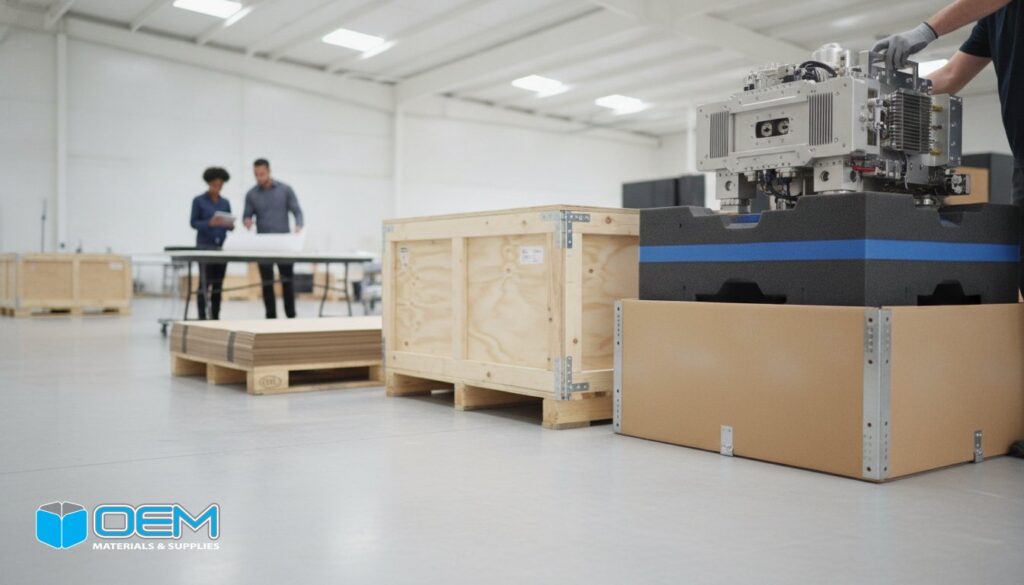
Shipping air is the most expensive mistake a manufacturer can make in the current logistics climate. You’ve likely felt the impact of the 5.9% general rate increases implemented by major carriers in 2026, alongside stricter Large Package Surcharge triggers that now penalize cubic volume more aggressively. When you’re moving heavy machinery or aerospace components across Southern California, standard solutions often lead to inefficient dimensional weight and excessive freight costs. Implementing engineered custom packaging for oversized products is no longer just about protection; it’s a critical strategy for maintaining operational margins and ensuring your assets survive the rigors of LTL transit.
We understand that your team spends too much labor time on complex, non-standard crating that still results in occasional product damage. This guide provides a technical roadmap for engineering structural packaging systems that prioritize load stabilization and handling safety. You’ll learn how to select the right materials, from heavy-duty corrugated to custom foam inserts, to optimize warehouse efficiency and reduce shipping risks. We’ll also look at how right-sizing your packaging helps you stay ahead of evolving regulations like California’s SB 54 while protecting your bottom line.
Key Takeaways
- Learn how to mitigate rising freight costs by optimizing dimensional weight through engineered custom packaging for oversized products.
- Identify the structural thresholds for choosing between high-ECT corrugated containers and heavy-duty wood crates based on load weight and transit risks.
- Reduce labor costs and floor congestion by implementing pre-assembled packaging kits designed for rapid assembly in industrial environments.
- Utilize local Southern California design and prototyping services to accelerate your product development cycle while ensuring asset protection.
- Explore how Vendor Managed Inventory (VMI) can stabilize your supply chain and eliminate lead time issues for large-scale packaging materials.
Critical Challenges in Packaging Oversized Industrial Products
Industrial oversized packaging applies to any asset that exceeds standard parcel dimensions or pallet footprints, typically requiring LTL (Less-Than-Truckload) or flatbed transport. For manufacturers in sectors like aerospace or automotive, engineering custom packaging for oversized products requires a deep understanding of physical stresses. Unlike standard shipping, where weight is the primary cost driver, oversized items are governed by volume and structural requirements. Applying fundamental packaging engineering principles ensures that the container doesn’t just hold the product but actively protects it against the unique rigors of industrial logistics.
Freight and Dimensional Weight Considerations
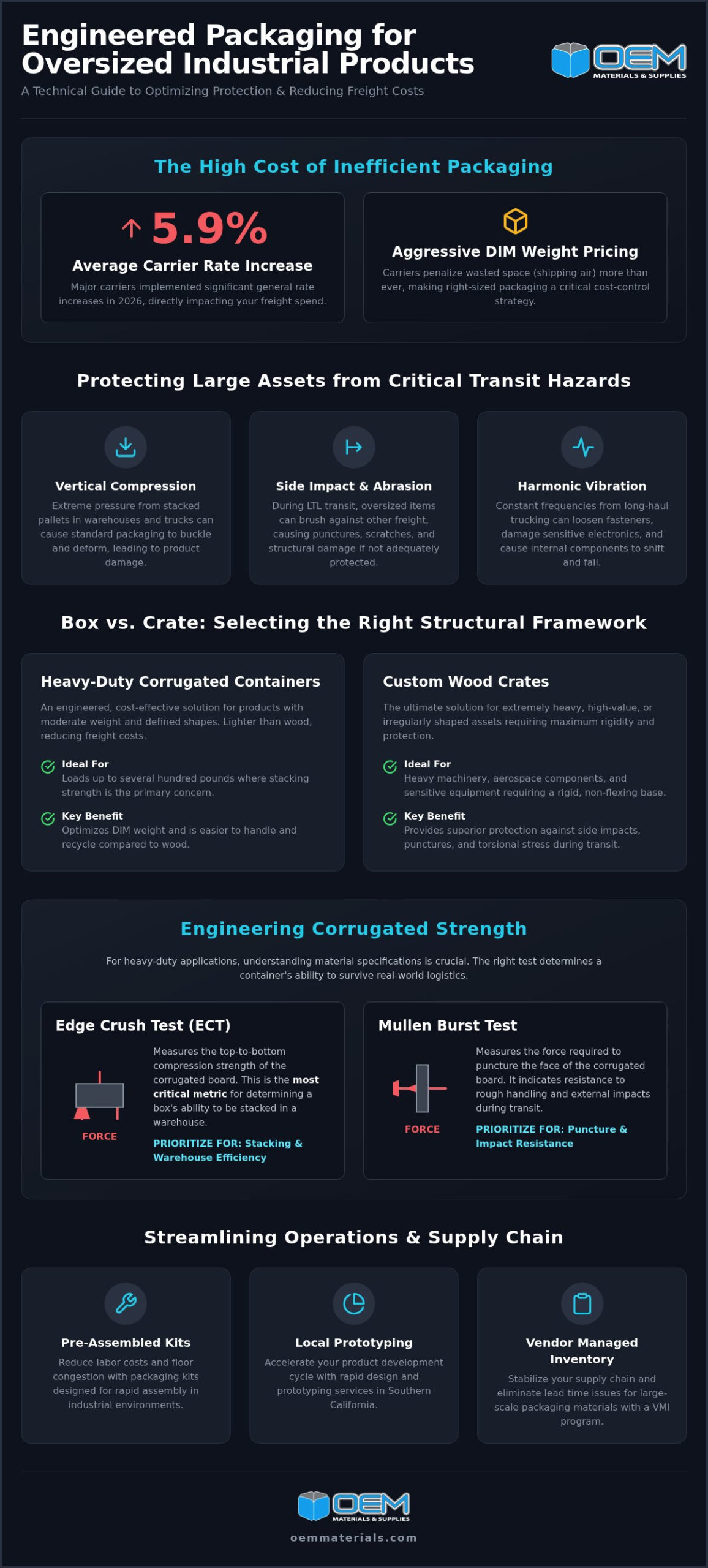
Carriers use dimensional weight (DIM) to calculate costs based on the space a package occupies rather than its actual weight. With major carriers implementing a 5.9% average rate increase in 2026, inefficient packaging leads to immediate financial penalties. Oversized dimensions often trigger LTL freight re-classifications, moving a shipment into a more expensive category. Finding the sweet spot involves minimizing the external dimensions of custom corrugated boxes or wood crates while maintaining the necessary internal clearance for cushioning. The pallet footprint is equally critical. If a product overhangs the pallet, it risks damage and often incurs over maximum limits fees, which can exceed $1,800 per package depending on the carrier and dimensions.
Protecting Large Assets from Transit Hazards
Large-scale assets face extreme vertical compression in warehouse environments where pallets are stacked multiple levels high. Standard corrugated materials often fail under these loads, leading to box deformation and product damage. Side-impact protection is another requirement, especially for wide industrial components that may brush against other freight during LTL transit. Vibration is a constant threat; harmonic frequencies during long-haul trucking can loosen fasteners or damage sensitive electronics within a large assembly. Load stabilization is the process of securing an asset to its base or internal framework to prevent internal shifting that causes structural failure or surface abrasion during transit. By balancing material weight with structural integrity, engineers can prevent these failures without adding unnecessary freight costs.
Engineering Material Strength for Large-Scale Shipments
Engineering custom packaging for oversized products isn’t simply a matter of scaling up standard dimensions. It requires a fundamental shift in material selection to account for the massive static and dynamic loads involved in industrial shipping. When an asset weighs several hundred pounds, the primary concern shifts from puncture resistance to stacking strength and base stability. Utilizing heavy duty plastic pallets provides a consistent, non-deflecting foundation that prevents the package from bowing or collapsing during forklift maneuvers, ensuring the entire unit remains secure throughout transit.
Corrugated Strength and ECT Ratings
Selecting the right corrugated grade is the first step in ensuring structural integrity for large-scale shipments. While single-wall boxes suffice for lightweight components, oversized industrial loads demand double-wall or even triple-wall configurations. Triple-wall corrugated provides exceptional vertical compression strength, often serving as a viable alternative to wood in specific weight classes. It’s vital to understand the difference between Edge Crush Test (ECT) and Mullen burst tests. ECT measures the box’s ability to withstand stacking pressure, which is essential for warehouse efficiency and vertical loading. In contrast, the Mullen test measures the force required to puncture the liner board. For heavy-duty applications, prioritizing high ECT ratings ensures your corrugated packaging box manufacturers provide containers that won’t buckle under the weight of stacked freight. Adhering to OSHA equipment safety standards during the handling and securing of these large containers is essential to maintain a safe work environment.
Custom Foam and Cushioning for Heavy Parts
Internal protection for heavy assets relies on precise engineered foam density. A 500-pound part will simply bottom out through standard low-density polyurethane foam, leading to metal-on-metal impact and surface damage. For these applications, closed-cell polyethylene foam is the industry standard due to its high load-bearing capacity and vibration dampening properties. The physics of foam density requires careful calculation; too much foam leads to excessive shock transmission, while too little results in structural failure. Engineered foam packaging must be designed with the specific G-force rating of your equipment in mind to prevent internal shifting. If you’re currently facing damage issues with heavy components, consulting with a packaging design professional can help you identify the specific material density required for your payload.
Box vs. Crate: Selecting the Right Structural Framework
Selecting the appropriate container for industrial assets involves more than just comparing material costs. The decision between a heavy-duty box and a timber frame depends on the asset’s center of gravity, sensitivity to vibration, and the required method of handling. For many Southern California manufacturers, custom packaging for oversized products often utilizes a hybrid approach. This involves combining a heavy-duty wood base with a triple-wall corrugated sleeve to provide the rigidity of a crate with the weight savings and ease of disposal found in corrugated materials. This specific configuration is highly effective for mid-to-heavy items that require a stable pallet foundation but don’t need the full puncture resistance of a six-sided wood enclosure.
When to Use Heavy Duty Corrugated
High-ECT (Edge Crush Test) corrugated containers are the preferred choice when the primary goal is maximizing warehouse space and minimizing tare weight. Triple-wall corrugated can often support weights exceeding 250 pounds if the load is properly distributed across a pallet. One of the main advantages of corrugated is that it arrives flat-packed, which significantly reduces the amount of floor space required for inventory compared to pre-built crates. This makes it a cost-effective solution for electronics or medical devices that are large in volume but relatively low in density. However, once a product’s footprint becomes irregular or its weight exceeds the burst strength of the linerboard, a transition to custom wood crates and pallets is necessary to ensure the unit remains intact during LTL handling.
The Role of Wood Crates in Machinery Shipping
Wood crates provide the ultimate structural framework for heavy machinery and aerospace components that possess non-standard footprints or offset centers of gravity. Unlike corrugated, wood can be engineered to include internal blocking, bracing, and tie-down points that prevent any internal movement. Maintaining ISO 9001:2015 quality management standards in the production of these crates ensures that every unit meets rigorous safety and durability requirements. For international shipments, wood crates must be ISPM-15 compliant to prevent the spread of pests, a requirement that doesn’t apply to corrugated or plastic alternatives. Additionally, wood frames allow for the integration of specialized base features, such as 4-way forklift entry or heavy-duty skid runners, which are essential for the safe use of cranes and industrial lifts during the loading process.
Optimizing the Packaging Process for Labor Efficiency
Labor costs often represent a significant portion of the total cost of ownership in industrial shipping. When handling custom packaging for oversized products, the time spent on assembly can quickly erode margins if the system isn’t engineered for speed. Designing for rapid assembly means creating a logical flow where components fit together with minimal tool requirements. This approach reduces the physical strain on warehouse personnel and ensures that packing remains a predictable part of the production cycle. It is important to note that actual cost savings and efficiency gains will vary depending on specific variables, including product dimensions, material selections, and individual shipping requirements.
Streamlining Warehouse Operations with Kitting
Large-scale industrial programs often suffer from packaging sprawl, where dozens of individual SKUs are stored separately. Implementing custom packaging kits consolidates all necessary components, such as custom foam inserts, corrugated sleeves, and heavy-duty tape, into a single unit. This reduces manufacturing floor bottlenecks by eliminating the time workers spend searching for disparate materials. Integrating labels and ribbons directly into the kitting process allows for automated inventory tracking as soon as the asset is packed. By reducing the number of packaging SKUs, Southern California operations in Los Angeles and Orange County can reclaim valuable warehouse floor space and simplify their procurement cycles.
Stabilizing the Load for Safety
Once an oversized item is placed in its container, load stabilization is the final defense against transit damage. Load stabilization with stretch film requires specific overlap and tension settings to ensure the heavy payload doesn’t shift on the pallet. For oversized cartons, applying edge protectors is essential to prevent high-tension straps from crushing the corrugated corners. This maintains the structural integrity of the box during vertical stacking and LTL transit. Properly secured loads minimize the risk of pallet failure or tipping during transit, which directly enhances the safety of warehouse personnel and logistics handlers. If your current packing process is causing delays or labor overruns, you can request a custom packaging audit to identify specific efficiency improvements for your product line.
Custom Industrial Packaging Solutions in Southern California
Southern California represents one of the most demanding logistical environments in the United States. For manufacturers operating in Orange County, Los Angeles, and the Inland Empire, the intersection of high warehouse costs and proximity to major shipping hubs like the Ports of Los Angeles and Long Beach creates a unique set of requirements. Implementing custom packaging for oversized products in this region isn’t just about the materials; it’s about the speed and reliability of the local supply chain. We serve as a dedicated partner for aerospace, medical, and automotive OEMs across San Diego and Riverside, providing the technical support needed to move large-scale assets safely through the LTL network.
Prototyping and Custom Design Services
Industrial product launches often operate on compressed schedules where a single delay can impact the entire project timeline. Waiting for packaging samples from out-of-state vendors is often not an option for high-stakes programs. Our custom packaging design services offer rapid prototyping that allows Southern California engineers to evaluate structural integrity within days rather than weeks. By utilizing local design teams in Los Angeles and Orange County, manufacturers can facilitate faster approval cycles through physical fit-testing and on-site design reviews. This hands-on approach ensures that every custom crate or corrugated sleeve is engineered to the exact specifications of the asset, reducing the risk of damage during the first critical shipments.
VMI and JIT: Solving the Space Challenge
One of the most significant challenges with oversized packaging is the massive amount of floor space required to store large-format materials. In high-rent industrial areas like Irvine or the South Bay, using production space for the storage of empty boxes or crates is an expensive inefficiency. Packaging VMI programs address this by shifting the burden of inventory management to the supplier. Through Vendor Managed Inventory, we monitor your usage levels and ensure that stock is always available without cluttering your facility. This is often paired with Just-In-Time (JIT) delivery, where packaging materials arrive exactly when they are needed on the assembly line. For manufacturers in San Diego and the Inland Empire, these programs are essential for maintaining a lean operation while ensuring that high-volume production lines never stop due to a lack of packaging components.
Securing Your Large-Scale Assets for Efficient Transit
Engineering a reliable system for large-scale industrial assets requires more than just scaling up standard containers. It demands a precise balance between material density, structural integrity, and freight cost optimization. Implementing custom packaging for oversized products ensures your high-value equipment survives the rigors of LTL transit while reducing the hidden costs of inefficient packing and excessive labor. By integrating the structural principles and material selections discussed in this guide, you can stabilize your supply chain and protect your operational margins.
OEM Materials & Supplies has served Southern California manufacturers for decades, providing technical expertise for the aerospace and medical sectors. Our full-service VMI and JIT capabilities help you maintain a lean operation without sacrificing protection. To facilitate an accurate recommendation for your specific application, contact OEM Materials & Supplies for a custom oversized packaging quote or prototype. Please provide your product dimensions, weight, and estimated annual usage so our engineering team can develop a solution tailored to your requirements. We look forward to partnering with you to secure your assets from production to final delivery.
Frequently Asked Questions
What is the best material for shipping heavy industrial machinery?
The best material for shipping heavy industrial machinery depends on the specific weight and footprint of the asset. Custom wood crates are the primary choice for extremely heavy loads due to their superior structural rigidity and blocking capabilities. For mid-to-heavy machinery, heavy-duty triple-wall corrugated provides a lighter alternative that reduces tare weight. Selecting the right material involves analyzing the center of gravity to ensure the package remains stable during forklift handling.
How do I calculate the correct ECT rating for my oversized box?
You calculate the correct Edge Crush Test (ECT) rating by evaluating the product’s weight and the anticipated stacking height in your warehouse. For oversized products, standard grades like 32 ECT are often insufficient. Most industrial applications require 44 ECT, 48 ECT, or even double-wall 71 ECT to prevent the bottom container from buckling under pressure. Our engineering team analyzes these variables to ensure your custom packaging for oversized products maintains its structural integrity.
When should I use a wood crate instead of a heavy-duty corrugated box?
Use a wood crate when the product weight exceeds the burst strength of triple-wall corrugated or when the asset has an irregular footprint requiring internal blocking. Wood is necessary for items needing crane-lift capabilities or those with sensitive centers of gravity that require rigid stabilization. Corrugated is better suited for high-volume, uniform items where tare weight reduction is a priority for lowering freight costs across Southern California and beyond.
What are the freight implications of shipping oversized packaging?
Shipping oversized items triggers LTL freight re-classifications and Large Package Surcharges, which were updated by major carriers in early 2026. These fees are increasingly based on cubic volume and dimensional weight rather than actual scale weight. Inefficient custom packaging for oversized products often leads to “shipping air,” where you pay for unused space. Optimizing box dimensions to the minimum safe footprint is essential for controlling these logistics expenses across your Southern California distribution network.
Can custom foam inserts be used for products weighing over 200 pounds?
Custom foam inserts are highly effective for products over 200 pounds if you use high-density closed-cell polyethylene instead of standard polyurethane. Polyethylene provides the load-bearing capacity required to prevent heavy parts from bottoming out during transit. For heavy assets, foam inserts are engineered to specific densities to absorb vibration and shock without collapsing. This ensures that sensitive industrial components remain suspended and protected throughout the rigors of the regional supply chain.
How does dimensional weight affect the cost of shipping large items?
Dimensional weight (DIM) is a pricing technique that uses a package’s volume to calculate a billable weight. Carriers use a DIM factor to determine if the package’s size warrants a higher price than its physical weight. For large, lightweight items, the DIM weight is almost always higher than the scale weight. This makes right-sizing your packaging critical to avoid paying for unutilized volume in the truck or warehouse, especially with the 2026 rate increases.
Are there specific regulations for shipping oversized items internationally?
International shipments of oversized items must comply with ISPM-15 standards for wood packaging materials. This regulation requires all wood crates and pallets to be heat-treated and stamped to prevent the spread of pests. While corrugated materials are exempt from ISPM-15, any wood bracing used inside must still be compliant. Additionally, you should verify the specific recyclability requirements of the destination country, such as the EU’s updated 2026 packaging and waste regulations.
How can I reduce the labor time spent on packing large products?
Reducing labor time involves moving away from manual, multi-step crating toward pre-assembled packaging kits. These kits include all necessary components, such as custom foam and edge protectors, in a single SKU for rapid assembly. For high-volume manufacturers in Riverside or San Diego, implementing a Vendor Managed Inventory (VMI) program also eliminates time spent on material procurement and inventory counts, allowing your team to focus entirely on production and fulfillment efficiency.